
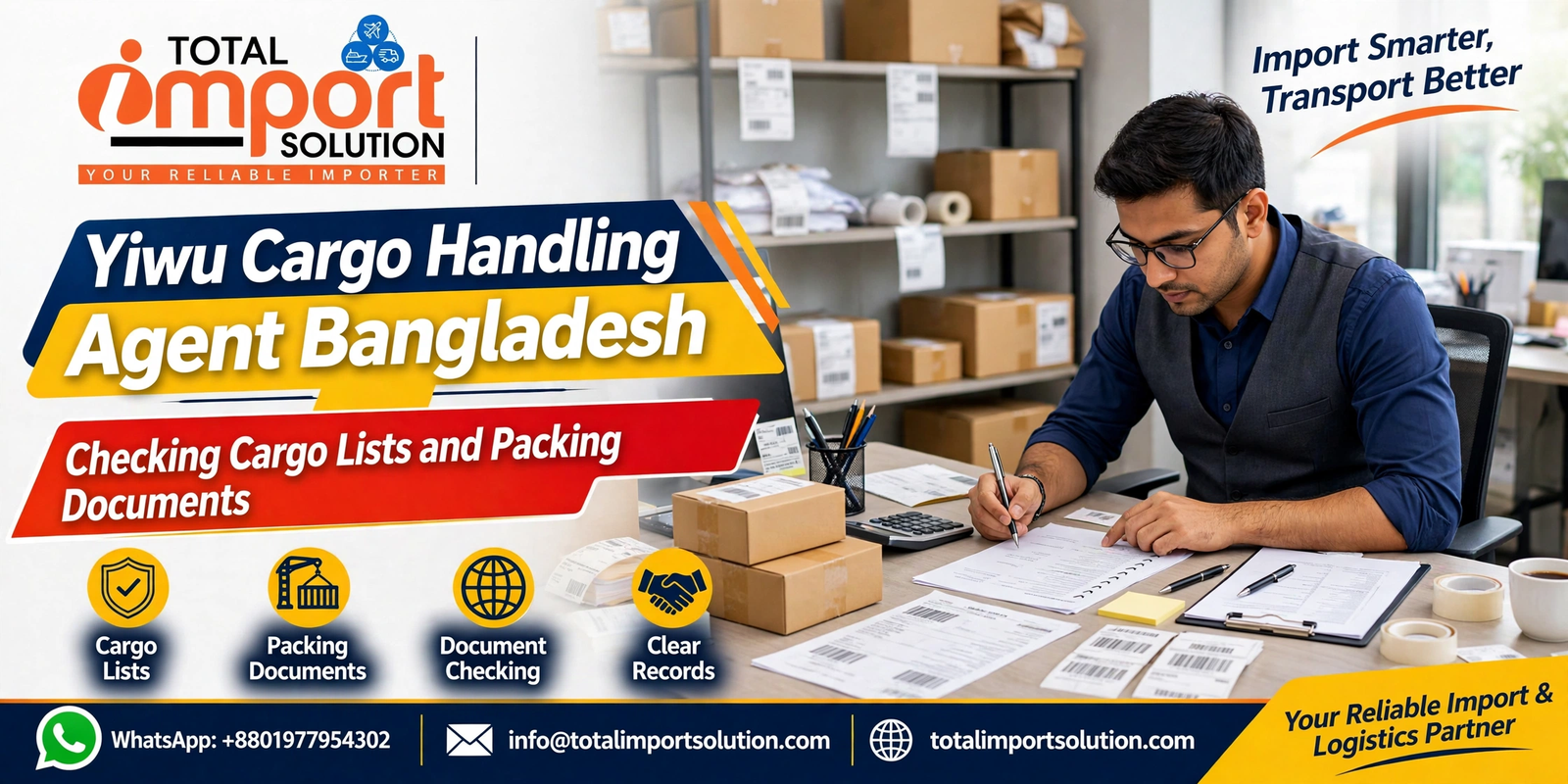
Yiwu Cargo Handling Agent Bangladesh
Yiwu is one of the largest wholesale markets in China. Thousands of stalls sell small goods, household items, toys, accessories, stationery, tools, decorations, and many other products that Bangladeshi buyers order in small and medium quantities. A Yiwu cargo handling agent in Bangladesh helps a buyer manage that cargo from the market stall to the port, and then onward to Bangladesh. The agent collects goods from suppliers, checks them, packs them, prepares the documents, and coordinates the shipment so that the buyer receives the goods they ordered in good condition.
Many buyers in Bangladesh order from several suppliers in Yiwu at the same time, and each supplier may send only a few cartons. Without a handling agent, the buyer must arrange pickup from each stall, check each carton, combine the cartons, and prepare the shipping papers on their own. That is difficult from Dhaka or Chittagong. A cargo handling agent in Yiwu does this work on the ground, in the market, at the warehouse, and at the loading point, and keeps the buyer informed at each step.
Since 2016, Total Import Solution has supported importers in Bangladesh with cargo handling, shipment planning, documentation, customs clearance support, and delivery coordination. This guide explains Yiwu cargo handling in practical, step-by-step terms. It covers what the agent does, why Yiwu matters for Bangladeshi buyers, the types of goods handled, market pickup, goods checking, packing and carton marking, consolidation, container loading, documents, customs clearance in general terms, delivery, common problems and fixes, and how to judge a good agent. No fixed prices, rates, duty percentages, or fees are given here. A rate or fee is confirmed only after checking the actual shipment and its documents, because the amount depends on the goods, their weight and volume, their classification, their value, and the rules in force at the time of import.
1. What a Yiwu Cargo Handling Agent Does
A Yiwu cargo handling agent is a person or team based in Yiwu who works for a buyer in Bangladesh. The agent receives the buyer’s orders, visits the suppliers in the market, collects the goods, checks the quantity and condition, packs the cartons, labels them, combines small orders into one shipment, prepares the cargo list and packing documents, and hands the cargo over for loading and transport. The agent is the buyer’s eyes and hands in the market.
The work starts before any goods move. The buyer sends the agent the supplier names, stall numbers, order details, and the quantity for each item. The agent confirms with each supplier that the goods are ready, the model and colour are correct, and the quantity matches the order.
After collection, the agent checks the goods. This is a basic check, not a full laboratory test. The agent counts the items, looks at the packing, checks for visible damage, and notes any difference between the order and the goods received. The agent then repacks the goods into strong cartons, marks each carton with the buyer name, carton number, and item details, and prepares a packing list that matches the cartons.
The table below shows the main jobs of a Yiwu cargo handling agent in order.
| Step | Agent Job | What the Buyer Receives |
|---|---|---|
| 1 | Confirm orders with suppliers | A clear list of ready and pending items |
| 2 | Collect goods from market stalls | Goods gathered at one warehouse |
| 3 | Count and check goods | A report of quantity and visible condition |
| 4 | Pack and mark cartons | Strong, labelled cartons ready for loading |
| 5 | Prepare cargo list and documents | Papers that match the cartons |
| 6 | Load and hand over cargo | Cargo loaded for transport to Bangladesh |
| 7 | Share updates and photos | Regular updates until the cargo leaves |
2. Why Yiwu Matters for Bangladesh Buyers
Yiwu is known for small goods. A buyer can find a wide range of products in one place: kitchen items, plastic goods, toys, fashion accessories, bags, shoes, stationery, home decoration, festival items, mobile accessories, and small tools. Many of these products are made in small factories around Yiwu, and the stalls in the market act as the sales point. For a Bangladeshi shop owner or wholesaler, this range is useful, because one trip to Yiwu, or one agent in Yiwu, can cover many product types.
Another reason Yiwu matters is small order size. Many suppliers in Yiwu accept orders of a few hundred pieces, or even a few dozen pieces for some items. This suits small and medium buyers in Bangladesh who do not want to order a full container of a single product.
The market is also organised by product type. Stalls selling the same kind of goods are grouped together, so an agent can visit several suppliers of one product in a short time and compare quality and packing. This helps the buyer choose the right supplier for the next order.
3. Types of Goods Commonly Handled in Yiwu
Yiwu cargo covers many product types. The table below lists common groups, what they usually include, and the handling care each group needs.
| Goods Group | Common Items | Handling Care |
|---|---|---|
| Household goods | Kitchen tools, plastic containers, cleaning items | Keep dry, stack cartons evenly |
| Toys and gifts | Soft toys, plastic toys, gift sets | Protect from crushing, check small parts |
| Fashion accessories | Hair items, jewellery, belts, scarves | Keep clean, pack in inner bags |
| Bags and luggage | Handbags, backpacks, travel bags | Protect shape, avoid heavy stacking |
| Stationery | Pens, notebooks, office items | Keep dry, pack flat items carefully |
| Home decoration | Artificial flowers, lamps, wall items | Fragile packing, mark cartons clearly |
| Festival items | Decorations, lights, party goods | Check before packing, keep sets together |
| Mobile accessories | Cases, chargers, cables | Count carefully, protect from moisture |
| Small tools | Hand tools, hardware items | Heavy cartons, strong tape, clear marking |
| Clothing items | T-shirts, socks, caps, gloves | Keep clean and dry, pack by size |
Most Yiwu cargo is light in weight but large in volume, so cartons may be big even when the goods inside are light. The agent should measure the cartons and record their size and weight, so the buyer knows how much space the shipment takes.
Some goods need extra attention. Glass items, ceramic items, and lamps can break if the carton is weak or the stacking is wrong. Goods with batteries or liquids need to be declared clearly, and the buyer should check the rules for those items before ordering. The agent should ask the supplier how the goods were packed at the factory, and add extra packing where needed.

4. Market Pickup and Supplier Coordination
Market pickup is the first physical step. The agent visits each supplier stall with the order details, collects the goods, and brings them to the warehouse. This sounds simple, but it needs careful coordination, because suppliers may be in different parts of the market, and some may not be ready on the planned day.
Follow these steps for a smooth market pickup:
- Send the agent a written order list with supplier name, stall number, item name, model or colour, quantity, and the buyer’s carton marking.
- Ask the agent to confirm with each supplier one day before pickup, so that the goods are packed and ready at the stall.
- Ask the agent to count the goods at the stall before taking them, and to note any short quantity on the order list.
- Ask the agent to take a photo of the goods and the stall sign.
- Ask the agent to bring the goods to the warehouse the same day, and to record the arrival of each supplier’s goods in a single list.
- If a supplier is not ready, ask the agent to tell the buyer the same day, with the supplier’s new ready date.
- Keep a copy of every order list, every count, and every photo in one file for the shipment.
The agent should also check the supplier’s packing at the stall. Some suppliers pack goods loosely, with thin cartons or weak tape. The agent can ask the supplier to improve the packing, or can repack the goods at the warehouse.
5. Checking Goods Before Packing
Checking goods before packing is the step that protects the buyer from receiving the wrong items. The check is done at the warehouse, after all goods have arrived from the stalls. The agent opens a sample of cartons, counts the items, and compares them with the order list.
A practical check covers these points:
- Quantity: count the items in each carton and compare with the order list. Note any shortage or extra items.
- Model and colour: check that the model, colour, and size match what the buyer ordered.
- Visible damage: look for broken, scratched, or dirty items, and separate damaged items from good ones.
- Packing condition: check whether the inner packing is complete, for example whether each item has its own bag or box.
- Labelling: check whether the supplier’s label on the goods matches the order, and note any wrong label.
The agent should not open every carton if the order is large, but should open enough cartons to be sure the goods are correct. For a small order, opening all cartons is practical. For a large order, the agent can open a sample from each supplier and each item type, and record which cartons were opened.
The table below shows common checking results and the usual next step.
| Check Result | What It Means | Usual Next Step |
|---|---|---|
| Quantity matches | Goods match the order | Pack the goods for shipment |
| Short quantity | Fewer items than ordered | Tell the buyer and ask the supplier |
| Wrong model or colour | Goods differ from the order | Tell the buyer and ask for a swap |
| Visible damage | Some items are broken or dirty | Separate damaged items and report |
| Weak inner packing | Items not protected inside the carton | Repack with better inner packing |
| Wrong label | Label does not match the order | Correct the label before packing |
6. Packing and Carton Marking
Packing decides whether goods arrive in good condition. Good packing uses strong cartons, enough tape, inner protection for fragile items, and clear marking on the outside. Weak packing is one of the most common causes of damage in Yiwu cargo.
Follow these steps for packing:
- Choose a carton size that fits the goods with little empty space. Empty space lets goods move and break.
- Use a strong carton. Double-wall cartons are better for heavy or fragile goods.
- Put fragile items in inner packing first, such as bubble wrap or foam, before placing them in the carton.
- Fill gaps with paper or soft packing material so the goods do not shift.
- Seal the carton with strong tape on all edges, not only on the top.
- Weigh each carton and write the weight on the carton and on the packing list.
- Mark each carton with the buyer name, the carton number, the item name, and the quantity inside.
- Mark fragile cartons with a clear fragile mark on at least two sides.
The packing list is the written record of all cartons. It lists each carton number, the item inside, the quantity, the weight, and the size. The packing list must match the cartons exactly. If a carton is added or removed after the list is written, the list must be updated. A packing list that does not match the cartons causes delay at the port and confusion at delivery.
7. Consolidation of Small Orders
Consolidation means combining many small orders from different suppliers into one shipment. This is one of the main reasons Bangladeshi buyers use a Yiwu cargo handling agent. A buyer may order from eight or ten suppliers, and each supplier may send only two or three cartons. Consolidation brings all cartons to one warehouse, checks them, and packs them into one shipment.
The consolidation process works like this:
- All supplier goods arrive at the agent’s warehouse and are recorded in one list.
- The agent checks each supplier’s goods against the order list.
- The agent repacks goods where needed and marks each carton.
- The agent groups cartons by buyer and by shipment, so that one buyer’s goods stay together.
- The agent prepares one packing list and one cargo list for the whole shipment.
- The agent arranges loading of the consolidated cargo into the container or vehicle.
Consolidation needs space and time. The warehouse must have enough room to hold cartons from all suppliers at the same time. The agent needs time to check and repack. The buyer should tell the agent the full list of suppliers in advance, so the agent can plan the warehouse space and the checking work.
Another problem is waiting for the last supplier. If one supplier is late, the whole shipment waits. The buyer and the agent should agree on a cut-off date. Goods that arrive after the cut-off date go into the next shipment, unless the buyer decides otherwise in writing. This keeps the shipment moving and avoids delay for the goods that are ready.
8. Container Loading and Warehouse Handling
Container loading moves cartons from the warehouse into the container or vehicle. Good loading protects the cartons and uses the space well. Poor loading causes crushed cartons, shifted goods, and damage on arrival.
Follow these steps for loading:
- Check the container or vehicle before loading. It should be clean, dry, and free from damage or bad smell.
- Load heavy cartons at the bottom and light cartons on top.
- Load fragile cartons where they will not be crushed, and mark their position on the loading list.
- Stack cartons evenly so that no carton hangs over the edge of the stack.
- Fill gaps between cartons so the load does not shift during transport.
- Count the cartons as they are loaded, and compare the count with the packing list.
- Take photos of the loaded container before the doors are closed.
- Seal the container and record the seal number on the loading list.
The loading list is a simple record: carton numbers, total carton count, total weight, and the seal number. The buyer should receive a copy of the loading list and the photos before the cargo leaves. These records help the buyer check the cargo on arrival in Bangladesh. If a carton is missing on arrival, the loading list and photos show whether the carton was loaded.

9. Documents Needed for Yiwu Cargo
Documents describe the cargo, the buyer, the supplier, and the shipment. Without correct documents, the cargo can be held at the port. The agent prepares the cargo papers in China, and the buyer or the buyer’s clearing agent uses them in Bangladesh.
The table below lists the common documents for Yiwu cargo and what each one shows.
| Document | What It Shows | Who Prepares It |
|---|---|---|
| Commercial invoice | Item names, quantities, and values | Supplier or agent |
| Packing list | Carton numbers, items, weights, and sizes | Agent |
| Cargo list | Full list of goods in the shipment | Agent |
| Bill of lading or transport document | Cargo details and transport route | Transport provider |
| Certificate of origin | Country where the goods were made | Supplier or issuing body |
| Import documents for Bangladesh | Buyer details and import papers | Buyer or clearing agent |
The buyer should check the documents before the cargo leaves China. The names, quantities, and values on the invoice should match the packing list. The carton numbers on the packing list should match the cartons loaded. Any difference should be corrected before loading, because correcting papers after the cargo has left is slow and can cause delay.
The buyer also needs import documents in Bangladesh, such as the import registration papers and the bank documents for the shipment. The buyer should prepare these in advance and share copies with the clearing agent. The clearing agent in Bangladesh works with the documents from China and the buyer’s papers to clear the cargo at the port.
10. Customs Clearance in Bangladesh in General Terms
Customs clearance is the process of presenting the cargo and its documents to the customs office at the port in Bangladesh, so that the cargo can be released. The buyer usually works with a clearing and forwarding agent in Bangladesh for this step. The Yiwu handling agent’s job is to make sure the papers from China are correct and complete, so that the clearing agent in Bangladesh can work without delay.
The general steps for customs clearance are:
- The buyer or clearing agent receives the documents from China and checks them against the cargo.
- The clearing agent submits the documents to customs with the buyer’s import papers.
- Customs checks the documents and the cargo details.
- Any duty or tax is assessed according to the classification of the goods and the rules in force at the time.
- The buyer pays the assessed amount through the proper channel and keeps the receipt.
- Customs releases the cargo for delivery.
Duty and tax depend on the type of goods, their classification, and the rules in force. No fixed duty percentage can be given in this guide, because the rules change and each shipment is different. The buyer should ask the clearing agent for the classification of the goods before ordering, so that there is no surprise at the port.
11. Delivery from Port to Your Warehouse or Shop
After customs release, the cargo is delivered from the port to the buyer’s warehouse or shop. This step needs planning: space, labour, and transport must be ready. The clearing agent or transport provider usually arranges the truck from the port, and the buyer arranges receiving at the warehouse or shop.
Follow these steps for delivery:
- Confirm the release of the cargo with the clearing agent and note the release date.
- Arrange a truck that fits the size and weight of the cargo.
- Tell the warehouse or shop team the expected arrival date and the number of cartons.
- Prepare space in the warehouse or shop before the truck arrives.
- Count the cartons on arrival and compare the count with the packing list.
- Open a sample of cartons and check for visible damage.
- Record any missing or damaged carton in writing, with a photo, on the same day.
- Store the goods in an organised way, grouped by item, so that selling or distribution can start at once.
If a carton is missing or damaged on arrival, the buyer should report it at once to the agent and the transport provider, with the packing list, the loading photos, and the delivery photos.
12. Common Problems and How to Fix Them
Problems happen in Yiwu cargo handling, even with a good agent. The table below lists common problems and how to fix them.
| Problem | Why It Happens | How to Fix It |
|---|---|---|
| Short quantity | Supplier sent fewer items than ordered | Report to buyer, ask supplier for the balance |
| Wrong model or colour | Supplier mixed up the order | Report to buyer, ask for a swap or a new order |
| Damaged goods | Weak packing or rough handling | Separate damaged items, repack, report |
| Mixed cartons | Cartons from different buyers mixed | Use clear marking and separate lists |
| Late supplier | Supplier not ready on the planned day | Set a cut-off date, move late goods to next shipment |
| Document mismatch | Papers do not match the cartons | Correct the papers before loading |
| Customs delay | Documents unclear or incomplete | Check papers early, share with clearing agent |
| Crushed cartons | Heavy cartons stacked on light ones | Load heavy at bottom, light on top |
| Missing carton on arrival | Carton lost or loaded wrongly | Check loading list and photos, report at once |
| Moisture damage | Cartons stored on a damp floor | Store on pallets, keep warehouse dry |
The buyer and the agent should agree on how problems are reported. A short written note with a photo, sent on the same day the problem is found, is the best method. The note should say what the problem is, which supplier and item it affects, and what the agent suggests. The buyer should reply in writing, so that both sides have a record of the decision.
13. How to Judge a Good Cargo Handling Agent
A good cargo handling agent is judged by the work, not by promises. Look at how the agent communicates, checks goods, packs, and keeps records. A good agent answers messages quickly, shares photos and lists without being asked, and reports problems at once.
Use the table below as a checklist when judging an agent.
| Quality | What to Look For | Why It Matters |
|---|---|---|
| Clear communication | Fast replies, written updates, photos | Buyer knows what is happening |
| Careful checking | Counts goods, checks model and colour | Wrong goods are found early |
| Good packing | Strong cartons, clear marking | Goods arrive in good condition |
| Honest reporting | Reports problems the same day | Buyer can decide quickly |
| Organised records | Packing lists, loading lists, photos | Mistakes can be traced |
| Market knowledge | Knows the stalls and suppliers | Pickup is faster and smoother |
| Warehouse space | Clean, dry, organised warehouse | Goods are stored safely |
| Document care | Papers match the cartons | Customs clearance is smoother |
Since 2016, Total Import Solution has worked as an importer and logistics partner for buyers in Bangladesh, with cargo handling support, documentation, customs clearance support, and delivery coordination. When choosing an agent, the buyer should ask how the agent checks goods, how the agent packs, what records the agent keeps, and how the agent reports problems. The answers should be clear and practical. A buyer should also ask other buyers about their experience, and should check the agent’s past work where possible. The right agent is one who does the small steps well, every time.
Frequently Asked Questions
1. What is a Yiwu cargo handling agent?
A Yiwu cargo handling agent is a person or team in Yiwu who works for a buyer in Bangladesh. The agent collects goods from market suppliers, checks them, packs them, prepares the cargo papers, and coordinates loading and transport.
2. Why do Bangladesh buyers need an agent in Yiwu?
Most buyers order from several suppliers at once, and each supplier sends only a few cartons. An agent in Yiwu collects all the goods, checks them, combines them into one shipment, and keeps the buyer informed.
3. What types of goods are handled in Yiwu?
Household goods, toys, fashion accessories, bags, stationery, home decoration, festival items, mobile accessories, small tools, and clothing items are common. Most Yiwu cargo is light but large in volume.
4. How does market pickup work?
The buyer sends a written order list with supplier names, stall numbers, and quantities. The agent confirms readiness, collects the goods, counts them at the stall, and brings them to the warehouse the same day.
5. How are goods checked before packing?
The agent counts the items, checks the model, colour, and size against the order, looks for visible damage, checks the inner packing, and notes any problem in writing with a photo for the buyer.
6. How should Yiwu cargo be packed?
Use strong cartons with little empty space, inner packing for fragile items, gaps filled, strong tape on all edges, and each carton marked with the buyer name, carton number, item name, and quantity.
7. What is consolidation?
Consolidation is combining many small orders from different suppliers into one shipment at the agent’s warehouse. All goods are checked, repacked where needed, marked, and listed on one packing list before loading.
8. What documents are needed for Yiwu cargo?
A commercial invoice, packing list, cargo list, bill of lading or transport document, certificate of origin where needed, and the buyer’s import documents for Bangladesh.
9. How does customs clearance work in Bangladesh?
The clearing agent submits the documents from China with the buyer’s import papers to customs. Customs checks the documents and the cargo, assesses any duty or tax under the rules in force, and releases the cargo after payment through the proper channel.
10. How are duty and tax decided?
They depend on the type of goods, their classification, and the rules in force at the time of import. No fixed percentage can be given in advance. Ask the clearing agent for the classification before ordering.
11. What happens if goods arrive short or damaged?
The buyer should count the cartons on arrival, check a sample for damage, and report any missing or damaged carton in writing with a photo on the same day to the agent and the transport provider.
12. How is a container loaded for Yiwu cargo?
Heavy cartons go at the bottom and light cartons on top, fragile cartons are placed where they will not be crushed, gaps are filled so the load does not shift, cartons are counted as loaded, and photos are taken before the doors are closed.
13. What should a buyer send the agent before ordering?
A written order list with supplier name, stall number, item name, model or colour, quantity, carton marking, and the cut-off date for the shipment helps the agent plan pickup, checking, and packing.
14. How can a buyer judge a good cargo handling agent?
Look for clear communication, careful checking, good packing, honest same-day reporting, organised records, market knowledge, a clean and dry warehouse, and documents that match the cartons.
15. Can small orders from many suppliers be combined?
Yes. That is the main purpose of consolidation. Small orders from many suppliers are collected at one warehouse, checked, packed, and shipped together as one shipment with one packing list.
16. How can I contact Total Import Solution for Yiwu cargo handling?
Contact Total Import Solution on WhatsApp at +8801977954302, by email at info@totalimportsolution.com, or through totalimportsolution.com. Share your order list and shipment details for a practical plan.
Contact Total Import Solution
- Service: Yiwu Cargo Handling Agent Bangladesh
- WhatsApp: +8801977954302
- Email: info@totalimportsolution.com
- Website: totalimportsolution.com
- Company: Total Import Solution, an importer and logistics partner based in Bangladesh. Since 2016, it has served importers with cargo handling and delivery coordination.
