
What Happens if a Leased Container is Damaged in Transit?
A leased container can be damaged in transit, and when it happens, the importer who leased it needs a clear plan. The container is not the importer's property. It belongs to the leasing company or the container owner, and the lease agreement sets out what the importer must do when the box comes back with a dent, a bent door, a broken seal, a hole in the wall, or a floor that is no longer sound. Knowing the steps in advance saves time, protects the cargo inside, and keeps the repair discussion fair.
Damage can happen at many points. A container can be struck by handling equipment at the port, shifted during loading, affected by rough weather at sea, or damaged during road transport after discharge. Some damage is easy to see, such as a dented side panel or a door that will not close. Other damage is hidden, such as a bent corner casting, a damaged floor, or a seal that no longer holds. This guide explains what happens at each stage, who is involved, what records matter, and how repairs are arranged and checked.
Since 2016, Total Import Solution has supported importers in Bangladesh with container leasing guidance, shipment planning, documentation, customs clearance support, and delivery coordination. The team works with buyers who lease containers for the first time and with buyers who lease them on a regular basis. This guide gives practical steps only. No fixed repair charge, fee, or settlement figure is given here, because a repair charge is confirmed only after checking the actual container, the damage, and the documents for that lease. A rate or fee is confirmed only after checking the actual shipment and documents.
1. What Damage in Transit Means for a Leased Container
Damage in transit means any harm to the leased container that happens between the time it is picked up in sound condition and the time it is returned to the depot. The container is handed over with a condition record, and it is expected to come back in a similar condition, apart from fair wear from normal use. A dent in the wall, a bent door rod, a damaged lock, a torn seal, a hole in the roof, or a cracked floor all count as damage. The lease agreement is the document that decides what counts as damage and what counts as fair wear, so the importer should read it before the container is picked up.
| Damage point | What it usually looks like | Why it matters |
|---|---|---|
| Side wall | Dent, bend, or hole in the panel | Affects strength and weather protection |
| Roof | Dent or hole from handling equipment | Lets rain into the container |
| Doors | Bent rod, broken lock, or door that will not close | Cargo cannot be secured properly |
| Floor | Crack, soft spot, or missing board | Heavy cargo may not be supported |
| Corner casting | Bent or cracked fitting | Lifting and stacking become unsafe |
| Seal and lock | Broken seal or damaged lock rod | Security and customs checking are affected |
2. Who Is Involved When Damage Happens
Several parties can be involved when a leased container is damaged, and each one has a different role. The importer is the lessee, the party that leased the container and is responsible for it during the lease period. The leasing company or container owner is the lessor, the party that owns the box and sets the return condition. The shipping line or carrier moves the container by sea. The port terminal handles the container at loading and discharge. The trucking company moves it by road. The surveyor or inspector checks the damage and writes a report. The insurer, if cargo or container cover was arranged, may also be involved.
| Party | Role in a damage case | What the importer should ask for |
|---|---|---|
| Importer or lessee | Leased the container and holds it during the lease | Keep the lease agreement and condition record |
| Leasing company or lessor | Owns the container and sets the return condition | Ask for the return standard in writing |
| Carrier | Moves the container by sea | Ask for the condition noted on the transport document |
| Port terminal | Handles the container at the port | Ask for the handling record if damage is found |
| Trucking company | Moves the container by road | Ask for the delivery note with the condition noted |
| Surveyor or inspector | Checks the damage and writes a report | Ask for a dated report with photos |
| Insurer | Handles a claim if cover was arranged | Ask what papers the claim needs |
3. What to Do First When Damage Is Found
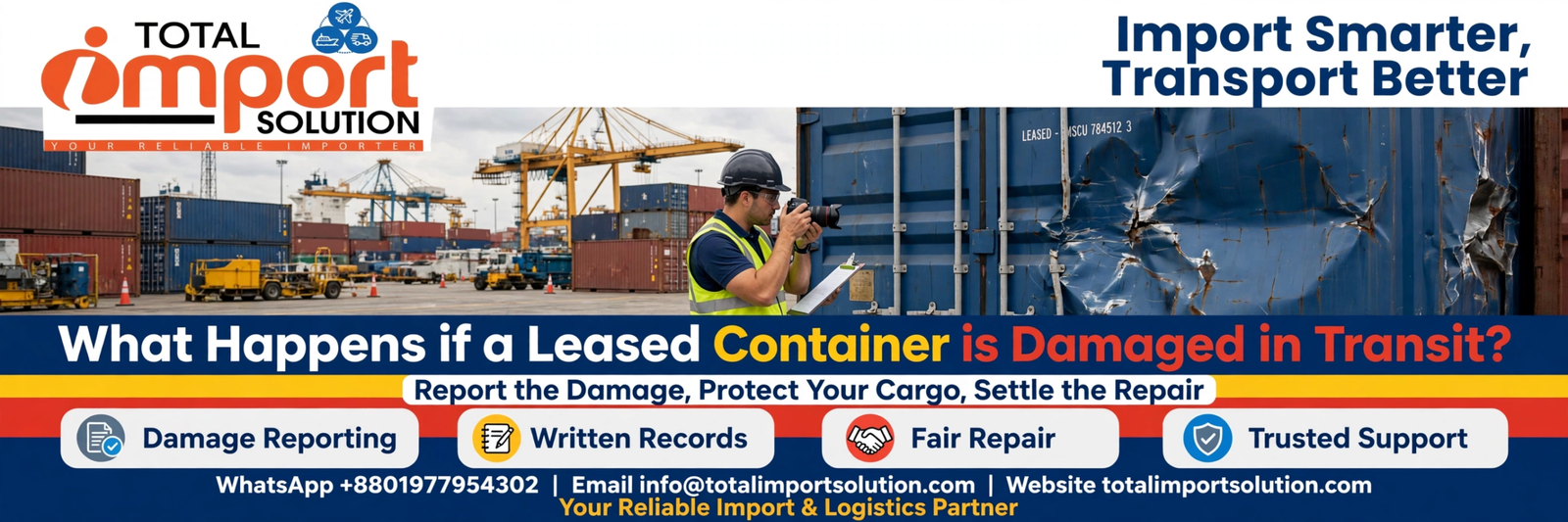
The first step when damage is found is to stop and record it before the container is moved or opened further. Do not unload the cargo in a hurry, and do not send the container back to the depot without a record. Take clear photos of the damaged area from several angles, including one wide photo that shows the container number and one close photo that shows the damage itself. Note the date, the time, and the place where the damage was found. Check the seal number against the transport document, and note whether the seal is intact or broken. Then tell the agent and the leasing company at once, in writing, with the photos attached.
Step 1: Stop and look. Do not move the container or unload the cargo until the damage has been seen and recorded.
Step 2: Take photos. Photograph the container number, the damaged area from several angles, and the seal.
Step 3: Note the details. Write down the date, time, place, container number, and seal number.
Step 4: Check the seal. Compare the seal number with the transport document and note whether it matches.
Step 5: Report in writing. Tell the agent and the leasing company at once, with the photos and the notes attached.
4. How to Record the Damage Properly
A good damage record is the strongest tool an importer has. The record should show what the damage is, where it is, when it was found, and what the container looked like when it was picked up. The pick-up condition record is the starting point. If the container was already marked with a dent or a scratch at pick-up, that mark should be on the record, and the importer should keep a copy. When new damage is found, the new record should be compared with the pick-up record, so that only the new damage is discussed. Photos should be dated, and the container number should be visible in at least one photo. A written note from the driver, the yard staff, or the surveyor adds weight to the record.
| Record item | What to include | Why it matters |
|---|---|---|
| Pick-up condition record | Marks and dents noted at pick-up | Shows what damage is new |
| Photos of the damage | Wide and close views, container number visible | Proves the damage and its place |
| Date and time | When the damage was found | Fixes the damage to a point in the lease |
| Place | Port, yard, warehouse, or road point | Shows where the damage was found |
| Seal number | Seal as found, compared with the document | Shows whether the cargo was touched |
| Written note | Note from driver, yard staff, or surveyor | Adds a witness to the record |
| Cargo condition | State of the cargo inside | Separates container damage from cargo damage |
5. The Container Condition Report and the Lease Agreement
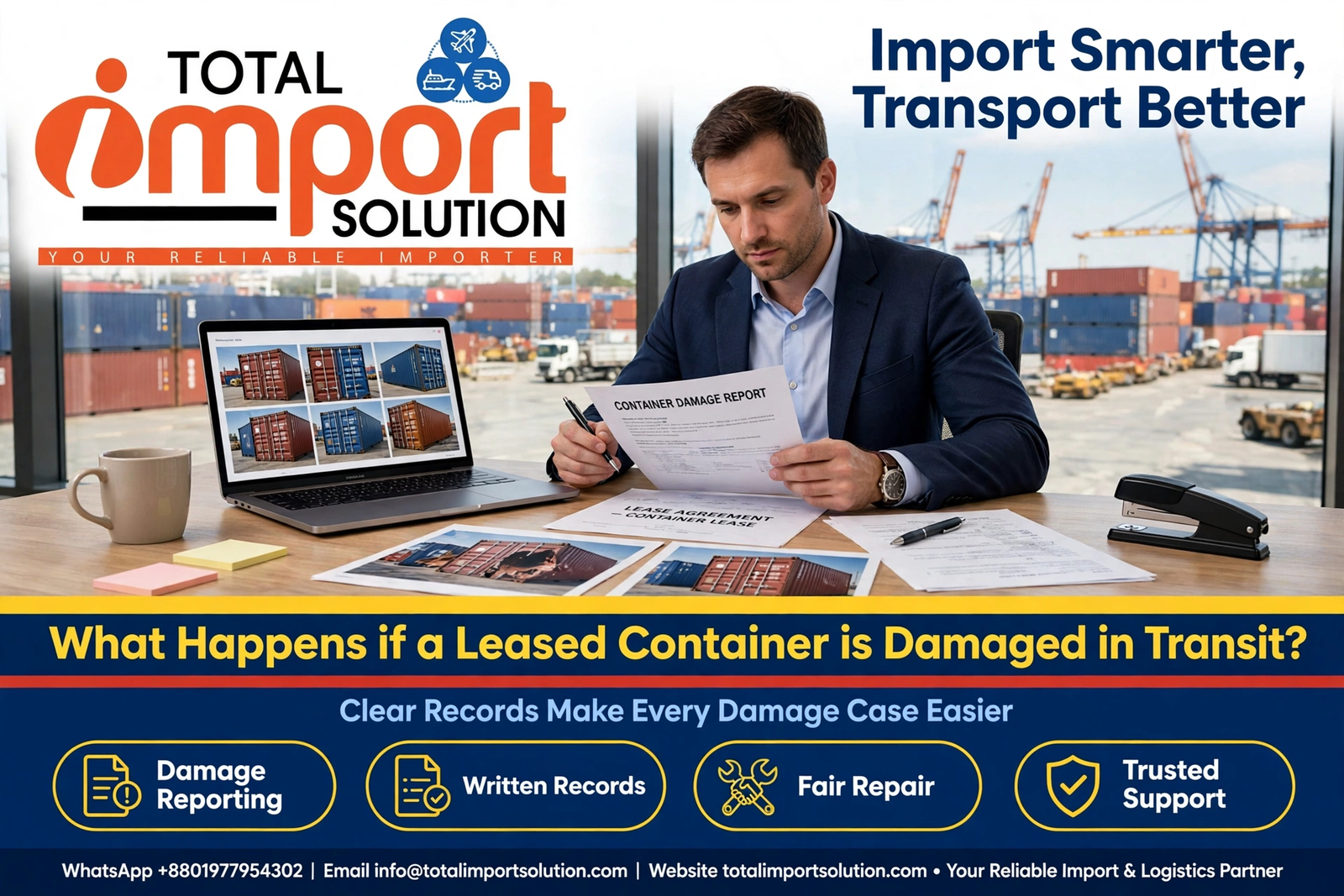
The container condition report and the lease agreement are the two papers that decide most damage cases. The condition report is written when the container is picked up and again when it is returned. It lists every dent, scratch, and defect, with the place on the container where each one sits. The lease agreement sets out the importer's duties, the return standard, the time allowed for return, the charge for late return, and the way repair charges are worked out. Some agreements say the importer pays for all damage found on return, apart from fair wear. Others share the cost depending on where the damage happened. The importer should read these two papers before signing, and keep copies of both.
Step 1: Read the lease agreement before signing. Note the return standard, the time allowed, and the repair charge rules.
Step 2: Check the pick-up condition report. Walk around the container and confirm every mark on the report.
Step 3: Take pick-up photos. Photograph all four sides, the roof edge, the doors, and the floor.
Step 4: Keep copies. Keep the signed agreement and the condition report with the shipment file.
Step 5: Compare at return. Use the pick-up report as the base when the return condition is checked.
6. Types of Damage and What They Mean
Not all damage is the same. Minor damage, such as a small dent in a side panel or a scratch in the paint, may not affect the use of the container, but it is still noted on the return report. Structural damage, such as a bent corner casting, a twisted frame, or a cracked floor beam, affects the strength of the container and may take it out of service until it is repaired. Door damage can stop the container from being sealed, which matters for customs checking and for security. Roof damage lets rain in, which can harm cargo. Floor damage can make the container unsafe for heavy cargo. The type of damage decides whether the container can be repaired at the depot, whether it needs a workshop, and how long the repair will take.
| Type of damage | Effect on the container | Usual next step |
|---|---|---|
| Small dent or scratch | Appearance only, use not affected | Noted on the return report |
| Bent door or door rod | Door will not close or seal | Repair at the depot or workshop |
| Roof dent or hole | Rain can enter the container | Repair before the next use |
| Floor crack or soft spot | Heavy cargo not supported | Floor board or beam repair |
| Bent corner casting | Lifting and stacking unsafe | Workshop repair and recheck |
| Broken seal or lock | Security and checking affected | Seal and lock replaced, record updated |
| Hole in the side wall | Weather protection lost | Panel repair or replacement |
7. Who Pays for the Repair
Who pays for the repair depends on the lease agreement and on where the damage happened. In many agreements, the importer pays for damage that happens while the container is in the importer's care, apart from fair wear from normal use. If the damage happened during sea transport or port handling, the importer may ask the carrier or the terminal to accept responsibility, but that needs a record showing the container was sound before that stage and damaged after it. If the damage was already on the pick-up condition report, the importer should not pay for it. If cargo cover or container cover was arranged, the insurer may handle part of the cost, but the claim needs the photos, the reports, and the documents. No fixed charge can be stated in advance, because the charge depends on the actual damage, the repair work needed, and the terms of that lease. A rate or fee is confirmed only after checking the actual shipment and documents.
| Situation | Who usually pays | What the importer needs |
|---|---|---|
| Damage in the importer's care | The importer, apart from fair wear | The lease agreement terms |
| Damage during sea transport | The carrier, if the record proves it | Sound condition before loading, damage after |
| Damage during port handling | The terminal, if the record proves it | Handling record and photos |
| Damage during road transport | The trucking company, if the record proves it | Delivery note with the condition noted |
| Damage already on the pick-up report | Not the importer | The pick-up condition report |
| Damage covered by an arranged policy | The insurer, under the policy terms | Photos, reports, and documents |
8. How Repairs Are Arranged and Checked
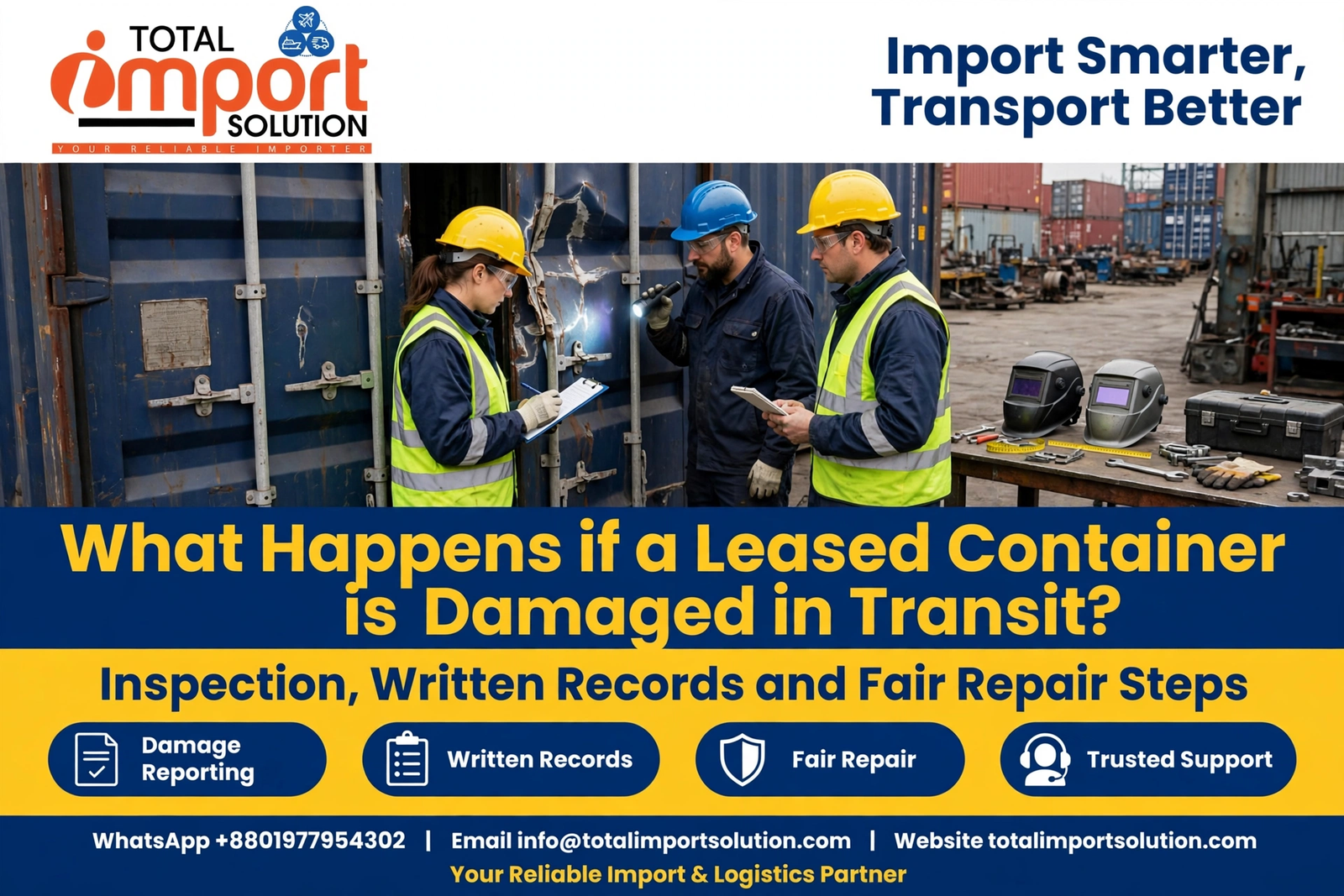
Repairs are usually arranged by the leasing company or by an approved repair depot. The importer should not arrange a repair on their own without asking the leasing company first, because an unapproved repair can be rejected, and the importer may still be charged for a second repair. The normal course is that the leasing company inspects the container, lists the repair work, and gives a written estimate. The importer reviews the estimate against the damage record, asks questions about any item that does not match the photos, and agrees in writing before the work starts. After the repair, the container is checked again, and a fresh condition report is written. The importer should keep a copy of the estimate, the repair list, and the final check.
Step 1: Ask the leasing company. Tell them about the damage and ask how the repair will be arranged.
Step 2: Get a written estimate. Ask for the repair list and the estimate in writing before work starts.
Step 3: Compare with the record. Check every item on the estimate against the photos and the damage record.
Step 4: Agree in writing. Confirm the agreed repair work in writing before the work begins.
Step 5: Check the finished repair. Ask for a fresh condition report after the repair is done, and keep a copy.
9. Damage Found at Loading, at Sea and at Delivery
The stage where damage is found changes what the importer should do next. Damage found at loading, before the container leaves the port of loading, should be noted on the loading record and the transport document, and a different container should be requested if the damage affects the cargo. Damage that happens at sea is usually found at discharge, when the container is unloaded from the vessel. The importer should check the container before it leaves the port area, because once it is on the road, it becomes harder to show where the damage happened. Damage found at delivery, at the warehouse or factory, should be recorded at once, with photos and a note from the driver. At every stage, the rule is the same: record first, report in writing, and keep the container number and seal number in every note.
| Stage where damage is found | What to do | What record to keep |
|---|---|---|
| At loading | Note it on the loading record, ask for another container if needed | Loading record and photos |
| At discharge from the vessel | Check the container before it leaves the port area | Discharge note and photos |
| At the port yard | Record the damage with the yard staff present | Yard note and photos |
| On the road | Stop in a safe place, take photos, note the place | Driver note and photos |
| At delivery | Record it at once, with the driver present | Delivery note and photos |
| At return to the depot | Compare with the pick-up record | Return condition report |
10. Cargo Damage and Container Damage Are Not the Same
Cargo damage and container damage are two different matters, and they are handled in different ways. Container damage is harm to the box itself, and it is a matter between the importer and the leasing company. Cargo damage is harm to the goods inside, and it is a matter between the importer, the supplier, the carrier, and the insurer if cover was arranged. A dented container wall does not always mean the cargo is damaged, and cargo can be damaged inside a container that looks sound from the outside, for example by water, heat, or rough handling. When both are found, each one needs its own record, its own photos, and its own report. Mixing the two records makes both cases harder to settle.
| Matter | What is harmed | Who handles it |
|---|---|---|
| Container damage | The box, doors, floor, roof, or fittings | Importer and leasing company |
| Cargo damage | The goods inside the container | Importer, supplier, carrier, and insurer |
| Water entry | Cargo wet through a roof or wall fault | Cargo record, with the container fault noted |
| Broken seal | Security of the cargo in question | Carrier and agent, with the seal record |
| Shifted cargo | Goods moved inside during transit | Packing record and loading photos |
| Missing goods | Cartons or items not delivered | Packing list count against delivery count |
11. Common Mistakes That Make a Damage Claim Harder
Several common mistakes make a damage case harder to settle. The first is returning the container without a record, which leaves the importer with no proof of what the damage was or when it happened. The second is unloading the cargo before the damage is photographed, which removes the link between the container fault and the cargo state. The third is reporting the damage by phone only, with nothing in writing, so there is no dated record. The fourth is arranging a repair without asking the leasing company, which can lead to a rejected repair and a second charge. The fifth is signing a return report without reading it, which can mean accepting damage that was already there at pick-up. The sixth is mixing the container record with the cargo record, so neither case is clear. Each of these can be avoided by following the record-first rule at every stage.
| Mistake | Why it causes trouble | What to do instead |
|---|---|---|
| Returning without a record | No proof of the damage or the timing | Photograph and note the damage first |
| Unloading before photos | The link between container and cargo is lost | Photograph the container, then the cargo |
| Reporting by phone only | No dated written record exists | Report in writing with photos attached |
| Repairing without asking | The repair may be rejected | Ask the leasing company first |
| Signing without reading | Damage at pick-up may be accepted | Read the return report line by line |
| Mixing container and cargo records | Neither case is clear | Keep a separate record for each |
12. How to Reduce the Risk of Damage on the Next Lease
Damage cannot be removed from transport altogether, but the risk can be reduced with careful planning. Choose a container that is in sound condition at pick-up, and walk around it before signing the condition report. Pack the cargo so that it cannot shift, with bracing and dunnage where needed, and keep the weight spread evenly across the floor. Ask the agent about the handling plan at each port, and about the road route from the port to the warehouse. Keep the lease agreement, the condition report, and the transport documents together in one file for each shipment. After each lease, review what went well and what went wrong, and use that review when planning the next lease. A small amount of care at pick-up and packing saves a large amount of trouble at return.
Step 1: Inspect at pick-up. Walk around the container and check the walls, roof, doors, floor, and seals.
Step 2: Pack with care. Brace the cargo, spread the weight evenly, and keep the load from shifting.
Step 3: Plan the route. Ask the agent about handling at each port and the road route to the warehouse.
Step 4: Keep one file. Put the lease, the condition report, and the transport documents together.
Step 5: Review after return. Note what went well and what to change on the next lease.
13. How to Judge a Good Leasing and Logistics Provider
A good provider is judged by clear communication, careful paperwork, and honest handling of problems. Look for a provider that gives the lease terms in writing before signing, supplies a full condition report at pick-up, answers questions about damage in plain language, and reports a problem at once with a suggested fix. Check that the provider keeps dated records, gives written estimates before repair work, and checks the repair after it is done. Ask other importers about their experience with the provider, and look for a provider that has worked with Bangladesh importers on a regular basis. The aim is a provider that treats damage as a normal part of transport to be handled fairly, not as a surprise to be argued about. Total Import Solution has worked with importers in Bangladesh since 2016, and the team aims to give that kind of clear, steady support on every lease.
| Quality to look for | What it looks like in practice | How to check it |
|---|---|---|
| Clear lease terms | Terms given in writing before signing | Ask for the agreement in advance |
| Full condition report | Every mark listed at pick-up | Walk around the container with the report |
| Plain communication | Damage explained in plain language | Ask questions and note the answers |
| Fast reporting | Problems reported at once, with a fix suggested | Ask how problems are reported |
| Written estimates | Repair list and estimate before work | Ask for the estimate in writing |
| Repair check | Container checked again after repair | Ask for the final condition report |
| Bangladesh experience | Regular work with Bangladesh importers | Ask about past shipments to Bangladesh |
Frequently Asked Questions
1. What should I do first if a leased container arrives damaged?
Stop, photograph the damage from several angles with the container number visible, note the date, time, place, and seal number, and report it in writing to the agent and the leasing company at once, with the photos attached.
2. Who owns the leased container?
The leasing company or container owner owns it. The importer leases it for a set period and must return it in the condition set out in the lease agreement, apart from fair wear from normal use.
3. What is a container condition report?
It is a written record of the container's state at pick-up and at return, listing every dent, scratch, and defect with its place on the container. It is the base for deciding which damage is new.
4. What counts as fair wear?
Fair wear means the small marks that come from normal use, such as light scratches in the paint. The lease agreement decides what counts as fair wear, so the importer should read it before signing.
5. Who pays for the repair of a damaged leased container?
It depends on the lease agreement and on where the damage happened. Damage in the importer's care is usually paid by the importer, apart from fair wear, while damage during sea transport or port handling needs a record proving where it happened.
6. Can I repair a damaged leased container myself?
Ask the leasing company first. An unapproved repair can be rejected, and the importer may still be charged for a second repair, so get the repair plan agreed in writing before work starts.
7. What if the damage was already there when I picked up the container?
If it is on the pick-up condition report, the importer should not pay for it. That is why the pick-up inspection and photos matter so much.
8. What if the seal is broken on arrival?
Note the seal number as found, compare it with the transport document, photograph it, and report it in writing at once. A broken seal raises a question about the security of the cargo, and it needs a clear record.
9. Is container damage the same as cargo damage?
No. Container damage is harm to the box, handled between the importer and the leasing company. Cargo damage is harm to the goods inside, handled between the importer, the supplier, the carrier, and the insurer if cover was arranged.
10. What documents do I need for a damage case?
The lease agreement, the pick-up and return condition reports, dated photos, the transport document, the delivery note, the surveyor report if one was made, and the written damage report sent to the agent and the leasing company.
11. What if damage is found only after the cargo is unloaded?
Record it at once with photos, note the date and place, and report it in writing. Hidden damage is harder to prove, which is why the pick-up and delivery checks matter.
12. How long do repairs usually take?
It depends on the type of damage and the repair work needed. A small dent may be fixed at the depot, while structural damage may need a workshop. Ask the leasing company for the plan in writing for that container.
13. Can a damaged container still be used for cargo?
It depends on the damage. A container with a small dent may still be used, while one with a bent corner casting, a broken door, or a hole in the roof should not be loaded until it is repaired and checked.
14. What mistakes should I avoid in a damage case?
Returning the container without a record, unloading before taking photos, reporting by phone only, repairing without asking the leasing company, signing a return report without reading it, and mixing the container record with the cargo record.
15. How can I reduce the risk of damage on the next lease?
Inspect the container at pick-up, pack the cargo so it cannot shift, spread the weight evenly, plan the handling and road route with the agent, and keep all the lease and transport documents together in one file.
16. How can Total Import Solution help if a leased container is damaged in transit?
Total Import Solution supports importers with lease guidance, damage recording advice, document checking, communication with the agent and the leasing company, customs clearance support, and delivery coordination in Bangladesh, with one team from order to delivery.
Contact Total Import Solution
- WhatsApp: +8801977954302
- Email: info@totalimportsolution.com
- Website: totalimportsolution.com
- Service: What Happens if a Leased Container is Damaged in Transit?
- Company: Total Import Solution — Since 2016, serving importers in Bangladesh.
