
Solar Panel Shipping: Secure 40ft HC Container Sourcing
Solar power is growing fast in Bangladesh. Rooftop systems sit on factory roofs in Dhaka, Chattogram and Gazipur, ground-mounted arrays serve industrial sites and rural projects. Behind every project is a shipment of solar panels, and most large panel orders travel in a 40ft high cube container. A panel looks simple — a sheet of glass over solar cells in an aluminium frame — but it is fragile cargo. Glass can crack, frames can bend and corners can chip. Secure 40ft HC container sourcing means planning the container, the packing, the loading and the documents as one job, so the panels that leave the factory arrive at the project site in good condition.
This guide explains solar panel shipping in a secure 40ft high cube container in practical, step-by-step terms: what the shipment includes, why panels need special care, container checks, packing and bracing, moisture protection, loading day, documents, customs clearance in Bangladesh, and delivery to the project site. No fixed prices, rates, duty figures or fees are given here. A rate or fee is confirmed only after checking the actual shipment and its documents.
Total Import Solution, since 2016, supports importers in Bangladesh with sourcing, shipment planning, documentation, customs clearance support and delivery coordination. The aim of this guide is to help you plan a solar panel shipment properly, so the container is sound, the packing is strong, the papers match the cargo, and the panels arrive ready for installation.
1. What Solar Panel Shipping in a 40ft HC Container Covers
Solar panel shipping in a 40ft high cube container covers the movement of panels from a factory or supplier to a buyer in Bangladesh. The buyer may be a solar EPC contractor, a project developer, a distributor, a factory owner building a rooftop plant, or an importer supplying panels to installers across the country. The shipment may be a single container for one project, or several containers for a large ground-mounted plant. Each container follows the same basic steps, but the packing, the loading plan and the documents change with the size and type of panel.
The shipment covers more than the sea journey. It starts with the order and the factory packing, continues through loading supervision, transport to the port, the sea journey, arrival at Chittagong Port, customs clearance, and delivery to a warehouse or directly to the project site. A good plan looks at every stage before the panels leave the factory.
| Shipment stage | What happens | Who checks it |
|---|---|---|
| Sourcing and order | Panels ordered, specifications and packing agreed | Buyer and supplier |
| Factory packing | Panels packed in cartons or crates on pallets | Supplier, with buyer checks |
| Container loading | Container checked, panels loaded and braced | Loading supervisor |
| Arrival and customs | Documents checked, clearance done at Chittagong Port | Clearing agent and customs |
| Delivery | Panels delivered to warehouse or project site | Transport team and receiver |
2. Why Solar Panels Need Special Care
A solar panel is built around a sheet of tempered glass. The glass protects the solar cells underneath, and it must stay whole for the panel to work as designed. A crack lets moisture reach the cells, and a bent frame can put pressure on the glass and the junction box at the back. Panels are also large and flat, so they catch wind on a loading dock and stack badly if laid flat without support.
Damage usually comes from a small cause: a panel corner hits a container wall, a stack leans on an uneven floor, a strap is pulled too tight, a forklift fork catches a frame, or rain reaches an uncovered carton. Each one can spoil a panel, so careful handling is needed at every point, from the factory floor to the project site.
| Risk | How it happens | What prevents it |
|---|---|---|
| Cracked glass | Impact on a corner or edge, pressure on the face | Corner protection, upright loading |
| Bent frame | Uneven support, heavy load on one side | Flat pallets, even weight, proper bracing |
| Damaged junction box | Cables caught, box pressed against a hard surface | Cable ties, clear space at the back |
| Water damage | Rain, condensation, a leaking container roof | Dry container, moisture protection |
3. The 40ft High Cube Container: Size, Condition and Fit
A 40ft high cube container, often written as 40ft HC, is taller than a standard 40ft container. The extra height matters for solar panels, because panels are usually shipped standing upright on pallets, and the taller door opening makes loading easier. Container dimensions vary by maker and age, so use only approximate figures when planning and always check the actual container before loading. As a widely standard approximate guide, a 40ft HC container is about 12 metres long inside, about 2.35 metres wide inside, and about 2.69 metres high inside, with an internal volume of about 76 cubic metres. Check the actual container, its door opening and its floor before you plan the load.
How many panels fit depends on the panel size, the pallet size, the packing method and the weight limit of the container. Large modern panels are bigger than older models, so a container that once held a certain number of panels may hold fewer today. Count the panels per pallet, the pallets per container, and the total weight, and leave space for bracing. A container packed to the last centimetre is hard to brace.
Before loading, check the container inside and out in daylight, and reject any container with a leaking roof or a broken seal.
| Container check | What to look for | If it fails |
|---|---|---|
| Roof and walls | Dents, holes, rust, daylight showing through | Reject the container, ask for another |
| Doors and seals | Doors close fully, seals whole, locking rods work | Ask for repair or a replacement |
| Floor | Flat, dry, no soft spots or raised nails | Clean and repair, or reject it |
| Door opening | Tall enough for upright pallets to pass | Replan pallet height or change container |
4. Sourcing and Checking Solar Panels Before Packing
Sourcing means finding the right factory or supplier for the panels your project needs. Before you order, write down the panel type, the wattage class, the panel dimensions, the frame colour, the quantity, and the packing method you want. A clear list helps the supplier give a clear answer, and it helps you compare one supplier with another. Without a list, it is easy to order a panel size that does not match the mounting structure.
Ask the supplier how the panels are packed at the factory, how many panels go in one carton or crate, whether pallets are used, and what corner and edge protection is included. Ask for photos of the packing, and ask what the supplier does if a panel is found damaged before shipping. If you can, arrange a factory visit or a third-party inspection before the container is loaded.
| Sourcing point | What to do | Why it matters |
|---|---|---|
| Clear specification | Write down panel type, size, quantity, packing | Avoids ordering the wrong panel |
| Packing method | Agree cartons, crates, pallets, corner protection | Packing agreed before production ends |
| Factory check | Visit or arrange an inspection with photos | Damage found before loading, not after arrival |
| Count on arrival | Count panels against the packing list | The count matches the documents |
5. Packing Solar Panels for a Long Sea Journey
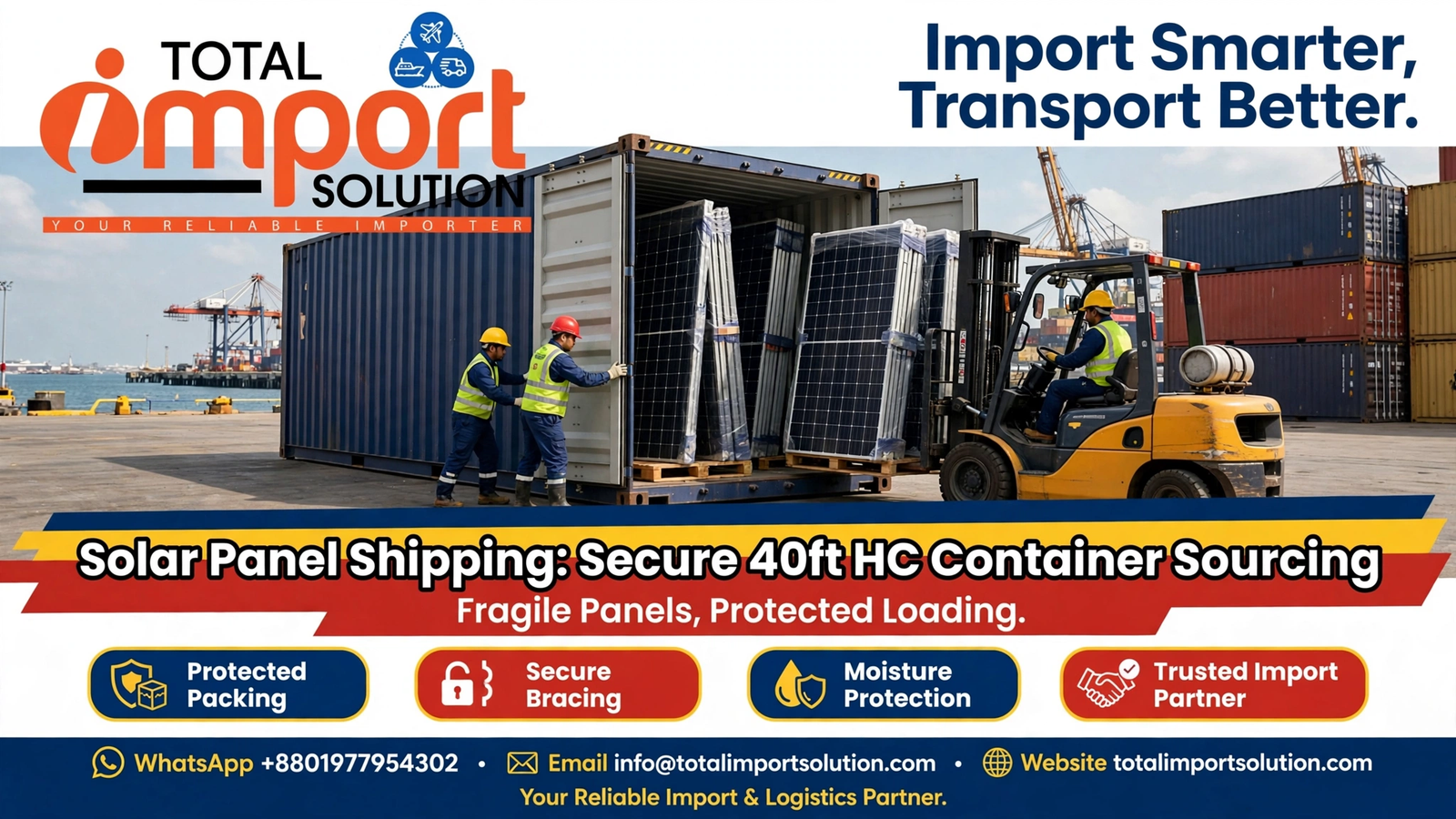
Packing is the first line of defence for a solar panel. At the factory, panels are usually packed in cartons, with two panels face to face or in a small stack, separated by protective sheets. Cartons are then placed on wooden pallets and wrapped, or panels are packed in wooden crates for extra protection. Cartons on pallets suit large orders and easy forklift loading, while crates give stronger protection for long journeys and rough handling.
Whatever the method, the packing must protect the corners and edges, keep the glass faces from touching or rubbing against a hard surface, hold the panels firmly so they do not shift, and keep water out. Check that corner protectors are fitted on all four corners, that separator sheets sit between panels, and that the outer wrapping is whole.
| Packing method | How it works | Best for |
|---|---|---|
| Cartons on pallets | Panels in cartons, stacked on pallets, wrapped in film | Large orders, easy forklift loading |
| Wooden crates | Panels packed in a rigid wooden crate | Long journeys, rough handling |
| Mixed load | Panels with inverters or mounting parts | Small projects ordering a full system |
6. Bracing, Blocking and Securing the Load Inside the Container
A container on a ship moves. It rolls with the sea, it brakes on a truck, and it is lifted by a crane at the port. If the cargo inside can move, it will move, and moving panels hit each other and hit the container walls. Bracing, blocking and securing stop that movement: blocking fills the gaps so the load cannot slide, bracing uses timber or bars to hold it in place, and securing ties it to the container fittings with straps or lashings.
Load the pallets upright, in straight rows, with the weight spread evenly across the floor. Do not leave a large empty space at the door end, because the load will slide forward when the container brakes. Fill gaps with timber blocks, air bags or dunnage, and strap the pallets so they cannot tip. Keep straps over the pallet and frame, not across the bare glass.
| Securing step | What to do | What to check |
|---|---|---|
| Even floor loading | Spread pallets evenly, heaviest low and centred | No lean, no high stack on one side |
| Gap filling | Block gaps with timber, air bags or dunnage | No space for a pallet to slide |
| Strapping | Strap pallets to container fittings | Straps firm, not cutting into frames |
| Final check | Push, look and photograph the finished load | Load is tight, straight and recorded |
7. Moisture, Dust and Weather Protection
Water is a quiet enemy of solar panel shipments. Rain can wet cartons on an open dock, condensation can form inside a container when temperatures change, and a small roof leak can drip onto the top cartons for the whole journey. Wet cartons go soft and lose their strength, and moisture can reach the panels if the packing is open or torn.
Start with a dry container. Check the floor and walls for damp before loading, and do not load in heavy rain without cover. Use moisture absorbers or desiccant bags inside the container where the loading team advises them, and keep the carton wrapping whole. Cover pallets waiting on the dock with tarpaulins, and store panels under cover, off the ground, at the project site until they are installed.
| Protection step | What to do | Why it helps |
|---|---|---|
| Dry container check | Check floor, walls and roof for damp | Loading starts dry, not wet |
| Covered handling | Keep panels under cover on dock and site | Rain never reaches the cartons |
| Moisture absorbers | Place desiccant bags inside as advised | Condensation is reduced in transit |
| Whole wrapping | Keep film and carton wrapping unbroken | Water and dust stay outside |
8. Loading Day: Step-by-Step Supervision
Loading day is the day the plan becomes a real container load. A supervisor should be present for the whole loading, not just at the start. The supervisor checks the container, watches the forklift work, counts the pallets, checks the bracing, and takes photos at each stage. Without a supervisor, small errors — a pallet loaded backwards, a gap left unfilled, a strap missed — go unseen until the container is opened in Bangladesh.
Step 1. Arrive before loading starts and inspect the empty container in daylight. Step 2. Record the container number, check the doors, floor, roof and seals, and reject a faulty container. Step 3. Count the pallets and cartons against the packing list as they arrive. Step 4. Load pallets upright in straight rows, keeping the weight even across the floor. Step 5. Fill every gap with blocking and brace the last row at the door end. Step 6. Strap the load, check for movement by hand, and photograph the finished load. Step 7. Close the doors, fit the seal, record the seal number, and send the report and photos to the buyer.
| Loading record | What to record | Why it matters |
|---|---|---|
| Container number | The full number as painted on the door | The buyer can track the right container |
| Seal number | The seal number fitted at loading | The seal proves the container was not opened |
| Pallet count | Pallets loaded, panels per pallet, total panels | The count matches the packing list |
| Photos | Empty container, loading rows, braced load, sealed doors | A record of how the cargo left the factory |
9. Documents for Solar Panel Shipments
Documents are as important as the packing. A solar panel shipment needs a set of papers that agree with each other: the same panel type, the same quantity, the same shipper and consignee, and the same container number on every document. If one document says one quantity and another says a different quantity, customs clearance can stop while the difference is explained. Prepare the documents early and check them line by line.
The core documents are the commercial invoice, the packing list, the bill of lading, and the certificate of origin where it applies. The invoice shows the seller, the buyer, the panel description and the quantity. The packing list shows how the panels are packed — cartons, crates, pallets, panels per pallet — and the total number of packages. The bill of lading shows the container number, the seal number, the port of loading and the port of discharge. Other papers may be needed, such as test reports, datasheets, or a warranty document from the maker.
| Document | What it shows | Check before shipping |
|---|---|---|
| Commercial invoice | Seller, buyer, panel description, quantity | Names and quantities match the order |
| Packing list | Cartons, crates, pallets, panels per package | Package count matches the loaded container |
| Bill of lading | Container number, seal number, ports | Numbers match the loading report |
| Certificate of origin | Country where the panels were made | Issued correctly where customs asks for it |
| Datasheet and test report | Panel specifications and test results | Datasheet matches the panels shipped |
10. Customs Clearance and Delivery in Bangladesh
When the container arrives at Chittagong Port, customs clearance begins. The clearing agent, often called a C and F agent, submits the documents, the customs authority checks the declaration, and the container is released once the checks are complete and the applicable duty and taxes are settled. The amount depends on the panel classification, the declared value and the rules in force at the time. No fixed duty figure is given here, because the correct figure is confirmed only after checking the actual shipment and its documents.
Plan clearance before the vessel arrives. Send the full document set to the clearing agent early, confirm the HS classification with the agent, and agree who pays which charge at the port. Ask the agent what can delay clearance — a missing paper, a mismatch between documents, or a physical inspection — and prepare for each one.
| Clearance step | What happens | How to prepare |
|---|---|---|
| Documents sent | Full set sent to the clearing agent before arrival | Send scans early, keep originals ready |
| Declaration filed | Agent files the declaration with customs | Classification and values checked with agent |
| Checks and inspection | Documents checked, container inspected if selected | Papers agree, cargo matches packing list |
| Release and delivery | Container released, truck booked to site | Receiver named, unloading plan agreed |
11. Delivery to Solar Projects: Rooftop, Ground-Mount and Remote Sites
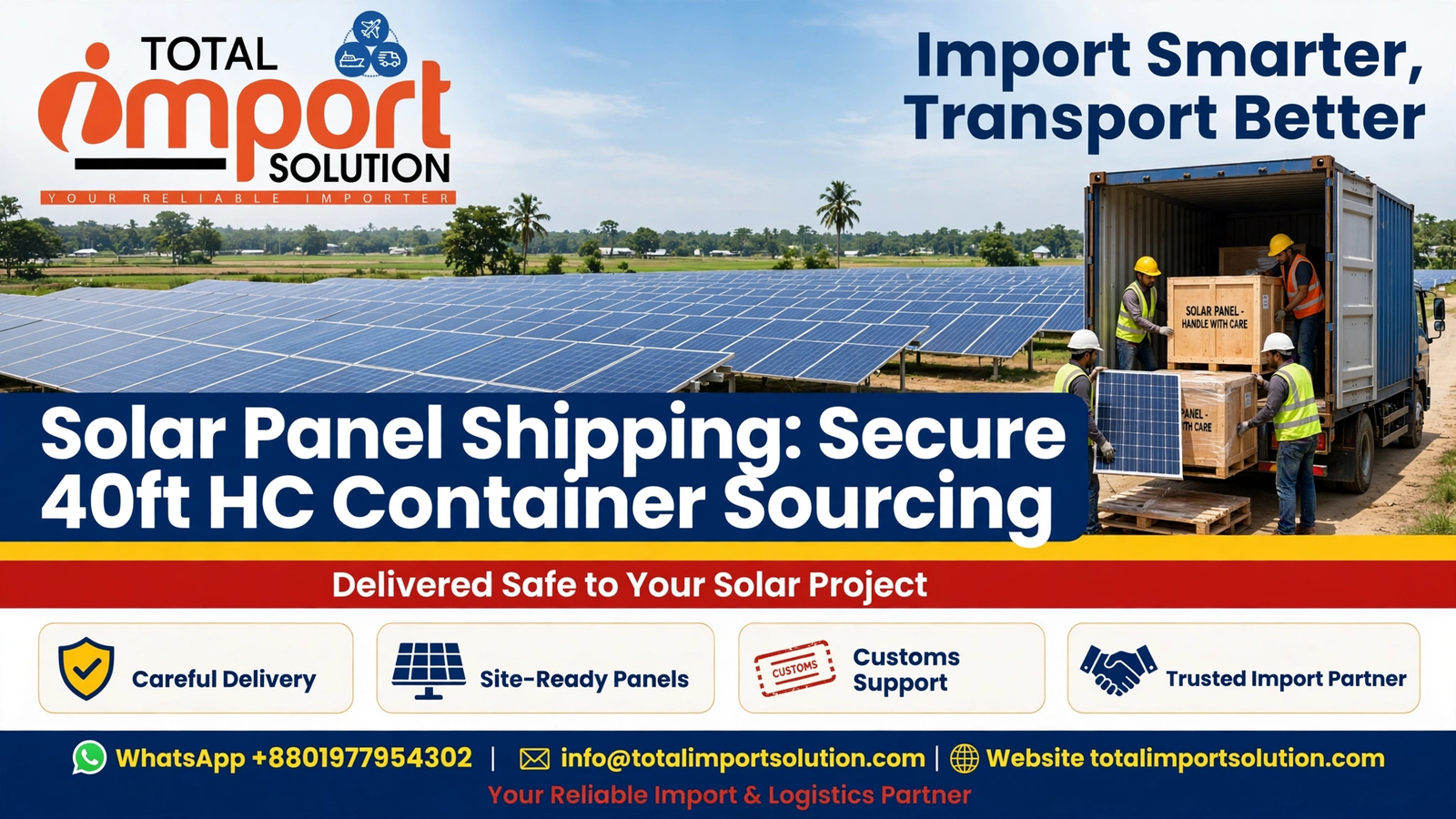
Delivery is not the same for every solar project. A rooftop project on a factory in Dhaka needs a truck that can reach the gate, a place to unload, and a way to carry panels to the roof. A ground-mounted project may be on open land with a dirt road that is hard for a large truck in rain. A remote project may need smaller trucks for the last part of the journey.
Visit the site before delivery if you can, or ask the project team to send photos of the access road, the gate, the unloading area and the storage space. Check the turning space for the truck, the height of any gate or overhead cable, and the ground under the unloading area. If a 40ft container truck cannot reach the site, unload at a warehouse and move the panels in smaller loads.
| Project type | Delivery challenge | How to plan it |
|---|---|---|
| Factory rooftop | City traffic, tight gate, roof access | Book a truck that fits the gate, plan roof lifting |
| Ground-mounted plant | Open land, dirt road, large quantity | Check road and turning space, plan staged delivery |
| Remote or rural site | Narrow road, long last leg | Unload at warehouse, use smaller trucks |
| Distributor warehouse | Regular deliveries, mixed stock | Agree a fixed unloading bay and counting routine |
12. How to Judge a Good Container Sourcing and Shipping Provider
A good provider is judged by how they work, not by what they promise. Look at how they check a container before loading, how they pack and brace the panels, how they keep records, and how they handle documents. A provider who photographs the empty container, the loading rows and the sealed doors, and sends the seal number and the loading report the same day, is a provider who can show their work and keep the buyer informed.
Ask a provider to explain their process in plain steps: how they source the container, who supervises the loading, what packing they use, how they protect against moisture, what documents they prepare, and how they handle a damaged carton found at loading. Also ask for references from other solar importers, and speak to them about damage, delays and communication.
Total Import Solution has worked with importers since 2016. Choose a provider who plans with you before loading, stays in contact during the journey, and supports clearance and delivery after arrival.
| What to judge | Good signs | Warning signs |
|---|---|---|
| Container check | Empty container inspected and photographed | No inspection, container accepted unseen |
| Loading supervision | Supervisor present, load braced and recorded | Loading left to the dock alone |
| Packing | Corner protection, separators, firm wrapping | Loose panels, torn cartons, no protection |
| Documents | Papers checked against cargo before sailing | Documents prepared late, mismatched details |
| Communication | Seal number and photos sent the same day | No updates until the container arrives |
13. Planning Checklist, Common Mistakes and a Practical Timeline
A solar panel shipment runs best when it is planned in order. Start with the specification and the order, agree the packing, book the container, arrange the inspection, prepare the documents, supervise the loading, and plan clearance and delivery before the vessel sails. Each step depends on the one before it, so a delay early in the plan becomes a delay at the port. Write the plan down, share it with the supplier, the loading team and the clearing agent, and tick each step off.
Common mistakes are easy to list and easy to avoid: ordering panels without agreeing the packing, accepting a container without checking the roof and floor, leaving gaps in the load unfilled, sending documents late with mismatched quantities, and planning delivery without checking the site road. Each mistake is small at the time, and each one is costly at the port or at the site.
| Checklist item | Done | Notes |
|---|---|---|
| Panel specification written and agreed | Type, size, quantity, packing method | |
| Supplier and packing confirmed | Cartons or crates, corner protection, pallets | |
| Container booked and checked | Roof, floor, doors, seals, door opening | |
| Inspection arranged | Factory check or loading supervision agreed | |
| Documents prepared and checked | Invoice, packing list, bill of lading agree | |
| Loading supervised and recorded | Photos, seal number, loading report sent | |
| Clearance planned with agent | Agent has documents before vessel arrival | |
| Delivery planned for the site | Road, gate, unloading, storage checked | |
| Panels counted on arrival | Count matches packing list, damage noted |
Frequently Asked Questions
1. What is a 40ft high cube container?
A 40ft high cube container, often written as 40ft HC, is about 40 feet long and taller than a standard 40ft container. The extra height helps when panels are loaded upright on pallets. Always check the actual container before planning the load.
2. How many solar panels fit in a 40ft HC container?
The number depends on the panel size, the pallet size, the packing method and the weight limit of the container. Large modern panels take more space than older models, so count the panels per pallet and the pallets per container for your actual panels, and leave room for bracing.
3. Why are solar panels shipped upright instead of flat?
Panels are usually shipped upright on pallets because upright loading spreads the weight evenly and keeps pressure off the glass face. Flat stacking can press the weight of the upper panels onto the lower ones, and a flat stack is harder to brace.
4. What packing protects solar panels best?
Strong factory packing protects panels best: cartons or wooden crates, corner protectors on all four corners, separator sheets between panels, firm straps, and whole outer wrapping. Crates give stronger protection for long journeys, while cartons on pallets suit large orders.
5. How do I check a container before loading?
Inspect the empty container in daylight. Look at the roof for dents and rust, check the door seals and locking rods, look at the floor for soft spots, holes or raised nails, and check that the doors close and lock cleanly. Reject a container with a leaking roof or a broken seal.
6. What is bracing and why does it matter?
Bracing means holding the load in place with timber, bars, air bags or dunnage so it cannot slide or tip during the journey. A container moves on the sea, on a truck and under a crane, and an unbraced load will move with it. Fill every gap and strap the pallets.
7. How can moisture damage a solar panel shipment?
Rain can wet cartons on an open dock, condensation can form inside a container when temperatures change, and a small roof leak can drip onto the top cartons. Wet cartons go soft and lose strength, and moisture can reach the panels if the packing is torn.
8. Which documents do I need for a solar panel shipment?
The core documents are the commercial invoice, the packing list, the bill of lading, and the certificate of origin where it applies. Datasheets, test reports and warranty documents from the maker may also be needed. Check with your clearing agent early which papers customs will ask for.
9. What happens during customs clearance in Bangladesh?
The clearing agent submits the documents, the customs authority checks the declaration, and the container is released once the checks are complete and the applicable duty and taxes are settled. Send the full document set to the agent before the vessel arrives.
10. How are panels delivered to a solar project site?
Delivery depends on the site. A rooftop project needs a truck that fits the gate and a plan for lifting panels to the roof. A ground-mounted plant needs a check of the road and turning space. A remote site may need unloading at a warehouse and smaller trucks for the last leg.
11. What should I do if a carton is damaged at loading?
Open the carton and check the panel inside before it goes into the container. If the panel is damaged, set it aside and note it on the loading report. If the panel is sound, repack the carton with fresh protection. Never load a damaged panel into a sealed container.
12. Should I use a loading supervisor?
Yes, a supervisor should be present for the whole loading. The supervisor checks the container, watches the forklift work, counts the pallets, checks the bracing, and takes photos at each stage. Without a supervisor, small errors go unseen until the container is opened in Bangladesh.
13. How do I store solar panels after delivery?
Store panels upright, under cover, off the ground, and away from site traffic until the installation team is ready. Keep the wrapping on until the panels reach the installation point, and handle panels with clean gloves. Never drag a panel across the ground or drop a pallet.
14. Can inverters and mounting parts travel in the same container?
Yes, a mixed load is common for small projects ordering a full system. Pack the inverters and mounting parts separately from the panels, keep heavy parts low and away from the glass faces, and list every item on the packing list. The panels still need their own corner protection and bracing.
15. What should I check when the container arrives?
Check the seal number against the loading report, count the pallets against the packing list, and look at the cartons for crushing or water damage. Note any problem on the delivery paper and take photos at once. If the seal number does not match, tell the agent and the supplier before unloading.
16. How do I choose a shipping provider for solar panels?
Judge a provider by how they work: container checks, packing, loading supervision, document checks, records and communication. Ask them to explain their process in plain steps, ask for references from other solar importers, and choose a provider who supports clearance and delivery after arrival.
Contact Total Import Solution
- WhatsApp: +8801977954302
- Email: info@totalimportsolution.com
- Website: totalimportsolution.com
- Service: Solar Panel Shipping: Secure 40ft HC Container Sourcing
- Company: Total Import Solution — Since 2016, serving importers in Bangladesh.
