
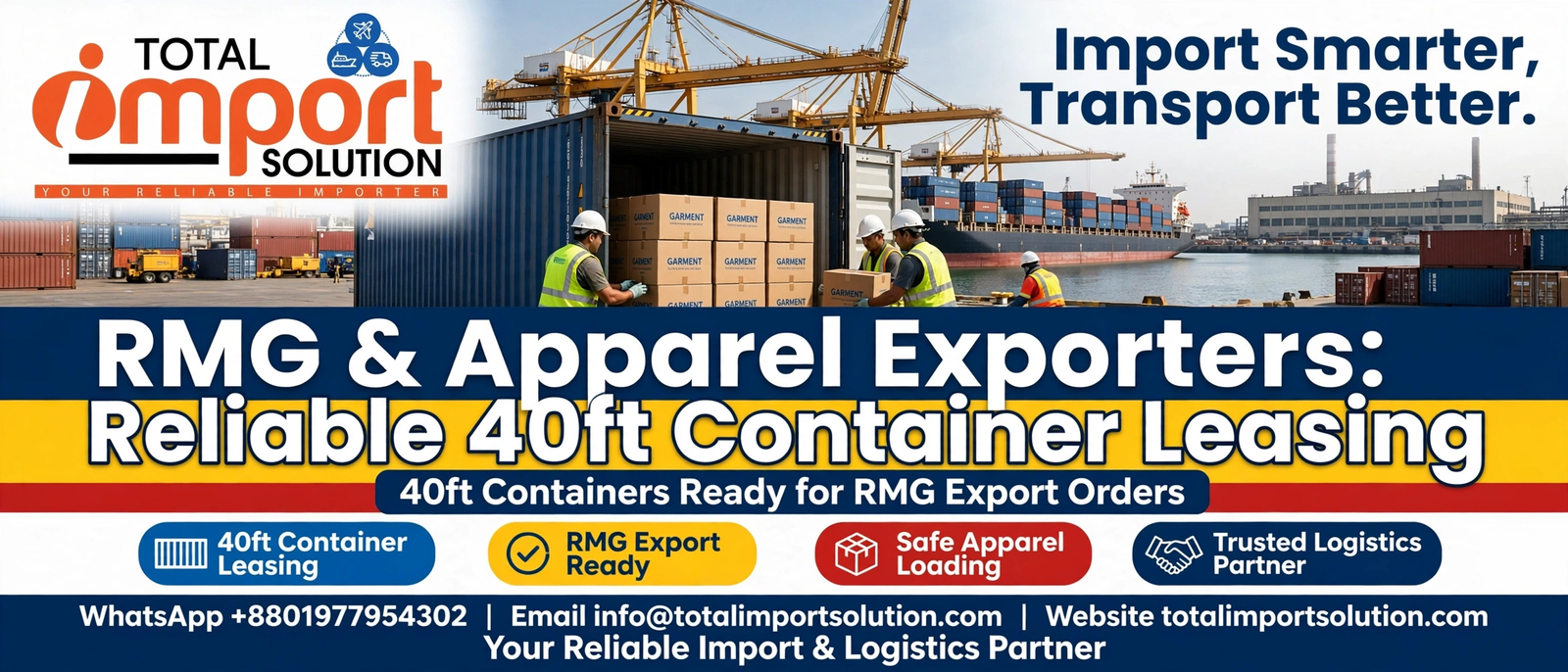
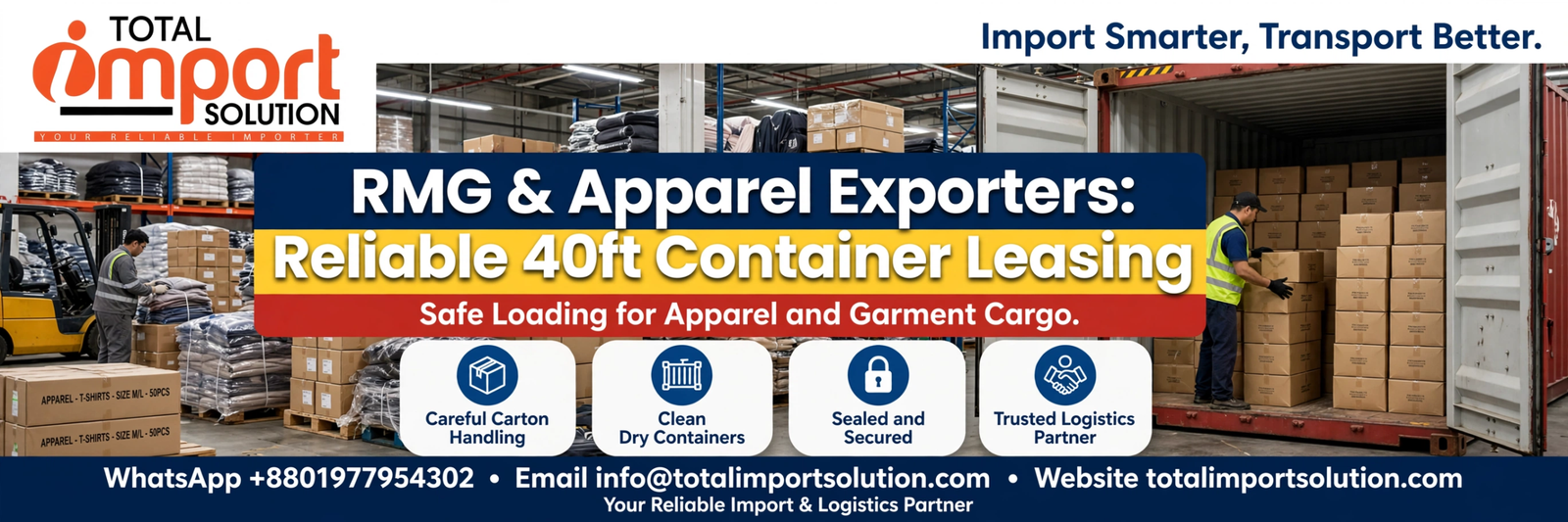
RMG & Apparel Exporters: Reliable 40ft Container Leasing
For a ready-made garment exporter in Bangladesh, the container is where the order either holds together or starts to fall apart. Shirts, trousers, knitwear, jackets and woven garments leave the factory in cartons, and those cartons must arrive at the buyer in the same condition in which they left. A 40ft container, leased on clear terms and loaded with care, gives an RMG exporter the space, the protection and the single sealed unit that a large export order needs.
This guide explains reliable 40ft container leasing for RMG and apparel exporters, step by step. It covers how to fix the facts of your order, how to choose the right container type, how to judge a leasing provider, what to get in writing, how to book in time, how to load and seal apparel cargo safely, and how to follow the shipment from the factory gate to the destination port. Total Import Solution has served importers and exporters in Bangladesh Since 2016, and the checks in this guide are the same checks its team uses when it helps an exporter plan a shipment.
A rate or fee for a lease is confirmed only after checking the actual shipment and the documents. No figure in this guide should be treated as a price for your order, because the cargo, the route, the season, the documents and the port conditions all shape the final figure.
1. What 40ft Container Leasing Means for RMG Exporters
Leasing a 40ft container means arranging the use of a large steel box for one shipment, or for a set period, so that your apparel cargo can be loaded at or near the factory, carried to the port, shipped by sea, and delivered to the buyer. After the goods are unloaded at the destination, the empty container is returned to the place named in the leasing instruction. You use it for the shipment you have in hand, and you return it under the terms you agreed.
For an RMG exporter, the lease usually sits inside a wider export arrangement. One party supplies the container, another carries it by sea, a clearing agent handles the export documents and customs, and a partner such as Total Import Solution can bring the chain together. Before you ask for any figure, it helps to know who does what: who supplies the container, who books the vessel, who handles the export documents, who clears customs, and who arranges delivery at the destination.
2. Why RMG Export Orders Suit the 40ft Container
Apparel cargo is light for its size. A carton of folded shirts or knitwear takes up a lot of room but weighs little, so the limit on an RMG shipment is usually volume rather than weight. That is exactly where the 40ft container earns its place. It holds about twice the volume of a 20ft container, so a large export order that would need two small boxes can often travel in one large one. One container means one seal, one set of loading records, one container number to track, and one unloading at the destination.
The 40ft high cube is the version most apparel exporters ask about first, because it gives extra height for light, tall cartons stacked to the roof. A standard 40ft dry container suits most general apparel cargo. The supplier should confirm the carton sizes and the total weight in writing before the container is chosen.
| Container choice | When it suits an RMG order | What to check first |
|---|---|---|
| 40ft standard dry container | Most general apparel and garment cartons | Carton sizes, total weight, stacking height |
| 40ft high cube container | Light, tall cartons stacked high | Extra height needed, roof clearance, weight |
| 40ft reefer container | Apparel that needs a controlled temperature | Power supply, temperature setting, monitoring |
| 20ft container | A small order, or heavy compact cargo | Volume needed, weight limit, order size |
A 40ft container is approximately 12 metres long, approximately 2.4 metres wide, and approximately 2.4 metres high inside a standard box, with a high cube giving approximately 2.7 metres of internal height. Its internal volume is approximately 67 cubic metres for a standard box and approximately 76 cubic metres for a high cube, and its payload is approximately 26 to 28 tonnes. These are widely standard approximate figures only. Always check the actual container before loading, because boxes differ by age, maker and condition, and the figures on the door of the actual container are the ones that count.
3. Fix Your Export Order Facts First
Every sound leasing plan starts with the order, not the container. Before you contact anyone about a lease, write down the facts of your shipment in one short list. What are the goods — shirts, trousers, knitwear, jackets, or a mixed order? How many cartons are there, what size is each carton, and what is the total weight? How are the goods packed, and do any cartons need to stay upright, dry, or on top? Which buyer is the order for, and which port must it reach?
Also fix the places and the dates: where exactly is the factory, where must the goods arrive, and by when are they needed at the destination? The answers decide the container size and type, the loading point, and how much time the journey needs. The buyer should confirm the delivery requirement in writing, and the factory should confirm the cargo-ready date in writing, because the whole plan is built backwards from those two dates. A plan built on a guessed date will slip, and a slipped plan is what pushes a shipment into the next sailing.
Keep the facts in one file that everyone can see. When the leasing provider, the shipping line and the clearing agent all work from the same list, the same carton count and the same dates, there is far less room for a mistake.
4. Choose the Right 40ft Container Type for Apparel Cargo
Most RMG cargo travels well in a standard dry 40ft container, because garments in sealed cartons need a clean, dry, ventilated box rather than special equipment. The box must be clean inside, free of smells, free of rust flakes and damp patches, and fitted with doors that close firmly and seal properly. A damp or unclean container can damage a whole load of apparel, and the damage is often found only when the buyer opens the cartons. Inspect the box before a single carton goes in, and refuse a box that fails the check.
Some orders need a different type. A high cube suits tall cartons that stack high without crushing the layers below. An open top container suits cargo loaded from above. A flat rack suits oversized cargo that does not fit inside a standard box. A refrigerated container suits cargo that must stay at a controlled temperature, and it needs a power supply during transport and storage.
| Apparel cargo | Container type to ask about | Loading note |
|---|---|---|
| Folded shirts, knitwear, trousers | 40ft standard dry container | Stack evenly, keep cartons dry and upright |
| Tall cartons, light bulky garments | 40ft high cube container | Use the extra height, do not overload the top |
| Jackets, padded or bulky outerwear | 40ft high cube container | Allow room for the bulk, avoid crushing |
| Cargo needing a set temperature | 40ft reefer container | Confirm power supply and temperature setting |
| Oversized or awkward pieces | Open top or flat rack container | Confirm loading method and lashing points |
5. How to Judge a Reliable Leasing Provider
The word reliable is used often in container leasing, and it is worth asking what it should mean in practice. A reliable provider is one you can judge on clear, checkable points, not on a promise. The first point is the condition of the containers: clean, dry, sound boxes, supplied with a condition report, and replaced without argument when a box fails inspection. The second point is clear communication: a named contact, answers in writing, and cut-off dates given early rather than at the last minute.
The third point is honest paperwork. A reliable provider puts the size, the type, the pick-up point, the ports, the destination, the return depot, the free time and the charges in writing before you confirm. The fourth point is a track record with exporters like you: other RMG exporters who have used the provider, and who can say whether the boxes arrived on time and in good condition. Ask for references, and ask what happened when a shipment went wrong, because the answer tells you more than a smooth sales talk.
The fifth point is how the provider handles a problem. Containers get delayed, vessels change, and documents need correction. A reliable provider tells you early, in writing, and offers a practical next step.
6. Lease Terms to Get in Writing Before You Book
A container lease is an agreement, and an agreement should be written down. Before you confirm, ask for the terms in writing and read them slowly. They should state the container size and type, the pick-up point, the loading window, the ports, the destination, the return depot, the free time allowed for loading, unloading and return, and what is included in the figure — and what is not, such as port charges, documentation, customs duty and other government charges, storage, the final delivery, and any charge for a late or damaged return.
Ask how the figure is worked out. The total cost of a shipment is made up of several parts: the container lease, the sea freight, the port charges at both ends, customs duty and other government charges, the clearing fee, and the final delivery charge. A rate or fee is confirmed only after checking the actual shipment and the documents, and it depends on the cargo, the route, availability, the documents, payment and port conditions. Compare offers by the full list of parts, not by one headline figure, because an offer that leaves out port charges or the final delivery can look cheaper and cost more in the end.
| Term to confirm | Why it matters | What to ask |
|---|---|---|
| Container size and type | A wrong box cannot be fixed at loading time | Confirm size, type and container number in writing |
| Pick-up point and loading window | The box must be at the factory on time | Confirm the date, time and place in writing |
| Return depot and free time | A late or wrong return can attract extra charges | Confirm the depot and the free days in writing |
| What is included | A headline figure can hide missing parts | Ask for a full list of included and excluded items |
| Damage and late return | Accidents happen, and the rules should be clear | Ask how damage and late return are handled |
Keep a copy of the signed terms with the shipment file, next to the invoice, the packing list and the bill of lading. Never confirm a lease on a phone call alone.
7. Booking in Time Around Cut-Off Dates and Production
RMG production runs to a tight schedule, and the container booking must fit the factory, not the other way round. The cargo-ready date comes first: the day the last carton is packed, checked and ready to leave the factory. The booking is then planned backwards from that date, allowing time for the container to reach the factory, for loading and sealing, for the move to the port, and for the port cut-off dates. A booking made close to the sailing date may find no container and no space left, and the cargo then waits for the next sailing.
Every booking has cut-off dates, and they are the real deadlines. The document cut-off is the last time shipping documents can be submitted. The cargo cut-off is the last time the loaded container can enter the port. Ask for both cut-off dates in writing at booking, put them in the calendar, and build the plan around them rather than around the departure time. If the cargo-ready date slips, tell the leasing provider and the shipping line at once, in writing, so the booking can be adjusted before the cut-off passes.
Follow this simple sequence for each order:
- Confirm the buyer requirement and the cargo-ready date in writing.
- Fix the carton count, carton sizes and total weight in one list.
- Choose the container size and type, and confirm it in writing.
- Ask for the lease terms in writing, and read them before confirming.
- Confirm the booking, and write down both cut-off dates.
- Arrange the container delivery to the factory with time to spare.
- Load, seal, record the seal number, and check the documents.
- Follow the shipment to the port, and keep the buyer informed.
A plan that follows these eight steps leaves room for a small delay without losing the sailing.
8. Loading Apparel Cargo Safely in a 40ft Container
Loading is where careful preparation pays off, and it is also where apparel cargo is most often damaged. Before the container is loaded, check that it is clean, dry, and free of damage, and that its doors close and seal properly. Check the floor for nails, splinters and damp patches, and check the roof and walls for leaks. A single damp patch or a sharp nail can ruin the cartons it touches, and the cartons around them.
Load the cargo so that it cannot move. Heavy cartons go at the bottom, light cartons on top, and the weight should be spread evenly from side to side and from front to back. Fill gaps with dunnage or empty cartons so that the load cannot shift when the container is lifted or when the vessel moves. Fragile goods need cushioning and clear marking, and cartons that must stay upright should be marked and loaded that way. Keep a record of what went into the container and in which order, with the carton numbers and the marks, so that the buyer can check the load at the other end.
Follow these loading steps in order:
- Inspect the empty container inside and out, and record any damage.
- Sweep the floor, check for damp, smells and sharp points.
- Load heavy cartons first, at the bottom and spread evenly.
- Stack light cartons on top, keeping the load level and stable.
- Fill gaps so nothing can shift during lifting and sea travel.
- Mark upright and fragile cartons clearly, and load them as marked.
- Count the cartons as they go in, and check the count against the packing list.
- Close the doors, fit the seal, and record the seal number at once.
When loading is finished, the container is sealed, and the seal number is recorded and checked against the shipping documents. Photograph the loaded container, the seal, and the container number, and keep the photographs with the shipment file.
9. Sealing, Documents and Records for the Export Shipment
Once the container is loaded and sealed, the paperwork becomes the shipment. The bill of lading is the key transport document for the journey, and the exporter should receive a copy and check it carefully: the shipper, the consignee, the port of loading, the port of discharge, the container number, the seal number, and the description of the goods. Any mistake should be corrected while the vessel is still at sea, because a correction is harder and slower after arrival. A wrong container number or a wrong seal number on the bill of lading can hold a shipment at the destination port.
The export file for an RMG order usually holds the invoice, the packing list, the bill of lading, the certificate of origin where needed, and the export registration documents. Each document should agree with the others on the same points: the same buyer, the same goods, the same carton count, the same weight, and the same container and seal numbers. When one document says one thing and another says something else, customs and the buyer both have reason to stop and ask questions, and every question costs time.
| Document | What to check | Common mistake to avoid |
|---|---|---|
| Invoice | Buyer, goods, quantities, values as agreed | A quantity that does not match the packing list |
| Packing list | Carton count, carton marks, weights | A carton count that does not match the loaded count |
| Bill of lading | Container number, seal number, ports, consignee | A seal number copied wrongly from the loading record |
| Certificate of origin | Origin details as required by the buyer | A missing or out-of-date certificate |
| Export registration papers | Registration details current and correct | An expired or mismatched registration |
Keep the whole file in one place, with copies given to the clearing agent in advance. Do not wait until the vessel sails to start the documents.
10. From Factory to Port: Moving the Loaded Container
After sealing, the loaded container travels from the factory to the port, usually by road on a flatbed truck, and sometimes by river where that suits the cargo. The move should be booked with time to spare, because road traffic, weather and port queues can all add hours. A container that leaves the factory late and arrives at the port after the cargo cut-off will wait for the next sailing, whatever the booking said. Plan the move so that the container reaches the port well before the cut-off, and keep the driver and the port contact in touch during the journey.
At the port, the container is received, checked against the booking, and placed in the yard to wait for loading onto the vessel. The exporter or the agent should confirm that the container has been received, and should keep the receipt with the shipment file.
11. Arrival, Customs and Delivery at the Destination Port
When the vessel reaches the destination, the container is discharged and moved into the yard or a nearby depot. Customs at the destination requires the bill of entry or its local equivalent, the bill of lading, the invoice, the packing list and the import registration documents of the buyer. The buyer or the buyer agent should have copies of the file in advance, so that clearance can start as soon as the vessel arrives.
Delays at the destination usually come from the same causes as delays at the loading port: a document that does not match, a seal number that was copied wrongly, or a carton count that differs from the packing list. Each of these can be avoided by the checks in this guide.
The empty container is then returned to the depot named in the leasing instruction, within the free time allowed. Returning the empty container late, or to the wrong depot, can attract extra charges, so the buyer or the buyer agent should be told the return depot and the return date in writing, before the container is unloaded. A clear return instruction, given early, is the last step of a well-planned lease, and it protects the exporter from charges that have nothing to do with the goods.
12. Costs You Should Ask About — Without Guessing a Figure
An RMG exporter needs a clear picture of the total cost of a shipment, but a clear picture does not mean a guessed figure. The total cost is made up of several parts, and each part should be asked about separately, so that nothing is hidden inside a single headline figure. The parts are the container lease, the sea freight, the port charges at both ends, customs duty and other government charges, the clearing fee, the final delivery charge, and any charge for storage, late return or damage. Ask for each part by name, and ask whether it is included or excluded.
A rate or fee is confirmed only after checking the actual shipment and the documents. The cargo, the route, the season, the availability of containers and vessel space, the documents, payment and port conditions all shape the final figure, and a figure given before those facts are known is a guess, not a quotation. When you compare providers, compare them on the same full list of parts, with the same cargo facts and the same dates, so that the comparison is honest. A provider who gives a full written breakdown is easier to trust than a provider who gives a single figure and no detail.
| Cost part | Ask this question | Watch out for |
|---|---|---|
| Container lease | What is included, and for how many days | Free time that ends before the return date |
| Sea freight | Which service, which ports, which sailing | A sailing that changes after confirmation |
| Port charges | Charges at loading port and destination port | Charges listed at one port and missing at the other |
| Customs duty and government charges | Which charges apply to this cargo | A charge left out of the headline figure |
| Clearing fee and final delivery | Who clears, who delivers, and to where | Delivery to the port only, not to the buyer |
| Storage, late return, damage | How each is charged, and when | Rules that were never put in writing |
Plan the budget with room for a small change. A document correction, an extra day in the yard, or a changed sailing can add a charge, and a budget with no room for change turns a small problem into a crisis.

13. Working With Your Agent, Mistakes to Avoid, and How Total Import Solution Helps
The simplest way to run a 40ft container lease well is to work with one agent who knows the whole chain, from the factory gate to the destination port. A good agent checks the container before loading, confirms the lease terms in writing, watches the cut-off dates, follows the documents, and keeps the exporter and the buyer informed at each step. Total Import Solution has worked with importers and exporters in Bangladesh Since 2016, and it helps RMG exporters in exactly this way: by planning the shipment from the real order facts, by arranging the container and the booking, by checking the documents, and by following the container until delivery is confirmed.
The mistakes to avoid are the same ones that appear in almost every delayed or damaged RMG shipment. The first is choosing the container before fixing the carton count and the weight. The second is confirming a lease on a phone call, with nothing in writing. The third is loading a container that has not been inspected, and sealing it without recording the seal number. The fourth is leaving the documents until the vessel sails, and finding a mismatch too late to fix. The fifth is planning the factory-to-port move with no time to spare, so that a small delay becomes a missed cut-off. The sixth is forgetting the empty return, and paying extra charges for a late or wrong return. Avoid these six mistakes, and most RMG export shipments will run as planned.
Start each order with the eight-step sequence in Section 7, keep one file for the order, and keep every confirmation in writing. When you need help, ask early rather than late.
Frequently Asked Questions
1. What is 40ft container leasing for RMG exporters?
It is an arrangement to use a 40ft container for one shipment, or for a set period, so that apparel cargo can be loaded at the factory, carried to the port, shipped by sea, and delivered to the buyer, with the empty container returned to the depot named in the instruction.
2. Why is a 40ft container a good fit for apparel cargo?
Apparel cargo is light for its size, so volume is usually the limit rather than weight. A 40ft container holds about twice the volume of a 20ft container, so a large export order can often travel in one box, with one seal and one set of loading records.
3. Should I choose a standard 40ft container or a high cube?
A standard dry 40ft container suits most general apparel cartons. A high cube suits light, tall cartons that stack high. The choice should follow the real carton sizes, the stacking height and the total weight, confirmed in writing before the container is chosen.
4. How do I judge whether a leasing provider is reliable?
Judge the provider on five checkable points: the condition of the containers, clear communication in writing, honest written terms, a track record with RMG exporters, and how the provider handles a problem when one appears.
5. What lease terms should I get in writing?
Get the container size and type, the pick-up point, the loading window, the ports, the destination, the return depot, the free time, and what is included and excluded, all in writing, before you confirm the lease.
6. When should I book the container?
Book as soon as the cargo-ready date and the carton facts are fixed. Booking early gives more choice of container and sailing, and more time to fix a document problem before the cut-off dates pass.
7. What are the cut-off dates I must watch?
The document cut-off is the last time shipping documents can be submitted, and the cargo cut-off is the last time the loaded container can enter the port. Ask for both in writing at booking, and build the plan around them.
8. How should apparel cartons be loaded in a 40ft container?
Load heavy cartons at the bottom, light cartons on top, spread the weight evenly, fill gaps so nothing can shift, mark upright and fragile cartons clearly, and count the cartons as they go in against the packing list.
9. How do I check a container before loading?
Check that it is clean, dry and free of damage, that the floor has no nails, splinters or damp patches, that the roof and walls do not leak, and that the doors close firmly and seal properly. Refuse a box that fails the check.
10. What documents do I need for an RMG export shipment?
You usually need the invoice, the packing list, the bill of lading, the certificate of origin where needed, and the export registration documents. Each document should agree with the others on the buyer, the goods, the carton count, the weight, and the container and seal numbers.
11. What is the seal number, and why does it matter?
The seal number is the number of the seal fitted to the container doors after loading. It is recorded at loading, checked against the bill of lading, and checked again at the destination, so that everyone can see the container was not opened on the way.
12. How is the total cost of a shipment worked out?
The total is made up of the container lease, sea freight, port charges at both ends, customs duty and other government charges, the clearing fee, and the final delivery charge. A rate or fee is confirmed only after checking the actual shipment and the documents.
13. What happens if the cargo-ready date slips?
Tell the leasing provider and the shipping line at once, in writing, so the booking can be adjusted before the cut-off passes. A slipped date that is shared early can usually be managed, while a slipped date shared late can mean a missed sailing.
14. How is the empty container returned?
The empty container is returned to the depot named in the leasing instruction, within the free time allowed. The buyer or the buyer agent should be told the return depot and the return date in writing before the container is unloaded.
15. What are the most common mistakes in RMG container leasing?
The most common mistakes are choosing the container before fixing the carton facts, confirming on a phone call with nothing in writing, loading without inspecting the box, leaving documents until the vessel sails, planning the port move with no time to spare, and forgetting the empty return.
16. How can Total Import Solution help with my RMG export order?
Total Import Solution can help with the container lease, the booking, the documents, customs clearance and the final delivery, and it will confirm any rate or fee only after checking the actual shipment and the documents. Contact the team on WhatsApp +8801977954302 to discuss your order.
Contact Total Import Solution
- WhatsApp: +8801977954302
- Email: info@totalimportsolution.com
- Website: totalimportsolution.com
- Service: RMG & Apparel Exporters: Reliable 40ft Container Leasing
- Company: Total Import Solution — Since 2016, serving importers in Bangladesh
