PSI inspection agent China Bangladesh
When goods are ordered from China and shipped to Bangladesh, the importer cannot see the goods before they leave the factory. The cartons may look right in a photo, the supplier may promise the right quality, and the packing list may list the right quantity — but the importer only finds out the truth when the container arrives at Chittagong Port or Pangaon port. By then it is too late to fix a problem cheaply.
A PSI inspection agent in China solves this problem. PSI means Pre-Shipment Inspection. The agent visits the supplier’s factory or warehouse in China before the goods are loaded, checks the goods against the order, and sends a written report with photos to the importer in Bangladesh. The importer then decides, with facts in hand, whether the goods are ready to ship.
This guide explains what PSI is and why it matters, what a PSI inspection agent does, when PSI is needed for China to Bangladesh imports, the step-by-step process from booking to report, the documents needed, what the inspector checks, the common PSI problems and how to fix them, PSI and customs clearance in general terms, the cost and timing factors, how to judge a good agent, and the mistakes to avoid. No fixed rates or fees are given here. A rate or fee is confirmed only after checking the actual shipment and its documents.
Total Import Solution, since 2016, provides import support for businesses in Bangladesh, including PSI inspection coordination for China imports, document checking, and customs clearance support through Chittagong Port, Pangaon port, and Dhaka Airport, with delivery coordination to factories and warehouses in Dhaka, Gazipur, and Narayanganj.
1. What Is PSI (Pre-Shipment Inspection) and Why Does It Matter?
PSI, or Pre-Shipment Inspection, is a physical check of the goods at the supplier’s factory or warehouse in China, carried out before the goods are packed for export and loaded into the container. An independent inspector, working for the importer, opens cartons, counts the goods, measures them, tests how they work where a test is possible, and checks the packing and the shipping marks.
The inspection matters because the importer buys from a distance. A photo from the supplier shows what the supplier wants the importer to see. A PSI report shows what is actually on the factory floor. The report records the quantity produced, the quantity checked, the defects found, the packing used, and the condition of the goods, with photos for each point.
PSI protects the importer in three ways. First, it finds problems while they can still be fixed at the factory — a wrong colour, a missing part, a weak carton, a wrong label. Second, it gives the importer a written record that can be used to ask the supplier to correct the goods before shipment. Third, it gives the bank and the buyer a clear picture of what is being shipped, which helps the rest of the import process run smoothly.
Without PSI, the importer discovers problems at the port in Bangladesh. At that point the goods are already paid for, already shipped, and already in a container. Fixing a problem then means sending the goods back, accepting goods that are not right, or paying for a repair in Bangladesh. PSI moves the discovery of problems to the factory, where fixing them is fastest and cheapest.
2. What Does a PSI Inspection Agent Do?
A PSI inspection agent is a professional who carries out the pre-shipment inspection on behalf of the importer. The agent works in China, at the supplier’s factory or warehouse, and reports directly to the importer in Bangladesh. The agent does not work for the supplier, and the report goes to the importer, not to the factory.
| Service | What it covers |
|---|---|
| Inspection booking | Arranging the inspection date with the supplier and the factory |
| Quantity check | Counting the finished goods and comparing the count with the order |
| Quality check | Checking the goods against the sample, the specification, and the order |
| Function test | Testing how the goods work, where a test is part of the order |
| Measurement check | Measuring size, weight, and dimensions against the order |
| Packing check | Checking cartons, inner packing, labels, and shipping marks |
| Loading supervision | Watching the goods being loaded into the container where agreed |
| Photo report | Photos of the goods, the defects, the packing, and the loading |
| Written report | A clear report with the findings, the defects, and the recommendation |
| Follow-up | A re-inspection after the supplier corrects the problems found |
A good agent explains each of these steps in plain words before the inspection starts. You should know what the agent will check, what documents you must provide, what the report will contain, and how you will be updated. If an agent cannot explain the inspection clearly, that is a warning sign.
The agent’s job is to report facts, not to approve or reject the goods for you. The report tells you what was found, with photos, and you decide what to do next. The agent can advise you on the findings, but the decision to ship, to ask for corrections, or to hold the shipment belongs to the importer.
3. When Is PSI Required for China to Bangladesh Imports?
PSI is not needed for every shipment, but it is needed in several common situations. The list below shows when importers usually arrange PSI.
| Situation | Why PSI is needed |
|---|---|
| First order from a new supplier | The importer has no record of the supplier’s quality yet |
| Large order value | The risk of a problem is larger, so a check before shipment is worth it |
| Letter of credit asks for it | The bank or the L/C terms may ask for an inspection report |
| Buyer asks for it | The end buyer in Bangladesh may want proof of quality before delivery |
| Goods made to a specification | Custom goods must match the drawing, the sample, or the specification |
| Branded or labelled goods | Labels, logos, and printing must be checked before the goods leave China |
| Fragile or sensitive goods | Packing must be checked, because weak packing breaks in transit |
| Previous problem with the supplier | A past defect or short shipment makes a fresh check sensible |
PSI is also useful when the goods are ordered in several lots. The first lot can be inspected, and the findings used to correct the later lots before they are produced. This saves time and avoids repeating the same defect across the whole order.
Some importers arrange PSI for every order from China, as a routine step. Others arrange it only for new suppliers, large orders, or orders where the L/C or the buyer asks for it. Either approach is reasonable. What matters is that the decision is made before the goods leave the factory, not after they arrive in Bangladesh.
4. The Step-by-Step PSI Process from Booking to Report
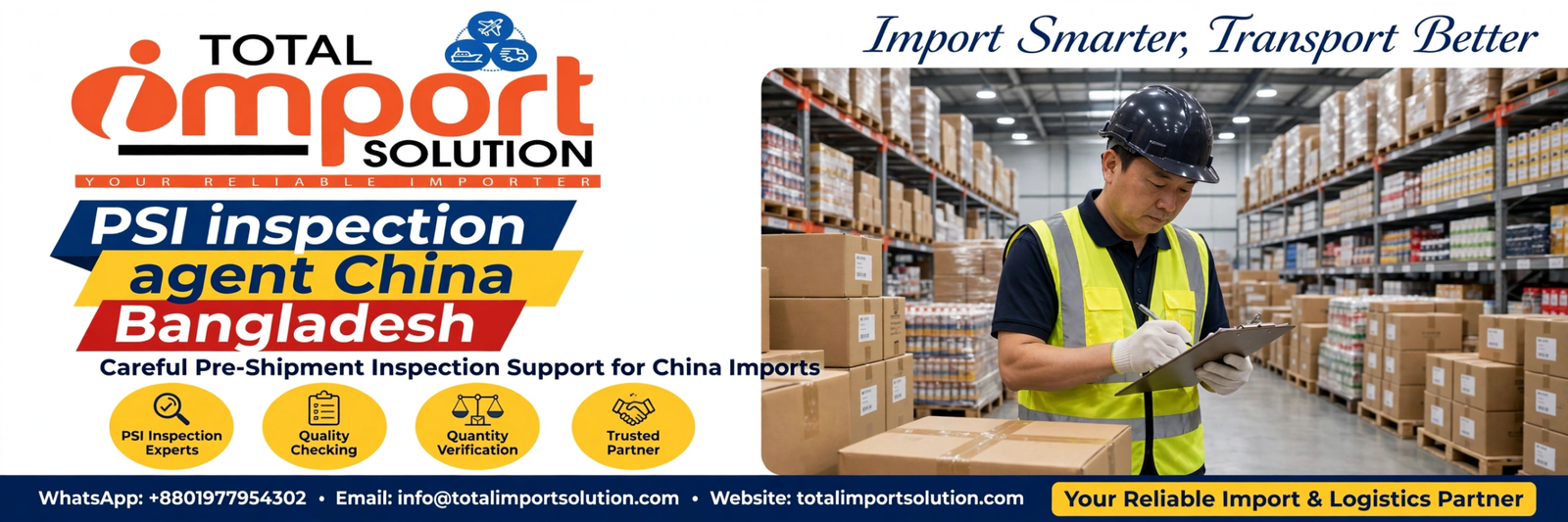
A PSI inspection follows a clear sequence. The steps below show the usual order, from the moment the goods are ready at the factory to the moment the importer receives the report.
Step 1: Share the order details with your agent. Send the purchase order, the product specification, the approved sample details, the packing instructions, and the supplier’s contact details. The agent needs these papers to know what to check the goods against.
Step 2: Book the inspection date. The agent contacts the supplier and agrees a date when the goods are finished and ready for checking. The inspection should happen when the full order is produced and packed, or nearly so, so the check covers the real shipment.
Step 3: The inspector visits the factory or warehouse. The inspector goes to the supplier’s premises in China with the order details, the specification, and a checklist. The inspector works on site, in the factory or the warehouse where the goods are stored.
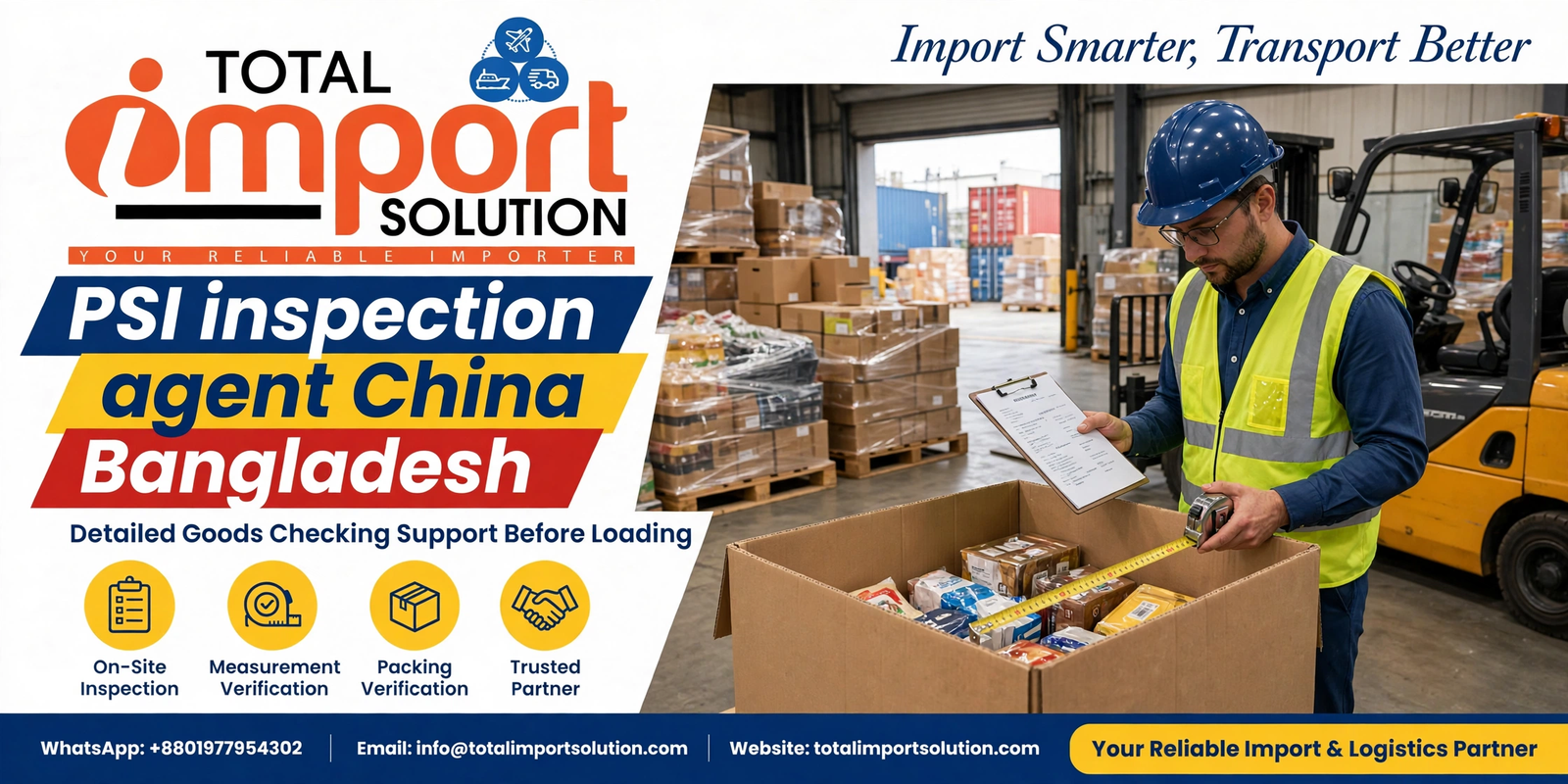
Step 4: Quantity check. The inspector counts the finished goods and compares the count with the order quantity. If the order is for a large number of pieces, the inspector checks a sample of cartons and counts the pieces inside them, then works out whether the total quantity matches the order.
Step 5: Quality and function check. The inspector checks the goods against the sample and the specification — colour, material, size, finish, labels, and printing. Where the goods are meant to work in a particular way, the inspector tests a sample of them to see that they work as ordered.
Step 6: Packing and marking check. The inspector checks the cartons, the inner packing, the labels, and the shipping marks. The packing must protect the goods during sea transport, and the marks must match the shipping documents so the cartons are not mixed up.
Step 7: Loading supervision where agreed. If the importer asks for it, the inspector stays to watch the goods being loaded into the container, checks the container number, and notes the seal number. This step links the inspection to the actual shipment.
Step 8: The report is written and sent. The inspector writes the report with the findings, the defects found, the photos, and a recommendation. The report is sent to the importer in Bangladesh, usually within a short time after the inspection, so the importer can decide quickly.
Step 9: The importer decides what to do next. With the report in hand, the importer can accept the goods, ask the supplier to correct the defects, or hold the shipment. If corrections are made, a re-inspection can be arranged to confirm the fixes.
5. Documents You Need for a PSI Inspection
The inspection runs on documents. The inspector checks the goods against the order papers, so those papers must be complete and correct before the inspection date. The table below lists the documents most commonly needed.
| Document | What it is for |
|---|---|
| Purchase order | The order showing the goods, quantity, price terms, and delivery terms |
| Product specification | The written specification the goods must match |
| Approved sample details | The sample the supplier agreed to match, with photos or a reference |
| Packing instructions | How the goods should be packed, labelled, and marked |
| Commercial invoice | The supplier’s invoice showing the goods, quantity, and value |
| Packing list | The list of packages, weights, and contents of the shipment |
| Certificate of origin | Proof of where the goods were made, where required |
| Test certificates | Test reports for the goods, where the order asks for them |
| Supplier contact details | The factory address and the contact person for the inspection |
| Letter of credit details | The L/C terms, where the L/C asks for an inspection report |
Share these documents with your agent before the inspection date, so the inspector arrives prepared. If the specification is missing or unclear, the inspector cannot judge whether the goods are right. Send the specification in writing, with photos of the approved sample where possible, so there is no confusion at the factory.
Keep the originals and copies together in one file for each shipment. The PSI report joins that file after the inspection, together with the invoice, the packing list, the bill of lading, and the bill of entry, so the whole import has one complete record.
6. What the Inspector Checks: Quality, Quantity and Packing
The inspection covers three areas: quality, quantity, and packing. Each area has its own checks, and each check is recorded in the report with photos.
| Check area | What the inspector looks at |
|---|---|
| Quantity | Number of finished pieces, number of cartons, count against the order |
| Appearance | Colour, finish, surface, shape, and general look against the sample |
| Workmanship | Seams, joints, edges, printing, and assembly quality |
| Function | Whether the goods work as ordered, tested on a sample |
| Size and weight | Measurements and weight against the specification |
| Labels and marks | Product labels, care labels, barcodes, and shipping marks |
| Inner packing | How each piece is wrapped and protected inside the carton |
| Outer cartons | Carton strength, size, sealing, and condition |
| Loading | Container condition, loading order, and seal where supervised |
The inspector does not check every single piece. For a large order, the inspector selects a sample of cartons at random, opens them, and checks the pieces inside. The sample is chosen across the whole lot, not only from the top of the pile, so the findings reflect the full shipment.
Defects are sorted into groups so the importer can judge them. A serious defect stops the goods from working or makes them unsafe. A major defect is easy to see and affects how the goods look or work. A minor defect is small and does not affect use. The report lists the defects found in each group, with photos, so the importer can decide which ones must be fixed before shipment.
7. Common PSI Problems and How to Fix Them
The four problems below are the most common, and each one has a clear fix if it is found during the inspection.
Short quantity. The factory has produced fewer pieces than the order asks for, or some cartons hold fewer pieces than the packing list says. The fix is to ask the supplier to produce the missing pieces before shipment, and to re-check the count after the shortfall is made up. Never accept a short shipment without a written agreement on the missing quantity.
Wrong quality or wrong specification. The goods do not match the approved sample — the colour is different, the material is different, or a part is missing. The fix is to show the supplier the sample and the specification, ask for the goods to be corrected or remade, and arrange a re-inspection to confirm the correction.
Weak packing. The cartons are thin, the inner packing is missing, or the goods move freely inside the carton. Weak packing breaks during sea transport, and the goods arrive damaged. The fix is to ask the supplier to use stronger cartons and proper inner packing, and to check the packing again before loading.
Wrong labels or shipping marks. The labels show the wrong model, the wrong quantity, or the wrong destination, or the shipping marks do not match the documents. Wrong marks cause confusion at the port and can delay clearance. The fix is to ask the supplier to correct the labels and marks before the goods are loaded, and to check the corrected marks against the packing list.
In every case, the PSI report is the evidence. It shows the supplier exactly what is wrong, with photos, so the correction can be agreed in writing. Do not agree to corrections by phone alone — ask for the correction in writing, and confirm it with a re-inspection where the problem is serious.
8. PSI, HS Code and Customs Clearance in General Terms
PSI and customs clearance are linked in a practical way. The inspection checks the goods in China; the clearance in Bangladesh runs on the documents that describe those same goods. If the description on the inspection report, the invoice, the packing list, and the bill of lading all match, the clearance runs smoothly.
The description of the goods matters for the HS code. The HS code is the classification code for your goods, and it decides how customs treats the shipment and how the duty is assessed. The code is based on what the goods are, what they are made of, and how they are used. If the inspection finds that the goods are different from what the invoice describes, the HS code and the duty treatment may need to be checked again before the bill of entry is filed.
If you are unsure about the HS code for your goods, ask your agent before the shipment is filed. The agent can help you check the description of the goods against the classification, and can tell you which details customs will look for. The supplier’s description is a starting point, not the answer. A supplier may describe goods in general words, or use a code from their own country that does not match the Bangladeshi classification.
Duty is assessed on the declared value of the goods and the treatment for the HS code. The exact amount depends on the shipment, the goods, and the current rules, so no fixed rate can be given in a guide like this. What you can do is ask your agent for a clear breakdown of the assessed duty and charges for your shipment, in writing, before you pay.
9. PSI Costs and Timing Factors
No fixed fee can be given here, because the cost of a PSI inspection depends on several factors. The main ones are listed below.
Size of the order. A large order takes longer to check than a small one, because the inspector must open more cartons and check more pieces. The inspection time grows with the quantity.
Location of the factory. Factories in different parts of China take different amounts of travel time to reach. A factory far from the inspector’s base adds travel time and cost to the inspection.
Type of goods. Simple goods are quick to check. Goods that need a function test, a measurement, or a special test take longer, and the inspector needs the right tools and instructions for the test.
Re-inspection. If the first inspection finds defects and the supplier corrects them, a re-inspection is needed to confirm the fixes. The re-inspection is a separate visit, and it should be planned when the corrections are booked.
Loading supervision. Watching the loading adds time at the factory or the warehouse, because the inspector stays until the container is loaded and sealed. This step is worth it when the importer wants proof that the inspected goods are the goods that were loaded.
Always compare the total cost of the inspection with the risk it covers. A short shipment, a wrong specification, or a damaged delivery costs far more than an inspection. Ask your agent for a clear written quotation for the inspection, listing the service fee and any travel or re-inspection cost separately, before the work starts. A rate or fee is confirmed only after checking the actual shipment and its documents.
10. How to Judge a Good PSI Inspection Agent
Not every agent is equally suited to PSI work. The table below gives a practical way to compare agents before choosing one.
| What to check | A good sign | A warning sign |
|---|---|---|
| Inspection experience | The agent has inspected similar goods in China before and knows the factory process | The agent has never inspected your type of goods and asks no questions about them |
| Independent reporting | The report goes to you, the importer, with photos and clear findings | The report is shared with the supplier first, or the findings are vague |
| Clear checklist | The agent works from your order, specification, and sample | The agent inspects without your papers and checks only the general look |
| Photo evidence | Every finding has a photo, including the defects and the packing | The report has few photos, or the photos do not show the defects |
| Honest findings | The agent reports defects plainly, even when the supplier disagrees | The agent passes goods that clearly do not match the order |
| Communication | The agent updates you at each step: booked, inspected, report sent | You have to chase the agent for news |
| Record keeping | The agent gives you a complete report file after the inspection | The agent keeps the report and gives you only a short summary |
Ask the agent for a sample report before you book. A good sample report shows the quantity checked, the defects found, the photos, and a clear recommendation. If the agent cannot show a sample report, that is a warning sign.
11. Working with Your PSI Agent
PSI works best when the importer and the agent share information early.
Send the order papers as soon as the supplier confirms the order. Do not wait until the goods are finished. The agent needs time to study the specification, prepare the checklist, and book the inspection date with the factory.
Tell the agent about any change. If the supplier changes the material, the colour, the packing, or the delivery date, the agent must know at once. A change that is small for the supplier can be large for the inspection, because the inspector checks the goods against the original order.
Agree the inspection scope in writing before the work starts. The scope should list what will be checked — quantity, quality, function, packing, and loading — and what the report will contain. If a new check is needed during the inspection, ask the agent to confirm it in writing before it is done.
Keep the report with the shipment file. The report should sit with the invoice, the packing list, the bill of lading, the bill of entry, and the delivery note, so the whole import has one complete record. If a problem appears after the goods arrive, the report shows what was checked before shipment.
12. Common Mistakes to Avoid
Mistake 1: Skipping PSI for a new supplier. A new supplier has no record with you. Without an inspection, you trust the supplier’s word alone. Always inspect the first order from a new supplier.
Mistake 2: Booking the inspection too late. If the inspection is booked after the goods are loaded, there is nothing left to check. Book the inspection while the goods are still at the factory and can still be corrected.
Mistake 3: Sending an unclear specification. If the specification is vague, the inspector cannot judge whether the goods are right. Send the specification in writing, with photos of the approved sample, before the inspection date.
Mistake 4: Accepting a report without photos. A report without photos is only words. Ask for photos of the goods, the defects, the packing, and the loading, so you can see what the inspector saw.
Mistake 5: Ignoring the defects in the report. A report that lists defects is not a failed inspection — it is the inspection doing its job. Read the defects, ask the supplier to correct them in writing, and arrange a re-inspection where the problem is serious.
Mistake 6: No written agreement on corrections. Corrections agreed by phone alone are easy to forget or deny. Ask for the correction in writing, with a date, and confirm it with a re-inspection.
Mistake 7: No loading check. Goods that pass inspection can still be mixed up at loading. Where the order is large or the goods are valuable, ask for loading supervision so the inspected goods are the goods that go into the container.

13. How Total Import Solution Helps
Total Import Solution, since 2016, supports importers in Bangladesh with the practical work around importing, including PSI inspection coordination for China imports, document checking, and customs clearance support through Chittagong Port, Pangaon port, and Dhaka Airport. The team helps importers arrange inspections in China, check the goods against the order and the specification, review the inspection report, prepare the bill of entry, coordinate with customs and the port, and arrange delivery to factories and warehouses in Dhaka, Gazipur, and Narayanganj.
The approach is simple: understand the shipment first, arrange the inspection before the goods leave the factory, review the report with the importer, and confirm the documents and the clearance plan before the vessel sails.
To discuss a shipment, share the purchase order, the product specification, the supplier details, and the delivery address, and the team will help arrange the inspection and review the clearance steps for your cargo.
Frequently Asked Questions (FAQs)
1. What is PSI?
PSI means Pre-Shipment Inspection. It is a physical check of the goods at the supplier’s factory or warehouse in China, carried out before the goods are packed for export and loaded into the container.
2. What does a PSI inspection agent do?
The agent visits the factory in China, counts and checks the goods against the order and the specification, tests a sample where a test is part of the order, checks the packing and the labels, and sends a written report with photos to the importer in Bangladesh.
3. When do I need PSI for a China import?
PSI is needed for a first order from a new supplier, for a large order, when the letter of credit or the buyer asks for it, when the goods are made to a specification, and when a past problem makes a fresh check sensible.
4. What does the PSI report contain?
The report contains the quantity checked, the quality findings, the defects found with photos, the packing check, and a recommendation. It is the written record of what the inspector found at the factory.
5. How long does a PSI inspection take?
The time depends on the size of the order, the type of goods, and whether a function test is needed. Your agent can tell you the expected time once the order details and the factory location are known.
6. Can PSI be done after the goods are loaded?
No. PSI must happen before the goods are loaded into the container. Once the container is sealed and shipped, the goods cannot be checked or corrected at the factory.
7. What happens if the inspection finds defects?
The report lists the defects with photos. The importer asks the supplier to correct them in writing, and a re-inspection can be arranged to confirm the fixes before the goods are shipped.
8. What documents do I need for a PSI inspection?
The purchase order, the product specification, the approved sample details, the packing instructions, the commercial invoice, the packing list, and, where the L/C asks for it, the letter of credit details.
9. What is the difference between PSI and loading supervision?
PSI checks the goods at the factory before packing. Loading supervision watches the inspected goods being loaded into the container and notes the container and seal numbers, so the inspected goods are the goods that ship.
10. Does PSI replace customs clearance?
No. PSI checks the goods in China. Customs clearance is a separate process in Bangladesh, run on the bill of lading, the invoice, the packing list, and the bill of entry, with the HS code and the duty assessment.
11. How does PSI help with the HS code?
The inspection confirms what the goods actually are, so the description used for the HS code matches the real goods. If the inspection finds the goods are different from the invoice description, the code can be checked again before filing.
12. What is a re-inspection?
A re-inspection is a second visit after the supplier corrects the defects found in the first inspection. It confirms that the corrections were made before the goods are shipped.
13. Can I arrange PSI for every order from China?
Yes. Some importers arrange PSI for every order as a routine step. Others arrange it only for new suppliers, large orders, or orders where the L/C or the buyer asks for it. Either approach is reasonable.
14. What should the PSI report photos show?
The photos should show the goods, the defects found, the packing, the labels and shipping marks, and the loading where supervision was agreed, so you can see what the inspector saw.
15. What is the most common cause of delay in PSI?
Booking the inspection too late, sending an unclear specification, and the supplier not having the full order ready on the inspection date. Sharing the papers early and agreeing the date in writing avoids most delays.
16. How do I arrange PSI inspection with Total Import Solution?
Contact Total Import Solution by WhatsApp or email with the purchase order, the product specification, the supplier details, and the delivery address. The team will help arrange the inspection and explain the clearance steps for your shipment.
Total Import Solution — Contact Us
Total Import Solution, since 2016, provides sourcing and import support for businesses in Bangladesh, including PSI inspection coordination and customs clearance support through Chittagong Port, Pangaon port, and Dhaka Airport. For a review of your shipment and the inspection steps for your goods, contact us:
- WhatsApp: +8801977954302
- Email: info@totalimportsolution.com
- Website: totalimportsolution.com
