
Prime Mover and Container Trailer Rental from Chittagong to Dhaka
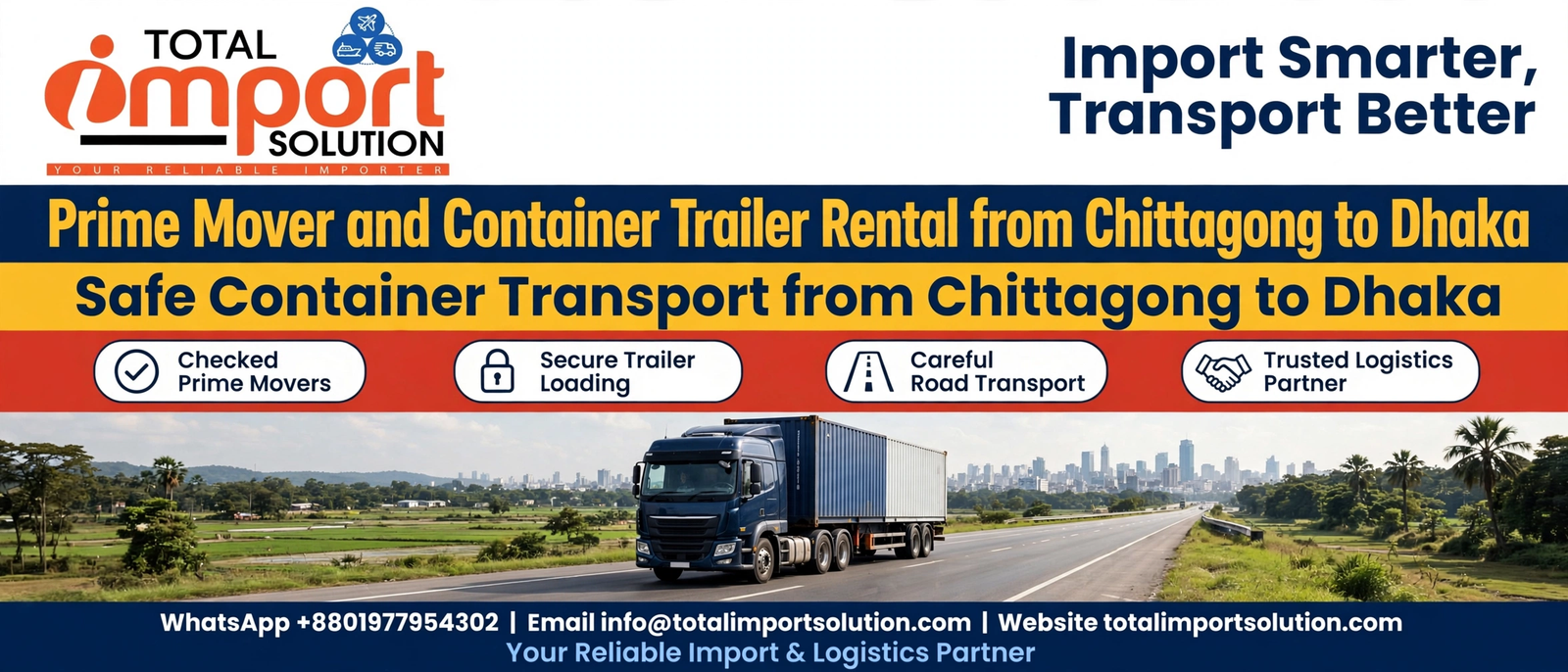
Most import cargo that arrives at Chittagong Port travels to Dhaka by road. The container is loaded onto a trailer, the trailer is pulled by a prime mover, and the combination carries the load along the highway to a factory, warehouse, or project site in Dhaka. For an importer who does not own trucks, renting a prime mover and container trailer is the usual way to move that load. Prime Mover and Container Trailer Rental from Chittagong to Dhaka covers that hire: choosing the right vehicle and trailer, booking the rental, checking the vehicle before loading, preparing the documents, and arranging delivery and return.
This guide explains the subject in practical, step-by-step terms: what the rental covers, which vehicles and trailers are used, how to book, how to check the vehicle and container, which documents are needed, how to plan the journey, and how to judge a good provider. No fixed prices, rates, or fees are given here. A rate or fee is confirmed only after checking the actual shipment and its documents.
Total Import Solution, since 2016, supports importers in Bangladesh with shipment planning, documentation, customs clearance support, and delivery coordination. This guide aims to help you plan a prime mover and trailer rental properly, so the right vehicle is booked, the container is loaded safely, the papers match the load, and the delivery reaches Dhaka without avoidable delay.
1. What Prime Mover and Trailer Rental Covers
A prime mover is the truck unit that pulls a trailer, and a container trailer is the flat platform, fitted with twist locks, on which a shipping container sits. A rental covers the hire of the prime mover together with the trailer for a trip, usually from the port or depot in Chittagong to a named destination in Dhaka. The provider supplies the vehicle, the trailer, and the driver, while the importer supplies the cargo details, the destination, and the documents. The rental covers the loaded journey to Dhaka and, in most cases, the return of the empty trailer and prime mover to Chittagong after unloading.
The rental also covers coordination around the trip. The provider must know the container number, size, loaded weight, loading point, and delivery point before the vehicle is sent. If any detail changes, the provider should be told at once, because a trailer suited to one container size may not suit another, and a delivery point the driver does not know can delay the trip. A rental booked with complete and correct details starts smoothly; one booked with missing details can lead to the wrong trailer, a delayed departure, or a delivery to the wrong place.
| Rental part | What it covers | Who provides it |
|---|---|---|
| Prime mover | The truck unit that pulls the trailer | The rental provider |
| Container trailer | The platform with twist locks that carries the container | The rental provider |
| Driver | Drives the prime mover and trailer on the trip | The rental provider |
2. Types of Prime Movers and Trailers
Prime movers used for container transport in Bangladesh are heavy trucks built to pull a loaded trailer over a long highway journey. They differ in power and in the weight they are built to pull, and the provider should match the prime mover to the loaded container. A unit too light for the load can struggle on the road, while a well-matched unit handles the journey steadily. The importer should confirm with the provider that the prime mover suits the loaded container weight and size.
Container trailers also come in different forms. A flatbed trailer carries the container on a flat platform and is the common choice for standard dry containers. A skeletal trailer is a frame that holds the container by its corner fittings and is also widely used for container transport. Some trailers are built for a 20-foot container, some for a 40-foot container, and some can be adjusted for either size. The trailer must have working twist locks, because these locks hold the container to the trailer. A trailer with a broken or missing twist lock should not be used for a loaded container.
| Vehicle or trailer | Used for | What to check |
|---|---|---|
| Prime mover | Pulls the loaded trailer to Dhaka | Matched to the loaded container weight |
| Skeletal trailer | Holds the container by its corner fittings | Frame sound, twist locks working |
| 20-foot trailer | Carries a 20-foot container | Length matches the container |
3. Container Sizes and Loads for the Trip
The two container sizes most often carried from Chittagong to Dhaka are the 20-foot container and the 40-foot container. As a widely standard approximate guide, a 20-foot container holds about 33 cubic metres of cargo, and a 40-foot container holds about 67 cubic metres. These figures are approximate only, and the actual usable space depends on the shape of the cargo, the packing, and the container itself, so always check the actual container before planning a load. The trailer must match the container length: a 20-foot container on a trailer built for a 40-foot container, or the reverse, is not a safe combination unless the trailer is built to be adjusted.
The weight of the loaded container matters as much as its size. It must be known before the trip, because it decides which prime mover and trailer are suitable, and road rules set limits on the weight a vehicle may carry. The weight on the shipping documents should be checked against the actual load where possible. An overloaded trailer is a risk on the road and can cause trouble at a weighbridge or checkpoint. If the weight is not known, ask the shipper or the agent to confirm it before booking.
| Container | Approximate capacity | Trailer and planning note |
|---|---|---|
| 20-foot container | About 33 cubic metres, approximate | Use a trailer matched to 20-foot length |
| 40-foot container | About 67 cubic metres, approximate | Use a trailer matched to 40-foot length |
| Loaded weight | Must be known before the trip | Decides the prime mover and trailer choice |
| Weight check | Documents checked against the actual load | Avoids an overloaded trailer on the road |
4. When to Rent a Prime Mover and Trailer
An importer rents a prime mover and trailer when a container must move from Chittagong to Dhaka and the importer does not have a suitable vehicle of its own. This is the common case for most importers, because owning and maintaining heavy trucks is a separate business. Rental is also the right choice when the need is occasional: a few containers a month do not justify owning a fleet, while a rental can be booked for each shipment as it arrives. Even an importer with its own vehicles may rent extra units when several containers arrive at once and the owned fleet is already busy.
Rental is also used when a factory or warehouse needs a single container delivered at a set time. The importer books the vehicle for that delivery, the container is loaded at the port or depot, and the vehicle delivers it to the named place. The key point is timing: book as soon as the container details are known, so the provider can send a suitable vehicle. A last-moment booking may still be possible, but the choice of vehicle is smaller and the risk of delay is higher.
| Situation | Why rental fits | What to do |
|---|---|---|
| No owned trucks | Importer does not run a transport fleet | Book a rental for each shipment |
| Several containers at once | Owned fleet already busy | Rent extra units for the peak |
| Urgent need | Container ready and must move | Book as soon as details are known |
5. Booking a Rental: Step-by-Step
Step 1: Gather the shipment details. Note the container number, size, and type, the loaded weight, the loading point in Chittagong, and the delivery address in Dhaka, and check that the details match the shipping documents.
Step 2: Contact the rental provider. Share the details, ask for a vehicle suited to the container size and weight, confirm the date and loading point, and ask what the provider needs from you before the trip.
Step 3: Confirm the booking in writing. The booking should name the container, the vehicle type, the loading point, the delivery address, and the date, and both sides should keep a written copy.
Step 4: Prepare the documents. The agent prepares the papers the driver will need for the journey and checks that the container number is the same on every document.
Step 5: Check the vehicle on arrival. When the prime mover and trailer arrive at the loading point, check the trailer, the twist locks, and the tyres before loading.
Step 6: Load and secure the container. The container is lifted onto the trailer, the twist locks are engaged, and the container number and seal are checked and recorded.
Step 7: Confirm the departure. The driver receives the documents, the departure is noted, and the receiving party in Dhaka is told the vehicle is on its way.
Step 8: Confirm delivery and return. On arrival in Dhaka, the container number and seal are checked, the delivery is confirmed in writing, and the empty trailer returns after unloading.
6. Checking the Vehicle and Trailer Before Loading
The vehicle check should happen before the container is loaded, because a fault found after loading is harder and slower to fix. Start with the trailer: the platform should be firm and free of damage, and all four twist locks should be present and working. A twist lock that does not turn or does not hold should be reported at once, and the trailer should not be used for a loaded container until it is fixed. Check the tyres for damage and for tread, and check that the trailer lights work, because the vehicle will travel on the highway and must be visible to other road users.
Check the prime mover as well: the engine should start cleanly, the brakes should work, and the coupling between prime mover and trailer should be secure. The driver should hold the papers for the trip and know the destination address. If anything is wrong, note the problem and inform the provider before loading. A vehicle check takes only a short time, and it prevents a breakdown on the road, a container shifting on the trailer, or a trip stopped at a checkpoint.
| Check point | What to look for | Action if there is a problem |
|---|---|---|
| Twist locks | All present, turning and holding firmly | Do not load until fixed or trailer changed |
| Trailer platform | Firm, free of damage | Repair or change the trailer |
| Tyres | No damage, tread in good order | Change the tyre before departure |
| Coupling | Prime mover and trailer securely joined | Do not depart until secure |
7. Loading and Securing a Container
Loading is done with a crane, a reach stacker, or a forklift at the port or depot. The container is lifted, lowered onto the trailer platform, and set down so its corner fittings sit directly over the twist locks, which are then turned to lock the container to the trailer. This step matters: a container that is not locked to the trailer can shift during the journey, especially when the vehicle brakes or turns. After locking, check from the side that the container sits level and all four corners are held.
Before departure, the container number and seal number are checked against the papers and recorded, and the seal should be intact. If the seal number does not match the papers, note the matter and inform the agent before the vehicle leaves. The driver should also confirm the destination address and the receiver in Dhaka. A load that is checked, locked, and recorded at the loading point travels with far less risk than one sent off in a hurry.
| Loading step | What to do | Why it matters |
|---|---|---|
| Position the trailer | Trailer placed for the lifting equipment | Safe and level loading |
| Lower the container | Corner fittings set over the twist locks | Container sits correctly |
| Engage twist locks | All four locks turned and holding | Container cannot shift on the road |
| Check the seal | Seal number checked against the papers | Papers match the container |
| Record the load | Container number, seal, trailer number noted | The trip has a written record |
8. Documents Needed for the Trip
A prime mover carrying a container from Chittagong to Dhaka must travel with the right documents. The main papers are the bill of lading or transport document, the invoice and packing list, the import papers, and the delivery note or release note that allows the container to leave the port or depot. The driver should carry copies of these papers, and the container number should be the same on every document. A single wrong digit in a container number can cause a delay at a checkpoint, because the papers will not match the container on the trailer.
The importer or agent should prepare a small trip file for the driver: the delivery address in Dhaka, the receiver's name and phone number, and any instructions about the route or unloading. The driver should also carry the vehicle papers. Before departure, the agent should check the whole set of papers once more, because a missing paper found on the road is far harder to fix than one found at the loading point. Keep a copy of every document with the shipment file, so any question about the trip can be answered from the papers.
| Document | What it shows | Who prepares it |
|---|---|---|
| Bill of lading or transport document | The shipment and the container details | The importer or agent |
| Invoice and packing list | What the cargo is and how it is packed | The importer or agent |
| Release or delivery note | Permission to take the container out | The port, depot, or agent |
| Trip details for the driver | Delivery address and receiver contact | The importer or agent |

9. Planning the Journey from Chittagong to Dhaka
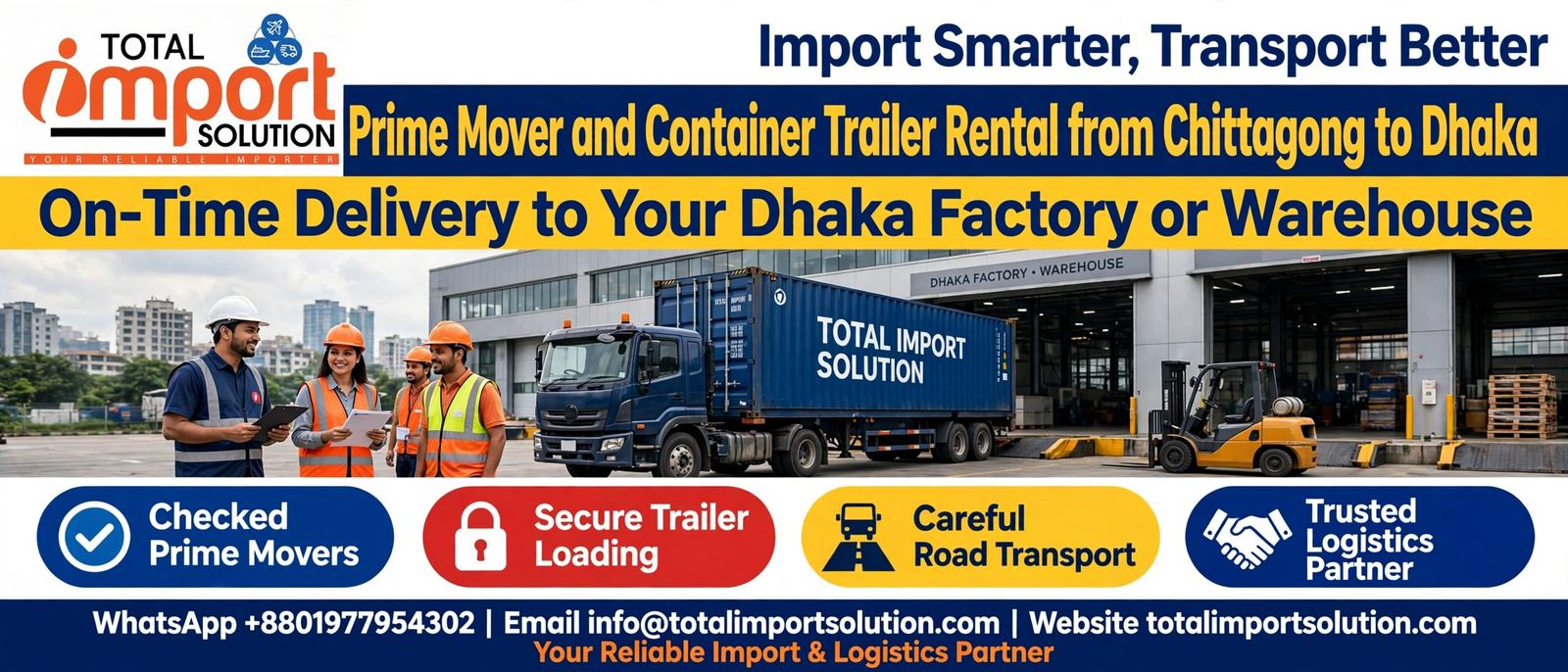
The journey from Chittagong to Dhaka runs on the highway and should be planned before the vehicle leaves. The driver should know the route, the delivery address, and the receiver's name. The receiving party in Dhaka should be told the vehicle is on its way, so someone is ready to receive the container when it arrives. A container that arrives at a factory with no one ready can wait on the road, which wastes time and adds risk. The importer should also confirm the unloading plan: where the container will be placed, whether the cargo will be unloaded at once or the container stored, and what equipment is available at the site.
Road conditions, traffic, and weather can affect the journey, so the plan should allow room for the unexpected. The driver should keep in contact with the agent or importer during the trip and report any problem at once, such as a breakdown or a road closure. The importer should not press the driver to rush, because a heavy vehicle carrying a loaded container needs to travel at a safe speed. A journey planned with clear communication is far more likely to end with a safe delivery than one left to chance.
| Planning point | What to do | Why it matters |
|---|---|---|
| Route | Driver knows the route and the destination | No wrong turns or lost time |
| Receiver ready | Receiving party told the vehicle is on its way | Someone is ready at arrival |
| Unloading plan | Place, equipment, and timing confirmed | Unloading starts without delay |
| Safe speed | Driver travels at a safe speed for the load | The container and cargo stay safe |
10. Delivery and Unloading at the Dhaka Destination
Delivery in Dhaka begins with the arrival check. When the prime mover and trailer reach the factory, warehouse, or project site, the receiver checks the container number and seal number against the papers. If the numbers match and the seal is intact, delivery can proceed. If the seal number does not match, or the seal is broken, note the matter and inform the agent before unloading. Confirm the delivery in writing, with the date, the container number, and the receiver's name.
Unloading needs space and planning. The trailer must be able to enter the site, turn, and stop where the container can be unloaded safely, on firm and level ground. If the container will be lifted off the trailer, the lifting equipment must be ready. If the cargo will be unloaded while the container sits on the trailer, the doors need room to open and the area around the trailer must be clear. After unloading, the empty container is checked and the trailer is released for its return trip. A delivery received carefully, with the checks done and the papers signed, closes the trip cleanly.
| Delivery step | What to do | Record to keep |
|---|---|---|
| Arrival check | Container number and seal checked against the papers | Delivery note with date and numbers |
| Seal check | Seal intact and matching the papers | Note of any mismatch |
| Unloading | Cargo unloaded in a clear, safe area | Cargo checked against the packing list |
| Release for return | Trailer released for the return trip | Return noted in the shipment file |
11. Rental Terms: What to Read Before You Sign
A prime mover and trailer rental should be covered by a written agreement or booking confirmation. Read it in full before signing. The terms should name the container, vehicle type, loading point, delivery address, date, and period of hire. They should also describe who is responsible for the vehicle during the trip, what happens if the vehicle breaks down, and what happens if delivery is delayed. If any term is unclear, ask the provider to explain it in plain language before you agree. A term not understood at booking can become a dispute after the trip.
Pay attention to the return terms as well. The agreement should say where the empty trailer and prime mover return to, and who is responsible for the container after unloading. It should also say how damage is handled: who pays if the trailer is damaged during the trip, and how the damage is recorded. A rental is confirmed only after checking the actual shipment and its documents, and the hire terms should be read in full, because the terms describe the trip, the responsibilities, and the return. Keep a signed copy of the agreement with the shipment file.
| Term to check | What it should say | Why it matters |
|---|---|---|
| Vehicle and container | Vehicle type and container named | The right vehicle is booked |
| Loading and delivery points | Places and date named | Both sides know the trip |
| Breakdown | What happens if the vehicle breaks down | The trip can be recovered |
| Damage | How damage is recorded and handled | Disputes are avoided |
12. Common Problems on the Road and How to Prevent Them
Several problems can occur on the road between Chittagong and Dhaka, and most can be prevented with planning. A breakdown is the most common: a tyre fails, an engine fault appears, or a coupling works loose. A vehicle check before departure reduces this risk, and a provider with a support plan can send help or a replacement vehicle if a breakdown happens. Ask the provider before the trip what happens in the event of a breakdown, so the answer is known in advance and not worked out on the roadside.
Other problems include a container that shifts on the trailer, a seal found broken on arrival, and a delivery to a site that is not ready. A shifting container is prevented by engaging all four twist locks and checking that the container sits level before departure. A broken seal is handled by noting it at once and informing the agent before unloading. A site that is not ready is prevented by confirming the unloading plan with the receiver before the vehicle leaves Chittagong. Each problem is easier to handle when reported at once, so the driver should call the agent the moment something goes wrong.
| Problem | Prevention | If it happens |
|---|---|---|
| Breakdown | Vehicle check before departure | Provider sends help or a replacement |
| Container shifts | All four twist locks engaged, level check | Stop safely and inform the agent at once |
| Broken seal on arrival | Seal checked before departure | Note it and inform the agent before unloading |
| Papers do not match | Container number checked on every document | Agent corrects the papers before departure |
13. How to Judge a Good Rental Provider
A good rental provider can be judged by how it handles the basics. The vehicles should be in good working order, with trailers that have working twist locks and tyres in good condition. The provider should ask for the container details before confirming a booking, because one that books a vehicle without knowing the container size and weight is guessing. The driver should be experienced on the Chittagong to Dhaka route and know the delivery address before departure. The provider should give a written booking confirmation and be reachable during the trip.
Communication is the clearest test. A good provider answers questions plainly, confirms the booking in writing, and informs the importer at once if a vehicle will be late or a problem arises on the road. Total Import Solution, since 2016, has worked with importers in Bangladesh on shipment planning, documentation, customs clearance support, and delivery coordination, and the same standard applies here: clear records, written agreements, and honest communication. Ask for references from other importers, and check how the provider handled a past breakdown or delay, because the way a provider handles a problem tells you more than any brochure.
| Judging point | Good sign | Warning sign |
|---|---|---|
| Vehicle condition | Prime movers and trailers in good order | Worn tyres, broken twist locks |
| Booking care | Provider asks for container size and weight | Booking without shipment details |
| Driver experience | Driver knows the route and the destination | Driver unsure of the address |
| Written confirmation | Booking confirmed in writing | Verbal booking only |
| Communication | Provider reachable during the trip | No contact after departure |
Frequently Asked Questions
1. What is a prime mover?
A prime mover is the truck unit that pulls a trailer. In container transport, the prime mover pulls a container trailer carrying a shipping container from the loading point to the destination.
2. What is a container trailer?
A container trailer is a flat platform fitted with twist locks, on which a shipping container sits for the journey. The twist locks hold the container to the trailer so it cannot shift.
3. Why rent a prime mover and trailer instead of owning one?
Most importers do not own heavy trucks, because owning and maintaining a fleet is a separate business. Renting lets an importer book a vehicle for each shipment as it arrives, without the cost of owning trucks.
4. How do I book a prime mover and trailer rental?
Gather the container number, size, and type, the loaded weight, the loading point, and the delivery address, then share these with the provider and confirm the booking in writing, with the vehicle type, places, and date named.
5. What container sizes are usually carried to Dhaka?
The two common sizes are the 20-foot container and the 40-foot container. As a widely standard approximate guide, a 20-foot container holds about 33 cubic metres and a 40-foot container about 67 cubic metres. Always check the actual container before planning a load.
6. Why must the loaded weight be known before the trip?
The weight decides which prime mover and trailer are suitable, and road rules set limits on the weight a vehicle may carry. An overloaded trailer is a risk on the road and can cause trouble at a weighbridge or checkpoint.
7. What should I check on the trailer before loading?
Check that the platform is firm and free of damage, that all four twist locks are present and working, that the tyres are in good order, and that the trailer lights work. Do not load a container onto a trailer with a broken twist lock.
8. What are twist locks and why do they matter?
Twist locks are the fittings on a trailer that hold a container by its corner fittings. They stop the container from shifting when the vehicle brakes or turns, so all four must be engaged before departure.
9. What documents does the driver need for the trip?
The driver should carry the bill of lading or transport document, the invoice and packing list, the release or delivery note, the trip details with the delivery address and receiver contact, and the vehicle papers. The container number should be the same on every document.
10. What happens if the seal number does not match the papers?
Note the mismatch at once and inform the agent before the vehicle leaves or before unloading. A seal mismatch should be recorded in writing with the date and the numbers involved.
11. What should the receiver do when the container arrives in Dhaka?
The receiver should check the container number and seal number against the papers, confirm the delivery in writing, and check the cargo against the packing list during unloading.
12. What if the vehicle breaks down on the road?
The driver should inform the agent or the provider at once. Ask the provider before the trip what happens in the event of a breakdown, so you know in advance whether help or a replacement vehicle will be sent.
13. How is the empty trailer returned after delivery?
After unloading, the empty container is checked and the trailer is released for its return trip to Chittagong. The return should be noted in the shipment file so the hire is closed cleanly.
14. What should a rental agreement include?
A rental agreement should name the container, the vehicle type, the loading and delivery points, the date, the period of hire, the breakdown and delay terms, the return place, and how damage is handled. Read it in full before signing.
15. How do I judge a good rental provider?
Look for vehicles in good working order, a provider that asks for container size and weight before booking, an experienced driver who knows the route, a written booking confirmation, clear communication during the trip, and a breakdown plan explained in advance.
16. How can Total Import Solution help with prime mover and trailer rental?
Total Import Solution supports importers in Bangladesh with shipment planning, documentation, customs clearance support, and delivery coordination. Contact the team on WhatsApp at +8801977954302 or by email at info@totalimportsolution.com to discuss a prime mover and trailer rental requirement.
Contact Total Import Solution
- WhatsApp: +8801977954302
- Email: info@totalimportsolution.com
- Website: totalimportsolution.com
- Service: Prime Mover and Container Trailer Rental from Chittagong to Dhaka
- Company: Total Import Solution — Since 2016, serving importers in Bangladesh
