
Pharma Industry: Certified Reefer Container Hire for Raw Materials
Pharma raw materials are not ordinary cargo. Many of them need steady, controlled conditions from the supplier warehouse to the factory gate in Bangladesh. If the temperature moves outside the range the product needs, or if moisture, dust, or rough handling gets in, a whole shipment can lose its value before it ever reaches production. That is why pharma importers pay close attention to reefer container hire, and why they look for a provider who can show checks, records, and a clear plan, not only a container.
This guide explains certified reefer container hire for pharma raw materials in plain, practical words. It covers what a reefer container does, how to choose one, what documents to prepare, how booking and loading work, what happens at the port, how the cold chain is checked during the journey, and how delivery to a pharma factory should be handled. It also explains how to judge a provider, what mistakes to avoid, and how Total Import Solution supports importers in Bangladesh through each step. Total Import Solution has served importers in Bangladesh since 2016, and this guide follows the same careful, step-by-step approach used in that work.
1. What Certified Reefer Container Hire Means for Pharma Raw Materials
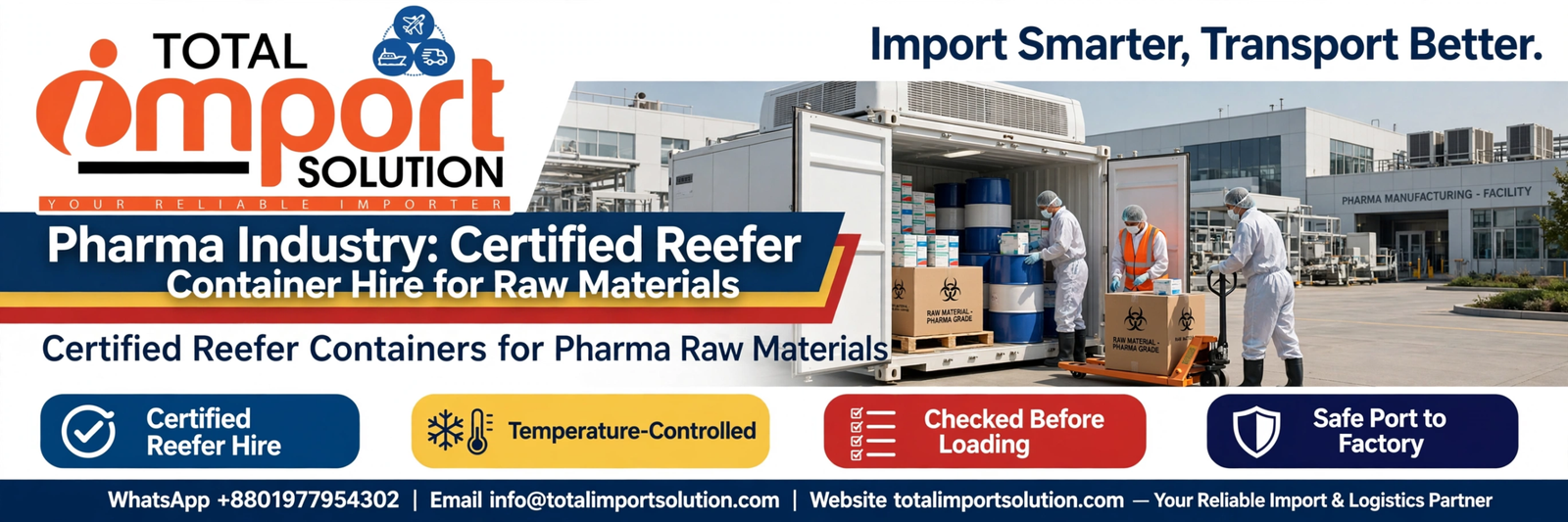
Certified reefer container hire means hiring a refrigerated container that has been checked, serviced, and documented so that it is fit for temperature-controlled cargo. For pharma raw materials, the word certified should always lead to a question: certified by whom, checked when, and shown in which document. A good provider can answer those questions in writing and can show the inspection record for the actual unit you will use.
A reefer container is a shipping container with a built-in cooling unit. It holds a set temperature range, moves air around the cargo, and helps protect the load from heat outside. It does not make a poor product good, and it does not fix a shipment that was already stored badly before loading. It protects a good product during transport when it is used in the right way, with the right setting, the right packing, and the right checks.
| Term | What it means in plain words |
|---|---|
| Reefer container | A container with a cooling unit that holds a set temperature range during transport |
| Certified hire | Hire where the unit has been inspected and the checks are recorded and available to you |
| Cold chain | The unbroken chain of controlled conditions from origin to delivery |
| Pre-trip inspection | A check of the reefer unit before loading, covering cooling, airflow, seals, and controls |
| Set point | The temperature setting chosen for the journey, based on the product requirement |
2. Why Pharma Raw Materials Need Temperature-Controlled Transport
Pharma raw materials are made to a set quality standard. Heat, cold outside the required range, moisture, and long exposure to poor conditions can change them in ways that are hard to see from the outside. A drum may look fine while the material inside no longer meets the standard your production team needs. That risk is the main reason temperature-controlled transport matters so much in pharma imports.
Bangladesh is warm for much of the year, and a container sitting in sun at a port or on a truck can heat up fast. A reefer container guards against that heat by holding the set range and by moving air through the load. It also helps when a shipment waits at a port, when a vessel calls at a warm port on the way, or when road delivery takes place during a hot part of the day. Without that control, you are relying on luck and on the weather, and that is not a sound plan for pharma cargo.
| Risk | What can happen | How careful planning helps |
|---|---|---|
| Heat during waiting time | Material warms beyond its required range | Reefer unit holds the set range while the container waits |
| Moisture and damp | Packing weakens and material is exposed | Dry packing, sealed drums, and a checked container floor |
| Poor airflow | Some parts of the load warm while others stay cool | Planned stowage with space for air to move |
| Rough handling | Drums dent, seals break, labels come off | Trained handling, clear labels, and a loading plan |
| Missing records | No proof of conditions during the journey | Temperature records and handover notes kept on file |
3. How a Reefer Container Works — in Plain Words
A reefer container looks like a normal container from the outside, but it has a cooling unit at one end, a control panel, and vents that move air through the load. The unit cools the air inside, pushes it along the floor and up through the cargo, and draws it back to the unit. That moving air is what keeps the load even. If the air cannot move, because boxes are packed tight against the vents or stacked in a solid wall, some parts of the load will not be cooled in the right way.
Before loading, the unit is checked in a pre-trip inspection. The cooling system is run, the controls are tested, the door seals are checked, the drain is checked, and the inside is checked for cleanliness and for any smell left from a past load. For pharma cargo, cleanliness matters a great deal. A container that carried a strong-smelling load before may not be fit for pharma raw materials, even if the cooling works well. Ask for a clean container and ask how it was cleaned.
The set point is chosen from the product requirement, not from habit. Your supplier should state the storage requirement in writing. Your agent should confirm that the reefer unit can hold that range and that the setting is recorded on the booking and on the loading note. Do not state any temperature figure as a fact for a specific product in a general guide, and do not accept a setting that was chosen without seeing the product requirement. Speak in general terms about temperature-controlled transport, and always check the product’s own storage requirement for the actual shipment.
Follow these steps when you plan the loading:
- Get the storage requirement in writing from the supplier or product data sheet.
- Share it with your agent and ask for a reefer unit suited to that requirement.
- Ask for the pre-trip inspection record for the actual unit number.
- Agree on the packing plan, with space for airflow and clear labels on every drum or box.
- Confirm the set point in writing before loading starts.
- Check the container inside for cleanliness, dryness, and a sound door seal.
- Record the unit number, the set point, and the loading time in your shipment file.
4. Choosing the Right Reefer Container Size and Type
Choosing the right size starts with the size of your load and the way it is packed. A container that is too small forces tight packing, and tight packing blocks airflow. A container that is far too large for the load can still work, but you should ask your agent about stowage and airflow for a part load, so that the air moves in the right way and the load stays stable during the journey.
Container sizes are widely standard, but the actual inside space can differ from one unit to another, so treat the figures below as approximate only and check the actual container before you plan the load. A 20-foot reefer container holds an approximate internal volume of around 28 cubic metres, and a 40-foot reefer container holds an approximate internal volume of around 58 cubic metres. Those figures are approximate guides for planning, not exact facts for a specific unit. Always check the actual container, its inside measurements, and its loading limit with your provider before you confirm the packing plan.
| Container | Approximate internal volume | Best for |
|---|---|---|
| 20-foot reefer | Around 28 cubic metres, approximate | Smaller pharma loads, trial orders, and mixed drum loads |
| 40-foot reefer | Around 58 cubic metres, approximate | Larger orders, full drum loads, and regular supply runs |
Ask these questions before you choose. How many drums or boxes are in the load, and what is the weight of each one. How will they be stacked, and how much space will be left for airflow. Is the load a full container load or a part load that will share space or need extra care in stowage. Does the product need a reefer with a fresh-air vent setting, and if so, what setting does the supplier advise. Your agent should help you answer these questions with the supplier, so that the size you book fits the load you actually have.
5. Documents and Checks Before You Book
Good reefer shipments start with good paperwork. Documents do more than satisfy customs. They tell every person in the chain what the product is, how it must be stored, who supplied it, and who will receive it. When a document is missing or unclear, the shipment can wait at a port while someone asks for it, and waiting time is the last thing a temperature-controlled load needs.
Start with the product documents from your supplier. You will normally need a commercial invoice, a packing list, a certificate of origin where required, and the product data sheet or storage note for the raw material. The packing list should show the number of drums or boxes, the weight of each, and the marks on each package. The data sheet should state the storage requirement in clear words, so that the agent and the reefer provider can set the container in the right way.
Your agent will also need the booking details: the supplier address, the loading place, the port of loading, the port of arrival in Bangladesh, the receiver name and address, and the contact person at the factory. Keep one contact person at each end, with a phone number and an email address that is checked every day. When a question comes up during loading or at the port, a single clear contact saves time.
| Document or check | Why it matters | Who provides it |
|---|---|---|
| Commercial invoice | Shows the goods, the seller, and the buyer | Supplier |
| Packing list | Shows packages, weights, and marks | Supplier |
| Product data sheet | States the storage requirement | Supplier or maker |
| Certificate of origin | Shows where the goods were made, where required | Supplier or chamber |
| Reefer inspection record | Shows the unit was checked before loading | Container provider |
| Booking confirmation | Confirms the container, the setting, and the sailing plan | Agent or line |
| Import papers for Bangladesh | Needed for customs clearance on arrival | Importer with agent help |
6. Booking Steps from Enquiry to Loading
Booking a reefer container is a set of clear steps, and each step should be confirmed in writing. A verbal promise is easy to forget, and a written note is easy to check. Use the steps below as your booking checklist, and keep each confirmation in your shipment file.
Step one is the enquiry. Send your agent the product name, the storage requirement, the number of packages, the total weight, the supplier address, and the loading date you hope for. Ask for a reefer container suited to that requirement, and ask what checks are included. A rate or fee is confirmed only after checking the actual shipment and documents, so do not treat an early figure as final until the agent has seen the full details.
Step two is the booking confirmation. Your agent confirms the container type and size, the set point, the port of loading, the port of arrival, and the planned sailing. Read that confirmation line by line. Check the set point against the product requirement, check the ports, and check the receiver details. If anything is wrong, ask for a corrected confirmation before loading.
Step three is the container release and inspection. The provider releases a unit, runs the pre-trip inspection, and shares the record. Ask for the unit number and the inspection record, and check that the unit is clean, dry, and free of strong smells. If the record is missing or unclear, ask for it before the container goes to the supplier.
Step four is the loading plan. Agree with the supplier on the loading date, the packing order, the stowage plan, and the labels on each drum or box. Confirm who will be present at loading, who will check the set point, and who will seal the container. A loading plan agreed in advance avoids rushed decisions at the warehouse door.
| Booking step | What to confirm in writing | Keep on file |
|---|---|---|
| Enquiry | Product, storage need, packages, weight, dates | Your enquiry note |
| Booking confirmation | Container, set point, ports, receiver | Confirmation message |
| Inspection | Unit number, inspection record, cleanliness | Inspection record |
| Loading plan | Date, stowage, labels, seal, who attends | Loading note |
| Handover | Seal number, set point, loading time | Handover note |
7. Loading, Sealing and Handover at Origin
Loading day is where the plan meets the real load. The container should arrive at the supplier warehouse clean, dry, and already cooled to the set point where that is the agreed practice. The loader should check the inside once more before the first drum goes in. Look for water on the floor, dust, damage to the walls, and any smell that could affect pharma cargo. If the container is not clean, do not load it. Ask for another unit and record the change.
Load in the order agreed in the loading plan. Place drums and boxes in stable rows, with space for air to move along the floor and up through the load. Do not block the vents at the cooling end, and do not stack boxes in a solid wall from floor to roof. Leave the airflow paths open, and check the stowage from the door before closing. A photo of the loaded container, taken from the door, is a useful record, and many importers keep it in the shipment file.
Sealing matters. Once loading is done, the container door is closed and a seal is fitted. Record the seal number at once, and check that the number on the seal matches the number on the handover note and on the shipping documents. If the seal number differs on any paper, stop and ask for a correction before the container leaves. A seal is a simple thing, but it is the proof that the load was closed in the right way and was not opened on the way.
8. Port Handling, Customs and Arrival in Bangladesh
When the vessel reaches Bangladesh, the reefer container needs power and attention at the port. A reefer container that sits without power will warm up, so the port plan should cover where the container will be plugged in, who will check it, and how soon it can move to customs and to delivery. Your agent should explain that plan before the vessel arrives, so that you are not asking basic questions on the day the container lands.
Customs clearance in Bangladesh needs the documents you prepared before booking, plus the shipping documents from the line. Your agent will help you present the invoice, the packing list, the certificate of origin where required, and the other import papers. Check the documents again before they are submitted. A clear, complete file moves faster than a file with gaps, and a faster file means less waiting time for a temperature-controlled load.
| Arrival step | What happens | Your check |
|---|---|---|
| Vessel arrival | Container is discharged and moved to the reefer area | Agent confirms the container location |
| Power and check | Reefer unit is plugged in and checked | Ask for the check note |
| Customs filing | Import papers are submitted | Check names, weights, and counts |
| Customs review | Papers and goods are reviewed as required | Agent keeps you informed |
| Release | Container is cleared for delivery | Confirm the release note |
| Road delivery | Container moves to the factory | Confirm the truck, the route, and the time |
9. Cold-Chain Checks During the Journey
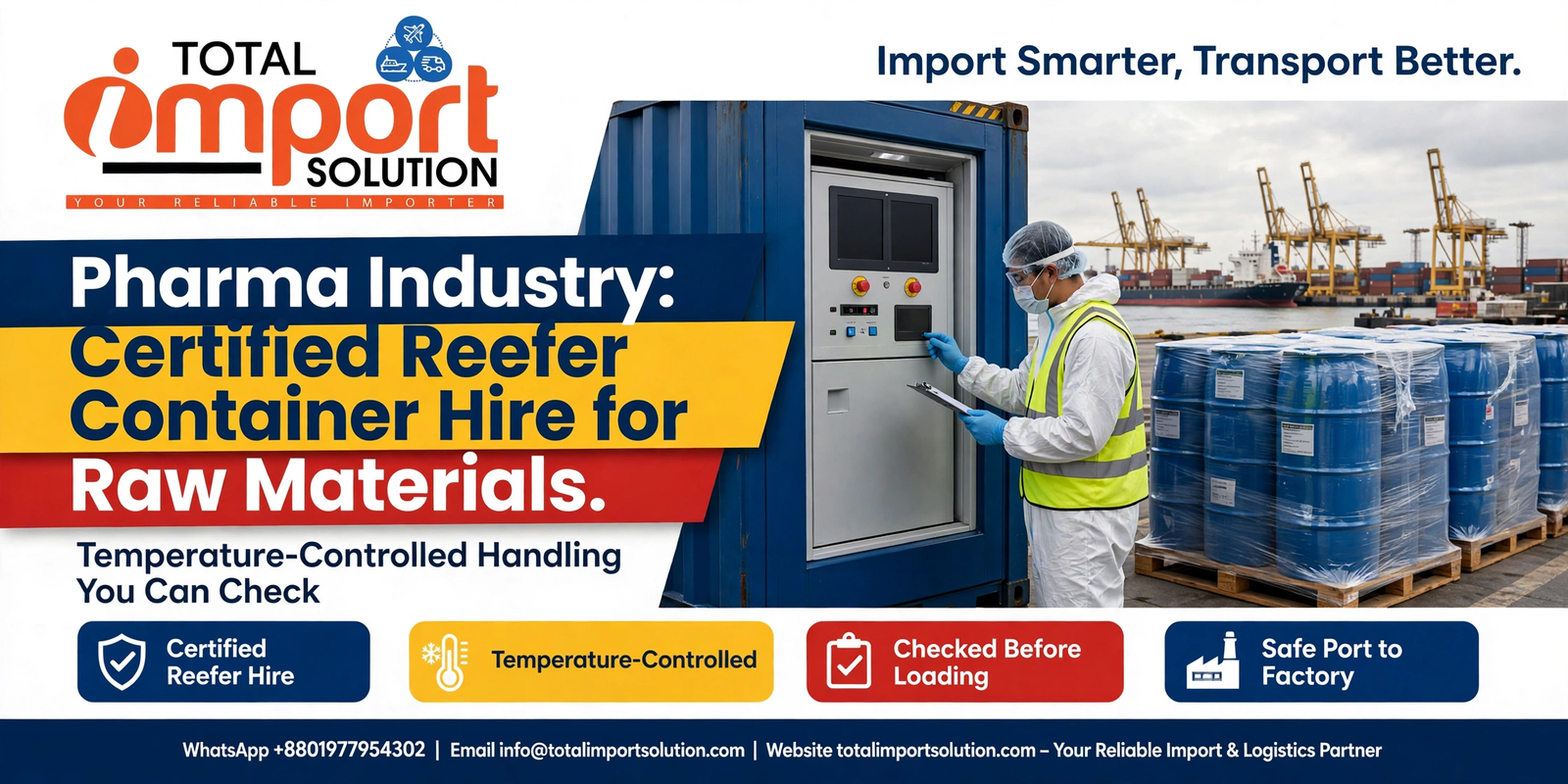
The cold chain is the full chain of controlled conditions from loading to delivery. A break at any point can affect the load, so checks should run through the whole journey, not only at the start and the end. Your agent and your provider should be able to tell you how the reefer unit is watched, what records are kept, and how you will receive those records.
During the sea journey, the reefer unit is powered on the vessel and checked by the crew as part of normal vessel work. During port waiting time, the unit is plugged in at the reefer area and checked there. During road delivery, the unit is powered by the truck or by a power source arranged for the trip. At each stage, someone should be responsible for the check, and that responsibility should be clear in writing before the shipment starts.
Ask for the temperature records when the shipment arrives. The records should cover the journey in a clear, readable form, with the unit number, the set point, and the times of the readings. Read them with your quality team. Look for steady readings within the required range, and look for any gap or change that needs an explanation. If a record shows a gap, ask your agent and your provider for a written explanation and keep it with the shipment file.
| Journey stage | Who checks | Record to keep |
|---|---|---|
| Loading and handover | Loader and agent | Set point, seal number, loading time |
| Sea journey | Vessel crew | Temperature records for the voyage |
| Port waiting | Port team and agent | Power and check notes |
| Customs and release | Agent | Release note and check note |
| Road delivery | Driver and agent | Delivery note and arrival time |
| Factory arrival | Factory team | Arrival check and unloading note |
10. Delivery from Port to Your Pharma Factory
Road delivery is the last leg, and it deserves the same care as the sea journey. The truck should be suited to the container size, the driver should know that the load is temperature-controlled, and the reefer unit should stay powered during the trip. Your agent should confirm the truck, the driver contact, the route, and the planned arrival time before the container leaves the port.
Tell your factory team the planned arrival time, the container size, and the number of drums or boxes to expect. The factory should have a clear unloading area, trained staff, and equipment for moving drums in a safe way. The unloading area should be clean, dry, and ready before the truck arrives, so that the load does not wait in the yard while space is cleared.
11. Storage, Unloading and Quality Checks on Arrival
Unloading should be planned, not rushed. Move drums and boxes in the order that keeps the load stable, and place them in the storage area agreed by your quality team. The storage area should be clean, dry, and suited to the product requirement. Keep the packages off a damp floor, keep labels visible, and keep a clear path for staff to move and to check the load.
Your quality team will have its own checks on arrival. Those checks may cover the labels, the seals on drums, the condition of the packing, the documents, and the temperature records. Give the quality team the full shipment file: the invoice, the packing list, the product data sheet, the inspection record, the handover note, the temperature records, and the arrival note. A complete file helps the team make a clear decision, and it saves time spent chasing missing papers.
| Arrival check | What to look for | Action if there is a problem |
|---|---|---|
| Labels and marks | Clear, correct, and matching the packing list | Note the package number and tell the agent |
| Drum and box condition | No dents, leaks, damp, or broken seals | Isolate the package and record it |
| Temperature records | Steady readings within the required range | Ask for a written explanation of any gap |
| Documents | Complete file with matching names and counts | Ask for the missing paper at once |
| Storage area | Clean, dry, and suited to the product | Move the load only to a fit area |
12. Costs, Quotes and What to Ask Before You Agree
Reefer hire and import handling involve several parts, and a clear quote should show those parts in a way you can read and compare. The parts may cover the reefer container hire, the sea freight, the port handling, the customs work, and the road delivery. Ask your agent to list each part in writing, so that you can see what is included and what is not. A rate or fee is confirmed only after checking the actual shipment and documents, so treat any early figure as a guide until the full details have been reviewed.
Ask these questions before you agree:
- What is included in the quote, and what is charged as a separate part.
- How the reefer unit is inspected, and what records you will receive.
- How the temperature is watched during the journey, and how you receive the records.
- What happens if the vessel is late or the container waits at the port.
- Who is your contact at each stage, and how fast will they reply.
- What documents you must provide, and by which date.
- How the seal, the set point, and the handover are recorded.

13. Working with Your Agent, Mistakes to Avoid and How Total Import Solution Helps
A good agent is a partner for the whole shipment, not only for the booking. Your agent should help you choose the container, prepare the documents, plan the loading, follow the vessel, clear customs, and arrange delivery to the factory. The best way to work with an agent is to share full details early, to confirm each step in writing, and to keep one contact person on your side who can answer questions fast.
Common mistakes are easy to avoid once you know them. The first mistake is booking without the product storage requirement in writing. Without it, the set point is a guess, and a guess is not a plan for pharma cargo. The second mistake is accepting a container without an inspection record. The third mistake is packing so tightly that air cannot move, or blocking the vents at the cooling end. The fourth mistake is sending incomplete documents and hoping customs will not ask for the missing paper. The fifth mistake is leaving road delivery and factory unloading to the last day, with no plan for the yard, the staff, or the storage area.
Total Import Solution works with pharma importers in Bangladesh as an importer and logistics partner, helping with sourcing, shipping, customs clearance, and delivery planning. The team helps importers prepare documents, check reefer container arrangements, follow the shipment through each stage, and plan delivery to the factory. Total Import Solution has served importers in Bangladesh since 2016, and the approach is practical: clear steps, written confirmations, and records kept at each stage, so that the importer always knows where the shipment stands.
Frequently Asked Questions
1. What is a reefer container?
A reefer container is a shipping container with a built-in cooling unit that holds a set temperature range and moves air through the load during transport.
2. Why do pharma raw materials need a reefer container?
Many pharma raw materials need steady, controlled conditions, and a reefer container protects them from heat and poor conditions during the journey to Bangladesh.
3. What does certified reefer container hire mean?
It means the reefer unit has been inspected and serviced, and the checks are recorded in a document you can see before loading.
4. How do I check if a reefer container is fit for pharma cargo?
Ask for the pre-trip inspection record for the actual unit number, check that the container is clean and dry, and check that it has no strong smell from a past load.
5. What storage requirement should I share before booking?
Share the storage requirement from the supplier or product data sheet in writing, so the agent and provider can choose the right setting for the actual product.
6. Which reefer container size should I choose?
Choose by the number and weight of your packages and the stowage plan, using approximate volume guides and checking the actual container before you confirm the load.
7. What documents do I need for a pharma reefer shipment?
You normally need a commercial invoice, a packing list, a product data sheet, a certificate of origin where required, and the booking and inspection records.
8. How is the temperature checked during the journey?
The reefer unit is powered and checked at each stage, and temperature records are kept for the voyage, the port waiting time, and the road delivery.
9. What is a pre-trip inspection?
A pre-trip inspection is a check of the reefer unit before loading, covering cooling, airflow, seals, controls, cleanliness, and the door seal.
10. What should I do if the container is not clean at loading?
Do not load it, ask for another unit, and record the change in your shipment file before loading starts.
11. Why does airflow matter inside a reefer container?
Airflow keeps the load even, so plan stowage with space for air to move and do not block the vents at the cooling end.
12. What happens at the port in Bangladesh?
The container is discharged, plugged in at the reefer area, checked, and then moved through customs clearance before road delivery to the factory.
13. What should I check when the container arrives at my factory?
Check the seal number, the reefer setting, and the outside of the container, note the arrival time, and keep the arrival note with the temperature records.
14. How are costs and quotes confirmed for a reefer shipment?
A rate or fee is confirmed only after checking the actual shipment and documents, so ask for each part of the quote in writing before you agree.
15. What mistakes should I avoid with pharma reefer shipments?
Avoid booking without the storage requirement in writing, loading without an inspection record, blocking airflow, sending incomplete documents, and leaving delivery planning to the last day.
16. How can Total Import Solution help with my pharma reefer shipment?
Total Import Solution helps with sourcing, shipping, customs clearance, and delivery planning, with clear steps and written records at each stage of the shipment.
Contact Total Import Solution
- WhatsApp: +8801977954302
- Email: info@totalimportsolution.com
- Website: totalimportsolution.com
- Service: Pharma Industry: Certified Reefer Container Hire for Raw Materials
- Company: Total Import Solution — Since 2016, serving importers in Bangladesh
