
Pangaon port C&F agent China cargo
Most goods imported from China into Bangladesh arrive by sea, and most importers think first of Chittagong Port. Yet there is another route that many Dhaka-based importers now use: Pangaon, an inland container port on the river near Dhaka. Cargo from China can reach Pangaon by river after arriving at a seaport, and from there it is a short road journey to factories and warehouses in Dhaka, Gazipur, and Narayanganj. For importers whose goods are bound for Dhaka, this route can save road time and handling, because the cargo is cleared close to where it will be used.
A Pangaon port C&F agent handles the customs clearance and forwarding work for such cargo. The agent prepares the documents, files the bill of entry, works with the customs officers at the inland port, arranges examination when it is required, and coordinates the release and the short delivery to the importer. For China cargo, which often arrives in many small consignments, in containers shared by several importers, or in full containers of one kind of goods, a good agent is the difference between cargo that reaches the factory on schedule and cargo that waits while papers are corrected.
This guide explains what a Pangaon port C&F agent does, what Pangaon port is and why importers use it for China cargo, how clearance at Pangaon differs from clearance at Chittagong Port, the import and clearance process step by step, the documents, the HS code, duty and cost factors, certificates and permissions, examination of cargo, delivery from Pangaon to Dhaka, how to judge a good agent, and the mistakes to avoid. No fixed rates or fees are given here. A rate or fee is confirmed only after checking the actual shipment and its documents.
Total Import Solution, since 2016, provides import support for businesses in Bangladesh, including C&F support for China cargo through Pangaon port and Chittagong Port, with delivery coordination to factories and warehouses in Dhaka, Gazipur, and Narayanganj.
1. What Is a Pangaon Port C&F Agent?
A C&F agent, also called a clearing and forwarding agent, is a licensed professional who acts for the importer before the customs authority. The agent prepares and files the customs documents, arranges payment of the assessed duty and taxes where agreed, attends examination, and arranges release of the cargo from the port. The letters C and F stand for clearing and forwarding: clearing the cargo through customs, and forwarding it onward to the importer.
A Pangaon port C&F agent does this work at Pangaon, the inland container terminal on the Buriganga river near Dhaka. The agent meets the cargo when it arrives at the terminal, checks the bill of lading and the other documents, files the bill of entry with the customs office at the inland port, works with the customs officers there, and arranges delivery of the goods from the terminal to the importer’s address.
In Bangladesh, a C&F agent must hold a valid licence to file customs declarations. Without it, an agent cannot submit a bill of entry or represent an importer before customs. When you choose an agent for Pangaon, check the licence first, then ask how often the agent handles cargo at Pangaon port. An agent who works at the inland terminal regularly knows its procedures, its customs process, and the common problems that come up with river-borne cargo.
A C&F agent is not the shipping line or the supplier. The supplier in China makes and ships the goods, the shipping line carries them by sea and river, and the agent clears them at Pangaon and delivers them onward to Dhaka.
2. What Is Pangaon Port and Why Importers Use It for China Cargo
Pangaon is an inland container terminal on the river at Keraniganj, close to Dhaka. It was built so that containers bound for Dhaka could be brought by river from the seaport instead of being carried all the way by road. Vessels bring containers from the seaport up the river to Pangaon, where they are unloaded at the terminal and cleared through customs.
Importers use Pangaon for China cargo for several practical reasons. The first is distance. A factory in Dhaka or Gazipur is far from Chittagong Port, and the road journey is long. When cargo is cleared at Pangaon, the road journey after clearance is short, which means less road time, less risk of delay on the highway, and simpler delivery planning.
The second reason is congestion. Chittagong Port handles a very large volume of cargo, and the yard and the roads around it are often busy. An inland terminal like Pangaon handles a smaller volume, and the terminal area is less crowded, which can make the release and loading of a container smoother.
The third reason is suitability for Dhaka-bound cargo. Much of the cargo imported from China is bound for Dhaka, Gazipur, and Narayanganj: raw materials for garment factories, machinery parts, electronics, household goods, and general merchandise. When the final destination is Dhaka, clearing the cargo at a terminal near Dhaka is a natural choice, because the goods do not need to travel the full road distance from the seaport.
3. How Pangaon Clearance Differs from Chittagong Port
Clearance at Pangaon follows the same customs rules as clearance at Chittagong Port, because the customs law is the same across Bangladesh. The practice is different in several ways, and an importer should know them before choosing the route.
| Point | Pangaon inland port | Chittagong Port |
|---|---|---|
| Location | On the river near Dhaka, close to factories in Dhaka, Gazipur, and Narayanganj | On the sea coast at Chittagong, far from Dhaka |
| How cargo arrives | By river vessel from the seaport, after the sea voyage from China | Directly by ocean vessel from China |
| Road distance after clearance | Short road journey to Dhaka and nearby districts | Long road journey from Chittagong to Dhaka |
| Terminal size | Smaller inland terminal, less crowded yard | Very large seaport with a high volume of cargo |
| Cargo types | Best suited to containerised cargo bound for Dhaka | Handles all types, including bulk and oversized cargo |
| Delivery planning | Delivery can be arranged for the same day as release where possible | Delivery needs a long road plan and more time |
| Customs process | Same customs law, with the customs office at the inland terminal | Same customs law, with the customs office at the seaport |
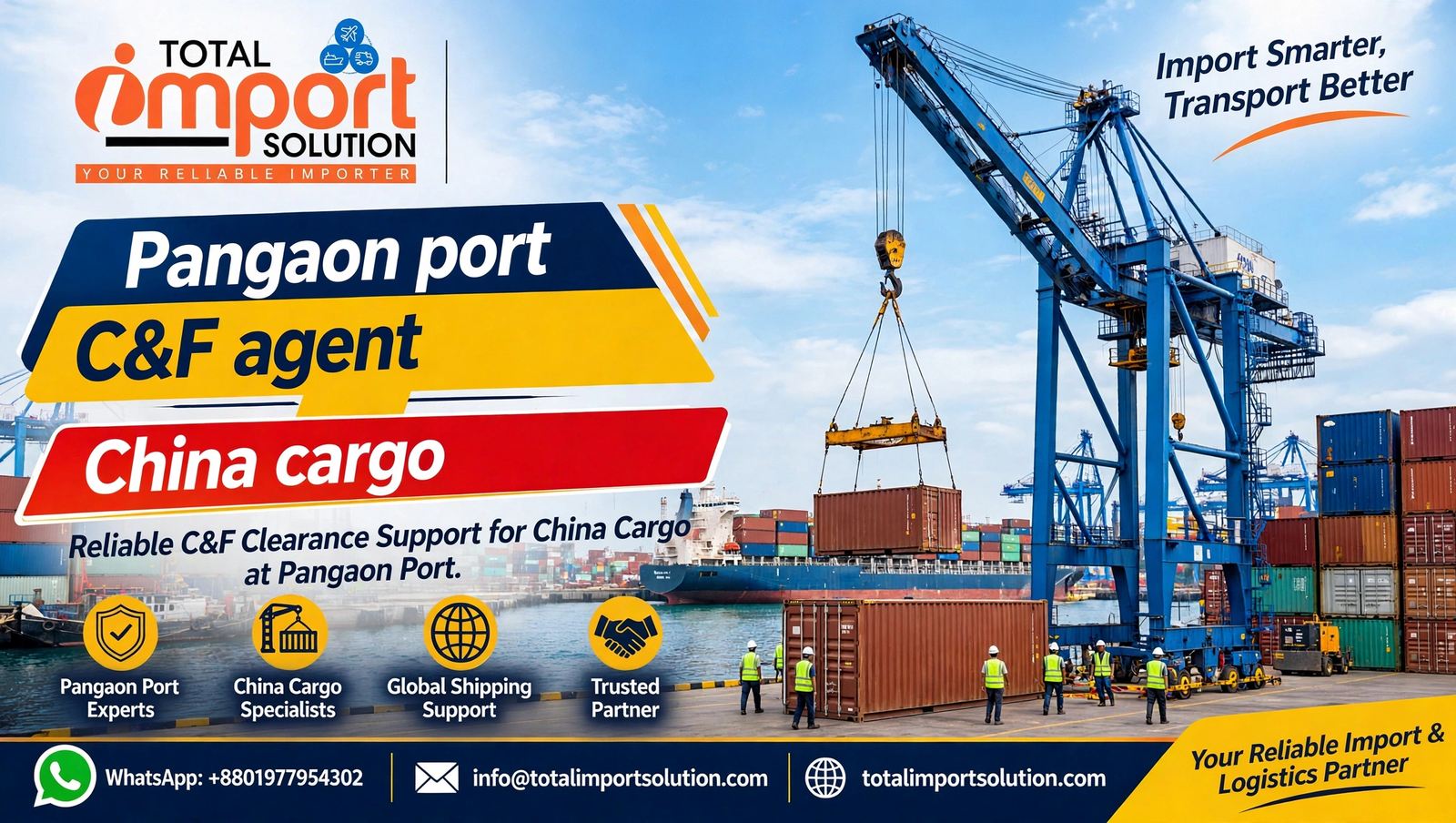
4. What Does a Pangaon Port C&F Agent Do?
A Pangaon port C&F agent’s work starts before the cargo arrives at the terminal and ends after the goods reach the importer. The main services are listed below.
| Service | What it covers |
|---|---|
| Document checking | Bill of lading, invoice, packing list, origin certificate, and other papers before filing |
| HS code support | Identifying the correct classification for the duty assessment |
| Bill of entry | Preparing and filing the bill of entry with customs at Pangaon |
| Duty and tax handling | Payment of assessed duty and charges where agreed |
| Customs examination | Coordinating with customs during examination at the terminal |
| Certificate checking | Pre-shipment inspection certificate and permissions where required |
| Terminal coordination | Following up with the inland terminal for release |
| Delivery arrangement | Transport from Pangaon port to the factory or warehouse in Dhaka |
| Problem solving | Document mismatch, damaged cargo, short shipment, re-assessment |
| Reporting | Keeping the importer informed at each stage |
A good agent explains each of these steps in plain words before the work starts. You should know what the agent will do, what documents you must provide, what charges you will pay, and how you will be updated. If an agent cannot explain the process clearly, that is a warning sign.
5. The Import and Clearance Process Step by Step
Importing China cargo through Pangaon port follows a clear sequence. The steps below show the usual order. The exact order can change with the shipment, the goods, and the customs process, so treat this as a guide, not a fixed timetable.
Step 1: Enquire and share the cargo details. Tell the agent what goods you are importing from China, their quantity, value, weight, port of loading in China, expected vessel, and delivery address in Dhaka, Gazipur, or Narayanganj. Share the supplier’s details and the documents you already have. The more complete the information, the more accurate the agent’s advice will be, including whether Pangaon is the right route for your cargo.
Step 2: Check the documents before the vessel sails. The agent checks the bill of lading, commercial invoice, packing list, and certificate of origin while the goods are still with the supplier in China. The names, quantities, values, and descriptions must match across the documents. A mismatch between the invoice and the packing list is one of the most common causes of delay at customs, and it is far easier to fix while the supplier can still correct the papers.
Step 3: Confirm the HS code. Every imported item has an HS code, the classification used to assess duty. The agent helps confirm the code for your goods. A wrong code can lead to the wrong duty assessment and to questions from customs, so discuss it with the agent before the shipment is filed, not after.
Step 4: File the bill of entry. Once the cargo is at Pangaon and the documents are ready, the agent prepares and files the bill of entry with the customs office at the inland terminal. This is the formal declaration of the imported goods. It includes the cargo description, quantity, value, HS code, origin, and other details.
Step 5: Duty assessment. Customs assesses the duty and related charges based on the declaration, the HS code, and the value of the goods. The agent informs you of the assessed amount and arranges payment where agreed. Keep a copy of the assessment and the payment receipt for your records.
Step 6: Customs examination if required. Customs may select a shipment for physical examination. The container is opened at the terminal and the goods are checked against the declaration, along with the packing and labels. The agent coordinates the examination and follows up until it is complete.
Step 7: Release from the terminal. After assessment and any examination, customs gives the release order. The agent completes the terminal formalities, settles the terminal charges, and arranges the release of the container.
Step 8: Delivery to your address. The cargo is transported from Pangaon port to your factory, shop, or warehouse in Dhaka or nearby. The agent confirms the delivery and shares the delivery details with you. Keep the delivery note and the customs documents together for your records.
Step 9: Closing the file. After delivery, the agent gives the importer a complete file: the bill of entry, the duty payment proof, the release order, and the delivery note. Keep this file. It is the record of the import, and it may be needed later for audit, for a warranty claim, or for a future import of the same goods.
6. Documents You Need for China Cargo at Pangaon
Customs clearance runs on documents. If a document is missing or wrong, the clearance stops until it is fixed. The table below lists the documents most commonly needed for China cargo cleared at Pangaon port.
| Document | What it is for |
|---|---|
| Bill of lading | Proof the goods were shipped, issued by the shipping line |
| Commercial invoice | The supplier’s invoice showing the goods, quantity, and value |
| Packing list | The list of packages, weights, and contents of the shipment |
| Certificate of origin | Proof of where the goods were made, where required |
| Import registration certificate (IRC) | The importer’s registration for importing goods into Bangladesh |
| L/C or payment documents | The letter of credit or payment papers for the purchase |
| HS code details | The classification of the goods for duty assessment |
| Product certificates | Test reports or certificates for regulated goods, where required |
| Pre-shipment inspection certificate | Inspection before shipment, where required |
| Permission or approval letter | Approval for restricted or special goods, where required |
| Authorisation letter | The importer’s letter authorising the agent to act on their behalf |
| Trade licence | The importer’s business registration |
Keep the originals and copies together in one file for each shipment. Share copies with your agent before the vessel sails from China, so any problem can be found while there is still time to fix it. The bill of lading deserves special attention: for cargo that travels by sea and then by river, the bill of lading must show the full journey and the final destination correctly. If a document is in Chinese, check whether a translated or English version is needed for customs. Ask your agent about this before the shipment leaves the supplier, because a translation arranged at the last minute can delay clearance.
7. HS Code and Classification for China Cargo
The HS code is the classification code for your goods. It decides how customs treats the shipment and how the duty is assessed. The code is based on what the goods are, what they are made of, and how they are used. A small difference in the goods can mean a different HS code.
China exports a very wide range of goods to Bangladesh, from garments raw materials and machinery parts to electronics, household goods, and general merchandise. Because the range is so wide, the classification work for China cargo is more varied than for cargo from a single industry. A spare part, a sample, a piece of electronic equipment, or a small machine may be hard to classify, and the supplier’s description may not be enough. If you are unsure about the HS code for your goods, ask your agent before the shipment is filed. The agent can help you check the description of the goods against the classification, and can tell you which details customs will look for.
The supplier’s description is a starting point, not the answer. A supplier in China may describe goods in general words, or use a code from their own country that does not match the Bangladeshi classification. Check the code against the goods themselves, using the invoice, the packing list, photographs, and, where needed, the advice of a consultant who knows the classification rules.
Duty is assessed on the declared value of the goods and the treatment for the HS code. The exact amount depends on the shipment, the goods, and the current rules, so no fixed rate can be given in a guide like this. What you can do is ask your agent for a clear breakdown of the assessed duty and charges for your shipment, in writing, before you pay. Keep the assessment papers and the payment receipts with your import file.
8. Duty and Cost Factors
No fixed fee can be given here, because the cost of clearing China cargo at Pangaon depends on several factors. The main ones are listed below.
Weight and size of the cargo. The terminal charges depend on how much space the cargo takes and how long it stays. A small consignment costs less to handle than a large one, and a full container is handled differently from a shared container.
Type of goods. Garments raw materials, machinery parts, electronics, household goods, and general merchandise each have different handling, examination, and documentation needs. Some goods need extra certificates or tests, which add to the cost and the time.
Duty and taxes. The assessed duty depends on the HS code and the declared value of the goods. The agent arranges payment where agreed, but the amount is set by customs, not by the agent.
Terminal charges. The inland terminal charges for handling, storage, and release of the cargo. If the cargo stays in the terminal longer than the free period, storage charges can grow, which is another reason to clear cargo promptly.
Examination. If customs selects the shipment for physical examination, there are extra handling steps. The agent should tell you when this happens and what it involves.
Always compare the total cost, including the agent’s fee, the duty, the terminal charges, and the delivery cost. Do not compare two quotations unless they cover the same shipment, the same documents, and the same delivery address. A low initial figure may exclude the terminal charges or the delivery, so ask what is included before you decide.
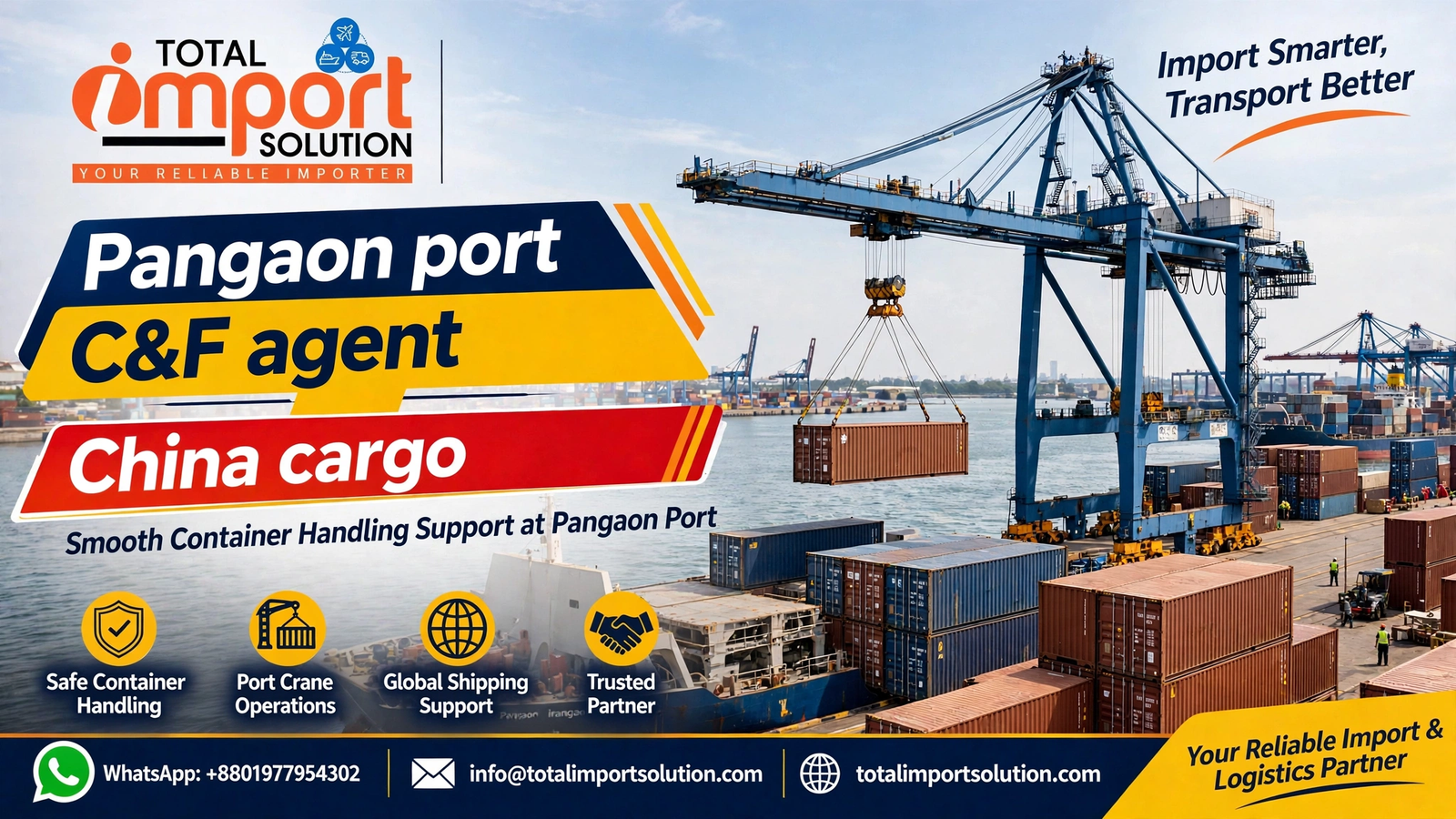
9. Certificates and Permissions
Some China cargo needs more than the standard documents. The agent checks these before the vessel sails from China.
Certificate of origin. Most shipments need a certificate showing where the goods were made. It is issued by the supplier or the chamber of commerce in the country of origin, and it must match the invoice. For China cargo, the certificate of origin is one of the first documents the agent asks for, because it supports both the classification and the value.
Pre-shipment inspection certificate. Required for certain goods, especially used or reconditioned machinery. The inspection confirms the condition, the year of manufacture, and the value before shipment. Arrange it through an approved agency in China before the goods are shipped.
Permission from a government department. Some goods, such as medical equipment, certain chemicals, or specific agricultural products, may need permission from the relevant department before import. The agent confirms this with the department’s rules and helps the importer apply in time.
Product certificates. Some goods need a test report or a quality certificate, depending on the product and the rules in force. Check this before ordering, because a missing certificate cannot be fixed quickly once the goods arrive at Pangaon.
10. Examination of Cargo at Pangaon Port
Physical examination is a normal part of customs work, and cargo at Pangaon is examined at the inland terminal. Because the terminal is smaller than a seaport, the examination is usually arranged in the terminal yard, and the agent should be ready for it.
During examination, the officer may check the goods against the declaration: the description, the quantity, the weight, the packing, and the labels. The officer may ask for a container to be opened so the contents can be counted or inspected. The agent arranges the handling for this and makes sure the goods are packed again properly afterwards.
For shared containers, examination needs extra care. The officer may need to check which goods belong to which importer, so the agent should have the packing list and the container manifest ready, with the importer’s own packages clearly marked. A clean and accurate declaration makes examination smoother, and an agent who has sorted the documents before the container arrives will find the examination faster.
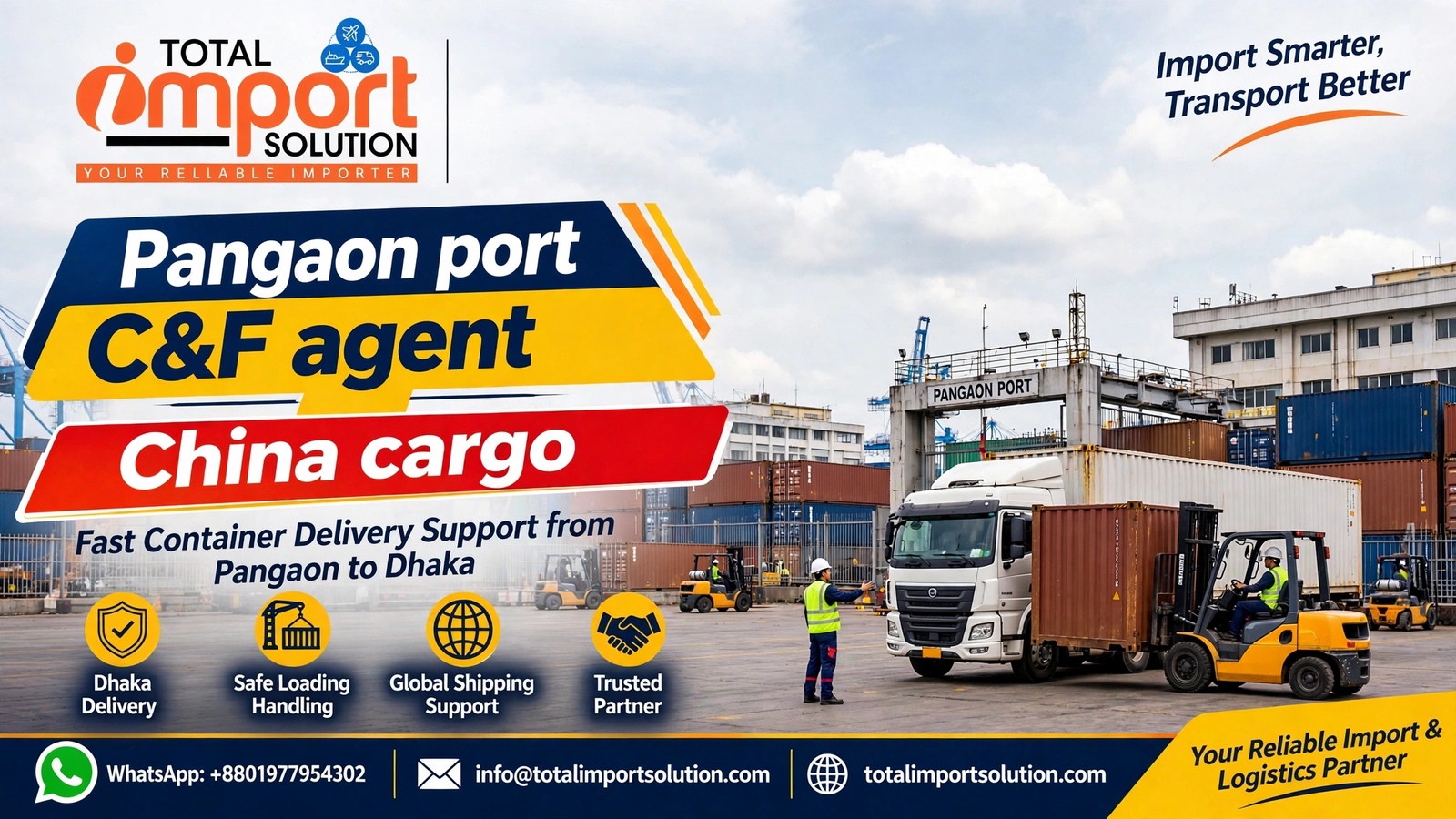
11. Delivery from Pangaon Port to Dhaka Factories and Warehouses
Clearance is only half the job. The goods must still reach the factory, shop, or warehouse, and delivery from Pangaon needs planning, even though the distance is short.
First, check the vehicle. China cargo is often packed in cartons, which need a covered vehicle, especially for electronics or goods that must stay dry. The agent and the transport team confirm the vehicle before the release, so the cargo is not left waiting at the terminal.
Second, check the receiving address. The factory gate must be wide enough for the vehicle, and there must be space to unload. If the goods are for a shop in Dhaka city, check the timing, because traffic can delay a delivery that looked simple on paper.
Third, keep the documents with the cargo. The release order, the bill of entry copy, and the delivery note should travel with the vehicle. If the vehicle is stopped on the road, the driver can show that the goods have been cleared and are on their way to the importer.
Factories in Dhaka, Gazipur, and Narayanganj receive most of the China cargo cleared at Pangaon. The distance from the terminal is short compared with Chittagong Port, so the delivery should be planned for the same day as the release where possible, to avoid extra storage at the terminal.
12. How to Judge a Good Pangaon C&F Agent
Not every agent is equally suited to Pangaon and China cargo. The table below gives a practical way to compare agents before choosing one.
| What to check | A good sign | A warning sign |
|---|---|---|
| Pangaon experience | The agent clears cargo at Pangaon regularly and knows the terminal | The agent mainly handles Chittagong and rarely visits Pangaon |
| China cargo knowledge | The agent has cleared China cargo before and knows its documents | The agent treats your cargo like any other shipment |
| HS code knowledge | The agent checks the code from the product details and explains the classification | The agent gives a code without reading the goods’ details |
| Document checking | The agent reviews your documents before the vessel sails and lists what is missing | The agent files first and asks for documents later |
| Clear charges | The service fee, terminal charges, and transport are listed separately in writing | The agent quotes one figure with no breakdown |
| Communication | The agent updates you at each step: vessel sailed, cargo at Pangaon, assessment, release | You have to chase the agent for news |
| Delivery planning | The agent arranges the vehicle and the delivery before release | The agent releases the cargo and leaves the delivery to you |
| Record keeping | The agent gives you a complete file after delivery | The agent keeps the documents and gives you only a receipt |
Ask the agent for a written quotation for your shipment. The quotation should list the agent’s service fee, the expected duty and charges as assessed, the terminal charges, and the delivery cost, separately. A rate or fee is confirmed only after checking the actual shipment, so a quotation given without seeing the documents or the cargo details is only a rough guide.
13. Common Mistakes to Avoid
Mistake 1: Sending documents late. When the documents arrive after the vessel sails, the agent has no time to check them, and the cargo waits at the terminal while corrections are made. Send the documents as soon as the supplier issues them.
Mistake 2: A wrong HS code. A code chosen without reading the product details is the most common cause of re-assessment. The code must follow the goods’ nature, not the importer’s preference.
Mistake 3: Under-declaring the value. A value lower than the real transaction value invites re-assessment and penalty. Declare the real value with the invoice and the payment record to support it.
Mistake 4: Forgetting a certificate. A missing pre-shipment inspection certificate or permission can hold a cargo for a long time. Check the certificate list before the supplier ships.
Mistake 5: Declaring used goods as new. Customs examination will show the true condition. Declare the condition honestly from the start.
Mistake 6: No delivery plan. Cargo released from the terminal still needs a vehicle and a receiving address ready. Plan the delivery before the release, not after.
Mistake 7: Comparing incomplete quotations. A quotation that leaves out terminal charges or transport looks cheaper but is not. Compare only quotations that cover the same shipment, the same documents, and the same delivery point.
14. How Total Import Solution Helps
Total Import Solution, since 2016, supports importers in Bangladesh with the practical work around importing, including C&F support for China cargo through Pangaon port and Chittagong Port. The team helps importers check documents, confirm HS codes, prepare the bill of entry, coordinate with customs and the terminal, and arrange delivery to factories and warehouses in Dhaka, Gazipur, and Narayanganj.
To discuss a shipment, share the product details, the supplier documents, the port of loading in China, and the delivery address, and the team will help review the documents and the clearance plan for your cargo.
Frequently Asked Questions (FAQs)
1. What does a Pangaon port C&F agent do?
The agent prepares the documents, files the bill of entry, works with customs during assessment and examination, arranges payment of the assessed duty and taxes, and helps release and deliver the China cargo from Pangaon port to the importer.
2. What is Pangaon port?
Pangaon is an inland container terminal on the river near Dhaka. Containers bound for Dhaka are brought there by river from the seaport, and cleared through customs at the terminal, close to the factories and warehouses that will receive them.
3. Why do importers use Pangaon for China cargo?
Because much China cargo is bound for Dhaka, Gazipur, and Narayanganj, and clearing it at a terminal near Dhaka means a short road journey after clearance, with simpler delivery planning than a long road journey from the seaport.
4. How does Pangaon clearance differ from Chittagong Port clearance?
The customs law is the same, but the cargo arrives by river at a smaller inland terminal near Dhaka, the road journey after clearance is short, and the agent must track both the sea leg from China and the river leg to Pangaon.
5. What is a C&F agent?
A C&F agent, or clearing and forwarding agent, is a licensed professional who clears cargo through customs and forwards it to the importer. The agent must hold a valid licence to file customs declarations.
6. Which documents are needed to clear China cargo at Pangaon?
The bill of lading, commercial invoice, packing list, certificate of origin, bill of entry, import registration certificate, payment documents, and, where required, a pre-shipment inspection certificate and any permission letter.
7. What is an HS code, and why does it matter for China cargo?
The HS code is the international classification number for the goods. The duty and tax depend on the code, so a wrong code can change the amount payable and cause re-assessment.
8. How long does clearance at Pangaon take?
The time depends on the documents, the assessment, whether an examination is ordered, and how quickly the duty is paid. Complete and correct documents make the process faster; missing papers slow it down.
9. What is a bill of entry?
It is the customs declaration filed by the agent for the cargo. It lists the goods, their HS code, their value, and the duty and taxes that apply, and it is the basis of the assessment.
10. What happens during customs examination at Pangaon?
The officer checks that the goods in the container match the documents: the description, the quantity, the weight, the packing, and the labels. The agent attends the examination and arranges any unpacking and repacking.
11. How is the duty on China cargo calculated?
The duty depends on the HS code, the declared value, and the rules in force at the time of import. No fixed figure can be given before the assessment, because the assessment is the customs officer’s decision.
12. Do I need a pre-shipment inspection certificate for China cargo?
It depends on the goods, especially if they are used or reconditioned. The agent checks the requirement before the supplier ships, so the certificate can be arranged in China.
13. Can shared containers be cleared at Pangaon?
They can, but each importer’s documents must be separate and complete, and the agent must check the container manifest against the importer’s own documents so that goods belonging to another importer are not declared by mistake.
14. What charges are there besides duty?
Terminal handling and storage charges, transport to the importer, and the agent’s service fee. These are separate from duty and should be listed in writing before the work starts.
15. What is the most common cause of delay in Pangaon clearance?
Missing or mismatched documents, a wrong HS code, and a missing certificate. Sending complete documents before the vessel sails from China is the best way to avoid delay.
16. How do I arrange China cargo clearance at Pangaon with Total Import Solution?
Contact Total Import Solution by WhatsApp or email with the goods, quantity, supplier documents, port of loading in China, and delivery address. The team will review the documents and explain the clearance steps for your shipment.
Total Import Solution — Contact Us
Total Import Solution, since 2016, provides sourcing and import support for businesses in Bangladesh, including C&F support for China cargo through Pangaon port and Chittagong Port. For a review of your documents and the clearance steps for your shipment, contact us:
- WhatsApp: +8801977954302
- Email: info@totalimportsolution.com
- Website: totalimportsolution.com
