
Open Top Container Hire for Heavy Machinery Transport: Complete Shipping Guide
Reliable Heavy Machinery Shipping Solutions by Total Import Solution | Established 2016
Transporting heavy machinery internationally requires more than simply booking a shipping container. Industrial equipment, excavators, construction machinery, generators, manufacturing equipment, and oversized cargo often require specialized loading arrangements, secure handling, and carefully coordinated transportation.
When conventional enclosed containers cannot accommodate the loading requirements of heavy equipment, an open top container can provide a practical and flexible shipping solution.
Whether you are importing construction machinery, exporting industrial equipment, relocating manufacturing assets, or transporting heavy project cargo, choosing the right container type is essential for protecting your investment and avoiding unnecessary shipping complications.
At Total Import Solution, we understand the importance of reliable import and logistics coordination. Since 2016, our company has focused on helping customers navigate international import requirements and logistics solutions.
Our goal is to help businesses make informed shipping decisions, coordinate suitable transportation arrangements, and move their cargo with greater confidence.
If you are looking for open top container hire for heavy machinery transport, this comprehensive guide explains everything you need to know, including container types, dimensions, loading methods, cargo preparation, safety considerations, shipping costs, and how to arrange the right transportation solution.
1. What Is an Open Top Container?
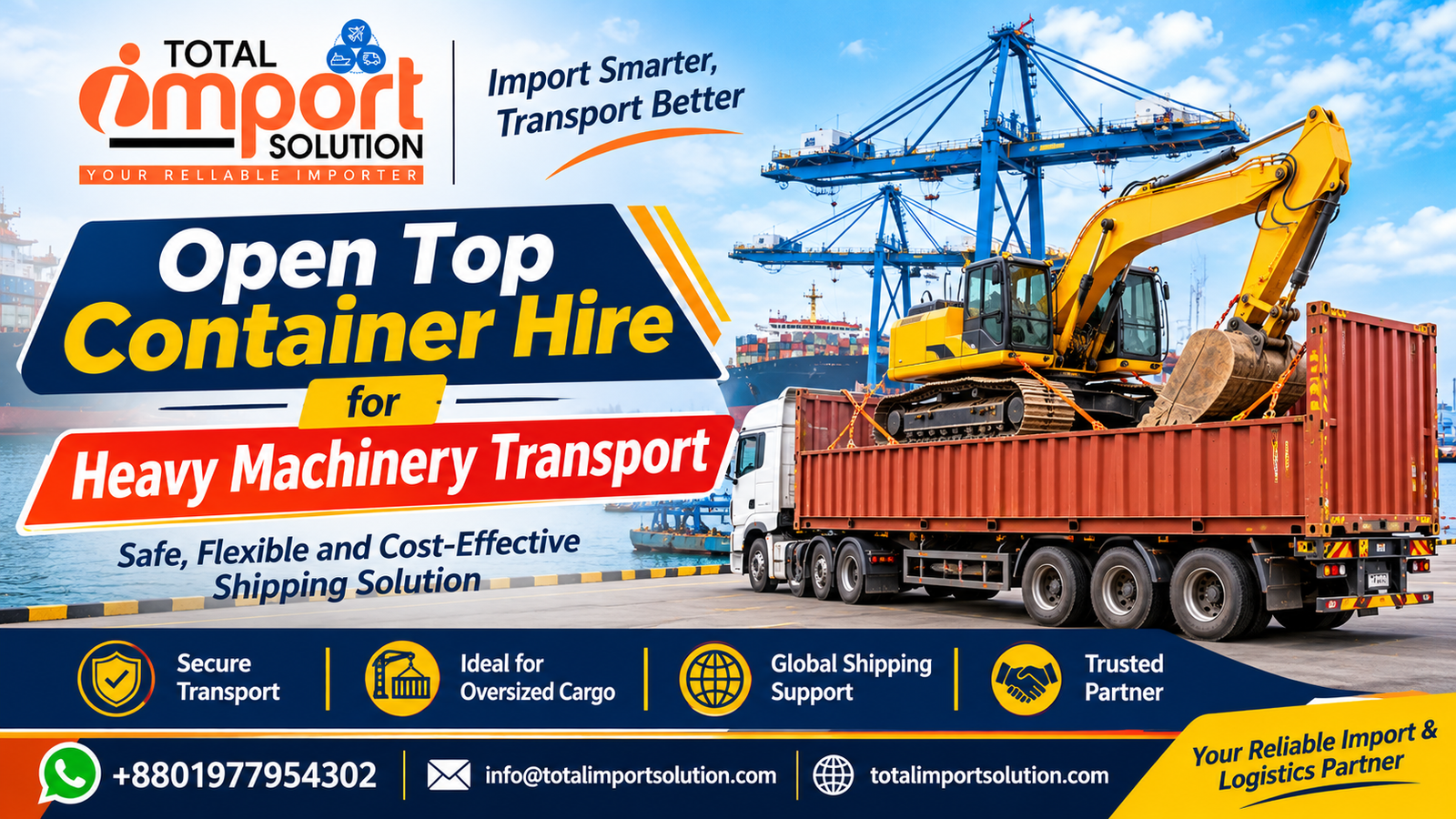
An open top container is a specialized shipping container designed with a removable roof or flexible tarpaulin covering instead of a conventional fixed steel roof.
Unlike standard dry containers, open top containers allow cargo to be loaded from above using cranes, lifting equipment, or other suitable machinery.
This makes them particularly useful for transporting heavy, tall, bulky, or awkwardly shaped cargo that cannot easily be loaded through conventional container doors.
Open top containers generally feature:
- Strong steel construction.
- Removable roof bows or supporting structures, depending on the design.
- A removable tarpaulin or other approved top covering.
- Standard container end doors.
- Reinforced flooring designed for specified cargo loads.
- Suitable securing points, depending on the container specification.
The main advantage is accessibility. Instead of requiring machinery to pass through a restricted doorway, cargo can be lowered vertically into the container.
For industrial transportation, this can simplify loading operations and provide greater flexibility.
How Does an Open Top Container Work?
The process generally follows these steps:
- Select an appropriate open top container based on the machinery’s dimensions and weight.
- Position the container at a suitable loading facility.
- Remove or open the roof covering according to the container design.
- Prepare the machinery for lifting.
- Use an appropriately rated crane or lifting system to lower the equipment into the container.
- Position and secure the machinery using an approved cargo-securing arrangement.
- Complete the required inspection and documentation.
- Close and secure the container covering.
- Transport the cargo to the designated port for shipment.
The precise procedure depends on the equipment, container specification, lifting arrangements, and carrier requirements.
2. Why Choose Open Top Container Hire for Heavy Machinery Transport?
Heavy machinery often presents transportation challenges that ordinary shipping containers cannot easily accommodate.
Some equipment is too tall to pass through standard container doors. Other machinery has unusual shapes, protruding components, or lifting requirements that make conventional loading difficult.
An open top container provides an alternative when cargo can fit within the container’s permitted dimensions but requires top access for loading.
Here are the major advantages.
A. Convenient Top Loading
The biggest advantage of an open top container is the ability to load cargo from above.
This is particularly beneficial when transporting:
- Excavators.
- Industrial generators.
- Heavy mechanical equipment.
- Construction machinery components.
- Manufacturing equipment.
- Agricultural machinery.
- Industrial pumps.
- Large metal structures.
A crane can lift the machinery and lower it into the container without requiring it to be driven through the end doors.
B. Suitable for Heavy Industrial Equipment
Open top containers are designed for cargo that requires specialized loading access.
However, suitability depends on the container’s maximum payload, floor capacity, cargo weight distribution, and lifting arrangements.
It is important to check the container’s actual specifications rather than assuming every open top container can accommodate every heavy machine.
C. Protection During International Shipping
An open top container normally uses a tarpaulin or another approved covering to protect cargo from external weather exposure.
When correctly installed and secured, the covering helps protect the machinery from rain, dust, and environmental exposure.
For sensitive machinery, additional protective packaging may be necessary.
D. Flexible Loading Arrangements
Different types of machinery have different loading requirements.
Some machines can be lifted directly using designated lifting points, while others require engineered lifting frames, spreader beams, or specialized handling equipment.
An open top container provides additional flexibility when arranging these operations.
E. Practical for International Import and Export
Open top containers are used in international shipping networks where suitable equipment, carrier acceptance, and route availability can be confirmed.
They can be useful for companies moving industrial machinery between manufacturing locations, distribution facilities, ports, and project sites.
3. What Types of Heavy Machinery Can Be Transported in Open Top Containers?
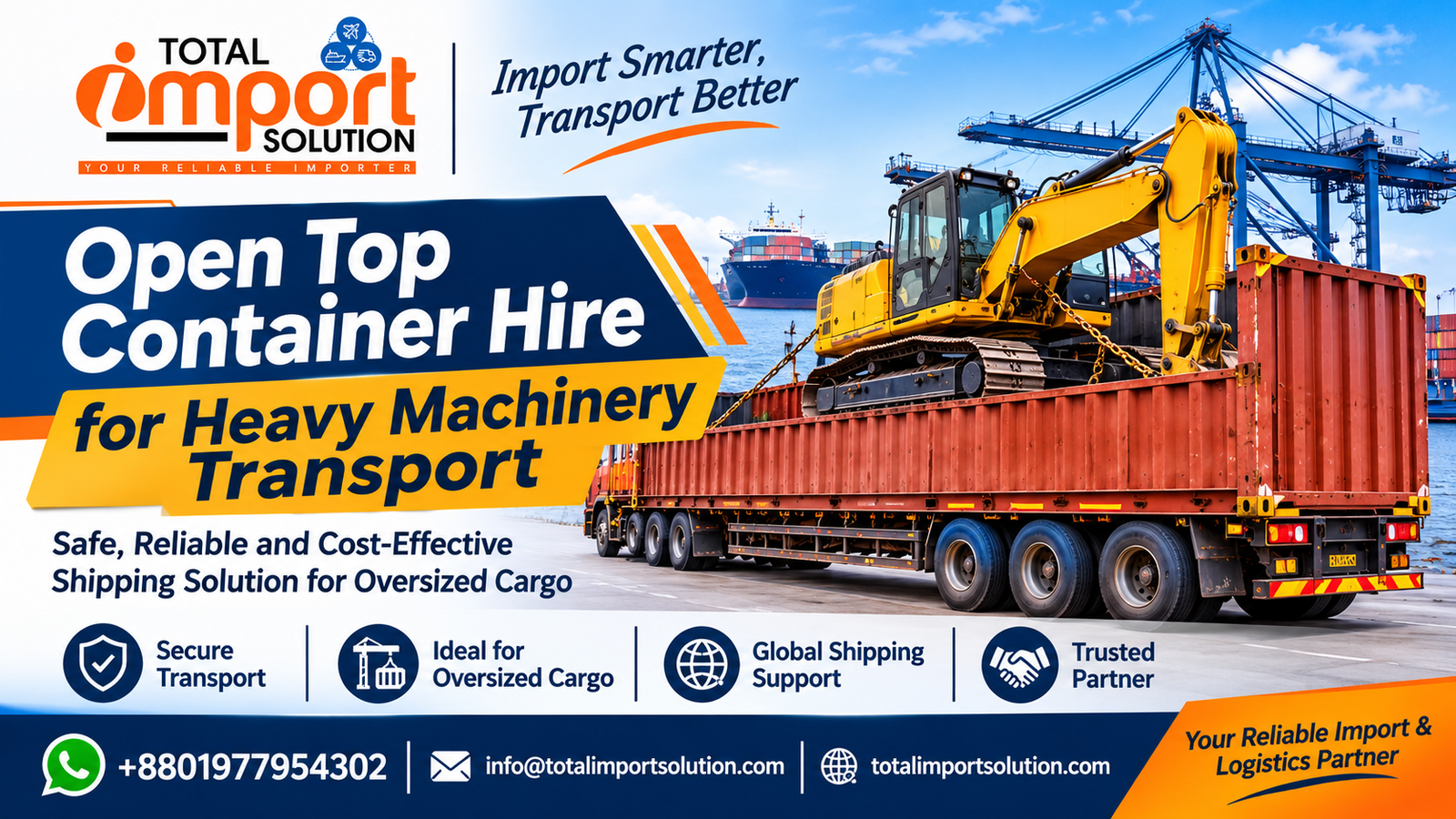
The correct container depends on the machinery’s actual dimensions, weight, configuration, and loading method.
Below are examples of cargo that may be suitable for open top container transportation.
Construction Machinery
Construction companies frequently transport machinery between international markets and project locations.
Examples include:
- Excavators.
- Mini excavators.
- Construction equipment components.
- Hydraulic machinery.
- Road construction equipment.
- Compactor components.
- Drilling machinery parts.
Before booking, measure the machinery in its transport configuration. Attachments, booms, buckets, and other components may need to be removed or separately secured.
Industrial Generators
Industrial generators can be heavy and difficult to handle because of their size and weight distribution.
An open top container may be considered when top loading is required and the generator fits within the permitted internal dimensions.
Important considerations include:
- Total generator weight.
- Base dimensions.
- Lifting points.
- Centre of gravity.
- Fuel and fluid drainage requirements.
- Protection against moisture.
Manufacturing Equipment
Factories and industrial facilities often import machinery that cannot easily be loaded through conventional container doors.
Examples include:
- Industrial presses.
- Production line components.
- Large motors.
- Heavy pumps.
- Mechanical processing equipment.
- Industrial machinery assemblies.
An open top container can offer a practical loading arrangement for equipment that is otherwise difficult to handle.
Agricultural Machinery
Agricultural equipment and components may also require specialized shipping arrangements.
Examples include:
- Tractor components.
- Harvesting equipment parts.
- Agricultural processing machinery.
- Irrigation equipment.
- Large mechanical attachments.
The final decision should be based on dimensions, weight, and shipping-line approval.
Mining and Engineering Equipment
Mining and engineering projects frequently involve heavy components that require careful transportation planning.
Depending on their specifications, certain equipment parts may be suitable for open top containers, while larger cargo may require flat rack or breakbulk transportation.
4. Understanding 20ft and 40ft Open Top Containers
Open top containers are commonly available in 20ft and 40ft configurations, although availability varies by shipping market and route.
Choosing between them requires more than comparing container length.
The machinery must fit within the usable internal dimensions and comply with the container’s payload and structural limitations.
20ft Open Top Container
A 20ft open top container may be appropriate for:
- Smaller industrial machinery.
- Heavy components with compact dimensions.
- Industrial pumps.
- Manufacturing equipment.
- Machinery parts requiring crane loading.
Its shorter floor length may make it suitable for certain concentrated cargo arrangements, but weight distribution and floor-loading limits must be checked.
40ft Open Top Container
A 40ft open top container may be considered for:
- Longer industrial equipment.
- Large machinery components.
- Multiple compatible cargo units.
- Manufacturing equipment.
- Longer construction machinery components.
It provides greater floor length than a 20ft container, but that does not automatically mean it can carry twice the weight.
The payload depends on the container’s individual specifications and applicable road, rail, and shipping restrictions.
20ft vs 40ft Open Top Container Comparison
| Feature | 20ft Open Top | 40ft Open Top |
|---|---|---|
| Length | Approximately 20 feet | Approximately 40 feet |
| Loading | Top loading | Top loading |
| Typical use | Compact heavy cargo | Longer or larger cargo |
| Storage space | Smaller | Larger |
| Weight capacity | Specification-dependent | Specification-dependent |
| Best selection method | Cargo dimensions and weight | Cargo dimensions and weight |
Important: These are general container categories, not guaranteed cargo capacities. Always request the actual container specification and verify the permitted payload, internal dimensions, door dimensions, floor capacity, and lifting arrangements.
5. Open Top Container vs Standard Shipping Container
One of the most common questions from machinery importers is whether they should choose a standard container or an open top container.
The answer depends primarily on the cargo’s physical dimensions and loading requirements.
Standard Dry Container

A standard dry container has a fixed steel roof and end doors.
It is generally suitable for machinery that can be loaded through the container doors and fits within the available internal dimensions.
Advantages include:
- Broad availability.
- Conventional loading procedures.
- Enclosed cargo protection.
- Suitable for many general cargo shipments.
Limitations include restricted top access and door-opening dimensions.
Open Top Container
An open top container provides access from above.
Advantages include:
- Crane-assisted top loading.
- Flexibility for certain tall cargo items.
- Easier loading of some bulky equipment.
- Removable or flexible roof covering.
Limitations may include:
- Different equipment availability.
- Additional loading and securing requirements.
- Potential additional costs.
- Carrier-specific restrictions.
Which Container Should You Choose?
Choose a standard dry container when the machinery fits through the doors and can be loaded safely using conventional methods.
Consider an open top container when vertical loading access is necessary and the cargo fits within the permitted dimensions.
If the cargo exceeds the container’s internal width or length, or is too tall for the permitted open-top configuration, a flat rack, platform, or breakbulk solution may be more appropriate.
The correct decision should always be made after reviewing the cargo specifications.
6. Open Top Container vs Flat Rack Container
Another important comparison is between open top and flat rack containers.
Although both are used for specialized cargo, their designs and applications are different.
Open Top Container
An open top container has side walls and end walls with a removable or flexible roof covering.
It is particularly useful when cargo needs to be lowered vertically into a container but can otherwise fit within the permitted internal dimensions.
Flat Rack Container
A flat rack container generally has a strong base with end walls, while the side walls and roof are absent.
Some designs have collapsible end walls.
Flat racks are often considered for:
- Wide machinery.
- Oversized industrial equipment.
- Heavy structural components.
- Cargo exceeding conventional container dimensions.
- Machinery that cannot fit inside standard container walls.
Comparison Table
| Requirement | Open Top | Flat Rack |
|---|---|---|
| Top loading | Yes | Yes |
| Side walls | Yes | Generally no |
| Roof covering | Removable/flexible | No conventional roof |
| Oversized width | Limited | More suitable |
| Top-loading machinery | Suitable | Suitable |
| Weather exposure | Covered, subject to design | More exposed |
| Cargo securing | Required | Required |
Neither option is universally better.
The best solution depends on the machinery, shipping route, cargo dimensions, weight, loading facility, and carrier acceptance.
7. How to Calculate the Right Container Size for Heavy Machinery
Selecting the correct container is one of the most important parts of the shipping process.
A container may appear large enough based on its external dimensions, but the usable internal space can be different.
Before requesting a quotation, collect the following measurements.
Step 1: Measure Cargo Length
Measure the total length of the machinery in its shipping configuration.
Include any components that cannot be removed.
Step 2: Measure Cargo Width
Measure the widest part of the equipment.
Consider protruding components, mirrors, attachments, hydraulic systems, and other extensions.
Step 3: Measure Cargo Height
Measure from the lowest supporting point to the highest part of the machinery.
For open top shipping, the height of the cargo and the permitted loading configuration must be checked carefully.
Step 4: Confirm Total Weight
Provide the actual gross cargo weight, including any transport packaging or supporting structures where applicable.
Do not rely on estimated weight when the equipment’s specifications are available.
Step 5: Check the Centre of Gravity
Heavy machinery does not always distribute weight evenly.
An incorrect loading arrangement can create serious stability and securing problems.
The centre of gravity should be identified before lifting and loading.
Step 6: Review Lifting Requirements
Confirm whether the machinery has approved lifting points.
If necessary, obtain lifting drawings and arrange appropriate lifting equipment.
Step 7: Confirm Container Compatibility
Compare the cargo measurements with the actual container specifications.
Also confirm:
- Maximum payload.
- Internal length and width.
- Door dimensions.
- Top opening dimensions.
- Floor-loading limitations.
- Securing points.
- Carrier acceptance.
A container should never be selected based only on its nominal 20ft or 40ft designation.
8. How Heavy Machinery Is Loaded into an Open Top Container
Loading heavy machinery requires careful planning, trained personnel, and appropriate lifting equipment.
The following is a general overview of the process.
Cargo Inspection
Before loading begins, inspect the machinery for visible damage and identify any components that could become loose during transportation.
Photograph the equipment and record its condition.
Lifting Plan Preparation
A suitable lifting plan should identify:
- Cargo weight.
- Centre of gravity.
- Lifting points.
- Crane capacity.
- Lifting accessories.
- Lifting path.
- Ground conditions.
- Exclusion zones.
The lifting plan should be prepared and approved by competent personnel.
Crane Selection
The crane must have sufficient rated capacity for the actual lifting configuration and operating radius.
The lifting accessories must also be appropriate for the machinery.
Container Positioning
Position the container on a suitable, stable surface.
Confirm that the container and its supporting arrangement are appropriate for the loading operation.
Machinery Placement
Lower the machinery carefully into the container.
Avoid sudden movements, uncontrolled swinging, and impact with the container walls or floor.
Cargo Securing
After positioning, secure the equipment using a suitable engineered cargo-securing arrangement.
The arrangement should account for the cargo’s weight, centre of gravity, expected transportation forces, and available securing points.
Final Inspection
Before closing the container, verify that:
- The machinery is correctly positioned.
- Securing arrangements are complete.
- Loose components are protected.
- The cargo does not exceed permitted dimensions.
- Required photographs and records are available.
- The container covering can be properly installed.
Only then should the shipment proceed to the next stage.
9. Essential Cargo Securing Requirements for Heavy Machinery
Cargo securing is one of the most important safety considerations in heavy machinery transport.
A machine that is not properly secured can shift during road, rail, or sea transportation.
This can damage the cargo, the container, or surrounding equipment and may create serious safety risks.
Use Suitable Lashing Equipment
Depending on the cargo and approved securing design, suitable equipment may include:
- Certified lashing straps.
- Rated chains.
- Appropriate shackles.
- Engineered securing brackets.
- Timber blocking.
- Anti-slip materials.
- Approved support structures.
The equipment must be appropriate for the forces expected during transportation.
Protect the Machinery
Sensitive surfaces and exposed components may require protective materials.
Hydraulic cylinders, electrical components, control panels, and precision parts should receive suitable protection.
Prevent Movement
The securing arrangement must control movement in all relevant directions.
Simply attaching a few chains to the machinery does not automatically make a load safe.
Verify Container Compatibility
Cargo securing points must be suitable for the forces applied.
Do not assume that every point on a container is designed to accept heavy concentrated loads.
A competent cargo-securing professional should assess the arrangement before departure.
10. How Much Does Open Top Container Hire Cost?
The cost of open top container hire for heavy machinery transport depends on several factors.
There is no single worldwide price because equipment availability, shipping routes, carrier rates, cargo dimensions, and port charges vary.
The most accurate quotation requires complete cargo information.
Main Factors Affecting Shipping Costs
1. Container Size
A 20ft and a 40ft open top container may have different hire and transportation costs.
2. Origin and Destination
The shipping route has a major influence on the total cost.
Origin handling, destination handling, port charges, and available shipping services all matter.
3. Cargo Weight
Heavy cargo may require specialized handling and may be subject to additional transport restrictions.
4. Cargo Dimensions
Cargo that exceeds standard container dimensions can require special arrangements or a different equipment type.
5. Loading and Unloading
Crane hire, lifting services, terminal handling, and other loading expenses may contribute to the total cost.
6. Cargo Securing
Specialized lashing, blocking, and securing requirements can increase preparation costs.
7. Documentation and Customs
Export and import documentation, customs clearance, duties, taxes, and inspection charges must be considered separately where applicable.
8. Container Availability
Open top equipment may not be available at every location or on every route.
Equipment positioning and availability can affect the quotation.
What Should a Shipping Quotation Include?
Before accepting a quotation, request a clear breakdown of:
- Container hire or equipment charges.
- Ocean freight.
- Origin handling charges.
- Destination handling charges.
- Loading and unloading.
- Lashing and securing.
- Documentation charges.
- Customs-related services.
- Insurance, if arranged.
- Additional surcharges.
- Free time and detention conditions.
- Any excluded charges.
This helps prevent misunderstandings and allows you to compare quotations fairly.
Looking for an open top container shipping quotation?
Contact Total Import Solution with your cargo specifications, origin, destination, and preferred shipping date. Our team can help review your requirements and discuss suitable logistics arrangements.
11. What Information Is Required to Book an Open Top Container?
Providing accurate cargo details helps the logistics provider identify suitable equipment and prepare a realistic quotation.
Before contacting a shipping company, prepare the following information.
| Required Information | Details |
|---|---|
| Cargo name | Type of machinery |
| Cargo weight | Total gross weight |
| Length | Overall cargo length |
| Width | Overall cargo width |
| Height | Overall cargo height |
| Origin | Loading location |
| Destination | Final delivery location |
| Container preference | 20ft or 40ft, if known |
| Loading method | Crane, forklift, or other method |
| Cargo photographs | Clear images from different angles |
| Shipping date | Expected ready date |
| Special requirements | Lifting, lashing, or handling needs |
If you do not know which container type is appropriate, provide the measurements and photographs first.
A logistics professional can help review the options.
12. Documents Required for International Heavy Machinery Shipping
International machinery transportation involves documentation that depends on the country, shipment type, customs regulations, and carrier requirements.
Common shipping documents may include:
Commercial Invoice
The commercial invoice describes the transaction between the seller and buyer.
It generally includes cargo descriptions, quantities, declared values, and seller and buyer details.
Packing List
The packing list identifies the cargo, packages, dimensions, weights, and other shipment information.
Bill of Lading
The bill of lading is an important shipping document issued by or on behalf of the carrier.
It provides information about the shipment and the contractual transportation arrangements.
Certificate of Origin
A certificate of origin may be required to establish where the machinery was manufactured or produced.
Export and Import Permits
Some types of industrial machinery may require additional permits, approvals, or regulatory documentation.
Insurance Documents
Cargo insurance documentation should be obtained where insurance is arranged.
The required documents should be confirmed with the relevant customs authorities, freight forwarder, and carrier before shipment.
13. International Shipping Routes for Heavy Machinery
Heavy machinery is transported through international shipping networks connecting manufacturing centres, industrial markets, ports, and project locations.
The best route depends on the origin, destination, cargo type, shipping schedules, and equipment availability.
China to Bangladesh
China is an important sourcing market for industrial machinery, manufacturing equipment, construction machinery, and industrial components.
Businesses importing equipment from China to Bangladesh should consider:
- Supplier coordination.
- Cargo inspection.
- Export documentation.
- Container availability.
- Port handling.
- Ocean freight.
- Bangladesh import requirements.
- Customs clearance.
- Final delivery arrangements.
Europe to Bangladesh
European machinery suppliers may provide specialized industrial and manufacturing equipment.
Depending on the origin and destination, shipments may require open top, flat rack, or other specialized cargo arrangements.
Middle East to South Asia
Industrial and construction equipment is frequently moved between international markets and South Asian destinations.
The appropriate shipping arrangement depends on the cargo and available services.
International Project Cargo
Large engineering projects may require multiple shipping methods.
Some components can be shipped in open top containers, while others may require flat racks, heavy-lift vessels, or breakbulk services.
The entire project should be evaluated before selecting equipment.
14. Common Problems in Heavy Machinery Shipping and How to Avoid Them
International machinery shipping can become expensive when important details are overlooked.
Here are some common mistakes to avoid.
Mistake 1: Selecting a Container Without Measuring the Cargo
A machine may fit within the external dimensions of a container but exceed its internal measurements or loading clearance.
Solution: Obtain accurate cargo measurements and compare them with the actual container specification.
Mistake 2: Ignoring Weight Distribution
A machine with a heavy concentrated load can create excessive floor pressure.
Solution: Review the machinery’s weight distribution and confirm the floor-loading requirements before loading.
Mistake 3: Using Inappropriate Lifting Points
Incorrect lifting can damage expensive equipment or create serious safety risks.
Solution: Follow the manufacturer’s lifting instructions and use a competent lifting team.
Mistake 4: Inadequate Cargo Securing
Insufficient lashing can allow machinery to move during transit.
Solution: Use a properly assessed cargo-securing plan.
Mistake 5: Ignoring Weather Protection
Moisture can damage electrical and mechanical components.
Solution: Use suitable protective packaging, corrosion protection, and an appropriate container covering.
Mistake 6: Failing to Check Carrier Restrictions
Not every shipping line accepts every cargo configuration.
Solution: Obtain carrier approval for the equipment type, cargo dimensions, weight, and loading method before making final arrangements.
Mistake 7: Incomplete Shipping Documentation
Missing or inaccurate documents can delay customs processing and cargo release.
Solution: Verify documentation requirements with the relevant authorities and shipping professionals before dispatch.
15. Why Choose Total Import Solution for Import and Logistics Support?
Choosing a logistics partner is an important decision for businesses involved in international trade.
A reliable partner should understand the importance of accurate cargo information, suitable equipment selection, shipping coordination, and clear communication.
Total Import Solution, established in 2016, is committed to helping customers navigate import and logistics requirements with practical support and a customer-focused approach.
We believe successful international shipping starts with proper planning.
Our approach focuses on understanding each customer’s requirements before discussing a suitable transportation arrangement.
Experience Since 2016
With a business history dating back to 2016, Total Import Solution brings an established commitment to import and logistics support.
We aim to help customers make informed decisions when arranging international cargo transportation.
Customer-Focused Communication
Every shipment has different requirements.
Our team encourages customers to share accurate cargo specifications so that suitable shipping options can be discussed.
Practical Shipping Guidance
Choosing between a standard container, open top container, flat rack, or another shipping method can be challenging.
We help customers understand the differences and identify which options should be evaluated for their cargo.
International Import and Logistics Focus
We understand that successful international shipping involves more than ocean freight.
Cargo preparation, documentation, handling, transportation coordination, and destination requirements all play important roles.
Support for Different Cargo Requirements
Whether you are importing industrial equipment, machinery components, construction materials, or general commercial cargo, the first step is understanding your requirements.
Contact us to discuss the appropriate logistics arrangement for your shipment.
16. How to Request an Open Top Container Hire Quotation from Total Import Solution
Arranging a quotation does not need to be complicated.
Follow these simple steps to begin.
Step 1: Contact Our Team
Reach out through WhatsApp or email.
Step 2: Share Your Cargo Details
Provide the machinery name, dimensions, total weight, and photographs.
Step 3: Confirm the Shipping Route
Tell us where the cargo will be collected and where it needs to be delivered.
Step 4: Discuss Container Requirements
Based on the cargo specifications, suitable options can be reviewed, including open top containers and alternative equipment where necessary.
Step 5: Review the Quotation
Check the proposed transportation arrangement, included services, exclusions, and applicable charges.
Step 6: Confirm the Shipment
Once the necessary arrangements and approvals are confirmed, the shipment can proceed according to the agreed schedule.
Request Your Heavy Machinery Shipping Quote Today
Are you planning to transport an excavator, generator, industrial machine, or other heavy equipment?
Let Total Import Solution help you explore a suitable international shipping arrangement.
Company: Total Import Solution
Established: 2016
WhatsApp / Hotline: +8801977954302
Email: info@totalimportsolution.com
Website: https://totalimportsolution.com
Contact our team today to discuss your cargo requirements.
17. Frequently Asked Questions About Open Top Container Hire
1. What is an open top container used for?
An open top container is used to transport cargo that requires loading from above. It is commonly considered for heavy machinery, industrial equipment, bulky cargo, and certain oversized items.
2. Can I transport an excavator in an open top container?
Yes, certain excavators and excavator components may be transported in open top containers if their dimensions, weight, loading configuration, and securing arrangements meet the container and carrier requirements. Larger excavators may require flat rack or specialized transportation.
3. What is the difference between an open top and a normal shipping container?
A standard container has a fixed steel roof, while an open top container has a removable or flexible roof covering. The open top design allows cargo to be loaded vertically using cranes.
4. Are open top containers available in 20ft and 40ft sizes?
Yes. Both 20ft and 40ft open top containers are commonly used in international shipping. Actual availability and specifications depend on the location and shipping line.
5. Can open top containers carry heavy machinery?
They can carry suitable machinery within their permitted payload, floor-loading, dimensional, and securing limits. Each shipment must be assessed individually.
6. Is an open top container waterproof?
Open top containers generally use a tarpaulin or approved covering to protect cargo. However, they should not automatically be considered equivalent to a fully enclosed dry container in every weather condition. Additional cargo protection may be necessary.
7. Can oversized machinery be transported in an open top container?
Some machinery that exceeds standard loading dimensions may be accepted under specific open-top arrangements, subject to carrier approval. Cargo exceeding the container’s permitted width or other structural limits may require a flat rack or breakbulk solution.
8. What is the maximum weight of an open top container?
There is no single maximum weight for all open top containers. Payload limits depend on the individual container’s rating, tare weight, floor capacity, and applicable transportation restrictions.
9. How much does it cost to hire an open top container?
The cost depends on the container size, origin, destination, cargo weight, equipment availability, handling requirements, shipping route, and additional charges. A detailed quotation requires complete cargo information.
10. Can heavy machinery be loaded using a crane?
Yes. Crane-assisted top loading is one of the main reasons open top containers are used. The crane, lifting accessories, lifting points, and loading plan must be suitable for the actual cargo.
11. What information is needed to arrange open top container shipping?
You should provide the cargo name, length, width, height, gross weight, origin, destination, photographs, and expected shipping date.
12. Is an open top container better than a flat rack?
Neither is universally better. Open top containers are useful when top loading is required but the cargo fits within the container’s permitted dimensions. Flat racks are often more suitable for cargo that exceeds conventional container width or other dimensional limits.
13. Can I ship industrial generators in an open top container?
Certain industrial generators can be transported in open top containers if the weight, dimensions, lifting requirements, and securing arrangements are suitable.
14. How long does international heavy machinery shipping take?
Transit time depends on the origin, destination, shipping service, transshipment requirements, port operations, customs procedures, and inland transportation. Ask for a route-specific schedule before booking.
15. Does Total Import Solution help with open top container shipping?
Contact Total Import Solution to discuss your heavy machinery transportation requirements, equipment options, and available logistics arrangements.
16. How can I contact Total Import Solution?
You can contact Total Import Solution using the following details:
- WhatsApp / Hotline: +8801977954302
- Email: info@totalimportsolution.com
- Website: https://totalimportsolution.com
Our team welcomes enquiries about import, cargo transportation, and logistics requirements.
18. Final Thoughts: Choose the Right Container for Safe Heavy Machinery Transport
Transporting heavy machinery internationally requires careful consideration of container selection, cargo dimensions, weight distribution, loading procedures, cargo securing, documentation, and transportation arrangements.
An open top container can be an effective option when machinery requires vertical loading access and fits within the container’s permitted specifications.
However, choosing the right shipping solution is not simply about selecting a 20ft or 40ft container. It is about understanding the cargo and planning the entire transportation process.
Whether you are importing an excavator, industrial generator, manufacturing machine, or other heavy equipment, proper preparation can help reduce avoidable complications and support a smoother shipping process.
Total Import Solution – Your Reliable Importer Since 2016.
We welcome your enquiries and look forward to discussing your international import and logistics requirements.
Get in touch today.
WhatsApp / Hotline: +8801977954302
Email: info@totalimportsolution.com
Website: https://totalimportsolution.com
Total Import Solution – Import Smarter, Transport Better.
