
Multimodal transport from China to Bangladesh
Most cargo that travels from China to Bangladesh does not move on one vehicle alone. A container may leave a factory in China by truck, travel by sea to a port, and then move by truck again to a warehouse in Dhaka or Chattogram. An urgent carton may fly part of the way and finish its journey by road. This way of moving goods, using two or more modes of transport under one plan, is called multimodal transport.
Multimodal transport from China to Bangladesh is not a single service with one fixed route. It is a plan built around the cargo itself: what the goods are, how much they weigh, how much space they take, how soon they are needed, and where they must be delivered. This guide explains it in practical terms: the modes, the connections, route planning, documents, packing, customs clearance, quotes, and how to judge a good partner. No fixed prices, rates, duty percentages, fees, transit times, or schedules are given here. A rate or fee is confirmed only after checking the actual shipment and its documents.
Since 2016, Total Import Solution has supported importers in Bangladesh with shipment planning, documentation, customs clearance support, and delivery coordination. The aim of this guide is to help you plan a multimodal shipment properly, so that the goods move in the right combination of modes, the papers match the cargo at every handover, and there are no surprises at the port or on the road.
1. What Multimodal Transport Means
Multimodal transport means moving the same goods by two or more different modes of transport, under one coordinated plan, from the place of origin to the place of delivery. The four modes used in trade between China and Bangladesh are sea, air, road, and rail, and a typical shipment uses at least two of them. For example, a container may be collected by truck from a factory, loaded onto a vessel at a port in China, unloaded at Chittagong Port, and then carried by truck to the buyer’s warehouse.
The key point is that the goods stay under one plan even when the vehicle changes. The cargo is packed once, in a way that suits every leg, and the documents travel with it. At each handover point, the cargo and the papers are checked before the next leg begins. The container that leaves the factory must fit the vessel, the truck, and the warehouse door.
| Feature | Single-mode transport | Multimodal transport |
|---|---|---|
| Modes used | One mode for the main journey | Two or more modes under one plan |
| Planning | Each leg arranged separately | All legs planned together |
| Documents | Separate papers for each leg | Coordinated documents for the whole journey |
| Handover | Buyer manages each change of vehicle | Handovers planned and checked in advance |
2. Why Importers Combine Sea, Air, Road and Rail
Importers combine modes because no single mode does everything well. Sea freight carries large volumes at a lower cost per unit than air, but it moves more slowly. Air freight moves cargo quickly, but it costs more and suits lighter, higher-value, or urgent goods better than heavy bulk cargo. Road transport reaches factories, warehouses, and shops directly, but it cannot cross the sea. Rail can move containers over long land distances in a steady way, but it needs rail terminals and connecting road legs at both ends. By combining modes, an importer can use sea for the heavy main load, air for the urgent part, and road for the first and last distances.
A combined plan also helps with cost control. A buyer may send the bulk of an order by sea and a small urgent sample or spare part by air, so the total cost is lower than sending everything by air and the urgent part still arrives in time. And when a shipment depends on one mode only, a problem in that mode affects the whole shipment, while a multimodal plan can be adjusted when a port is congested or a leg is delayed.
| Mode | Main strength | Main limitation | Typical use in a China–Bangladesh plan |
|---|---|---|---|
| Sea | Large volume, lower cost per unit | Slower than air | Main leg for containers and bulk cargo |
| Air | Fast movement | Higher cost, weight and size limits | Urgent, light, or high-value cargo |
| Road | Door-to-door reach | Cannot cross the sea | First and last distances, local delivery |
| Rail | Steady long-distance land movement | Needs terminals and road connections | Land leg where the route and terminals fit |
3. The Sea Leg — Ocean Freight from China to Bangladesh
The sea leg is the main leg of most multimodal shipments from China to Bangladesh. Containers are loaded at a port in China, carried by vessel, and unloaded at a port in Bangladesh, most commonly Chittagong Port, with Pangaon port also used for some cargo. The sea leg suits full containers, consolidated loads, heavy machinery, and any large-volume shipment.
The sea leg begins before the vessel sails. The cargo must be packed to survive the sea journey, the container must be loaded and sealed correctly, and the shipping documents must be ready. The packing list, the invoice, and the bill of lading are the core documents, and they must match the cargo exactly. At the port of arrival the container is unloaded, the documents are presented, customs clearance begins, and after clearance the container moves to the next leg, usually road transport to the buyer’s warehouse.
| Step | What happens | What the importer checks |
|---|---|---|
| Booking | Space on a vessel is booked for the container | Cargo details, weight, volume, and sailing plan |
| Packing and loading | Goods are packed and loaded into the container | Packing strength, weight spread, and seal |
| Sea voyage | Vessel carries the container to Bangladesh | Bill of lading details and cargo status |
| Arrival and unloading | Container is unloaded at the port in Bangladesh | Condition of the container and seal |
| Handover to next leg | Container moves to road transport or storage | Documents ready for customs and delivery |

4. The Air Leg — Air Freight for Urgent Cargo
The air leg is used when cargo must move quickly, or when the goods are light, small, or high in value relative to their weight. Air freight from China usually arrives at Dhaka Airport, and then moves by road to the buyer. The air leg is often combined with sea freight in one multimodal plan: the main load travels by sea, and a small urgent part travels by air.
Air cargo has strict rules. The weight and the size of each piece matter, because aircraft have limits on both, and the packing must be strong enough for air handling. Some goods cannot travel by air at all, or can travel only with special packing and declarations, such as batteries, liquids, chemicals, and magnetic items. The importer should confirm with the logistics partner, before booking, whether the goods are accepted for air transport. Because air cargo moves quickly, any error in the documents or the packing is felt sooner.
| Step | What happens | What the importer checks |
|---|---|---|
| Booking | Air space is booked for the cargo | Weight, size, and nature of the goods |
| Packing and labelling | Goods are packed for air handling | Packing strength, labels, and marks |
| Airport acceptance | Cargo is received, weighed, and checked | Weight, documents, and special-goods rules |
| Flight | Aircraft carries the cargo to Dhaka Airport | Air waybill details and cargo status |
| Arrival and clearance | Cargo is unloaded and customs clearance begins | Documents ready and goods in good condition |
| Handover to road | Cargo moves by truck to the buyer | Delivery address and receiving arrangement |
5. The Road Leg — Moving Cargo Inside Bangladesh and Across Borders
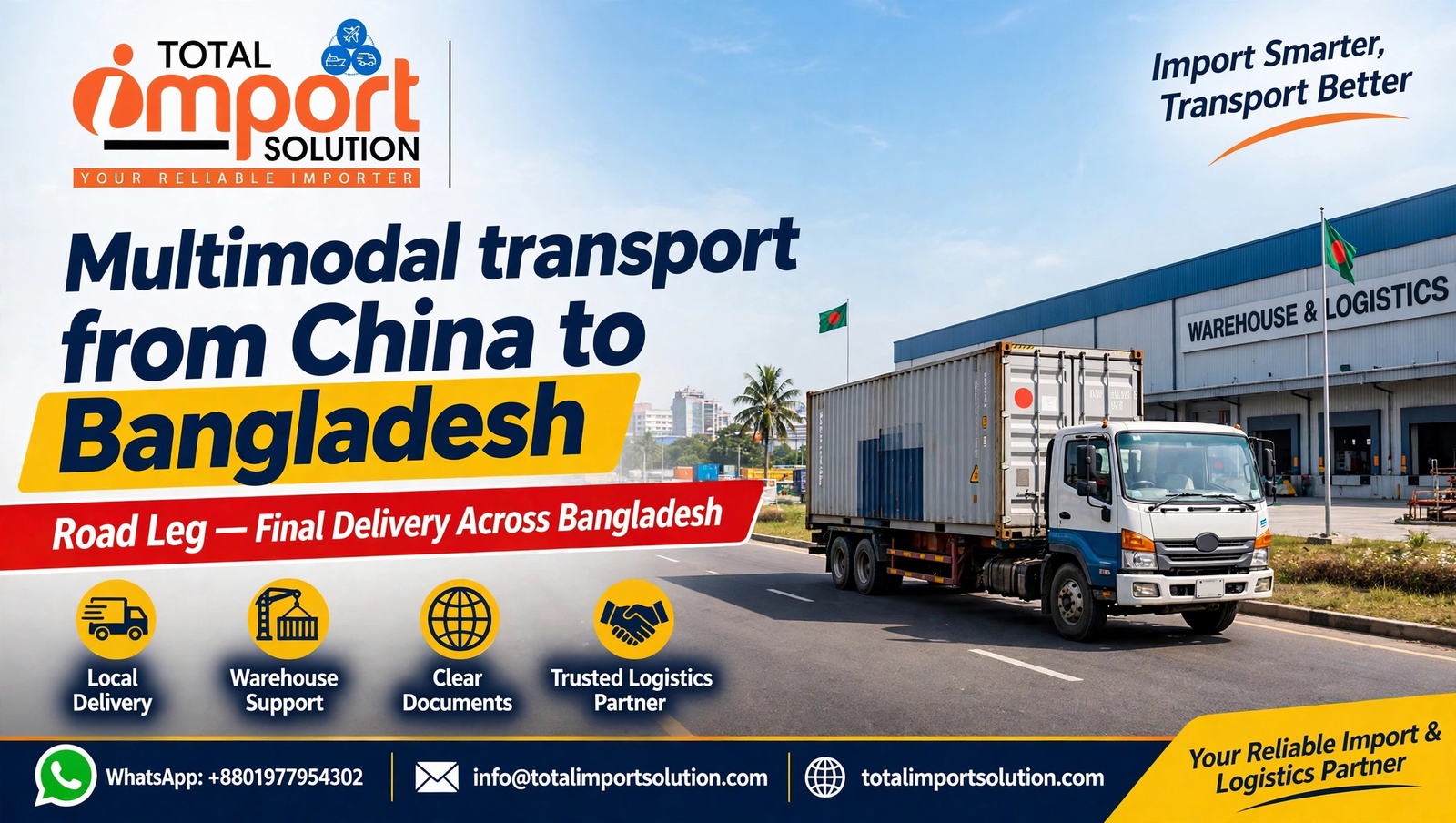
The road leg is the part of multimodal transport that most importers see most closely, because it is the leg that brings the goods to their door. Almost every multimodal shipment from China to Bangladesh ends with a road leg: from Chittagong Port, Pangaon port, or Dhaka Airport to the buyer’s warehouse, shop, or factory. Many shipments also begin with a road leg in China, from the supplier’s factory to the port or the airport.
Road transport is flexible. Trucks can reach places that ports, airports, and rail terminals cannot, and a truck can collect a container from the port and carry it to a warehouse in Dhaka, Chattogram, Gazipur, Narayanganj, or another district. But road transport needs planning too: the condition of the goods must be checked before the road leg begins, the load must be secured so that it does not shift, and the buyer must arrange a place to unload. In some routes a road leg can also cross a land border through a neighbouring country, which needs extra documents, and the importer should confirm the border procedure before choosing it.
| Road task | What it involves | What the importer checks |
|---|---|---|
| Collection from port or airport | Truck collects the container or cargo after clearance | Release papers and container or cargo condition |
| Loading and securing | Goods are loaded and fixed in place | Weight spread, securing, and covering |
| Journey to destination | Truck travels to the buyer’s address | Route, delivery time, and contact person |
| Unloading | Goods are taken off the truck at the warehouse | Unloading space, labour, and equipment |
| Proof of delivery | Delivery is recorded and confirmed | Signed receipt and cargo condition on arrival |
6. The Rail Leg — Where Rail Fits in a China–Bangladesh Route
Rail is the fourth mode in multimodal transport, and it fits some routes better than others. Rail can move containers over long land distances in a steady and organised way, and it is often used to carry containers from an inland factory or warehouse to a port, or from a port to an inland terminal. In a China–Bangladesh plan, rail is most commonly a connecting leg to the port or the airport, while the main sea or air leg does the rest.
| Question | If the answer is yes | If the answer is no |
|---|---|---|
| Is the factory far from the port? | Rail may be a practical link to the port | A direct truck may be simpler |
| Is there a rail terminal near the origin? | Rail loading is possible | Road must carry the cargo to the port |
| Is there a rail terminal near the destination? | Rail can carry the cargo inland | Road must carry the cargo from the port |
| Is the cargo heavy or bulky? | Rail handles heavy loads well | Road or sea may be enough |
| Is the delivery date flexible? | Rail fits a steady schedule | Air or direct road may be better |
7. How the Legs Connect — Transshipment and Handover Points
The most important part of multimodal transport is not any single leg. It is the connection between the legs. A shipment changes vehicle at a port, an airport, a rail terminal, or a warehouse. At each of these handover points, the cargo is unloaded from one mode, checked, stored or held if needed, and loaded onto the next mode. If a handover is planned well, the shipment moves through it without delay; if not, the cargo can wait and the delivery date can slip.
| Handover point | What changes | What must be checked |
|---|---|---|
| Factory to truck | Goods move from supplier to first vehicle | Packing, count, and marks |
| Truck to port or airport | Cargo is handed to the carrier | Container or piece count, seal, and documents |
| Vessel or aircraft change | Cargo moves between carriers | Condition, seal, and onward documents |
| Arrival port or airport | Cargo is unloaded for clearance | Condition, seal, and customs papers |
| Port to truck | Cargo moves to the final road leg | Release papers and loading safety |
8. Planning a Multimodal Route Step by Step
Planning a multimodal route starts with the cargo and the delivery date, and works backwards from there. The importer first writes down what the goods are, how many pieces there are, how much they weigh, how much space they take, and when they are needed. Then the importer and the logistics partner choose the modes, the route, and the handover points, and only after that are the bookings made and the documents prepared.
- Describe the cargo: goods, pieces, weight, volume, packing, and handling needs.
- Fix the delivery date and place: where the goods must go, and by when.
- Choose the modes: which modes, and in what order.
- Choose the route and the handover points: ports, airports, terminals, and warehouses.
- Confirm the documents: what is needed for each leg and for customs, and who prepares each one.
- Confirm packing and container needs: packing, container type, and loading plan.
- Book the legs in the order they will happen, and confirm each booking in writing.
- Prepare and check the documents: invoice, packing list, bill of lading or air waybill, and any certificates, all matching the cargo exactly.
- Load and dispatch: load the cargo, seal the container where needed, and start the first leg.
- Track each handover: follow the cargo and confirm the checks at each point are done and recorded.
- Clear customs: present the documents at the port or airport of arrival.
- Deliver and confirm: carry the cargo by road to the buyer, check the count and condition, and record the delivery.
Planning in this order prevents the most common problems: the modes are chosen for the right reasons, the handovers are known in advance, and the cargo does not wait at the port for missing papers. A multimodal plan is only as strong as its weakest handover, so the plan should give as much attention to the connections as to the legs themselves.

9. Documents for a Multimodal Shipment
Documents cause the most delay when they are wrong, and the smoothest progress when they are right. A multimodal shipment passes through several hands: the supplier, the carrier for each leg, the port or airport, the customs office, and the delivery team. Each of them needs documents that match the cargo, and if they do not match, the cargo can be held at a handover point until the error is fixed.
The core documents are the commercial invoice, the packing list, the bill of lading for the sea leg or the air waybill for the air leg, and the certificate of origin where it is needed. The invoice shows what the goods are and their value. The packing list shows how the goods are packed, how many pieces there are, and the weight and volume. Other documents may be needed depending on the goods, such as a fumigation certificate for wooden packing or a test report for electrical goods. The documents must work for every leg, not only the first one, and the names, numbers, weights, and values must be the same on every document. Check them twice: once before the cargo leaves the supplier, and once before it arrives in Bangladesh.
| Document | What it shows | Who prepares it |
|---|---|---|
| Commercial invoice | Goods, value, buyer, and seller | Supplier |
| Packing list | Pieces, packing, weight, and volume | Supplier |
| Bill of lading | Sea transport details and cargo receipt | Shipping line |
| Air waybill | Air transport details and cargo receipt | Airline or agent |
| Certificate of origin | Country where the goods were made | Supplier or chamber |
| Import permit or licence | Permission to import the goods where needed | Importer |
| Customs declaration | Goods declared for customs clearance | Importer or clearing agent |
10. Packing, Marking and Container Choices
Packing for a multimodal shipment must suit every leg of the journey, not only the first one. A carton that is strong enough for a short truck ride may not be strong enough for a sea voyage followed by a road journey. The packing must protect the goods from handling, from stacking, from moisture, and from movement during each leg. Agree the packing with the supplier before the goods are packed, and ask for photos of the packed goods before dispatch where possible.
Marking is as important as packing. Each carton should carry clear marks showing the buyer’s name or mark, the destination, the carton number, and any handling instruction, and the marks must match the packing list. A full container load suits a large order that fills a container, while a consolidated load suits a smaller order that shares a container. An open-top or flat-rack container may be needed for goods that are too tall or too wide for a standard container. Loading deserves the same care: heavy items at the bottom, light items on top, the weight spread evenly, the load secured, and the container sealed, with the seal number recorded on the documents.
| Packing or container choice | When it is used | What to check |
|---|---|---|
| Strong export cartons | General goods, samples, and small orders | Carton strength, sealing, and marks |
| Wooden crates | Heavy, fragile, or high-value goods | Crate strength, fixing, and fumigation where needed |
| Pallets | Goods that must be moved by forklift | Pallet size, strapping, and wrapping |
| Full container load | Large order that fills a container | Container condition, loading, and seal |
| Consolidated load | Smaller order sharing a container | Separation of goods and clear marks |
| Special container | Oversized or temperature-sensitive goods | Container type, fittings, and loading plan |
11. Customs Clearance in Bangladesh
Customs clearance is the step where the goods are formally presented to the customs authority in Bangladesh and the duty and taxes are assessed. For a multimodal shipment, clearance usually happens at the port or airport of arrival: Chittagong Port, Pangaon port, or Dhaka Airport. Clearance cannot begin until the cargo has arrived and the documents are ready, so the documents should be checked before dispatch.
The clearance process starts with the customs declaration, which lists the goods, their classification, their value, and their origin. The classification is done by HS code, a standard system for naming goods for customs purposes, and the HS code must be correct because it decides how the goods are treated. The importer should confirm the HS code with the supplier and the clearing agent before the shipment leaves China. Duty and taxes are assessed on the basis of the goods, their value, and the rules in force at the time of import. After clearance, the goods are released and the final road leg can begin.
| Clearance step | What happens | What the importer checks |
|---|---|---|
| Arrival and documents | Cargo arrives and papers are presented | Documents complete and matching the cargo |
| Declaration | Customs declaration is filed | Goods, HS code, value, and origin correct |
| Examination | Customs may examine the cargo | Cargo matches the declaration |
| Assessment | Duty and taxes are assessed | Assessment and receipts recorded |
| Release and delivery | Goods are released for the road leg | Release papers and delivery arrangement |
12. Costs, Charges and How a Quote Is Built
A multimodal shipment has costs at every stage, and the total cost is the sum of the costs of each leg plus the costs of the handovers, the documents, and the clearance. The sea or air freight is usually the largest single cost, but the road legs, the port handling, the documentation, the insurance, and the customs charges all add to the total. Ask for a quote that lists each cost separately, so the total can be understood and compared.
No fixed prices, rates, or fees are given in this guide. A rate or fee is confirmed only after checking the actual shipment and its documents, because the amount depends on the goods, their weight and volume, the route, the modes chosen, and the rules in force at the time. A quote given for one shipment cannot be applied to another without checking the new cargo and route. To compare quotes fairly, check that each quote covers the same scope: one may cover only the sea freight, while another covers the sea freight, the road legs, the port handling, and the documentation.
| Cost item | What it covers | What affects it |
|---|---|---|
| Sea or air freight | Main leg from China to Bangladesh | Weight, volume, route, and mode |
| Road transport | First and last distances by truck | Distance, load size, and vehicle type |
| Port and terminal handling | Loading, unloading, and storage at ports | Cargo size, handling needs, and storage time |
| Documentation | Preparing and handling the papers | Number and type of documents |
| Customs clearance | Declaration, examination, and release | Goods, classification, and value |
| Insurance | Cover for the cargo during transport | Value of the goods and the cover chosen |
| Delivery to warehouse | Final road leg and unloading | Distance and unloading needs |
13. Choosing a Multimodal Transport Partner
A multimodal shipment needs a partner who can plan and coordinate more than one mode of transport, such as a freight forwarder, a logistics company, or an import support company like Total Import Solution. Since 2016, Total Import Solution has worked with importers in Bangladesh as an importer and logistics partner.
The first thing to check is experience with the cargo and the route. A partner who has handled the same kind of goods, on the same route, will know the packing, the documents, and the handover points. Ask the partner to explain the plan in plain terms: which modes, which route, which handover points, which documents, and what happens if a leg is delayed. The second thing to check is communication: the partner should give regular updates and inform the importer promptly when something changes. The third thing to check is honesty about costs and limits. A good partner gives a quote that lists each cost, explains what is not included, and says plainly what the partner can and cannot do.
| What to check | Good sign | Warning sign |
|---|---|---|
| Experience | Has handled similar cargo on this route | Cannot describe the route or the handovers |
| Plan | Explains modes, route, and documents clearly | Gives only a price with no plan |
| Communication | Gives regular updates and answers promptly | Hard to reach and gives no updates |
| Documents | Checks papers before dispatch | Leaves document checks until arrival |
| Costs | Quote lists each cost and what is not included | One total with no breakdown |
Frequently Asked Questions
1. What is multimodal transport from China to Bangladesh?
Multimodal transport means moving the same goods by two or more modes of transport, such as sea, air, road, and rail, under one coordinated plan from China to Bangladesh. The goods change vehicle at handover points, but the plan, the packing, and the documents stay coordinated.
2. Which modes are used in a China to Bangladesh multimodal shipment?
The four modes are sea, air, road, and rail. Sea is the main leg for most containers. Air is used for urgent, light, or high-value cargo. Road covers the first and last distances, and rail is used as a connecting leg where the route and the terminals fit.
3. Is multimodal transport better than using only sea freight?
It depends on the cargo and the delivery date. Sea alone suits large, heavy loads with a flexible date, while multimodal transport suits cargo that needs a mix of economy and speed, such as a main load by sea and an urgent part by air.
4. What is the main port of arrival in Bangladesh for sea cargo?
Most sea cargo from China arrives at Chittagong Port, and some cargo is handled at Pangaon port. The choice of port depends on the cargo, the route, and the delivery plan, and it should be fixed during planning.
5. Where does air cargo from China arrive in Bangladesh?
Air cargo usually arrives at Dhaka Airport. After arrival, the cargo goes through customs clearance at the airport and then moves by road to the buyer’s warehouse, shop, or factory.
6. What documents are needed for a multimodal shipment?
The core documents are the commercial invoice, the packing list, the bill of lading for the sea leg or the air waybill for the air leg, and the certificate of origin where needed. Other documents may be needed depending on the goods.
7. How do the documents work across different legs?
The documents must match the cargo for every leg, not only the first one. The packing list, the invoice, and the transport documents should show the same goods, numbers, weights, and values throughout the journey.
8. What is a handover point in multimodal transport?
A handover point is a place where the cargo changes from one mode to another, such as a port, an airport, a rail terminal, or a warehouse. At each handover, the cargo, the container or packing, and the documents are checked.
9. What is transshipment?
Transshipment means moving cargo from one vessel or vehicle to another during the journey. A container may arrive at a port on one vessel and leave on another, or a pallet may arrive by air and continue by road.
10. How should goods be packed for a multimodal journey?
The packing must suit every leg, not only the first one. Cartons, crates, and pallets should be strong enough for handling, stacking, and movement during sea, air, road, and rail legs, and each package should be marked clearly.
11. Can a full container and a small order both use multimodal transport?
Yes. A full container load suits a large order that fills a container, while a consolidated load suits a smaller order that shares a container with other cargo. The planning steps are the same for both.
12. How is customs clearance done for a multimodal shipment?
Customs clearance usually happens at the port or airport of arrival in Bangladesh. The importer or the clearing agent files a customs declaration listing the goods, their HS code, their value, and their origin, and the goods are released after assessment and payment.
13. How is the cost of a multimodal shipment worked out?
The total cost is the sum of the costs of each leg plus the handovers, the documents, the clearance, and the insurance. No fixed rate is given here. A rate or fee is confirmed only after checking the actual shipment and its documents.
14. What problems are common in multimodal transport?
The most common problems are documents that do not match the cargo, packing that is too weak for one of the legs, a handover that was not planned, and a declaration filed late. Each can be avoided by preparing the documents early and planning every handover.
15. How do I choose a multimodal transport partner?
Look for a partner who has handled similar cargo on the same route, can explain the plan in plain terms, gives regular updates, checks the documents before dispatch, and gives a quote that lists each cost separately.
16. How can Total Import Solution help with multimodal transport from China to Bangladesh?
Since 2016, Total Import Solution has supported importers in Bangladesh with shipment planning, mode and route choice, documentation, customs clearance support, and delivery coordination for multimodal shipments from China, from the first description of the cargo through to final delivery.
Contact Total Import Solution
- WhatsApp: +8801977954302
- Email: info@totalimportsolution.com
- Website: totalimportsolution.com
- Service: Multimodal transport from China to Bangladesh — shipment planning, sea, air, road and rail coordination, documentation, customs clearance support, and delivery to your warehouse in Bangladesh.
