
Mongla Port Offload: Fast Container Sourcing & Transport
Mongla Port is one of the main sea ports of Bangladesh, and for many importers it is the first point where a container shipment touches land. When a vessel carrying your goods arrives at Mongla, the work that follows is called the offload: the containers are lifted from the vessel, placed on the quay, checked, moved to the yard, cleared through the formal steps, and then loaded for road transport to the final destination. Each of those steps needs planning, the right documents, and clear coordination between the people involved. When any step is late or unclear, the whole chain slows down, and the importer is the one who waits.
This article explains Mongla port offload work in plain steps. It covers how container sourcing works before the vessel arrives, what happens when the vessel berths, how the offload sequence runs, which documents to keep ready, how containers move from the quay to the yard and then by road, and how to plan the work so that it runs in an orderly and timely way. The word fast in the title does not mean rushing or skipping steps. It means planning early, keeping documents ready, and coordinating each handover so that no step waits for information that should have been prepared days earlier. Total Import Solution has served importers in Bangladesh since 2016, and this guide follows the same practical approach the company uses with its own clients: prepare first, check twice, and keep the buyer informed at every stage.
A rate or fee for any shipment is confirmed only after checking the actual shipment and documents, so this article gives you process and planning guidance rather than figures that would not fit your cargo.
1. What Mongla Port Offload Means for Importers in Bangladesh
A port offload is the full set of tasks that moves a container from a vessel to the land side of the port. It starts before the vessel arrives, because the plan for the offload is made while the vessel is still at sea. It ends when the container leaves the port area on a truck, or when it is placed in storage arranged by the importer. Between those two points there are many small tasks: berthing, crane work, quay handling, yard placement, document checks, customs steps, and transport booking. Each task has an owner, and the importer or the appointed agent keeps track of all of them.
For an importer in Bangladesh, the offload matters for three reasons. First, it is the point where the goods become reachable. Until the container is off the vessel, the importer cannot inspect the cargo, move it, or deliver it to a buyer or warehouse. Second, it is the point where errors show up. A wrong container number, a missing paper, or a seal that does not match the record can all be found at the offload stage, and finding them early is far better than finding them later. Third, it is the point where the schedule is set. The order in which containers come off the vessel decides which cargo is ready first, and that order should match the importer's own priorities.
| Offload stage | What happens | Who is involved |
|---|---|---|
| Planning before arrival | Documents checked, berth and crane plan prepared, transport arranged | Importer, agent, port staff |
| Vessel arrival | Vessel berths, arrival record made, offload order set | Port staff, vessel crew |
| Lifting | Containers lifted from vessel to quay by crane | Crane team, port staff |
| Quay and yard | Containers checked and moved to the yard | Yard team, agent |
| Formal steps | Documents and customs steps completed in order | Importer, agent, customs |
| Road transport | Container loaded on a truck and moved to destination | Transport team, driver |
2. Why Mongla Port Matters for Container Cargo
Mongla Port sits on the Pashur River in the south-west of Bangladesh. It is the second largest sea port in the country, and it handles a wide range of cargo, including containerised goods, bulk cargo, and project cargo. For importers, the port offers an alternative to the busier ports further east, and for cargo bound for the south-western districts, Mongla can shorten the road journey after the port. The port has berths, cranes, yard space, and warehousing, and it connects to the national road network for onward transport.
The value of Mongla for container cargo comes from its position and its facilities. Vessels call at Mongla from overseas loading ports, and containers are discharged onto the quay for yard placement and onward movement. The port area has space for stacking containers, and the road links from Mongla connect to Khulna and to Dhaka and other districts. Importers who plan their delivery around Mongla should study the road route from the port to their warehouse or buyer, and they should confirm the route and the vehicle type with their transport provider before the vessel arrives.
3. How Container Sourcing Works Before the Vessel Arrives
Container sourcing means arranging the container that will carry your cargo, and confirming the details of that container before it is loaded at the origin. Sourcing starts with the cargo itself: what it is, how much of it there is, how it should be packed, and which container size and type suits it. The sourcing step then covers the container number, the seal number, the loading plan, and the documents that travel with the container. All of this should be settled and written down before the vessel sails, because changes made at sea are slow and costly.
The sourcing checklist below is a useful starting point for any importer. Go through it with your supplier and your agent, and keep a copy of every confirmation. If a detail is missing, ask for it before loading. A missing container number or an unclear seal record can delay the offload at Mongla, because the port team needs to match each container to its record before it is moved.
| Sourcing item | What to confirm | Why it matters |
|---|---|---|
| Container size and type | Size, type, and condition suit the cargo | Wrong size means repacking or a second container |
| Container number | Number recorded exactly as marked | The number is the main identifier at every step |
| Seal number | Seal number recorded and matched | A seal mismatch stops the handover |
| Loading plan | Cargo loaded and secured as planned | Poor loading risks damage in transit |
| Documents | Packing list and related papers ready | Papers are checked at the port |
| Vessel and voyage | Vessel name and voyage details noted | The port plan uses the vessel schedule |
4. Vessel Arrival and Berthing: What Happens First
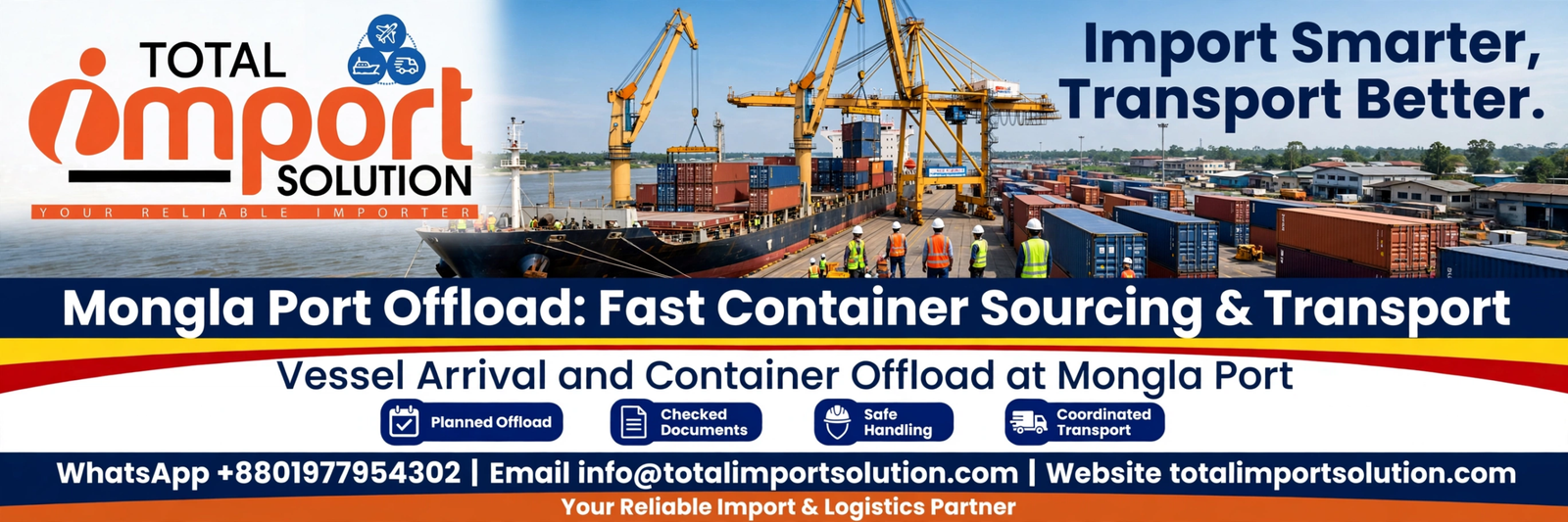
When a vessel approaches Mongla, the port is informed of its arrival, and a berth is assigned according to the port schedule. Berthing is the act of bringing the vessel alongside the quay so that cranes can reach the containers. The vessel crew and the port team work together on this step, and the importer does not need to be present, but the importer should know that the vessel has berthed, because that is the point from which the offload clock starts to run in practical terms.
After berthing, the port team prepares the offload plan for that vessel. The plan sets the order in which containers are lifted, which cranes are used, and where each container is placed on the quay and in the yard. The order often follows the stowage plan of the vessel, which shows where each container sits on board. Containers stowed on top come off first, and containers stowed below come off later.
The agent follows the berthing and the offload plan and keeps the importer informed. The key updates at this stage are simple: the vessel has berthed, the offload has started, and the importer's container is in a known position in the offload order. If the vessel waits for a berth, the agent should say so plainly and give the revised expectation once the port confirms it.
5. The Offload Sequence Step by Step
The offload sequence is the order of physical tasks that take a container from the vessel to the yard. It runs in the same order for most vessels, and understanding it helps the importer know where their container is at any time. The steps below describe the normal sequence at Mongla. The exact timing of each step depends on the vessel, the number of containers, the cranes in use, and the port schedule on the day.
Step one is crane positioning. The cranes move into place alongside the vessel and the lifting gear is prepared. Step two is the first lift: the crane lifts the topmost containers from the vessel and places them on the quay. Step three is quay handling: the container is checked against its number, and then moved by yard equipment to its allotted place in the yard. Step four is yard placement: the container is stacked or placed in a row where it can be reached for the next step. Step five is the record update: the port record notes that the container is ashore and where it sits. Step six is the handover to the next stage, which is the document and customs work followed by transport.
| Offload step | Task | What the importer should know |
|---|---|---|
| Crane positioning | Cranes move alongside the vessel | Offload is about to start |
| First lift | Top containers lifted to the quay | The sequence has begun |
| Quay check | Container number checked on the quay | The container is ashore |
| Yard move | Container moved to its yard place | The container has a known yard spot |
| Record update | Port record updated with the yard spot | The container can be found quickly |
| Handover | Container ready for the next stage | Documents and transport come next |
6. Container Sizes and Types: Checking the Actual Container
Containers come in standard sizes, and the two most common are the 20-foot and the 40-foot container. A standard 20-foot container is approximately 6 metres long on the outside, and its internal space is approximately 33 cubic metres. A standard 40-foot container is approximately 12 metres long on the outside, and its internal space is approximately 67 cubic metres. These figures are approximate standard figures, and the actual internal space of any single container can differ slightly by maker and by type, so always check the actual container and its markings before you plan the loading.
Other types exist for special cargo, such as open-top, flat-rack, refrigerated, and high-cube containers. Match the container type to the cargo, confirm the type in writing before loading, and note that using the wrong type can mean the cargo does not fit or is not protected as it needs.
Checking the actual container is a habit that saves trouble. Before loading at the origin, check the container number, the door seals, the floor, the walls, and the roof. Look for damage, leaks, or smells from a previous cargo. After arrival at Mongla, check the container number and the seal again before the container is opened. If the seal number does not match the record, stop and report it to the agent at once. Do not open a container whose seal does not match, because the seal is the proof that the container has not been opened in transit.
7. Documents You Need Ready Before Offload
Documents are the backbone of any import, and the offload at Mongla cannot run smoothly without them. The papers should be prepared before the vessel arrives, and copies should be held by the importer and by the agent. The table below lists the papers most importers need for a container shipment through Mongla. The exact set can vary with the cargo, the origin, and the rules in force at the time, so confirm the list with your agent for each shipment.
| Document | Purpose | Check before arrival |
|---|---|---|
| Commercial invoice | Shows the goods and their value as agreed | Names and figures match the order |
| Packing list | Shows how the goods are packed | Quantities match the invoice |
| Bill of lading | Proves the contract of carriage by sea | Container number and seal noted |
| Certificate of origin | Shows where the goods were made | Origin stated as required |
| Insurance papers | Cover for the cargo in transit | Cover matches the voyage |
| Import registration papers | Show the importer is registered | Registration is current |
| Product certificates | Show the goods meet the required standards | Certificates are valid for this cargo |
If any paper is missing when the vessel arrives, tell the agent at once. Some papers can be sent while the vessel is at sea, but others need more time. The agent can advise which papers are urgent and which can follow. The rule is simple: never let a missing paper be discovered at the moment the container is ready to move, because that is the moment when a delay costs the most.
8. Customs and Port Formalities in Order
After the container is ashore at Mongla, the formal steps begin. These are the customs and port steps that must be completed before the container can leave the port. The order of the steps follows the rules in force, and the agent guides the importer through them one by one. The importer should understand the order, even if the agent handles the detail, because that understanding helps the importer answer questions quickly when they arise.
The normal order starts with the arrival record and the documents being lodged. The customs office then reviews the papers and the cargo details. If the papers are in order, the assessment step follows, and then the importer completes the payment steps that apply to that shipment. A rate or fee is confirmed only after checking the actual shipment and documents, so no figure in this guide should be taken as the charge for your cargo. Once the formal steps are complete, the release is given, and the container can be loaded for road transport.
| Formal step | What it covers | Importer action |
|---|---|---|
| Arrival record | Vessel and container noted as arrived | Confirm the container details with the agent |
| Lodging papers | Documents submitted for review | Send complete and matching papers |
| Review | Papers and cargo details checked | Answer any query quickly and fully |
| Assessment | Shipment assessed under the rules in force | Note the assessment and keep a copy |
| Payment steps | Charges for the shipment completed | Keep receipts and records |
| Inspection if called | Cargo checked against the papers | Be ready and present if asked |
| Release | Container cleared to leave the port | Arrange transport promptly |
9. From the Quay to the Yard: Moving Containers Safely
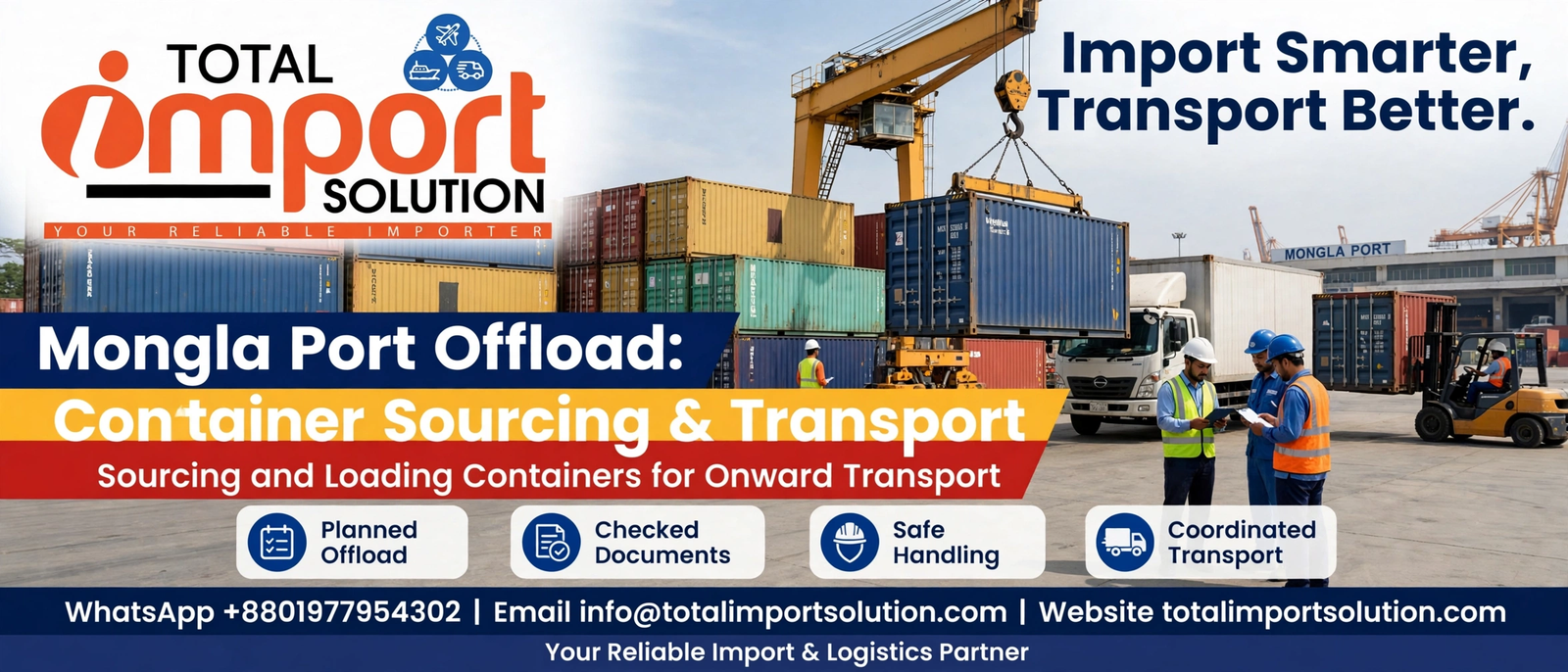
Once a container is lifted onto the quay, it must be moved to the yard. The yard is the storage area inside the port where containers wait for the formal steps and for transport. The move from quay to yard is done by yard equipment such as reach stackers, straddle carriers, or terminal tractors, depending on what the port uses. The driver and the ground staff guide each move, and the container is placed in a marked row so that it can be found again without delay.
Safety governs every yard move. The yard is a working area with heavy machines, and people on foot keep to marked walkways. Containers are stacked only as high as the yard plan allows, and the stack is planned so that a container needed early is not buried under containers needed later. The yard plan is part of the offload plan, and the agent can tell the importer where the container sits once it is placed.
10. Road Transport from Mongla Port to Your Destination
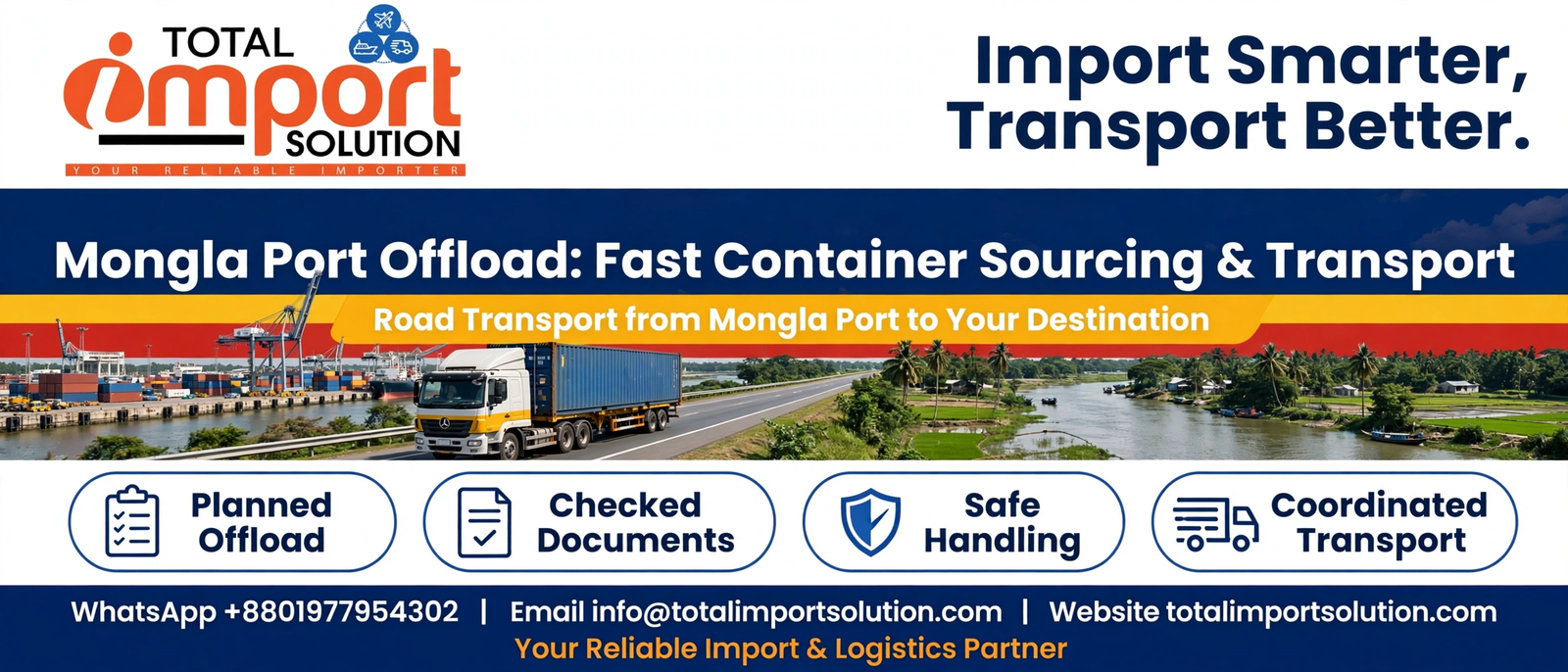
Road transport is the final leg of the Mongla offload chain. The container is loaded onto a truck or trailer at the port, secured, and driven to the importer's warehouse, factory, or buyer. The road route from Mongla runs through Khulna and connects to the wider national road network, so the destination decides the route, the vehicle, and the planning. A container bound for a warehouse near Mongla needs a short trip, while a container bound for Dhaka or another distant district needs a longer trip with more planning.
Booking transport early is the single most useful habit in this stage. The vehicle type should match the container size: a 20-foot container and a 40-foot container need different trailers, and a heavy container needs a vehicle rated for its weight. Confirm the vehicle, the driver, the loading time, and the destination address before the container is released. Also confirm who will receive the container at the destination, and make sure that person is ready with the equipment to unload it.
11. Planning for a Smooth and Timely Offload
A smooth offload is the result of planning, not luck. The planning starts weeks before the vessel sails, when the importer, the supplier, and the agent agree on the cargo, the container, the papers, and the schedule. The plan is then updated as the vessel sails, and it is confirmed again in the days before arrival. The table below gives a planning timeline that any importer can adapt to their own shipment.
| Planning point | When to do it | What to have ready |
|---|---|---|
| Cargo and container plan | Before loading at origin | Cargo list, container size and type |
| Papers | Before the vessel sails | Complete set, checked line by line |
| Transport outline | Before the vessel sails | Vehicle type, destination, receiver |
| Arrival check | While the vessel is at sea | Vessel position and expected berth |
| Berth and offload order | On arrival at Mongla | Offload order from the agent |
| Formal steps | As soon as the container is ashore | Papers lodged, queries answered |
| Road departure | As soon as release is given | Truck ready, driver briefed |
Total Import Solution has worked with importers in Bangladesh since 2016, and the planning habit above is the one the company returns to for every shipment: prepare early, keep the papers in order, and keep every party informed. A plan that is written down and shared is a plan that can be followed, and a plan that is followed is what makes an offload run in an orderly and timely way.
12. Common Delays and How to Reduce Them
Delays at a port offload have a small set of common causes, and most of them can be reduced by early action. The first cause is incomplete papers. A missing certificate or a figure that does not match across two papers will stop the formal steps until it is fixed. The fix is to check the papers before the vessel sails and to keep a checklist for each shipment. The second cause is a seal or number mismatch. The fix is to record the numbers at loading and to check them again at the quay.
The third cause is transport booked too late. The fix is to book the vehicle in outline before arrival and to confirm it once the offload order is known. The fourth cause is poor communication. When the importer, the agent, and the transporter do not share the same plan, each party waits for news from the others. The fix is a short daily update while the vessel is at sea and while the container is at the port, even if the update is only that nothing has changed. The fifth cause is cargo that is hard to handle, such as cargo that is badly packed or loaded in a way that slows the inspection. The fix is to agree the loading plan with the supplier before the container is sealed.
13. How to Judge a Good Provider for Mongla Port Offload Work
Choosing a provider for Mongla port offload work is a decision that affects the whole shipment, so it is worth judging a provider on clear points rather than on promises alone. A good provider explains the process in plain steps, gives a written plan before the vessel sails, and keeps the importer informed with short, regular updates. A good provider also checks the papers before they are lodged, so that errors are found early, and gives a clear account of each stage once it is done.
Ask a provider how they handle the points in this guide. How do they confirm the container and seal numbers? How do they plan the transport from Mongla? How do they keep the buyer informed while the container is at the port? How do they deal with a query from customs, or with a container that needs inspection? The answers should be practical and specific, not vague. A provider who can describe the steps in order is a provider who has done the work before.
Frequently Asked Questions
1. What is a Mongla port offload?
A Mongla port offload is the work that moves a container from a vessel at Mongla Port onto the quay, then to the yard, through the formal steps, and onto road transport. It covers berthing, crane lifts, quay checks, yard placement, document work, and the loading of the truck that carries the container to its destination.
2. Which containers can be offloaded at Mongla Port?
Standard containers in the common sizes can be offloaded at Mongla, including 20-foot and 40-foot boxes, and other types such as open-top, flat-rack, and refrigerated containers where the port facilities suit them. Confirm the container type and the port handling with your agent before the vessel sails.
3. What papers do I need for a container offload at Mongla?
You need the commercial invoice, the packing list, the bill of lading, the certificate of origin, insurance papers, import registration papers, and any product certificates that apply to your cargo. Confirm the exact list with your agent for each shipment, and check that names and figures match across every paper.
4. When should I start planning a Mongla port offload?
Start before the cargo is loaded at the origin. Agree the container size and type, the papers, and the transport outline at that stage, then update the plan while the vessel is at sea and confirm it again in the days before arrival at Mongla.
5. How is the offload order decided?
The offload order follows the vessel stowage plan and the port plan for that vessel. Containers stowed on top come off first. The importer cannot change the stowage plan once the vessel has sailed, so cargo that is needed first should be loaded where it can be reached first.
6. How do I check my container at Mongla?
Check the container number and the seal number against your records at the quay and again before the container is opened. If the seal number does not match the record, stop and report it to your agent at once, and do not open the container until the matter is resolved.
7. What is the difference between a 20-foot and a 40-foot container?
A standard 20-foot container is approximately 6 metres long outside, with approximately 33 cubic metres of internal space. A standard 40-foot container is approximately 12 metres long outside, with approximately 67 cubic metres of internal space. These are approximate standard figures, so always check the actual container and its markings.
8. What happens if a paper is missing when the vessel arrives?
Tell your agent at once. Some papers can be sent while the vessel is at sea, but others need more time. The agent can advise which papers are urgent and which can follow, and can guide you on the steps needed to complete the set.
9. Does customs inspect every container at Mongla?
No. Customs may ask to inspect some shipments, and the importer should be ready for that step. Keep the packing list at hand, pack the cargo so it can be checked without damage, and be present or reachable if an inspection is called.
10. How is road transport from Mongla arranged?
The container is loaded onto a truck or trailer at the port, secured, and driven to the warehouse, factory, or buyer. Book the vehicle in outline before arrival, confirm the vehicle type, driver, loading time, and destination once the release is given, and make sure the receiver is ready at the destination.
11. What causes most delays in a Mongla offload?
The most common causes are incomplete papers, a seal or number mismatch, transport booked too late, poor communication between the parties, and cargo that is hard to handle. Each of these can be reduced by early checks, a written plan, and short regular updates.
12. Can I track my container while it is at Mongla?
Yes, through your agent. The agent follows the berthing, the offload order, the yard placement, and the formal steps, and passes short updates to the importer. Ask your agent for the update schedule before the vessel arrives so you know when to expect news.
13. What should I do if the seal number does not match?
Stop, do not open the container, and report the mismatch to your agent at once. The agent will check the record with the port team and advise on the next step. A seal mismatch is a matter to resolve before the container moves on.
14. How do I choose a provider for Mongla port offload work?
Judge a provider on a written plan, clear and regular updates, careful paper checks, and clear records of past shipments. Ask how they confirm container and seal numbers, how they plan transport, and how they deal with queries or inspections, and look for practical and specific answers.
15. Is Mongla Port suitable for cargo bound for Dhaka?
Mongla connects to the national road network, so containers can move by road from Mongla to Dhaka and other districts. Study the route, confirm the vehicle type, and plan the journey with your transport provider before the vessel arrives.
16. How can Total Import Solution help with a Mongla port offload?
Total Import Solution can help with container sourcing, document checks, coordination with the port team, and road transport planning for shipments through Mongla Port. Contact the company with your shipment details and the papers you hold, and the team will guide you through the steps in order.
Contact Total Import Solution
- WhatsApp: +8801977954302
- Email: info@totalimportsolution.com
- Website: totalimportsolution.com
- Service: Mongla Port Offload: Fast Container Sourcing & Transport
- Company: Total Import Solution — Since 2016, serving importers in Bangladesh
