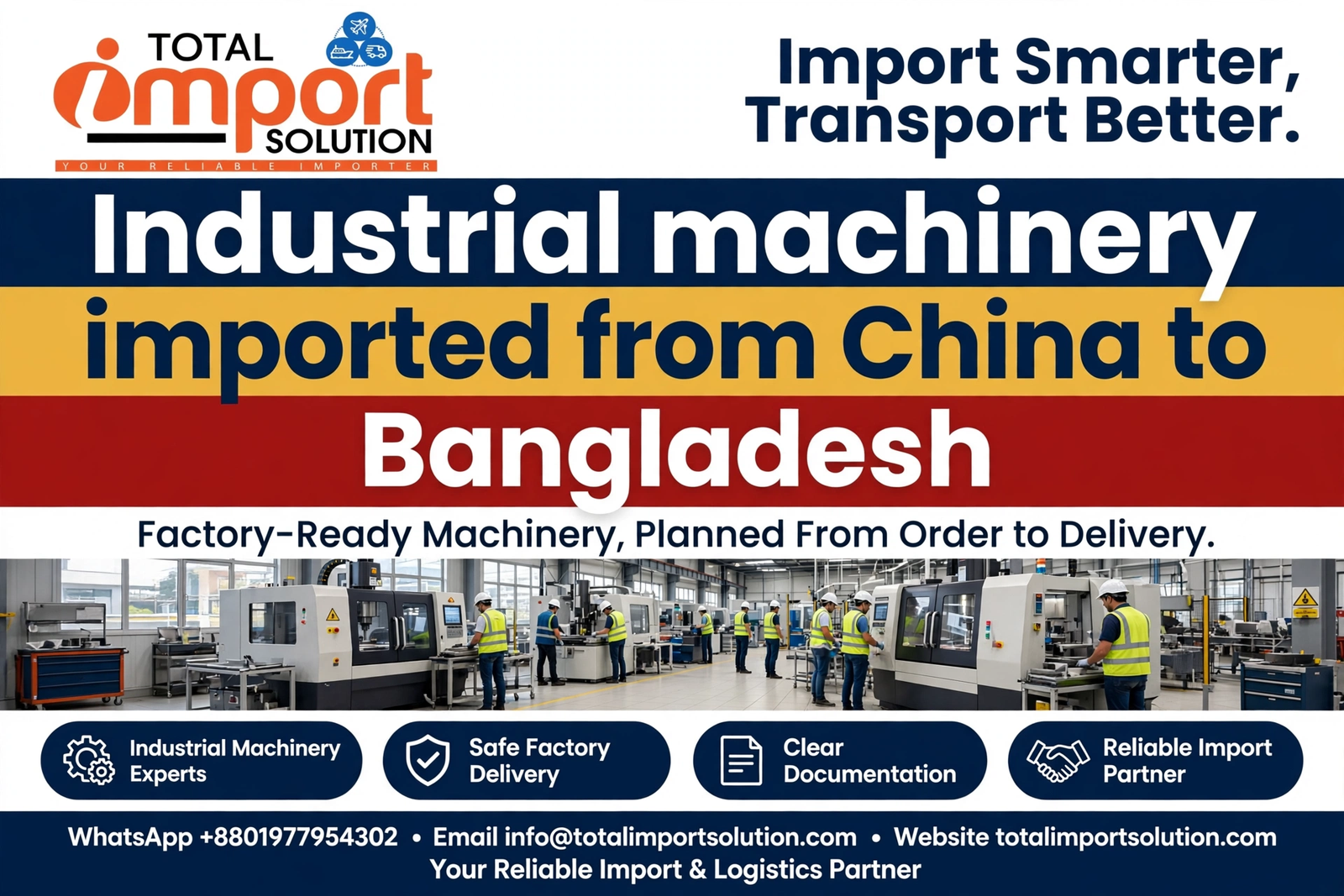
Industrial machinery imported from China to Bangladesh
Importing industrial machinery from China to Bangladesh can help a factory raise output, improve product quality and take on larger orders. At the same time, a machine is a large and heavy item. It needs careful planning, correct documents, safe packing and a clear delivery plan. A small mistake at the start can lead to delay, extra cost or a machine that does not fit the factory floor.
This guide explains the full process in plain steps: what the import covers, the main machine types, the documents, classification, the process from order to delivery, approvals, costs, common problems and how to judge a good import agent. Since 2016, Total Import Solution has worked with importers in Bangladesh on this careful, document-first basis.
1. What industrial machinery import from China covers
Industrial machinery import means bringing machines and production equipment made in China into Bangladesh for use in a factory, workshop or production site. The machinery is bought from a manufacturer or trading company in China, shipped by sea or air, cleared through customs and then delivered, installed and tested at the site.
The import covers more than the machine itself: spare parts, control panels, motors, moulds, tooling, installation parts and the packing that protects the machine. Many buyers order extra spare parts with the first shipment so routine maintenance does not stop production later.
A typical import has four parts: choosing the machine and agreeing the specification, agreeing the price, payment terms, packing and delivery terms, arranging the shipment with documents for export and for customs clearance, and then delivery, installation and testing at the site.
Before you start, be clear about why you need the machine. Write down what product it will make, how much output you need each day, what raw material it will use, what power supply it needs, how much floor space it needs and what skill your operators already have.
2. Types of industrial machinery commonly imported
The range of industrial machinery is very wide. The list below gives the main groups that buyers in Bangladesh commonly import from China. Your machine may fall into one group, or it may combine parts from more than one group.
| Machinery group | Typical use | What to check before ordering |
|---|---|---|
| Garments and textile machinery | Sewing, cutting, knitting, dyeing, finishing, embroidery | Stitch type, speed, fabric range, parts supply |
| Food processing machinery | Grinding, mixing, filling, sealing, baking, packing food | Food contact material, cleaning access, power need |
| Packaging machinery | Filling, sealing, labelling, wrapping, carton making | Pack size range, film size, changeover time |
| Printing machinery | Offset, flexo, digital and large format printing | Print size, colour units, ink type, parts supply |
| Plastic machinery | Injection moulding, extrusion, blow moulding, recycling | Mould size, material type, cooling need |
| Metal working machinery | Cutting, bending, welding, drilling, CNC work | Material thickness, accuracy, tooling, safety guards |
| Material handling machinery | Conveyors, lifts, forklifts, warehouse equipment | Load weight, lift height, floor load, safety brakes |
When you compare machines, do not compare only the model name. Compare the working width, the output per hour, the power need, the weight, the packed size, the voltage, the spare parts list and the warranty terms in writing. Ask the supplier for a specification sheet, a video of the machine working, a packing list with sizes and weights, and a list of the parts that wear out first. If the supplier cannot give these, treat that as a warning sign.
3. How to plan before you order
Good planning saves more time and money than any other step. Most import problems start before the order is placed, when the buyer has not yet fixed the specification, the site plan or the budget. Work through the steps below before you contact a supplier or pay any money.
Step 1: Write the job down. Describe the product, the raw material, the daily output you need, the working hours, the number of operators and the quality standard your buyers expect. Keep this note short and clear so a supplier can read it and reply with a matching machine.
Step 2: Measure the site. Measure the door width and height, the ceiling height, the floor space, the floor load capacity and the path from the gate to the machine position. A large machine may need a door removed or a crane to lift it into place. Measure first and order second.
Step 3: Check power and utilities. Check the voltage, the phase, the power load, the water supply and the compressed air supply. Ask the supplier for the exact power need in writing and ask your electrician to confirm that your supply can meet it.
Step 4: List the people. Decide who will operate the machine, who will maintain it and who will be trained. Ask whether training is included, whether it is on site or by video, how many days it lasts and whether the material is in a language your team can read.
Step 5: Set the budget in full. A machine budget is not only the machine price. It also includes packing, freight, insurance, port charges, customs duty and taxes, clearance charges, local transport, unloading, installation, spare parts and training. A rate or fee is confirmed only after checking the actual shipment and documents, so ask for a written estimate based on your real packing list, and keep a reserve for changes.
Step 6: Set the timeline and decide who will handle the import. Agree a realistic timeline with the supplier for production, inspection, packing, shipping, clearance and installation, and write the dates down. You can handle the import yourself if you have the documents and the experience, or you can work with an import agent. Section 13 explains how to judge a good agent.
4. Finding and checking a supplier in China
A good supplier is as important as a good machine. Take time to check the supplier before you pay. A low price from an unchecked supplier can cost far more than a fair price from a checked one.
Start with a short list. Ask for recommendations from other factory owners, your trade contacts and an import agent who has worked with machinery suppliers before. Look for suppliers who make the machine type you need, not suppliers who sell everything.
Check the supplier in writing. Ask for the company name, the factory address, the business licence details, the main products and a video of the factory floor, not only of the finished machine. Ask for a working video of the exact model with your type of raw material. A video of a different model does not prove that your machine will work.
Test communication. A supplier who replies slowly, who avoids direct questions or who changes the price without reason is hard to work with later. Keep all important points in writing, in messages or email, so both sides can refer back to them.
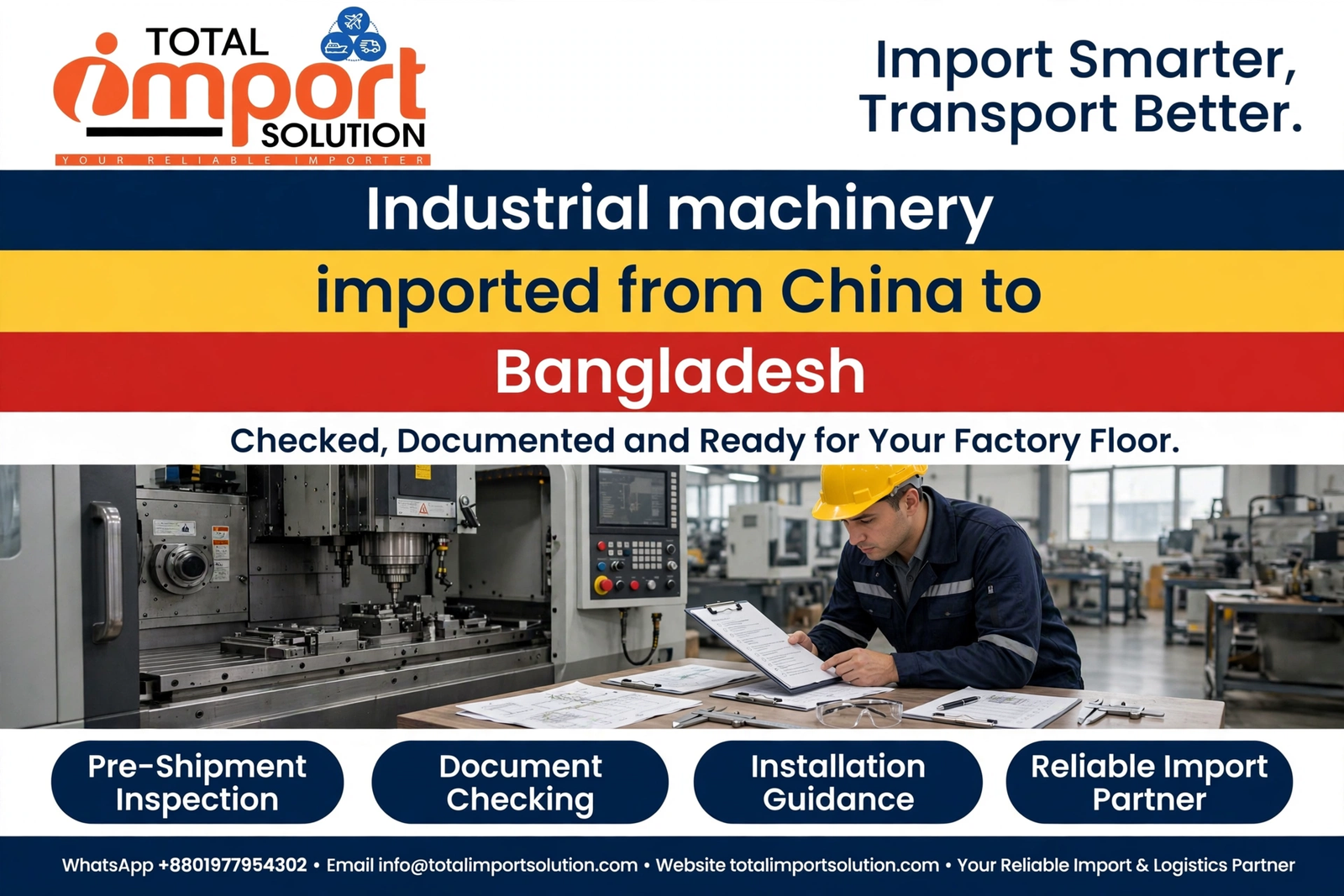
Use inspection where the order is large. For a large or high value machine, a pre-shipment inspection by an independent agent can check the machine, the packing and the documents before loading. Agree the inspection points in writing before production starts. Never pay the full amount before production and inspection. Agree the payment stages in writing: a deposit, a payment after inspection and a final payment linked to a clear stage.
5. Getting a clear quotation and order terms
A quotation is not only a price. It is the full written agreement about what you will receive, how it will be packed, how it will be shipped and what happens if something is wrong. Read every line before you accept it.
A clear quotation should show the machine model and specification, the quantity, the unit price, the total price, the payment terms, the production time, the packing type, the delivery terms, the port of loading, the port of arrival, the warranty period and the spare parts included. If any of these are missing, ask the supplier to add them in writing.
Check the delivery terms. Delivery terms decide who pays for freight, who arranges insurance, who handles export documents and where the risk passes from seller to buyer. Common terms include delivery at the factory in China, delivery on board the ship, delivery to the port in Bangladesh and delivery to your factory door. Ask your import agent to explain the term on your quotation in plain words before you accept it.
Check the packing and the warranty in writing. Ask for the packing size and weight for each case and the number of cases, as this packing list is needed for the freight estimate, the customs documents and planning the truck and unloading. A warranty should state how long it lasts, what parts it covers, what it does not cover, how a fault is reported and how the supplier will respond. Ask for a list of the parts that wear out first, and order the first set with the machine.
Keep one order file with the quotation, the order, the invoice, the packing list, the specification sheet, the payment records, the inspection report and all messages. It will be needed for customs clearance, installation and any later claim.
6. HS code and classification in general terms
Every imported item has a classification code, known as an HS code, which customs uses to identify the item and to decide the duty and tax treatment. It is based on what the item is, what it does and how it works. For industrial machinery, the code depends on the machine type, the function and the main working parts.
Correct classification matters. A wrong code can lead to delay at customs, extra questions, a revised assessment or a penalty. A correct code, supported by a clear description and a specification sheet, makes clearance smoother and faster.
Do not guess the code from a similar machine. Two machines that look alike can have different codes if they do different work. The supplier, the import agent and the customs clearing agent should work together to confirm the code before the shipment leaves China.
Prepare the information that supports the code: the machine name, the model, the function, the working principle, the main parts, the power need, the material it processes and the finished product it makes. A catalogue, a specification sheet and a working video help the clearing agent explain the machine to customs. Check the code early, before you pay for the machine. If the code changes, the duty and tax treatment may change, and your total cost will change with it. A rate or fee is confirmed only after checking the actual shipment and documents. Keep the code consistent, using the same code and description on the invoice, the packing list, the bill of lading and the customs declaration.
7. Documents you will need
Documents are the backbone of an import. A shipment with correct documents clears faster, while a shipment with missing or mismatched documents can wait at the port. Prepare the documents before the shipment leaves China, and check each one against the others.
| Document | Who issues it | What it proves |
|---|---|---|
| Commercial invoice | Supplier in China | Machine, model, quantity, price, buyer |
| Packing list | Supplier in China | Cases, sizes, weights, contents |
| Bill of lading or air waybill | Shipping line or airline | Shipment, vessel or flight, port, consignee |
| Certificate of origin | Chamber or authority in China | Country where the machine was made |
| Insurance document | Insurance company | Cover for loss or damage in transit |
| Import registration and licence papers | Buyer in Bangladesh | Buyer is allowed to import |
| Payment proof | Bank | Payment terms and payment made |
| Test or inspection certificate | Inspection agent or supplier | Machine checked before loading |
| Catalogue and specification sheet | Supplier in China | Machine function, size, power, parts |
| Customs declaration | Clearing agent in Bangladesh | Full declaration to customs |
Check the names and numbers. The buyer name, the supplier name, the machine name, the model, the quantity, the value and the port names must match across the invoice, the packing list and the bill of lading. A small spelling difference can cause a question at customs. Ask the supplier to send draft documents before the final versions so you can check them in time.
Keep originals safe. Keep the original bill of lading, the original invoice and the original packing list in a safe place, and keep scanned copies in your order file. The clearing agent will need the originals or the release documents to clear the shipment.
Ask about approvals early. Some machinery may need an approval, a permission, a test certificate or a registration before import or before use, depending on the machine type and the rules in force at the time. Ask your import agent and your clearing agent early, before you order, whether your machine needs any approval, and allow time to arrange it.
8. Packing, loading and shipping choices
Packing and shipping decide whether your machine arrives in working order. A good machine in weak packing can arrive damaged. A good packing job, with the machine fixed firmly inside, protects the machine through loading, sea movement, unloading and road transport.
Ask for export packing: a strong wooden case or steel frame, with the machine bolted to a base, waterproof covering, moisture protection inside and clear marks showing the case number, weight, lifting points and top side. Ask the supplier to send photos of the packing before loading, with the size and weight of each case.
Choose the shipping mode with care. Sea freight is the usual choice for large and heavy machinery because it can carry large cases. Air freight is faster, but it is limited by size and weight and is usually used for spare parts, urgent parts or small machines. Road transport from the port to your factory needs a truck that can carry the weight and size of the largest case.
Check the container choice. Large machinery may travel in a standard container, an open top container or a flat rack container, depending on the size and height of the packed machine. The supplier and the shipping agent should agree the container type before loading.
Insure the shipment and track it. Transit insurance covers loss or damage during loading, sea or air movement and unloading. Ask your agent what the insurance covers and what documents you need if you make a claim. Take photos of the packing before loading and of the cases on arrival. Ask the shipping agent for the vessel or flight details and the arrival date, and share it with your clearing agent early so clearance documents can be prepared before the ship arrives.
9. Customs clearance in Bangladesh
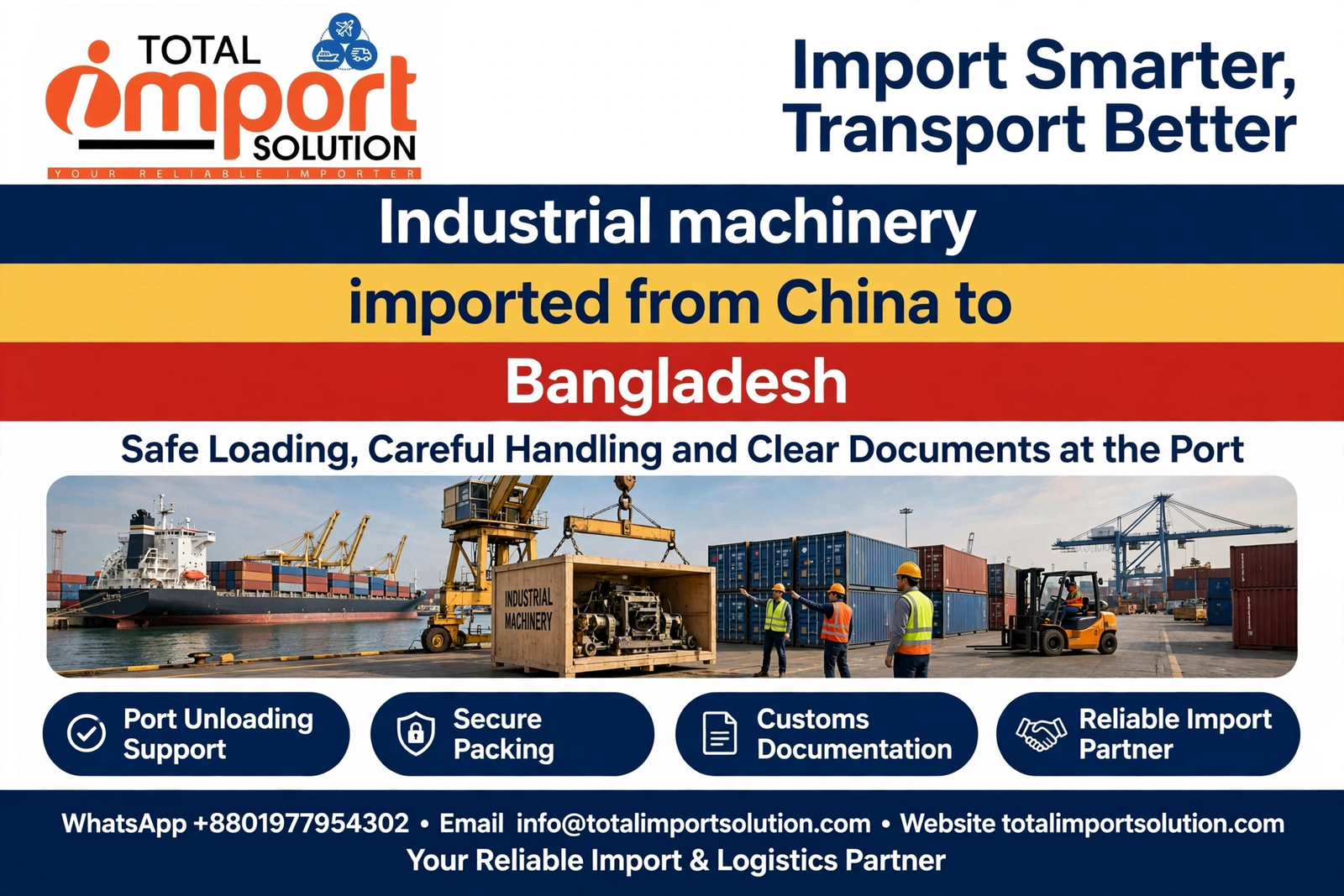
Customs clearance is the formal process of declaring the imported machinery to Bangladesh Customs, having the declaration checked, having the duty and taxes assessed and having the shipment released for delivery. It needs correct documents, a correct declaration and a clearing agent who knows machinery.
The process follows a clear order. First, the clearing agent receives your documents, including the bill of lading, the invoice, the packing list, the certificate of origin, the insurance document and your import papers. Second, the agent prepares the customs declaration, with the machine description, the HS code, the value, the quantity and the origin. Third, the declaration is submitted and the duty and taxes are assessed. Fourth, the duty and taxes are paid through the bank. Fifth, the shipment is examined if customs asks, and then it is released.
Prepare early. Send the documents to your clearing agent as soon as the ship leaves China, or earlier if the supplier can send draft documents. Early preparation lets the agent check the documents and prepare the declaration before the ship arrives.
Answer questions in full. Customs may ask for the catalogue, the specification sheet, the working video, the payment proof or an explanation of the machine function. Answer each question with a clear document, and keep a copy of every answer in your order file. Plan for examination, as customs may check the cases against the declaration, so make sure the packing list matches the cases. Keep the payment receipt, the assessment sheet and the release order together as part of your import record.
10. Delivery, unloading and installation
Delivery is the final physical stage, and it needs the same care as shipping. A machine that has travelled safely from China can still be damaged by a wrong truck, a weak lifting plan or a rushed unloading.
Plan the truck and the lifting. Choose a truck that can carry the weight and the size of the largest case, with space for the case to sit flat and to be tied down. Check that the road to your factory can take the truck and that the gate is wide enough. Large cases need a crane, a forklift or a chain block. Check the lifting points marked on the case and the lifting capacity of the equipment. Never lift a case by a weak point, and never stand under a lifted load.
Unload with care. Unload the cases one by one, check each case number against the packing list and take photos of each case as it arrives. Check for damage, such as a broken case, a wet mark or a dent. If you find damage, note it on the delivery receipt, take photos and inform your agent and your insurer the same day.
Install step by step. Follow the supplier installation manual and do not skip a step. Place the machine on a level floor, fix it to the floor if the manual asks for it, connect the power, the water and the air supply, and check each connection before you switch the machine on.
Test before full production. Run the machine first without load, then with a small test batch, then with a normal batch. Check the output, the quality, the noise, the vibration and the safety guards. Train the operators during the test run, so they learn the normal settings and the first signs of a fault. Keep a test record with the date, the operator name and the result in your order file.
11. Costs in general terms
The total cost of importing industrial machinery is made up of many parts, and each part depends on the real shipment. There is no single fixed cost that fits every machine, because the size, the weight, the route, the packing and the documents differ for each order. Plan the budget by listing each part and asking for a written estimate based on your actual shipment.
The main cost parts are the machine price, the export packing, the freight from China to Bangladesh, the transit insurance, the port charges, the customs duty and taxes, the clearing agent charge, the local transport, the unloading and lifting, the installation, the spare parts and the training. List each part separately in your budget so you can see where the money goes.
A rate or fee is confirmed only after checking the actual shipment and documents. A rate quoted for a small machine, a different port or a different month may not apply to your shipment. Ask the supplier, the shipping agent and the clearing agent for a written estimate based on your packing list, your port of arrival and your delivery address, and ask what is included and what is not included.
Watch for costs that are easy to miss: storage at the port, extra handling for an oversized case, a second truck, a crane hire, a power upgrade and a longer installation time. Ask your agent to list the costs that may arise if clearance is delayed, and keep a reserve in your budget. Since 2016, Total Import Solution has helped importers plan full shipment budgets on this written, item by item basis.
12. Common problems and how to avoid them
Most import problems are not new. They happen again and again, and they can be avoided with a check made at the right time. The table below lists the problems that buyers face most often and the simple step that avoids each one.
| Problem | How it happens | How to avoid it |
|---|---|---|
| Wrong machine size | Specification not written down | Write the product, output and size need first |
| Machine does not fit the site | Door and floor not measured | Measure gate, door, ceiling and floor first |
| Power supply too small | Power need not checked | Ask for power need in writing, check with electrician |
| Weak packing | Packing not agreed in writing | Agree export packing, case size and marks in the order |
| Damage in transit | Machine not fixed inside the case | Ask for photos of packing and fixing before loading |
| Document mismatch | Names or values differ across papers | Check invoice, packing list and bill of lading line by line |
| Wrong truck or lifting plan | Largest case size not shared | Share case sizes and weights with transport company |
| No spare parts | Wearing parts not ordered | Order first wearing parts with the machine |
| Supplier disappears after payment | Supplier not checked | Check factory, video and references before paying |
If a problem does happen, act fast and keep records. Take photos, keep the delivery receipt, inform your agent and your insurer the same day and keep every message in writing. Do not try to fix a large machine fault on your own if you are unsure. Contact the supplier, share the photos and the test record and follow the supplier advice in writing.
13. How to judge a good import agent
A good import agent makes the process simpler, not more confusing. The agent should explain each step in plain words, give you written estimates, keep you updated and keep your documents in order. Use the points below to judge an agent before you give them your order.
Check experience with machinery. Ask how many machinery shipments the agent has handled, what machine types they have handled and what ports they work with. An agent who has handled machinery before will know the packing, the documents and the clearance questions that a general agent may miss.
Check communication. A good agent replies to messages, answers direct questions, shares the shipment status and tells you early if there is a delay. Ask how often they will update you and who your contact person is. Slow communication before the order is a fair warning of slow communication during the shipment.
Check documents, estimates and references. Ask the agent to explain the full process from order to delivery and the stages where you must sign or pay. Ask for a written estimate that lists each cost part separately, based on your real packing list. A rate or fee is confirmed only after checking the actual shipment and documents, so a good agent will not give you a fixed total before they have seen the packing list. Ask for the names of other factory owners who have used the agent, and ask them about communication, documents, delivery and problem handling.
Check problem handling and the written agreement. Ask the agent what they do if a case is damaged, if customs asks a question, if the ship is delayed or if a document is wrong. A good agent has a clear answer for each case and acts the same day. Before you start, agree in writing what the agent will do, what the charge covers, when payments are due and how the agent will report each stage. A good agent checks, writes it down, updates you and keeps the shipment moving.
Frequently Asked Questions
1. What is meant by industrial machinery imported from China to Bangladesh?
It means buying a machine made in China, shipping it to Bangladesh, clearing it through customs and installing it at a factory or workshop in Bangladesh.
2. Which types of industrial machinery are commonly imported from China?
Garments and textile machinery, food processing machinery, packaging machinery, printing machinery, plastic machinery, metal working machinery and material handling machinery are commonly imported. The right type depends on your product and your daily output need.
3. How do I choose the right machine size?
Write down your product, your raw material, your daily output need and your floor space. Compare the working width, the output per hour, the power need, the weight and the packed size of each model. Choose a size that fits today with some room to grow.
4. What documents do I need to import industrial machinery?
You need a commercial invoice, a packing list, a bill of lading or air waybill, a certificate of origin, an insurance document, your import registration papers, payment proof and a catalogue and specification sheet. Your clearing agent will prepare the customs declaration.
5. What is an HS code and why does it matter?
An HS code is the classification code used by customs to identify an item and to decide its duty and tax treatment. A correct code makes clearance smoother, while a wrong code can cause delay or a revised assessment.
6. How is the HS code for my machine confirmed?
The code is confirmed from the real machine specification, the function, the working principle and the main parts, with help from the supplier, the import agent and the clearing agent. Confirm it before the shipment leaves China, and use the same code and description on all documents.
7. Should I import by sea or by air?
Sea freight is the usual choice for large and heavy machinery. Air freight is faster but is limited by size and weight, so it is usually used for spare parts, urgent parts or small machines.
8. How should industrial machinery be packed for export?
It should be packed in a strong wooden case or steel frame, fixed to a base so it cannot move, with waterproof covering and moisture protection inside, and with clear marks for the case number, weight, lifting points and top side. Ask for photos of the packing before loading.
9. How long does customs clearance take?
Clearance time depends on the documents, the machine type, the customs assessment and whether an examination is needed. Sending complete and matching documents to your clearing agent before the ship arrives is the best way to keep clearance on track.
10. What approvals may be needed before import?
Some machinery may need an approval, a permission, a test certificate or a registration before import or before use, depending on the machine type, the industry and the rules in force at the time. Ask your import agent and your clearing agent early, before you order, so you can allow time to arrange any approval.
11. How are the total import costs worked out?
The total is made up of the machine price, packing, freight, insurance, port charges, customs duty and taxes, clearing charges, local transport, unloading, installation, spare parts and training. A rate or fee is confirmed only after checking the actual shipment and documents.
12. Should I order spare parts with the machine?
Yes, order the first set of wearing parts with the machine. A small part that wears out can stop a large machine, and waiting for a part from China can halt production. Ask the supplier for the parts list, the price of each part and the time needed to supply them.
13. What should I check when the machine arrives at my factory?
Check each case number against the packing list, take photos of each case, look for damage and note any damage on the delivery receipt the same day. Then install step by step, test without load, test with a small batch and keep a test record.
14. What training should I ask the supplier for?
Ask for training that covers operation, daily maintenance, cleaning, safety and common faults. Agree in writing whether training is on site or by video, how many days it lasts and whether the material is in a language your team can read.
15. What should I do if a case arrives damaged?
Note the damage on the delivery receipt, take clear photos, inform your agent and your insurer the same day and keep every message in writing. Do not repair a damaged machine on your own if you are unsure. Contact the supplier, share the photos and test record and follow the supplier advice in writing.
16. How do I judge a good import agent for machinery?
Check their experience with machinery shipments, their communication, their document process, their written estimates, their references and their problem handling. A good agent explains each step in plain words, gives written estimates and keeps your documents in order.
Contact Total Import Solution
- WhatsApp: +8801977954302
- Email: info@totalimportsolution.com
- Website: totalimportsolution.com
- Service: Industrial machinery import from China to Bangladesh, with document checking, shipping, customs clearance support and delivery planning
- Since 2016, Total Import Solution has helped importers in Bangladesh plan machinery imports step by step, from supplier checking to installation at the factory.
