
Industrial Heavy Machinery Shipping: Flat Rack Hire Rates
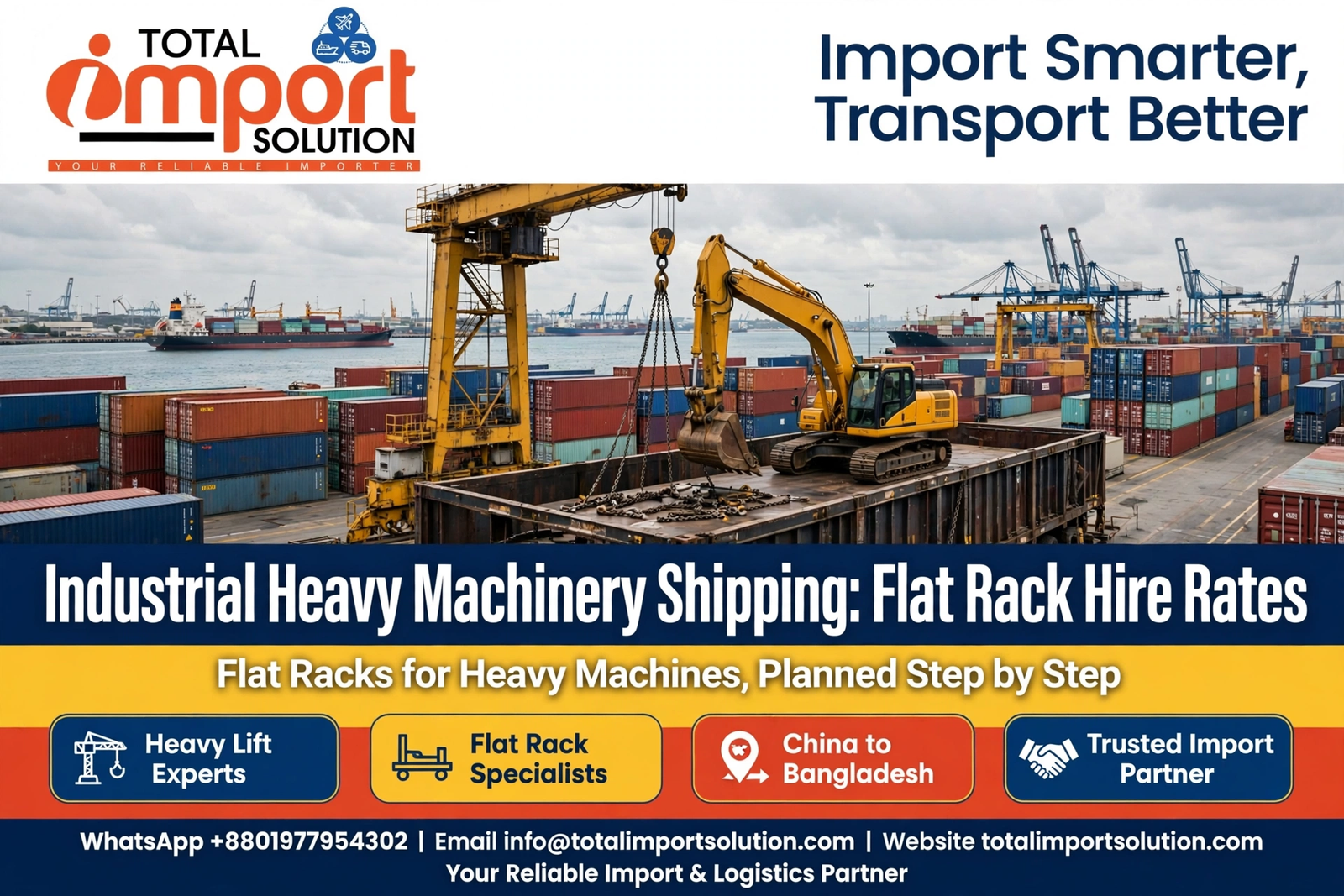
Factories, construction firms, and power projects in Bangladesh regularly bring in heavy machinery from China: excavators, generators, boilers, and plant equipment that keep a site running. Much of this machinery is too tall, too wide, or too heavy for a standard closed container, and that is where a flat rack container comes in. A flat rack has a strong floor and end walls, but no side walls and no roof, so a tall or wide machine can be loaded from the top or from the side and can stand above the frame where a closed box would not allow it.
This guide explains how industrial heavy machinery is shipped from China to Bangladesh on flat racks, and how flat rack hire rates are worked out. A hire rate is not a fixed figure printed in a list. It is worked out from the cargo size and weight, the route, the container type, the lease length, the handling needed, the season, and the documents, and a rate is confirmed only after checking the actual shipment and documents. No rate figure, price, or cost amount is given in this guide, because the real figure depends on the real shipment.
Since 2016, Total Import Solution has supported importers in Bangladesh with machinery shipment planning, flat rack booking guidance, documentation, port and delivery coordination, and customs support. The team works with buyers who are shipping a machine for the first time and with buyers who move heavy equipment on a regular basis. This guide gives practical steps only, and it stresses one point throughout: measure the machine, check the container plate, and agree the lashing plan before the machine leaves the factory.
1. What a Flat Rack Container Is
A flat rack is a shipping container built on a strong flat floor with end walls that can stand up or fold down, and with no side walls and no roof. The open top and open sides let a crane lower a machine onto the floor from above, or let a machine be driven or pushed on from the side where the yard allows it. Once the machine is in place, it is lashed to the floor and to lashing points on the frame, and the load is covered with a tarpaulin where the shipment needs weather protection.
| Flat rack feature | What it means | Why it matters for machinery |
|---|---|---|
| Open top and sides | No roof or side walls | Tall or wide machines can be loaded by crane |
| Strong floor | Built to carry heavy point loads | Excavators and boilers sit safely on the frame |
| Folding end walls | Ends can stand up or fold flat | Long machines can extend past the frame where allowed |
| Lashing points | Rings and slots around the floor and frame | Chains and straps hold the machine in place |
| Collapsible design | Empty racks can be stacked | Empty return takes less space on the vessel |
| Standard lengths | Common sizes are about 20 foot and 40 foot | The size must suit the machine and the route |
A flat rack is not a general purpose box, and it is not the right choice for every load. It suits cargo that is heavy, tall, wide, or awkward in shape, and cargo that must be lifted by crane.
2. When a Flat Rack Suits Heavy Machinery
A flat rack suits heavy machinery when the machine will not fit inside a standard closed container. An excavator with a cab that stands too tall, a generator set with a frame that is too wide, a boiler section that is too long, or a piece of plant equipment with parts that stick out on one side all point toward a flat rack. It also suits a machine that must be lifted by crane, because the open top lets the crane set the load down in one move without forcing it through a door.
| Machinery type | Why a flat rack suits it | What to check first |
|---|---|---|
| Excavator | Tall cab and long arm | Height above the frame and arm position |
| Generator set | Wide frame and heavy base | Weight on the floor and fixing points |
| Boiler section | Long and heavy, awkward shape | Length against the rack and support points |
| Plant equipment | Parts that stick out on one side | Width over the frame and lashing plan |
| Crane parts | Long beams and heavy sections | Length, weight spread, and lifting points |
| Small cartons | Light, loose, need a sealed box | Use a standard closed container instead |
The decision should also weigh the route and the ports. A flat rack load that stands above the frame may need special stowage on the vessel, and the loading port and the discharge port must both be able to handle the lift.
3. Measuring the Machine Before Booking
No flat rack should be booked before the machine is measured. The factory should give the length, width, and height of the machine as it will travel, including any part that sticks out, such as an exhaust stack, a control panel, a wheel, or a raised arm.
Step 1: Ask the factory for travel measurements. Get length, width, and height as the machine will travel.
Step 2: Measure the machine yourself or through the agent. Check the factory figures against the real machine where possible.
Step 3: Note every part that sticks out. Record exhaust stacks, panels, arms, and wheels that add size.
Step 4: Record the weight and the centre of gravity. Ask where the weight sits so the load can be placed evenly.
Step 5: Share a marked sketch or photo. Send the measurements and the sketch to the agent and the shipping line before booking.
4. Weight Limits and the Container Plate
Every container carries a plate that states its maximum gross weight, its tare weight, and its maximum payload, and the flat rack is no exception. The gross weight is the weight of the container plus the cargo, the tare weight is the weight of the empty container, and the payload is the cargo weight the container may carry. The machine, the lashing, the dunnage, and any cover must all fit within the payload shown on the plate. The plate is the authority, and the figures on it must be checked on the actual container, because flat racks of the same size can differ.
| Plate term | What it means | How to use it |
|---|---|---|
| Maximum gross weight | Container plus cargo, the top limit | Never load past this figure |
| Tare weight | Weight of the empty container | Subtract it from the gross weight |
| Maximum payload | Cargo weight the container may carry | Machine plus lashing plus dunnage must fit inside it |
| Size and type marks | Length and type of the flat rack | Confirm the rack suits the machine |
| Inspection date | Last inspection shown on the plate | Check the rack is in date for the voyage |
As a rough guide only, a standard 20 foot flat rack is about 6 metres long and a standard 40 foot flat rack is about 12 metres long, and payloads are commonly in the region of 25 to 40 tonnes depending on the type, but these are approximate figures only. The importer must check the plate on the actual container and ask the shipping line to confirm the allowed payload for the planned voyage.
5. Lashing, Blocking and Securing the Load
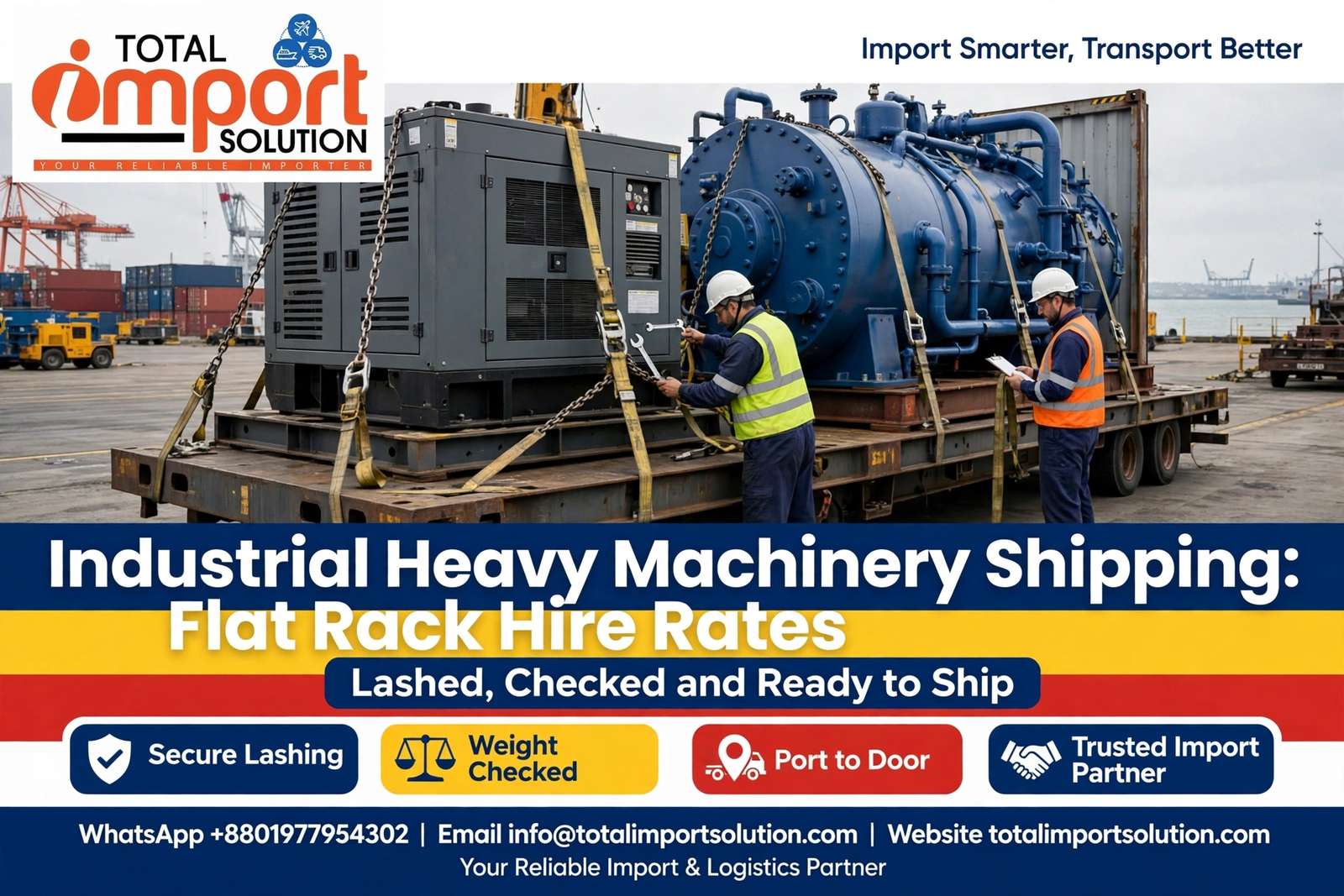
A machine on a flat rack is held in place by lashing and blocking, and the quality of that work decides whether the machine arrives in the same condition it left in. Lashing means chains, wire ropes, or straps fixed from the machine to the lashing points on the rack, pulled tight so the machine cannot slide or tip. Blocking means timber or steel stops placed against the wheels, tracks, or base of the machine so it cannot move forward or sideways. Both must be planned for the sea voyage, where the load will feel rolling and pitching for days.
Step 1: Plan the lashing before loading. Decide where each chain or strap will run and which lashing points it will use.
Step 2: Place the machine over the centre of the floor. Keep the weight even from side to side and from end to end.
Step 3: Block the wheels, tracks, or base. Fit timber or steel stops tight against the machine.
Step 4: Fix chains or straps to the lashing points. Pull each one tight and check that none rubs a sharp edge.
Step 5: Photograph the finished lashing. Keep photos of every side so the plan can be checked later.
Chains should be protected where they pass over a sharp edge, straps should be checked for cuts, and every fixing should be tight. The photos taken at this stage also serve as a record if a damage claim is ever needed.
6. Loading at the Factory and the Port
Loading a heavy machine onto a flat rack needs a firm yard, the right crane or forklift, and a clear plan. The factory yard or the port yard must have firm, level ground that can take the weight of the crane and the machine, and room for the crane to move with the load in the air. The loading team should agree the lift plan before the day of loading: which crane will lift, where it will stand, how the slings will be attached, and where the machine will be set down on the rack.
| Loading point | What to do | Why it matters |
|---|---|---|
| Firm ground | Level ground that can take the crane and the machine | A soft yard can tilt under the lift |
| Crane capacity | Crane rated above the machine weight | The lift must stay well inside the crane limit |
| Slings and hooks | Slings rated for the weight, hooks checked | A failed sling drops the machine |
| Lift plan | Agreed before the loading day | Every person on site knows the plan |
| Setting down | Machine lowered gently onto the rack floor | A hard landing can damage the rack |
| Space to work | Room around the rack for the lashing team | Lashing cannot be done in a tight corner |
The machine should be loaded in its travel position, with arms lowered and folded where the manual allows it, and with loose parts removed or fixed in place. The loading should be photographed from all four sides, and the photos should be kept with the shipment file.
7. Crane Handling and Lifting Points
A crane lifts a machine by its lifting points, and those points must be the ones the maker designed for lifting. The machine manual shows where the lifting eyes, lugs, or sling points are, and the loading team must use those points and no others. Lifting from a part that was not designed for it, such as a pipe, a panel, or a thin bracket, can bend or break the part and can drop the load. The slings must be long enough to keep the angle wide, and they must be protected where they pass over a sharp edge.
Step 1: Find the lifting points in the manual. Use only the points the maker designed for lifting.
Step 2: Check the slings and shackles. Confirm the rating is above the machine weight and the gear is in good order.
Step 3: Agree the lift signals. The crane driver and the banksman must agree the hand signals before the lift.
Step 4: Lift slowly and check the balance. Raise the machine a short way, check it hangs level, then continue.
Step 5: Lower gently onto the rack. Set the machine down slowly and keep hands clear until it is settled.
If the machine hangs unevenly at the first short lift, it should be set down again and the slings adjusted, because an uneven load can swing and can put too much strain on one sling.
8. Route and Port Planning from China to Bangladesh
The route for a flat rack shipment runs from the loading port in China to the discharge port in Bangladesh, and the choice of ports shapes the whole shipment. The loading port must have a crane that can lift the machine onto the rack and the rack onto the vessel, and the discharge port must have a crane that can lift the rack off and set it down safely. The importer should confirm both ports can handle the load before the booking is made, because a port that cannot lift the rack will hold the shipment up.
| Planning point | What to check | Why it matters |
|---|---|---|
| Loading port | Crane capacity and flat rack handling | The machine must be lifted onto the rack and the vessel |
| Discharge port | Crane capacity and yard space | The rack must be lifted off and the machine unloaded |
| Vessel stowage | Space for a load that stands above the frame | A tall load may need a special stow position |
| Road limits | Weight and height limits on the road at each end | The rack must be able to travel to the final site |
| Transit time | Sailing schedule and port calls | Planning the delivery date at the site |
| Return of the rack | Where the empty rack goes after unloading | The lease terms cover the return |
The delivery date at the site should be planned around the sailing schedule, the discharge port work, and the road journey, with time allowed for documents and customs checks.
9. Documents and Customs Checks
Heavy machinery needs a full set of documents, and the documents must match the machine. The commercial invoice, the packing list, the bill of lading, the certificate of origin, and any inspection certificate must all show the same machine description, the same weight, and the same number of packages.
Step 1: Collect the factory documents. Invoice, packing list, and any test or inspection papers from the maker.
Step 2: Check that every document agrees. The machine name, weight, and package count must match on all papers.
Step 3: Prepare the shipping documents. Bill of lading and certificate of origin, with the flat rack number shown.
Step 4: Send the documents to the customs agent early. The agent should review them before the vessel arrives.
Step 5: Keep a full copy of the file. Keep copies of every document with the shipment record.
The importer should ask the customs agent to confirm the classification and the papers needed before the vessel sails, because a missing paper found at the port costs far more time than a paper checked in advance.
10. Risk, Damage Checks and Insurance
A flat rack load is open to the weather and to the movement of the sea, so risk needs a plan. The machine should be covered with a tarpaulin where the shipment needs weather protection, and the cover should be tied down so it cannot flap or tear in the wind. Before loading, the machine should be photographed from all sides, with close photos of any existing mark, and the photos should be dated. After discharge, the machine should be checked again at once, in the presence of the port staff where possible, and any new damage should be noted and photographed before the machine leaves the port.
| Risk point | What to do | Why it matters |
|---|---|---|
| Weather cover | Tarpaulin tied down firmly | Rain and sea spray can damage the machine |
| Loading photos | Photos from all sides before loading | A record of the machine as shipped |
| Discharge check | Check the machine at once on arrival | New damage is found while the port can see it |
| Damage note | Note and photograph any new damage | A clear record supports any claim |
| Insurance cover | Ask the insurer what the policy covers | The importer should know the cover before sailing |
| Claim papers | Keep photos, documents, and reports together | A claim needs a full file |
Insurance should be discussed with the insurer before the vessel sails, and the importer should ask in plain language what the policy covers and what papers a claim would need. The insurer may ask for the loading photos, the lashing photos, and the survey report, so those records should be kept from the start.
11. Common Mistakes with Flat Rack Shipments
Most flat rack problems come from a small set of repeated mistakes, and all of them can be avoided with a check before the machine moves. The most common is booking the rack before measuring the machine, which leads to a rack that is too short, too narrow, or too light for the load. The next is weak lashing, where a chain is left loose or a strap runs over a sharp edge and cuts during the voyage. A third is documents that disagree, where the invoice says one weight and the packing list says another, and customs holds the shipment while the papers are corrected.
Step 1: Measure before booking. Never book a rack until the travel size and weight are known.
Step 2: Check the container plate. Confirm the payload on the actual rack, not on a general list.
Step 3: Plan the lashing in advance. Agree the chains, straps, and blocking before the loading day.
Step 4: Match every document. Check that the machine name, weight, and package count agree on all papers.
Step 5: Confirm both ports can handle the load. Ask about crane capacity at the loading port and the discharge port.
Each of these is easy to spot in advance and hard to fix once the vessel has sailed, so the checks should be done while the machine is still at the factory.
12. Returning the Flat Rack After Delivery
The flat rack is leased, and the lease terms cover its return, so the return should be planned before the machine is unloaded. Once the machine is off the rack, the rack should be cleaned, the lashing and blocking removed, and the floor swept. Any damage to the rack should be photographed and reported to the leasing company at once, with the photos kept on file. The rack should be returned to the place named in the lease, by the date named in the lease, because a late return can bring extra charges under the lease terms.
| Return point | What to do | Why it matters |
|---|---|---|
| Unload with care | Lift the machine off without dragging it | Dragging can damage the rack floor |
| Remove lashing | Take off all chains, straps, and blocking | The rack must return clean and empty |
| Clean the rack | Sweep the floor and remove rubbish | A clean rack is accepted without delay |
| Check for damage | Walk around the rack and photograph any mark | Damage found early is easier to settle |
| Return on time | Return to the named place by the named date | A late return can bring extra charges |
| Get a receipt | Ask for a signed return receipt | The receipt proves the rack was returned |
The empty rack is often collapsible, so several empty racks can be stacked for the return journey, but the folding of the end walls should be done by the depot staff or by a team that knows the rack.
13. How to Judge a Good Provider for Flat Rack Hire
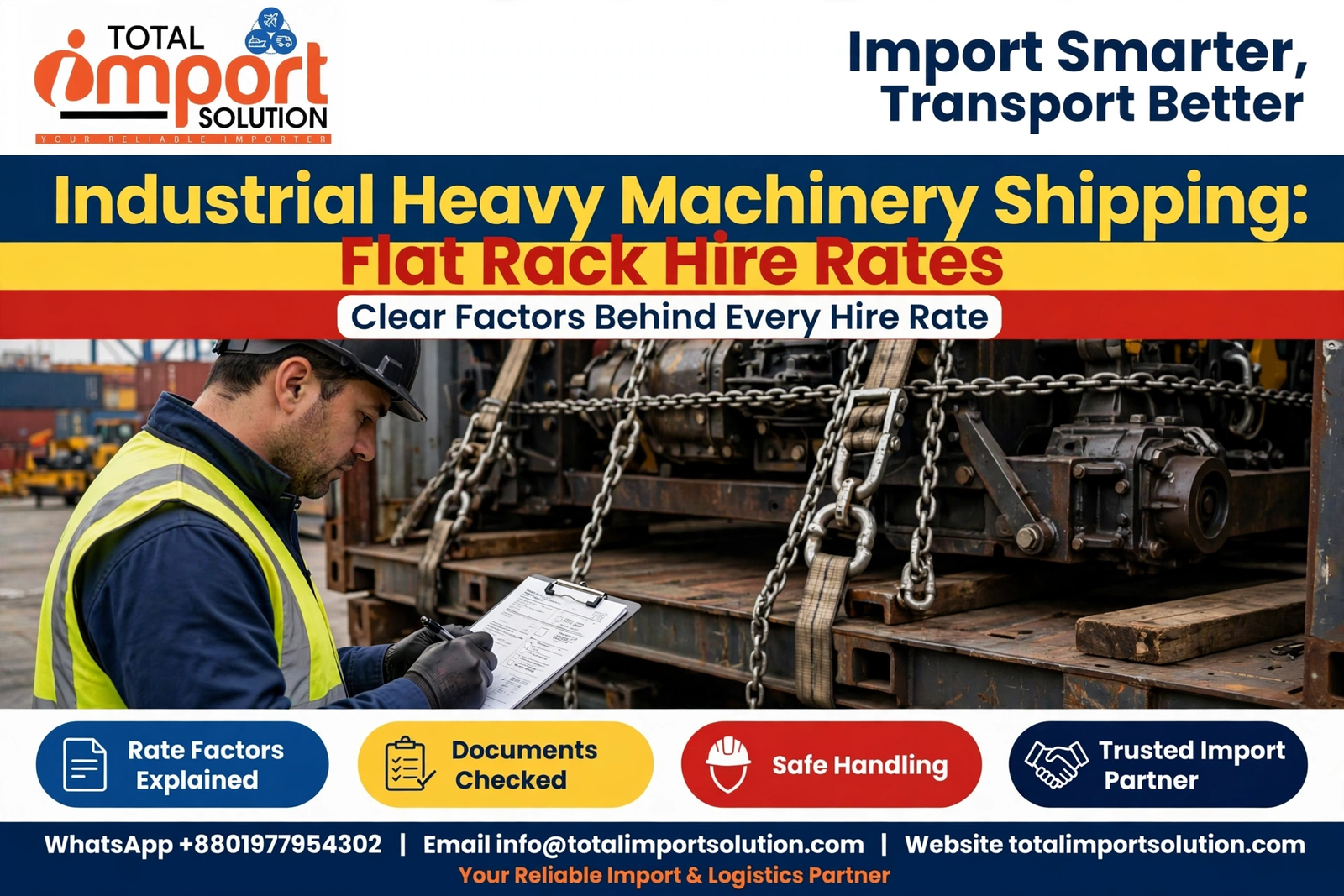
A good provider for flat rack hire is judged by clear terms, a sound rack, and honest communication. Look for a provider that explains the hire rate factors in plain language, gives the rate in writing after checking the shipment and documents, supplies a rack that matches the machine, and provides a full condition report at pick-up.
| Quality to look for | What it looks like in practice | How to check it |
|---|---|---|
| Clear rate factors | Size, weight, route, and lease length explained | Ask how the rate is worked out |
| Written rate | Rate given in writing after checking the shipment | Ask for the written quotation |
| Sound rack | Clean, dry, doors and end walls working | Walk around it with the condition report |
| Full condition report | Every mark listed at pick-up | Check the report against the rack |
| Fast answers | Questions on lashing and ports answered quickly | Ask questions and note the answers |
| Signed return receipt | Rack checked and receipt signed at return | Ask for the receipt at the depot |
| Bangladesh experience | Regular work with Bangladesh importers | Ask about past shipments to Bangladesh |
Total Import Solution has worked with importers in Bangladesh since 2016, and the team aims to give that kind of clear, steady support on every flat rack shipment, from the first measurement to the return of the empty rack. A provider that measures first, explains the rate factors honestly, and stays in contact through loading, sailing, and delivery is a provider worth keeping for the next machine.
Frequently Asked Questions
1. What is a flat rack container?
A flat rack is a shipping container with a strong floor and end walls but no side walls and no roof, so a tall, wide, or heavy machine can be loaded by crane from the top or the side.
2. When does heavy machinery need a flat rack?
When the machine is too tall, too wide, or too heavy for a standard closed container, or when it must be lifted by crane, a flat rack is the usual choice for the shipment.
3. What machinery is shipped on flat racks?
Excavators, generators, boilers, plant equipment, crane parts, and other heavy machines that are too big or too awkward in shape for a closed container.
4. How is a flat rack hire rate worked out?
From the cargo size and weight, the route, the container type, the lease length, the handling needed, the season, and the documents, and a rate is confirmed only after checking the actual shipment and documents.
5. Can I get a fixed hire rate before the shipment is checked?
No fixed figure can be given before the shipment is checked, because the rate depends on the real size, weight, route, and documents of the actual machine being shipped.
6. How do I measure a machine for a flat rack?
Measure the length, width, and height as the machine will travel, including every part that sticks out, and record the weight and where the weight sits.
7. What is the container plate and why does it matter?
The plate on the container states the maximum gross weight, the tare weight, and the maximum payload, and the machine plus lashing and dunnage must fit within the payload shown on the actual container.
8. How is a machine secured on a flat rack?
With chains, wire ropes, or straps fixed to the lashing points on the rack, and with timber or steel blocking against the wheels, tracks, or base, all pulled tight and photographed.
9. Can a flat rack load stand above the frame?
Yes, a tall machine can stand above the frame where the shipping line allows it, but the stowage, the ports, and the road route must all be checked for the extra height first.
10. Which documents are needed for heavy machinery?
The commercial invoice, packing list, bill of lading, certificate of origin, and any inspection certificate, all showing the same machine description, weight, and package count.
11. How do I protect a machine from weather on a flat rack?
Cover the load with a tarpaulin tied down firmly so it cannot flap or tear, and check the cover and the lashing again before the vessel sails.
12. What should I check when the machine arrives?
Check the machine at once on arrival, in the presence of the port staff where possible, and note and photograph any new damage before the machine leaves the port.
13. What mistakes cause the most trouble with flat racks?
Booking before measuring, weak lashing, documents that disagree, a rack that cannot carry the weight, and ports that cannot handle the lift.
14. How is a flat rack returned after delivery?
The machine is lifted off with care, the lashing and blocking are removed, the rack is cleaned and checked for damage, and it is returned to the place named in the lease by the named date.
15. What makes a good flat rack hire provider?
Clear rate factors explained in plain language, a written rate after checking the shipment, a sound rack with a full condition report, fast answers, and regular experience with Bangladesh importers.
16. How can Total Import Solution help with flat rack hire?
Total Import Solution supports importers with measurement advice, flat rack booking guidance, lashing planning, document checking, port and delivery coordination, and customs support in Bangladesh.
Contact Total Import Solution
- WhatsApp: +8801977954302
- Email: info@totalimportsolution.com
- Website: totalimportsolution.com
- Service: Industrial Heavy Machinery Shipping: Flat Rack Hire Rates
- Company: Total Import Solution — Since 2016, serving importers in Bangladesh.
