
How to Rent Containers from Ningbo to Dhaka Efficiently
Ningbo is one of the busiest export ports on the China coast, and Dhaka is the main destination for much of Bangladesh’s imported cargo. Every week, importers move goods between the two cities — garments and textiles, machinery and spare parts, electronics, raw materials and household goods. The question that decides whether the shipment runs smoothly is a practical one: how do you rent the right container, on the right terms, without wasting days or paying for mistakes?
This guide explains how to rent containers from Ningbo to Dhaka efficiently, step by step: fixing your cargo facts, choosing the container size and type, deciding between a one-way and a round-trip rental, getting the terms in writing, booking in time, loading and sealing, following the sea leg, and receiving the container in Dhaka. Rates and timing are confirmed at booking, depending on the cargo, the route, availability, documents, payment and port conditions.
What Renting a Container from Ningbo to Dhaka Really Means
Renting a container is not the same as buying one, and it is not the same as booking space on a vessel. When you rent a container for this route, you are arranging the use of a steel box for a single journey — or for a set period — so that your goods can be loaded at or near Ningbo, carried by sea, discharged in Bangladesh, and delivered to Dhaka. After the goods are unloaded, the empty container is returned to the place named in the rental instruction.
The rental usually sits inside a wider shipping arrangement. One party provides the container, another carries it by sea, and the importer or a partner such as Total Import Solution brings the chain together. Before you ask for a price, it helps to know who does what: who supplies the container, who books the vessel, who handles the export documents in China, who clears customs in Bangladesh, and who arranges the final delivery to Dhaka.
Step 1: Fix Your Cargo Facts First
Every efficient rental starts with the cargo, not the container. Before you contact anyone about a rental, write down the facts of your shipment in one short list. What are the goods? How much do they weigh, and how much space do they take up? How are they packed — cartons, crates, pallets, drums, or loose pieces? Do they need to stay dry, cool, or upright?
Also fix the places and the dates: where exactly is the supplier, where in Dhaka must the goods arrive, and by when are they needed? The answers decide the container size and type, the loading point, and how much time the journey needs. The supplier should confirm the cargo-ready date in writing, because the whole plan is built backwards from that date.
Step 2: Choose the Right Container Size and Type
Choosing the wrong container is one of the most expensive mistakes on this route, because a replacement may not be available on the day you need it. A 20-foot container suits heavy, compact cargo where weight limits the load — machinery parts, metal goods, stone and chemicals in drums. A 40-foot container suits lighter, bulkier cargo where volume limits the load — garments, textiles, consumer goods and furniture. A 40-foot high cube gives extra height for light, tall cargo.
A standard dry container suits most general cargo. An open top container suits cargo loaded from above, such as tall machinery, and a flat rack suits oversized cargo that does not fit inside a standard box. A refrigerated container, or reefer, suits cargo that must stay at a controlled temperature, such as food or certain chemicals, and it needs a power supply during transport and storage. A tank container suits liquid cargo. Measure and weigh the cargo, share the facts in writing, and let the choice follow the real cargo rather than a guess.
Step 3: Decide Between a One-Way and a Round-Trip Rental
Not every rental works the same way. A one-way rental means the container is picked up near Ningbo, loaded, carried to Bangladesh, unloaded in Dhaka, and returned empty to a depot named in the instruction — it does not go back to China. This suits a single shipment. A round-trip rental means the container goes out loaded and comes back, which only makes sense when there is cargo for the return leg.
Ask which kind of rental is being offered before you compare anything. A one-way rental and a round-trip rental are priced differently, and the return depot matters: returning the empty container to the wrong depot, or late, can attract extra charges. Confirm the return depot in writing, along with the free time allowed for unloading and return.
Step 4: Ask for the Rental Terms in Writing
A container rental is an agreement, and an agreement should be written down. Before you confirm, ask for the terms in writing and read them slowly. They should state the container size and type, the pick-up point, the loading window, the ports, the destination, the return depot, the free time, and what is included in the price — and what is not, such as port charges, documentation, customs duty, storage, the final delivery, and any charge for a late or damaged return.
Ask how the price is worked out. The total cost is made up of several parts: the container rental, the sea freight, the port charges at both ends, customs duty and other government charges, the clearing fee, and the final delivery charge to Dhaka. A rate is confirmed at booking, depending on cargo, route, availability, documents, payment and port conditions. Compare offers by the full list of parts, not by one headline figure, because an offer that leaves out port charges or the final delivery can look cheaper and cost more in the end.
Step 5: Book Early and Watch the Cut-Off Dates
Ningbo is a busy port, and vessel space fills up. A booking made close to the sailing date may find no space left, and the cargo then waits for the next sailing. Booking early gives more choice of container size and type, more chance of space on the preferred sailing, and more time to fix a document problem.
Every booking has cut-off dates, and they are the real deadlines. The document cut-off is the last time shipping documents can be submitted; the cargo cut-off is the last time the loaded container can enter the port. Ask for both cut-off dates in writing at booking, put them in the calendar, and build the plan around them rather than around the departure time. If the cargo-ready date slips, tell the rental provider and the shipping line at once, in writing, so the booking can be adjusted before the cut-off passes.
Step 6: Loading and Sealing at Ningbo
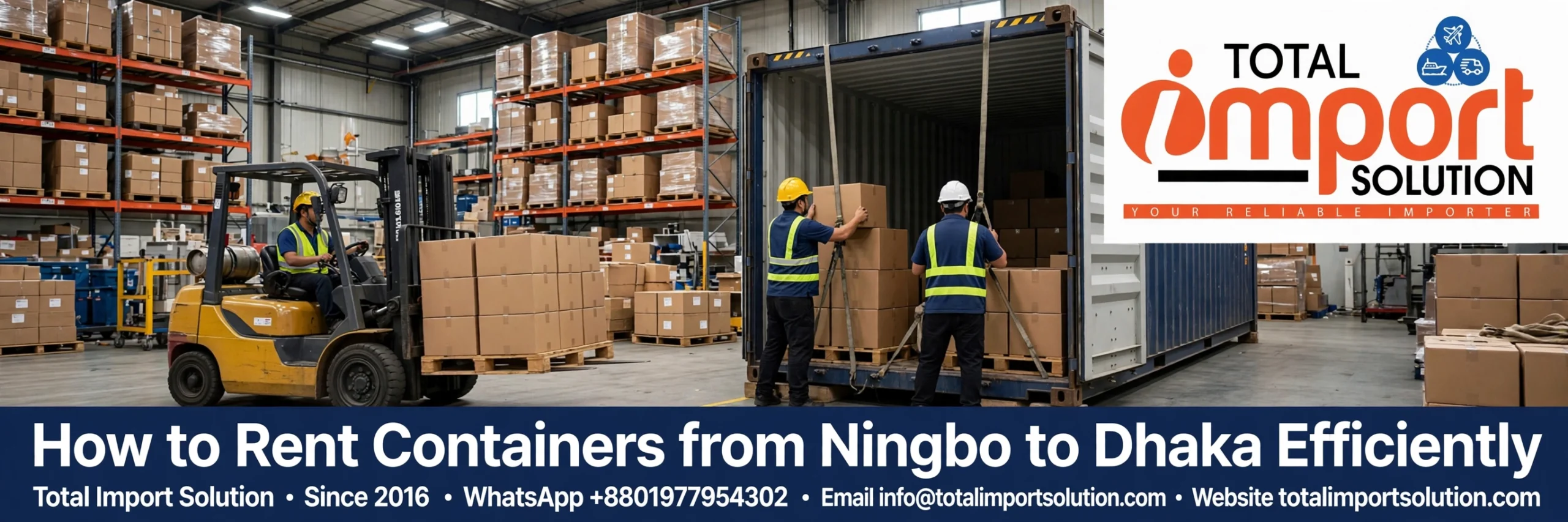
Loading is where careful preparation pays off. Before the container is loaded, check that it is clean, dry, and free of damage, and that its doors close and seal properly. A damp or unclean container can damage a whole load of garments or textiles.
Load the cargo so that it cannot move. Heavy items go at the bottom, light items on top, and the weight should be spread evenly. Fragile goods need cushioning and clear marking. Secure the load with straps or bracing where needed, and keep a record of what went into the container and in which order. When loading is finished, the container is sealed, and the seal number is recorded and checked against the shipping documents.
Step 7: The Sea Leg and Following the Shipment
Once the container is loaded and sealed, it moves to the port at Ningbo and is loaded onto the vessel. The shipping line or its agent issues the bill of lading, the key transport document for the journey. The importer should receive a copy and check it carefully: the shipper, the consignee, the port of loading, the port of discharge, the container number, the seal number, and the description of the goods. Any mistake should be corrected while the vessel is still at sea, because a correction is harder and slower after arrival.
While the vessel is at sea, the importer in Dhaka should prepare: the import documents checked, the payment arrangement in place, and the clearing agent given copies of the file in advance. Do not plan around a single arrival date: the sea leg depends on the route and whether the service is direct or transhipment.
Step 8: Arrival, Customs and Delivery in Dhaka
When the vessel reaches Bangladesh, the container is discharged at Chittagong Port or Mongla Port and moved into the yard or a nearby depot. From there it travels to Dhaka by road, or by river where that suits the cargo. Customs requires the bill of entry, bill of lading, invoice, packing list and import registration documents.
Prepare the customs file before the vessel arrives, so the bill of entry can be submitted as soon as it berths. Tell the clearing agent the vessel’s arrival in advance, with copies of the documents already shared. Before the container reaches the warehouse, confirm the delivery address, the receiver, the unloading equipment and the storage space. When it arrives, check the seal number against the bill of lading before opening it, and count the cargo against the packing list as it is unloaded.
Free Time, Demurrage and Detention
Free time is the number of days a container can stay at the port or in the importer’s hands without an extra charge. Demurrage is the charge for keeping a container inside the terminal beyond the free time; detention is the charge for keeping it outside the terminal, for example at a warehouse, beyond the free time. Both charges grow with each extra day.
Ask in writing how many free days apply, when they start, and what applies after they end, and keep the answer with the booking confirmation. Then build the receiving plan to fit inside the free time: truck booked, unloading team ready, warehouse space prepared. Return the empty container promptly, clean and dry, to the depot named in the return instruction, within the free time, and keep the gate-in receipt as proof of the return. A late return can attract detention, and a dirty or damaged container can attract cleaning or repair charges.
Common Mistakes That Waste Time and Money
Most problems on the Ningbo to Dhaka route happen again and again, for the same reasons. The first is choosing the wrong container: the cargo does not fit, or it needs a reefer or an open top and was booked into a standard dry box. The fix is to measure and weigh the cargo and share the facts in writing before booking. The second is a document mismatch: the invoice, the packing list and the bill of lading disagree on a quantity, a description or a value. Check the three documents against each other before the goods leave China.
The third mistake is booking late and missing the cut-off, so the container waits for the next sailing. The fourth is poor packing: cartons that are not strong enough, and goods that are not secured inside the container, can arrive damaged. The fifth is comparing offers by the headline rate alone and finding later that port charges, documentation or the final delivery were left out. The sixth is having no receiving plan in Dhaka, so the container waits at the warehouse gate while the unloading team and the storage space are arranged.
Working with a Rental Partner
Few importers handle every step of a Ningbo to Dhaka rental on their own. Most work with a supplier in China, a shipping arrangement, and a clearing agent in Bangladesh, and often with an importer or trade service that brings the whole chain together. A rental partner such as Total Import Solution can check container availability, place the booking, follow the vessel and coordinate with the clearing agent.
The partnership works best when the importer shares complete information: the real cargo facts, the real deadline, and any document problem that already exists. Agree the scope in writing — who supplies the container, who books the vessel, who prepares which documents, who clears customs, and who arranges the final delivery — so that no step is left to assumption. A good partner will also be honest about what cannot be promised: no one can promise a container on a fixed date or a fixed sailing, because availability, documents, payment and port conditions decide the timing.
A Practical Checklist Before You Confirm
Before confirming a rental, work through this checklist. First, confirm the cargo facts in writing: goods, weight, volume, packing, container size and type, and the supplier’s location. Second, confirm the rental kind — one-way or round-trip — and the return depot. Third, confirm the full cost in writing, with every part listed.
Fourth, confirm the booking, the vessel, and the cut-off dates, and put them in the calendar. Fifth, confirm the documents agree and are ready before the vessel sails. Sixth, confirm the loading plan, the seal number, and the bill of lading details. Seventh, confirm the receiving plan in Dhaka: truck, unloading team, warehouse space, and the clearing agent’s file. Eighth, confirm the free time and the return plan for the empty container.
Frequently Asked Questions
1. How do I rent a container from Ningbo to Dhaka?
Share the cargo facts, the supplier location and the destination in Dhaka with a rental provider, choose the container size and type, agree the terms in writing, and book the container and the vessel space. Rates and timing are confirmed at booking.
2. Which container size should I choose for a Ningbo to Dhaka shipment?
It depends on the cargo. A 20-foot container suits heavy, compact cargo, while a 40-foot container suits lighter, bulkier cargo, and a 40-foot high cube gives extra height. Measure and weigh the cargo first.
3. What is the difference between a one-way and a round-trip container rental?
A one-way rental means the container is returned empty to a depot in Bangladesh after unloading in Dhaka. A round-trip rental means the container goes out loaded and comes back, which only makes sense when there is cargo for the return leg.
4. What documents do I need to rent a container from Ningbo to Dhaka?
The key documents are the commercial invoice, the packing list and the bill of lading, along with the import registration, the payment documents, and any certificate the goods require.
5. How early should I book a container from Ningbo?
As early as possible. Booking early gives more choice of container size and type, more chance of space on the preferred sailing, and more time to fix document problems before the cut-off dates.
6. What are cut-off dates, and why do they matter?
Cut-off dates are the last times for submitting documents and for delivering the loaded container to the port. Missing one can mean losing the booking.
7. Can I rent a refrigerated container from Ningbo to Dhaka?
Yes, a refrigerated container suits cargo that must stay at a controlled temperature. Confirm that power is available during transport and storage.
8. How is the cost of renting a container from Ningbo to Dhaka worked out?
The total cost is made up of the container rental, the sea freight, the port charges at both ends, customs duty, the clearing fee, and the final delivery charge to Dhaka. Rates are confirmed at booking.
9. How long does a shipment from Ningbo to Dhaka take?
The total time depends on production time, the booking and sailing, the sea leg, customs and port handling, and the final delivery to Dhaka. Plan with a margin.
10. What should I check on the bill of lading?
Check the shipper, the consignee, the port of loading, the port of discharge, the container number, the seal number, and the description of the goods. Check it early.
11. What is free time, and why does it matter on this route?
Free time is the number of days a container can stay at the terminal or with the importer without an extra charge. Plan receiving and return to fit inside it.
12. What is the difference between demurrage and detention?
Demurrage is the charge for keeping a container inside the port terminal beyond the free time. Detention is the charge for keeping it outside the terminal, for example at a warehouse for unloading, beyond the free time. Both grow with each extra day.
13. What should I check when the container arrives in Dhaka?
Check the seal number against the bill of lading before opening the container, and count the cargo against the packing list as it is unloaded.
14. When and how should I return the empty container?
Return it promptly to the depot named in the return instruction, within the free time, clean and dry. Keep the gate-in receipt as proof of the return.
15. How can Total Import Solution help with renting a container from Ningbo to Dhaka?
Total Import Solution, an importer since 2016, can check container availability, arrange the rental and the booking, prepare and check the documents, work through customs clearance, and arrange delivery to the warehouse in Dhaka.
Contact Total Import Solution
Total Import Solution — Your Reliable Importer, since 2016.
WhatsApp: +8801977954302
Email: info@totalimportsolution.com
Website: totalimportsolution.com
Share the supplier location in Ningbo, the goods, the quantity and the destination warehouse in Dhaka to discuss the container, the route, the documents and the steps.
