
Heavy Lift Cargo Shipping from China to Bangladesh
Heavy lift cargo shipping from China to Bangladesh is the movement of cargo that is too heavy, too tall, too wide, or too long for a standard container. This kind of cargo needs special planning, special equipment, and careful handling at every stage. A single mistake in measurement, packing, or paperwork can delay a shipment for days.
Since 2016, Total Import Solution has helped importers move cargo from China to Bangladesh. This guide explains the full process in plain steps, from the first measurement at the factory to final delivery at the site in Bangladesh.
1. What Heavy Lift Cargo Means for China to Bangladesh Shipments
Heavy lift cargo is cargo that cannot be loaded into a standard shipping container without special handling. It may be heavy, oversized, or both. A transformer, a boiler, a large generator, a press machine, or a long steel structure all fall into this group.
The first step is to know the exact size and weight of each piece. Measure the length, width, and height after packing, not before. Weigh each piece on a certified scale and record the centre of gravity when the piece is uneven. The loading port in China and the discharge port in Bangladesh must both have a crane with enough capacity, and the road to the final site must be checked for bridge limits and turning space.
| Cargo Feature | Why It Matters | What to Check |
|---|---|---|
| Gross weight of each piece | Decides crane capacity and vessel gear | Certified weight certificate |
| Size after packing | Decides stowage space and road route | Final packed dimensions |
| Centre of gravity | Decides sling positions and lift balance | Marked lifting points |
2. Types of Heavy and Oversized Cargo from China
China supplies a wide range of heavy and oversized cargo to Bangladesh. The most common items are industrial machines for factories, power equipment, construction machines, and long steel products.
Industrial machines such as printing, textile, plastic, and food processing machines are often tall and top-heavy. They need a strong wooden case or a steel frame, with the base bolted down so the machine cannot move inside the packing. Power equipment such as transformers, generators, and boilers is often very heavy for its size. These pieces need lifting lugs that are tested and marked, and the lifting team must know the exact weight before the lift starts.
Construction and project cargo includes excavators, cranes, long pipes, steel beams, and pre-fabricated structures. Long pieces need support at several points so they do not bend during lifting or transport. Pipes and beams should be bundled so they stay stable, with edge protection where slings touch the cargo.
| Cargo Type | Common Examples | Main Handling Need |
|---|---|---|
| Industrial machines | Printing, textile, plastic, food machines | Strong case, bolted base, upright mark |
| Power equipment | Transformer, generator, boiler | Tested lifting lugs, leak check |
| Construction machines | Excavator, crane, loader | Track protection, tie-down points |
3. Main Routes and Ports for Heavy Lift Cargo
Most heavy lift cargo from China to Bangladesh moves by sea. The cargo is loaded at a port in China, carried by vessel to a port in Bangladesh, and then moved by road to the final site.
Chittagong is the main sea port for Bangladesh, and it handles the largest share of heavy and oversized cargo. Mongla is another sea port that serves the south-western part of the country. For cargo that must reach Dhaka and the surrounding industrial areas, Chittagong is often the practical choice, followed by road transport to the site.
| Route Stage | Key Point | Action Before Booking |
|---|---|---|
| Factory to loading port in China | Road limits and permits | Confirm route and truck type |
| Loading port in China | Crane capacity and experience | Confirm crane and berth |
| Sea voyage to Bangladesh | Stowage and lashing plan | Approve stowage plan in writing |
| Discharge port in Bangladesh | Crane, yard, and customs readiness | Confirm port readiness |
| Port to final site | Road survey and unloading gear | Survey route and site access |
4. Choosing the Right Vessel and Equipment
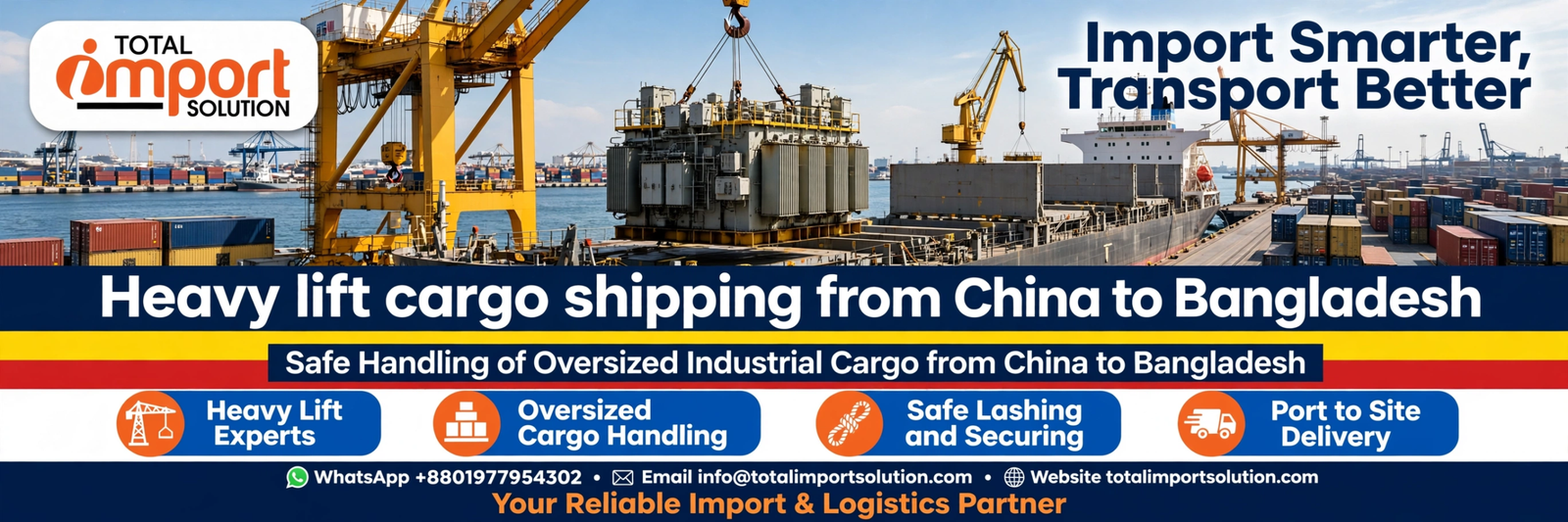
The vessel and the equipment must match the cargo. A heavy lift vessel has its own cranes on board and can lift heavy pieces without help from the port crane. A flat rack can work for cargo that is oversized but still fits within container handling limits. A roll-on roll-off vessel can work for wheeled machines that can be driven on board.
Start with the heaviest piece. If it is heavier than the port crane can lift, a heavy lift vessel with its own cranes is the practical option. If the cargo fits on a flat rack and the port can handle it, that route may be simpler. Do not choose the vessel first and then try to fit the cargo to it. The cargo decides the vessel, not the other way around. The lifting gear matters as much as the vessel. Slings, shackles, spreader beams, and lifting frames must be rated for the weight they will carry, and they must be inspected before use.
| Equipment | When It Is Used | What to Confirm |
|---|---|---|
| Heavy lift vessel with own cranes | Very heavy pieces, ports with limited cranes | Crane capacity and outreach |
| Flat rack container | Oversized cargo within handling limits | Flat rack size and lashing points |
| Low bed trailer | Tall cargo on the road | Bed height and axle load |
| Multi-axle trailer | Very heavy cargo on the road | Axle count and road permits |
5. Planning the Shipment Step by Step
Good planning is the difference between a smooth heavy lift shipment and a delayed one. The plan should start several weeks before the cargo is ready at the factory. Each step depends on the one before it, so a delay in measurement or paperwork will push the whole schedule.
Step one is to collect the cargo facts. Get the final dimensions, the weight, the centre of gravity, the packing type, and the handling notes from the supplier. Ask for photos of the packed cargo and a drawing that shows the lifting points. Step two is to choose the route and the ports. Confirm the loading port in China and the discharge port in Bangladesh, and check the crane capacity at both ports, the yard space, and the road route from each port. Step three is to book the vessel and the equipment, and to ask for the stowage plan and the lashing plan in writing. The stowage plan shows where each piece will sit on the vessel, and the lashing plan shows how each piece will be secured.
Step four is to prepare the documents. The commercial invoice, packing list, and other shipping documents must match the cargo exactly. A mismatch in weight, quantity, or description can hold the cargo at customs. Step five is to supervise loading. A surveyor or a trained supervisor should be present at loading to check the lifting, the positioning, and the lashing. The vessel should not sail until the lashing is checked.
- Collect final dimensions, weight, and handling notes.
- Choose the loading port, discharge port, and road routes.
- Book the vessel and approve the stowage and lashing plans.
- Prepare the invoice, packing list, and documents to match the cargo.
- Supervise loading, lashing, and securing in China.
- Track the voyage and prepare customs, truck, and crane.
- Discharge, clear customs, and move the cargo to the site.
6. Packing, Lashing, and Securing Heavy Cargo
Packing protects the cargo from rain, salt air, vibration, and movement during the voyage. Heavy cargo needs stronger packing than normal cargo, because the forces during lifting and sea transport are greater.
Wooden cases for heavy machines should use thick timber, strong joints, and steel straps. The base of the case should be strong enough to carry the full weight of the machine, and the machine should be bolted to the base. The inside of the case should have blocking and bracing so the machine cannot move. Steel frames and cradles are used for cargo that cannot fit in a case, such as long pipes, large tanks, or machines with an irregular shape. The cradle should support the cargo at several points and hold it in a stable position, with padding where it touches the cargo.
Lashing holds the cargo in place on the vessel and on the truck. Chains, wire ropes, and turnbuckles are used to tie the cargo down to the deck or to the trailer. The lashing must be tight, balanced, and checked after the first part of the journey, because vibration can loosen a lashing that was tight at the start. The lashing points on the cargo should be the lifting lugs or the marked securing points, not a fragile part of the machine.
| Packing and Securing Item | Purpose | Check Before Loading |
|---|---|---|
| Wooden case with bolted base | Holds machine firm inside the case | Bolts tight, base strong |
| Steel frame or cradle | Supports irregular or long cargo | Multi-point support, padding |
| Waterproof cover | Keeps rain and sea spray out | Cover sealed, no tears |
| Chains and wire ropes | Ties cargo to deck or trailer | Rated load, no damage |
7. Documents Needed for Heavy Lift Cargo
Documents are the backbone of a heavy lift shipment. The cargo cannot be loaded, cleared, or delivered without the right papers, and every paper must agree with the others.
The commercial invoice states what the cargo is, how many pieces there are, and the value agreed between buyer and seller. The packing list states the weight and dimensions of each piece, the packing type, and the marks on each case. The bill of lading is the transport document issued by the carrier, and it must match the invoice and the packing list. For heavy lift cargo, extra papers are often needed: a weight certificate, a lifting and handling note from the supplier, and a survey report from loading. Keep all of these papers in one file, and share copies with the shipping team, the customs agent, and the site team.
Check the documents before the vessel sails. Read the invoice, the packing list, and the bill of lading side by side. Check the names, the addresses, the piece count, the weight, and the description of the cargo. If a paper has an error, correct it before the vessel sails, because a correction after sailing takes more time and can delay customs clearance in Bangladesh.
| Document | What It Shows | Who Prepares It |
|---|---|---|
| Commercial invoice | Cargo description, quantity, value | Seller in China |
| Packing list | Weight, dimensions, packing of each piece | Seller or packer |
| Bill of lading | Transport record, ports, consignee | Carrier or shipping line |
| Weight certificate | Certified gross weight per piece | Weighbridge or surveyor |
| Handling note | Lifting points, centre of gravity | Supplier |
Since 2016, Total Import Solution has prepared and checked these documents for importers. A clean document file means a faster customs process and a shorter stay at the port.
8. Customs Clearance in Bangladesh
Customs clearance in Bangladesh is the process of presenting the cargo and its documents to customs, paying the applicable charges, and receiving permission to take the cargo out of the port.
The first step is to file the import documents with customs through the appointed customs agent. The agent checks the invoice, packing list, bill of lading, and other papers, and files the declaration. Customs may ask for the weight certificate, the handling note, or the survey report, so keep those papers ready. The second step is assessment. Customs checks the description, the quantity, and the value of the cargo against the declaration. For heavy machines, the description must be clear and specific, so customs can identify the item and its use. A vague description such as machine parts can cause questions, while a clear description with model and serial number helps the process move forward.
The third step is examination when customs asks for it. Heavy lift cargo may be examined at the port, and the examination team needs safe access to the cargo. The cases may be opened for inspection, and the cargo must be handled with care during the examination. The fourth step is payment of the applicable charges and release of the cargo. A rate or a fee is confirmed only after checking the actual shipment and documents. Once customs releases the cargo, arrange the truck and the site crane without delay.
| Customs Stage | What Happens | Your Preparation |
|---|---|---|
| Filing | Declaration filed with documents | Complete file, matching papers |
| Assessment | Description, quantity, and value checked | Clear item description |
| Examination | Cargo inspected at the port | Safe access, labour, packing ready |
| Release | Cargo cleared to leave the port | Truck and crane booked |
9. Inland Transport from Port to Site
Inland transport is the road journey from the discharge port to the final site in Bangladesh. For heavy lift cargo, this is often the hardest part of the whole shipment, because the roads, bridges, and site access must all suit a very heavy and often very wide load.
Start with a route survey. The survey team should drive the full route from the port to the site and record the road width, the bridge limits, the overhead wires, the sharp turns, and the condition of the road surface. Low bridges and overhead wires are a common problem for tall cargo, and narrow turns are a common problem for long cargo.
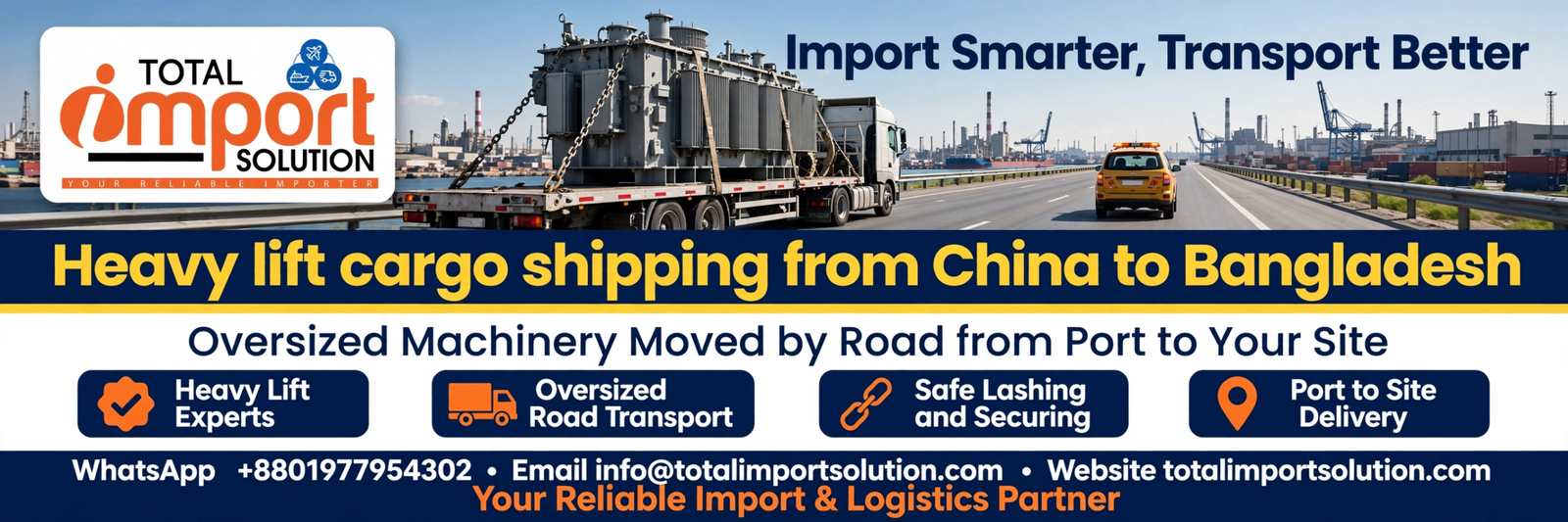
Choose the truck to match the cargo and the route. A low bed trailer keeps tall cargo lower to the ground, which helps with overhead clearance. A multi-axle trailer spreads a very heavy load across more axles, which helps with bridge limits and road rules. The truck driver should have experience with oversized loads and should know the route in advance. Plan the timing of the road journey as well. Heavy loads move at a slower speed and may need an escort vehicle, and the local authorities may need to be informed in advance. Keep the unloading plan ready at the site before the truck arrives.
| Inland Transport Item | Why It Matters | Action |
|---|---|---|
| Route survey | Finds bridges, wires, and narrow turns | Survey full route before arrival |
| Trailer selection | Matches weight, height, and length | Choose low bed or multi-axle |
| Driver experience | Safe handling of oversized load | Use driver with oversized experience |
| Site crane | Unloading at the site | Book crane and prepare ground |
10. Handling Risks and Delays
Heavy lift shipments face risks that normal container shipments do not. Weather can delay loading or discharge, a crane can break down, a document error can hold the cargo at customs, and a road survey can reveal a bridge that cannot carry the load.
Weather is the most common cause of delay at sea and at the port. Strong wind can stop a heavy lift, because a piece swinging in the wind is unsafe to handle. Rain can delay packing and loading, and rough seas can slow the vessel. Equipment failure is another risk. A crane, a trailer, or a lifting sling can fail if it is not inspected and maintained, so ask for the inspection records of the crane and the lifting gear before the lift. Document errors cause delays that are easy to prevent: a weight that is wrong, a description that is vague, or a paper that is missing can hold the cargo for days. Check every document twice, and ask a second person to check the file before it is filed.
| Risk | Likely Cause | How to Reduce It |
|---|---|---|
| Weather delay | Wind, rain, rough sea | Allow extra time in schedule |
| Crane or gear failure | Poor inspection or maintenance | Check inspection records |
| Document hold | Wrong weight or vague description | Double-check every paper |
| Road block | Bridge limit or narrow turn | Survey route in advance |
11. Working with Total Import Solution
Total Import Solution is an importer and logistics partner based in Bangladesh, working with importers to bring cargo from China to Bangladesh. For heavy lift cargo, the work starts with a clear discussion of the cargo, the factory location in China, the site location in Bangladesh, and the timeline for the project.
The first meeting should cover the cargo facts. Bring the dimensions, the weight, the packing list, and the supplier drawings. The team will check the route, the ports, the vessel options, and the documents needed for the shipment. If a piece of information is missing, the team will tell you what to ask the supplier for, so the plan is built on facts and not on guesses. During the shipment, the team coordinates the loading in China, the sea voyage, the customs clearance in Bangladesh, and the road transport to the site. Each stage is tracked, and the importer is updated when the cargo is loaded, when the vessel sails, when the vessel arrives, and when the cargo is released from the port. A single point of contact keeps the communication clear.
| Service Stage | What Total Import Solution Does | What the Importer Provides |
|---|---|---|
| Planning | Route, port, and vessel plan | Cargo facts and drawings |
| Documents | Checking and filing support | Invoice, packing list, papers |
| Loading | Supervision and survey coordination | Supplier readiness at factory |
| Customs | Agent coordination and follow-up | Funds for applicable charges |
12. Checklist Before the Cargo Leaves China
Use this checklist before the cargo leaves the factory in China. Every item should be checked and ticked off in writing.
Check the dimensions and the weight first. Measure each packed piece, weigh it, and compare the figures with the packing list. Mark the lifting points and the centre of gravity on the packing. Take photos of each piece from several angles, including the marks and the lifting lugs. Check the documents, the booking, and the port readiness together. Confirm the vessel booking, the crane capacity at the loading port, and the arrival plan at the discharge port in Bangladesh. Confirm the customs agent, the truck, and the site crane for the arrival date. Share the final document file with every party, and keep a copy for the shipping file.
- Measure and weigh each packed piece and compare with the packing list.
- Mark lifting points and centre of gravity on the packing.
- Check case strength, bolts, covers, and padding on sensitive parts.
- Confirm vessel booking and crane capacity at the loading port.
- Confirm customs agent, truck, and site crane for arrival in Bangladesh.
- Share the final document file with all parties and keep a copy.
| Checklist Area | Item to Check | Done |
|---|---|---|
| Dimensions and weight | Final packed size and certified weight | |
| Lifting marks | Lifting points and centre of gravity marked | |
| Packing | Case strength, bolts, covers, padding | |
| Documents | Invoice, packing list, bill of lading match | |
| Booking | Vessel, crane, and port confirmed |
13. Common Mistakes to Avoid
The most common mistake in heavy lift shipping is starting with the booking instead of the cargo facts. A vessel booked before the final dimensions are known may not have the crane capacity or the deck space for the actual cargo.
The second common mistake is weak packing. A case that looks strong on the outside can fail if the base is weak or the machine is not bolted down. A long piece without multi-point support can bend during lifting. The third common mistake is a document mismatch. A packing list that shows one weight and an invoice that shows another weight will cause questions at customs. A bill of lading that names the wrong consignee will delay release. Read the three main documents side by side before the vessel sails, and correct any error while there is still time.
The fourth common mistake is skipping the road survey. A route that looks fine on a map can have a low bridge, a narrow turn, or a weak culvert that the map does not show. The fifth common mistake is leaving the site unprepared. A truck that arrives at a site with no crane, no clear storage area, and soft ground cannot be unloaded safely. Prepare the site before the vessel arrives, and keep the crane booking flexible so it can move if the vessel is delayed by a day.
| Mistake | What Goes Wrong | Better Way |
|---|---|---|
| Booking before measuring | Vessel or crane cannot handle cargo | Measure first, book second |
| Weak packing | Case breaks, cargo shifts | Strong base, bolted, braced |
| Document mismatch | Customs hold and delay | Check papers side by side |
| Skipping road survey | Bridge or turn blocks the truck | Survey the full route |
| Unprepared site | Truck cannot unload safely | Prepare crane and ground early |
Frequently Asked Questions
1. What is heavy lift cargo shipping from China to Bangladesh?
Heavy lift cargo shipping is the movement of cargo that is too heavy, too tall, too wide, or too long for a standard container. It needs special vessels, cranes, packing, and road transport, with a plan that covers loading in China, the sea voyage, customs in Bangladesh, and delivery to the site.
2. What types of cargo count as heavy lift cargo?
Transformers, generators, boilers, large industrial machines, construction machines, long steel products, tanks, and pre-fabricated structures often count as heavy lift cargo.
3. Which ports in Bangladesh handle heavy lift cargo?
Chittagong is the main sea port for heavy lift cargo in Bangladesh, and Mongla also serves the south-western region. The discharge port should be chosen with the final site in mind, and the port team should confirm crane capacity and berth availability before the vessel arrives.
4. How do I start a heavy lift shipment from China?
Start by collecting the final dimensions, weight, centre of gravity, and handling notes for each piece from the supplier. Share these facts in writing with your shipping team, choose the route and ports, book the vessel and equipment, and prepare the documents before the cargo moves to the port.
5. What documents are needed for heavy lift cargo?
The main documents are the commercial invoice, packing list, bill of lading, and certificate of origin when required. Heavy lift shipments also need a weight certificate, a supplier handling note, and a survey report from loading. Every document must match the others in weight, quantity, and description.
6. How is heavy lift cargo loaded onto a vessel?
Each piece is lifted one by one with a crane, using slings, shackles, and a spreader beam when needed. The piece is placed in the position shown in the stowage plan, then lashed and secured to the deck or hold. The vessel does not sail until the lashing is checked and approved.
7. What is a stowage plan and a lashing plan?
A stowage plan shows where each piece will sit on the vessel. A lashing plan shows how each piece will be secured so it cannot move during the voyage. Both plans should be approved in writing before loading, and the loading team should follow them at the port.
8. How is heavy lift cargo packed for sea transport?
Heavy machines need a strong wooden case with a bolted base, blocking, and bracing inside, plus padding on sensitive parts. Long or irregular cargo needs a steel frame or cradle with multi-point support. A waterproof cover keeps rain and sea spray out, and the marks on the packing must match the packing list.
9. Can heavy lift cargo be moved by road in Bangladesh?
Yes, heavy lift cargo is moved by road from the port to the site on a low bed trailer or a multi-axle trailer. The route must be surveyed first for bridge limits, overhead wires, road width, and sharp turns, and the driver should have experience with oversized loads.
10. What happens during customs clearance in Bangladesh?
The customs agent files the import declaration with the invoice, packing list, and bill of lading. Customs checks the description, quantity, and value, and may examine the cargo at the port. After assessment and settlement of the applicable charges, customs releases the cargo for road transport to the site.
11. How long does a heavy lift shipment take?
The time depends on the factory location in China, the loading port, the sea voyage, customs clearance, and the road journey to the site. Heavy lift cargo takes longer to load and discharge than container cargo, so the schedule should allow extra time.
12. What should I check at the delivery site before the truck arrives?
Check the entry gate width, the turning space, the ground strength where the crane will stand, and the storage area for the cargo. The unloading crane should be booked, the ground should be prepared, and the storage area should be clear before the truck arrives at the site.
13. What are the most common causes of delay in heavy lift shipping?
Weather, crane or equipment failure, document errors, port congestion, and road blocks are the most common causes of delay. A route survey, a double-check of the documents, and extra time in the schedule help reduce these delays.
14. Who should I contact to arrange a heavy lift shipment?
Contact Total Import Solution with the cargo facts, supplier drawings, and project timeline. The team will check the route, ports, vessel options, and documents, and will coordinate loading in China, customs in Bangladesh, and road transport to the site.
15. Can Total Import Solution handle the full shipment from China to the site?
Yes, Total Import Solution coordinates the full chain for importers, from planning and documents to loading in China, customs clearance in Bangladesh, and road delivery to the site. Since 2016, the team has worked with importers and keeps a full shipping file for every shipment.
16. How is a rate or a fee confirmed for a heavy lift shipment?
A rate or a fee is confirmed only after checking the actual shipment and documents, including the weight, dimensions, route, ports, and equipment needed. Share the full cargo facts with Total Import Solution, and the team will check the shipment and confirm the applicable figures for that specific cargo.
Contact Total Import Solution
- WhatsApp: +8801977954302
- Email: info@totalimportsolution.com
- Website: totalimportsolution.com
- Service: Heavy lift cargo shipping from China to Bangladesh, with planning, documents, customs clearance, and road delivery to your site.
