
Guangzhou to Dhaka door-to-door cargo
Guangzhou is one of the main sourcing cities for importers in Bangladesh. Traders, wholesalers, retailers, factory owners, and online sellers buy garments, fabrics, electronics, household goods, hardware, machinery parts, and many other products from suppliers in Guangzhou and the surrounding region. When the order is ready, the goods still have to reach Dhaka in good condition, with the right papers, through customs, and on to the buyer’s warehouse, shop, or factory. Guangzhou to Dhaka door-to-door cargo is the service that covers that whole journey in one arrangement, from pickup at the supplier in Guangzhou to delivery at the door in Dhaka.
This guide explains Guangzhou to Dhaka door-to-door cargo in practical, step-by-step terms. It covers what the service includes, the types of cargo commonly sent on this route, how pickup and packing work in Guangzhou, how consolidation and container loading work, the documents you need, HS classification in general terms, the full process from order to delivery, customs clearance in Bangladesh, charges in general terms, delivery in Dhaka, the common problems and how to fix them, and how to judge a good cargo agent. No fixed prices, rates, duty percentages, or fees are given here. A rate or fee is confirmed only after checking the actual shipment and its documents, because the amount depends on the cargo, its weight and volume, its classification, its value, and the rules in force at the time of import.
Total Import Solution, Since 2016, supports importers in Bangladesh with shipment planning, pickup coordination, documentation, customs clearance support, and delivery coordination. The aim of this guide is to help you plan a Guangzhou to Dhaka shipment properly, so that the goods are picked up correctly, the papers match the cargo, and the delivery in Dhaka is smooth.
1. What Guangzhou to Dhaka Door-to-Door Cargo Covers
A Guangzhou to Dhaka door-to-door cargo service covers the movement of goods from a supplier in Guangzhou to a buyer in Dhaka, with the agent handling the stages in between. The buyer may be a wholesaler who sells to shops across Bangladesh, a retailer who sells directly to customers, a factory that needs raw material or machinery parts, or an online seller who needs regular small loads. The shipment may be a few cartons sent as a sample, a consolidated load shared with other cargo, or a full container for a large order. Each size of shipment follows the same basic steps, but the pickup, the packing, the documents, and the handling change with the size.
The service starts at the supplier’s factory or warehouse in Guangzhou. The agent or the agent’s partner collects the cartons, checks them against the order and the packing list, and brings them to a warehouse in China. From there the cartons are consolidated or loaded into a container, moved to the port, and sent on the sea or air journey to Bangladesh. On arrival at Chittagong Port, Pangaon port, or Dhaka Airport, the agent handles customs clearance, and then arranges delivery by truck to the buyer’s address in Dhaka, Gazipur, Narayanganj, or another nearby district. A good door-to-door plan looks at every one of these stages before the goods leave the supplier, because a problem at an early stage becomes harder to fix later.
| Stage | What happens | Who the buyer deals with |
|---|---|---|
| Pickup in Guangzhou | Cartons collected from the supplier | The agent or the agent’s partner |
| Warehouse in China | Cartons checked, sorted, and packed | The agent’s warehouse team |
| Loading and transport | Consolidation or container loading, port transfer | The agent and the carrier |
| Sea or air journey | Goods move from China to Bangladesh | The carrier, followed by the agent |
| Customs clearance | Papers filed and cargo checked in Bangladesh | The agent at the port |
| Delivery in Dhaka | Truck delivery to the buyer’s door | The agent and the transporter |
2. Types of Cargo Commonly Sent from Guangzhou to Dhaka
Guangzhou supplies a wide range of goods, and each type needs different packing and handling. Garments and fabrics are light but bulky, and they need dry packing and protection from damp and dirt. A carton of garments that gets wet in transit can lose its sale value, even if the garments themselves are not torn. Electronics such as chargers, lights, small appliances, and accessories are delicate, and they need cushioning, inner boxes, and careful handling so that screens, plugs, and small parts are not damaged.
| Cargo group | Examples | Packing care needed |
|---|---|---|
| Garments and fabrics | Shirts, trousers, cloth, scarves | Dry packing, moisture protection, clean cartons |
| Electronics | Chargers, lights, small appliances | Cushioning, inner boxes, careful handling |
| Household goods | Kitchen items, plastic goods, decoration | Separate wrapping, clear item list |
| Hardware and parts | Tools, fittings, machinery parts | Strong cartons, edge protection, weight marks |
| Bags and accessories | Bags, belts, wallets, caps | Dust covers, shape protection, counting |
| Mixed general cargo | Several product types in one order | One item type per carton where possible |
3. Pickup and Packing in Guangzhou
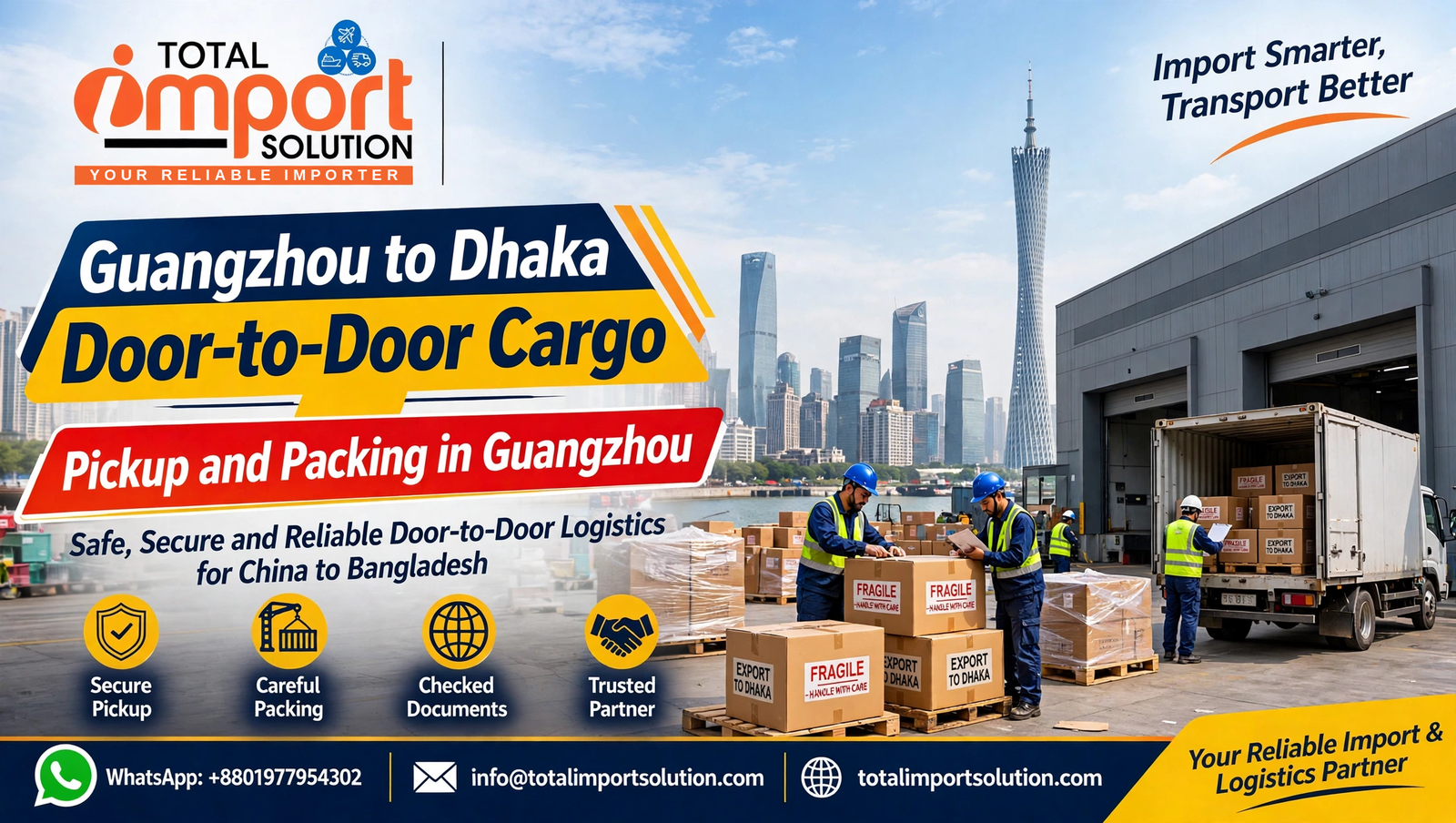
Pickup is the first physical step in a door-to-door shipment, and it sets the tone for the rest of the journey. The supplier should have the cartons ready, sealed, and marked before the pickup vehicle arrives. The pickup team checks the number of cartons, the marks on each carton, and the condition of the packing. If a carton is damaged, open, or unmarked, the team should note it at pickup time and tell the buyer, because a note made later is harder to prove. A photo of the cartons at pickup is useful, and many buyers ask for it as part of the service.
Packing decides whether goods arrive in saleable condition. A carton that is too weak will break under stacking. A carton that is too large will let the goods move and hit each other. The right carton is strong, fits the goods closely, and is sealed with strong tape on all seams. Fragile items need inner wrapping and cushioning. Heavy items should go in smaller cartons rather than one very large carton, because a large carton full of heavy goods is hard to lift and more likely to break.
| Packing point | Good practice | Problem it prevents |
|---|---|---|
| Carton strength | Use strong cartons suited to the weight | Carton breaking and goods spilling out |
| Carton size | Match the carton to the goods, avoid oversized boxes | Goods moving and damaging each other |
| Fragile items | Wrap each item, use cushioning and dividers | Breakage during handling and loading |
| Sealing | Tape all seams, strap heavy cartons | Carton opening during the journey |
| Marking | Item name, quantity, carton number, weight | Slow checking and wrong delivery |
| Pickup check | Count cartons, note damage, take photos | Disputes about what was collected |
4. Consolidation and Container Loading
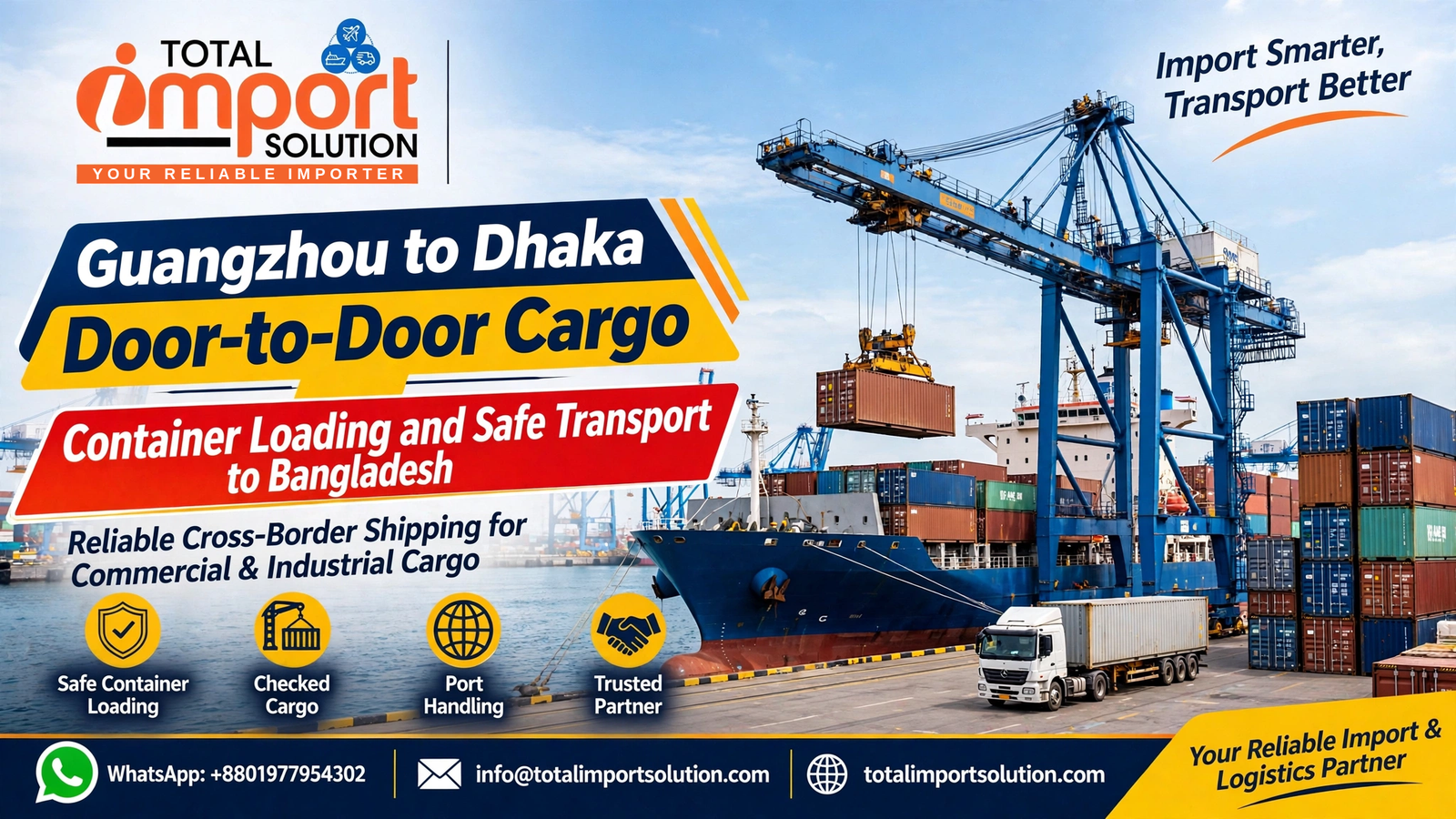
Many Guangzhou to Dhaka shipments are consolidated, which means that cartons from one buyer are loaded into a container together with cargo from other buyers. Consolidation suits a buyer whose order does not fill a whole container. The cartons are collected at a warehouse in China, checked against the packing list, and loaded with other cargo going to the same port in Bangladesh. Each buyer’s cartons keep their own marks, so that they can be separated on arrival.
Container loading needs a plan. Heavy cartons should go at the bottom and light cartons on top. Cartons with the same marks should be kept together where possible, so that unloading is simple. The load should be balanced across the container, and the cartons should be packed tightly so that they do not shift when the container moves. A container that is loaded loosely allows cartons to fall, and a fallen carton can damage other cargo in the same container.
| Loading point | What to check | Why it matters |
|---|---|---|
| Carton order | Heavy below, light above, same marks together | Safe load, easy unloading |
| Tight packing | No empty gaps, cartons braced | Cartons do not shift or fall |
| Container condition | Clean, dry, doors and seals in order | Goods stay dry and safe |
| Loading photos | Photos of cartons and container number | Proof of what was loaded |
| Seal number | Seal number recorded on the documents | Cargo matches the papers on arrival |
5. Documents Needed for Guangzhou to Dhaka Cargo
Documents are the backbone of an import shipment. Customs, the port, and the shipping line all work from the papers, so the papers must match the cargo. The most important documents are the commercial invoice, the packing list, and the bill of lading or airway bill. The invoice shows the supplier, the buyer, the description of the goods, the quantity, and the value. The packing list shows what is in each carton, including the item name, the quantity, and the weight. The bill of lading or airway bill is the transport document issued by the carrier, and it shows the port of loading, the port of arrival, and the consignee.
Other documents may be needed depending on the shipment. A certificate of origin shows where the goods were made. A letter of credit, where the buyer uses one, sets out the payment terms between buyer and supplier. The importer’s own papers include the trade licence, the import registration certificate, and the tax identification number. The buyer should keep copies of every document, and should check each one before the goods leave China. A spelling mistake in a name, a wrong quantity, or a value that does not match the invoice can all cause a delay at the port.
| Document | What it shows | Who issues it |
|---|---|---|
| Commercial invoice | Supplier, buyer, goods description, quantity, value | Supplier |
| Packing list | Contents of each carton, quantity, weight | Supplier |
| Bill of lading or airway bill | Transport details, ports, consignee | Carrier or forwarder |
| Certificate of origin | Country where the goods were made | Supplier or chamber |
| Import registration certificate | Importer’s right to import | Importer |
| Trade licence and tax papers | Importer’s business registration | Importer |
6. HS Classification in General Terms
HS classification is the system that customs uses to place each product into a category. Every product has an HS code, and the code decides how customs treats the item. Garments, electronics, household goods, and hardware fall into different groups under the system, and within each group there are further divisions by type and material. The code must match the actual product, not a general description. A shirt and the fabric used to make it, for example, are different items and are classified differently, even though they are related.
| Classification point | What to do | Why it matters |
|---|---|---|
| Clear description | Name the product, its material, and its use | Customs can place it in the right group |
| Separate items | List each type of product on its own line | Different products may have different codes |
| Mixed cartons | List every item in a mixed carton | Avoids a vague description at the port |
| Supporting papers | Keep catalogues, photos, and technical sheets | They support the description given |
| Early check | Check the code before shipping | Avoids a hold at the port |
7. Step-by-Step Process from Pickup to Delivery
Step 1: Choose the goods and the supplier. Decide which products you need, the quantity, and the quality level. Ask the supplier for a catalogue, photos, and a sample where the order is large. Compare the sample with what you asked for before placing the full order.
Step 2: Confirm the order in writing. Put the product names, the quantities, the packing method, the pickup address in Guangzhou, and the delivery address in Dhaka in a written order. A written order avoids a dispute about what was agreed, and it gives the agent a clear basis for the documents.
Step 3: Arrange pickup in Guangzhou. Tell the agent the supplier’s address, the contact person, and the date the cartons will be ready. The agent arranges the pickup vehicle and confirms the collection with the supplier.
Step 4: Check packing and marking. Ask the supplier how the goods will be packed and marked. Confirm the carton size, the inner packing, and the marks that will appear on each carton. Good packing agreed at this stage is better than a complaint after the goods arrive.
Step 5: Prepare the documents. The supplier prepares the invoice and the packing list. The buyer prepares the import papers. The agent checks that the documents match each other and match the order.
Step 6: Book the shipment. The agent books space on a vessel or a flight, based on the size of the shipment and the buyer’s need. The booking confirms the port of loading, the port of arrival, and the consignee details.
Step 7: Load and dispatch. The cartons are loaded into the container or onto the aircraft, the container is sealed, and the bill of lading or airway bill is issued. The buyer receives a copy of the transport document and the loading photos where available.
Step 8: Track the shipment. The agent follows the vessel or flight and keeps the buyer informed of the arrival. The buyer uses this time to prepare the customs papers and to arrange to receive the goods in Dhaka.
Step 9: Customs clearance. On arrival, the agent files the customs declaration with the invoice, packing list, bill of lading, and other papers. Customs checks the documents and the cargo, and the shipment is assessed under the rules in force at the time.
Step 10: Pay the assessed charges. The buyer pays the charges assessed by customs and the port, as confirmed after checking the actual shipment and documents. The agent gives the buyer a clear statement of what was paid and for what.
Step 11: Deliver to the door in Dhaka. After release, the goods are loaded onto a truck and delivered to the buyer’s address in Dhaka. The buyer checks the cartons against the packing list on delivery, and reports any shortage or damage at once.
8. Customs Clearance in Bangladesh
Customs clearance is the stage where the shipment is checked by the customs authority at the port of arrival. The agent files a declaration that describes the goods, their quantity, their value, and their classification. Customs compares the declaration with the invoice, the packing list, and the bill of lading. If the papers agree with each other and with the cargo, the clearance moves forward. If they disagree, customs may ask for more information or may open cartons for physical checking.
| Clearance point | What helps | What slows it down |
|---|---|---|
| Matching documents | Invoice, packing list, and bill of lading agree | Papers that disagree with each other |
| Clear description | Product name, material, and use stated plainly | Vague or mixed descriptions |
| Orderly packing | One product type per carton where possible | Mixed cartons with no clear list |
| Quick answers | Buyer and supplier reply promptly | Slow replies to a customs query |
| Agent support | Agent files papers and follows up | Papers filed late or incomplete |
9. Charges in General Terms
Charges on a Guangzhou to Dhaka shipment are assessed at several stages, and the buyer should understand each one in general terms before the goods are shipped. Duty is the charge assessed by customs on imported goods. For a mixed Guangzhou shipment, the duty depends on the classification of each product, the declared value, and the rules in force at the time of import. Different products may be treated differently, and a garment may be assessed differently from an electronic item or a hardware part. The buyer should not assume that every item in a mixed shipment is treated in the same way.
A rate or fee is confirmed only after checking the actual shipment and its documents. The buyer should ask for the charges in writing before shipping, and should keep that written statement with the invoice and the packing list. A charge given without checking the shipment is not a reliable figure, and the buyer should treat it as a general indication only, not as a fixed amount for the order.
| Charge | What it covers | How it is confirmed |
|---|---|---|
| Duty | Charge assessed by customs on the goods | After checking the shipment and documents |
| Other taxes on import | Taxes assessed under the rules in force | After checking the shipment and documents |
| Port handling | Loading, unloading, and handling at the port | Port statement for the shipment |
| Storage | Storage if cargo stays beyond the free period | Port statement for the shipment |
| Transport | Truck delivery from the port to the buyer | Agreed with the transporter |
| Agent service fee | Agent’s work on documents and clearance | Agreed in writing before shipping |
10. Delivery in Dhaka
After customs release, the goods must be delivered to the buyer’s door in Dhaka. The agent arranges a truck that suits the size of the shipment. A small load may go on a covered pickup, while a full container load needs a larger truck. The truck should be covered, because rain can damage cartons and can harm garments, electronics, and other goods. The cartons should be loaded in an orderly way, with heavy cartons below and light cartons above, just as they were loaded into the container.
11. Common Problems and Fixes
Even a well-planned shipment can face problems. The table below lists the problems that occur most often with Guangzhou to Dhaka door-to-door cargo, and the practical fix for each one. A buyer who knows these problems in advance can prevent most of them by checking the packing, the documents, and the pickup details before the goods leave Guangzhou.
| Problem | Likely cause | Practical fix |
|---|---|---|
| Damaged cartons | Weak cartons, loose loading | Strong cartons, tight load, photos |
| Missing items | No count at packing time | Count and list each item |
| Wrong documents | Papers not checked together | Check all papers before shipping |
| Damp damage | Damp packing or storage | Dry packing, dry storage |
| Delay at the port | Query on documents or cargo | Honest papers, quick replies |
| Wrong product sent | Order not confirmed in writing | Written order with product names |
12. How to Judge a Good Cargo Agent
A good cargo agent makes a Guangzhou to Dhaka shipment simple. A weak agent makes it hard. The buyer should judge an agent by clear signs, not by promises. The first sign is clear communication. A good agent explains each step, gives the buyer copies of the documents, and answers questions in plain language. An agent who is hard to reach, or who gives vague answers, will be hard to reach when a problem arises at the port.
The second sign is careful paperwork. A good agent checks the invoice and the packing list before the goods leave China, and files the customs papers on time in Bangladesh. The third sign is clear charges in writing. A good agent gives the buyer a written statement of the charges, explains what each charge covers, and confirms the amount only after checking the actual shipment and documents. The fourth sign is experience with the Guangzhou to Dhaka route. An agent who has handled this route before will know the packing needs, the documents, and the delivery pattern in Dhaka.
| Agent quality | Good sign | Warning sign |
|---|---|---|
| Communication | Clear answers, regular updates | Hard to reach, vague replies |
| Paperwork | Documents checked before shipping | Papers filed late or incomplete |
| Charges | Charges in writing, explained clearly | Fixed figure without checking the shipment |
| Experience | Has handled Guangzhou to Dhaka cargo before | No knowledge of the route or packing |
| Problem handling | Reports problems at once, suggests a fix | Hides problems until they grow |

13. Working with Your Agent, Mistakes to Avoid, and How Total Import Solution Helps
Working well with your agent starts with sharing full information. Tell the agent the exact products, the quantities, the supplier’s details in Guangzhou, the pickup address, the delivery address in Dhaka, and the date by which you need the goods. Share the order, the invoice, and the packing list as soon as they are ready. An agent who has the full picture can plan the shipment, check the documents, and spot a problem early. An agent who receives half the information must guess, and a guess can lead to a wrong document or a wrong booking.
Total Import Solution helps importers of Guangzhou cargo at each stage of the process. Since 2016, the company has supported buyers in Bangladesh with supplier coordination, pickup coordination, packing advice, document checking, HS classification support in general terms, customs clearance support, and delivery coordination to warehouses, shops, and factories in Dhaka and nearby districts. The team checks the invoice and packing list against the order, follows the shipment, files the customs papers, and keeps the buyer informed until the goods are delivered to the door. The buyer deals with one team from pickup to delivery, instead of dealing with many parties separately.
Frequently Asked Questions
1. What is Guangzhou to Dhaka door-to-door cargo?
It is a cargo service that covers the movement of goods from a supplier in Guangzhou to a buyer’s door in Dhaka, including pickup, packing, warehouse handling, loading, transport, customs clearance, and delivery, coordinated by one team.
2. Which products are commonly sent from Guangzhou to Dhaka?
Garments and fabrics, electronics, household goods, hardware and machinery parts, bags and accessories, and mixed general cargo, with each product group packed according to its own needs.
3. How does pickup work in Guangzhou?
The agent collects the cartons from the supplier’s factory or warehouse, checks the number and the marks, notes any damage, and brings the cartons to a warehouse in China for sorting and loading.
4. How should goods be packed for this route?
Use strong cartons matched to the weight of the goods, wrap fragile items, cover sharp edges, use cushioning and dividers, seal all seams, and mark each carton with the item name, quantity, carton number, and weight.
5. What is a consolidated shipment from Guangzhou?
It is a shipment where one buyer’s cartons are loaded into a container together with cargo from other buyers. It suits a buyer whose order does not fill a whole container.
6. What documents do I need for Guangzhou to Dhaka cargo?
The commercial invoice, the packing list, the bill of lading or airway bill, and the importer’s trade licence, import registration certificate, and tax papers. A certificate of origin may also be needed.
7. What is HS classification for Guangzhou cargo?
It is the system customs uses to place each product into a category. The code must match the actual product, its material, and its use, and it should be checked before the shipment leaves China.
8. How does the step-by-step process work?
The buyer orders the goods, confirms the order in writing, arranges pickup, checks packing and documents, books the shipment, loads the goods, tracks the journey, clears customs on arrival, pays the assessed charges, and receives delivery at the door in Dhaka.
9. How does customs clearance work in Bangladesh?
The agent files a declaration with the invoice, packing list, and bill of lading. Customs compares the papers with the cargo, and may open cartons for physical checking. Clear papers and orderly packing make the check quick.
10. How are charges on this route decided?
Duty depends on the classification of each product, the declared value, and the rules in force at the time of import. Other charges include port handling, storage, transport, and the agent’s service fee. A rate or fee is confirmed only after checking the actual shipment and its documents.
11. How should I check goods on delivery in Dhaka?
Count the cartons, compare the count with the packing list, check the marks, open a sample of cartons, and note any damage or shortage on the receipt before signing. Report any problem to the agent at once.
12. What causes damp damage to Guangzhou cargo?
Damp packing, a leaking container, or damp storage after arrival. Dry packing, a container check before loading, and dry storage in a room off the floor help prevent damp damage.
13. What if an item is missing on delivery?
Check the packing list count, photograph the carton and its contents, and tell the agent at once. The supplier can send the missing item with the next order or give a credit, based on the packing list record.
14. What if the supplier sends the wrong product?
Check the written order, photograph the product received, and tell the agent at once. A written order with product names and quantities is the clearest record of what was agreed.
15. How do I choose a good cargo agent for this route?
Look for clear communication, careful paperwork, charges given in writing, and experience with Guangzhou to Dhaka cargo. The agent should explain each step and report problems at once.
16. How can Total Import Solution help with my Guangzhou to Dhaka cargo?
Total Import Solution supports buyers with supplier coordination, pickup coordination, packing advice, document checking, HS classification support, customs clearance support, and delivery coordination to doors in Dhaka and nearby districts.
Contact Total Import Solution
- WhatsApp: +8801977954302
- Email: info@totalimportsolution.com
- Website: totalimportsolution.com
- Service: Guangzhou to Dhaka door-to-door cargo — pickup in Guangzhou, customs clearance, and delivery to your door in Dhaka.
- Company: Total Import Solution, serving importers in Bangladesh Since 2016.
