
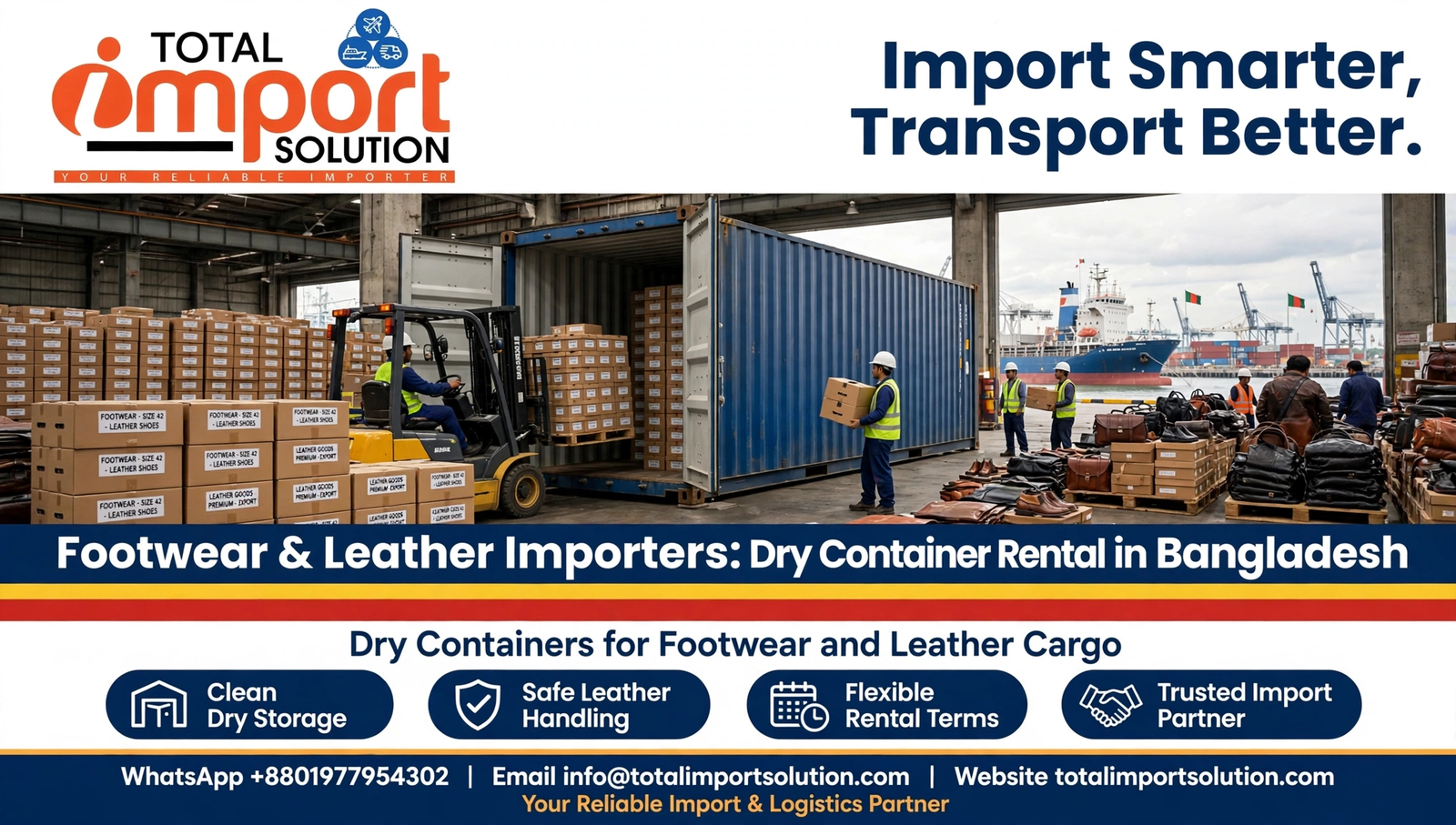
Footwear & Leather Importers: Dry Container Rental in Bangladesh
Footwear and leather goods are valuable cargo. Shoes, leather bags and leather jackets can be damaged by damp, dust, rough handling or a container that is not clean. For importers in Bangladesh, the container is where the cargo lives from the port to the warehouse, and its condition decides how the goods arrive.
Dry container rental gives an importer a clean, closed steel container for a shipment without buying a container. The importer rents it, loads the cargo, moves it, unloads it and returns it. This guide covers sizes, condition checks, packing, loading, documents, storage, common problems and planning from booking to return. Total Import Solution has served importers in Bangladesh since 2016, and this article shares the practical checks the team uses in daily work. Read it before you book: clean cargo in, clean cargo out, and a clear record at every step.
1. What Dry Container Rental Means for Footwear and Leather Importers
A dry container is a standard closed steel container with solid walls, a solid roof and doors that close and seal. It is made for general cargo that needs to stay dry and safe, and it is the common container type for boxed footwear, leather bags, leather garments and finished leather goods.
Rental means the importer uses the container for a set period and a set job. The provider supplies the container, and the importer pays for its use under the rental terms. The terms, including the rental period, delivery place, return place and charges, are agreed before delivery. A rate or fee is confirmed only after checking the actual shipment and documents, so share clear details about the cargo, route and timing before asking for a figure.
Rental gives a clean space for cargo that must stay dry, protects it from dust, rain and open handling, and lets the importer plan a shipment without keeping a container all year. It also gives a single closed unit that can be sealed, checked and opened at the warehouse in the presence of the importer or the appointed person. Rental is not buying: the importer does not own the box, and the return condition matters. Return it in the condition agreed in the terms, clean and free from damage caused during the rental. Read the return terms before loading, and note the condition at delivery.
2. Why Footwear and Leather Cargo Needs a Dry Container
Footwear and leather goods react badly to damp and dirt. Leather can mark, stain, stiffen or grow mould when it stays damp. Shoe boxes can soften and collapse when wet. Leather bags can lose shape when pressed under heavy cartons. Finished leather items can pick up smell from a dirty container floor. A dry container helps prevent these problems when it is clean, dry and sound.
The first need is dryness. Floor, walls and roof must be dry at loading, with no water on the floor, no wet patches on the roof and no damp smell inside. Door seals should close well so rain and road spray do not enter. A quick check with a dry hand on the floor and walls can show damp the eye may miss.
The second need is cleanliness. The container should be swept clean and free from old cargo, loose nails, sharp edges, oil, chemical smell and food waste. A past cargo can leave a smell that passes to leather goods. A container that carried strong smelling goods before may not be right for leather, even when it looks clean. Ask what it carried before, when the answer is known, and ask for a clean container when the cargo is leather.
The third need is protection from dust and damage. Closed doors keep dust out during road movement and waiting time. Strong walls protect cartons from side contact, and a sound roof keeps rain out. A container with a damaged roof, a bent door or a broken seal does not give this protection and should not be accepted.
3. How to Choose the Right Dry Container Size
The right size depends on the volume and weight of the cargo, the size of the cartons and the space at the loading and unloading points. Count the cartons, measure a sample carton and work out the total volume before choosing. Guessing can lead to a container that is too small, which means a second load, or too large, which means wasted space and loose cartons that move during transport.
The two common sizes are the 20-foot container and the 40-foot container. A 20-foot container is about 6 metres long. A 40-foot container is about 12 metres long. Both have an internal height of about 2.4 metres in approximate terms. These are widely standard approximate figures only. The actual internal size can vary from one container to another, so always check the actual container before loading.
| Container size | Approximate length | Common use |
|---|---|---|
| 20-foot dry container | About 6 metres | Smaller orders, mixed cartons, trial orders |
| 40-foot dry container | About 12 metres | Larger orders, many cartons of one style |
| 40-foot high cube | About 12 metres, taller | Tall cartons, light goods needing height |
Think about the cartons first. Light footwear cartons can be stacked higher, while heavy leather cartons need lower, stable stacks. Leather bags need space so they are not pressed flat, and shoe boxes need even rows so they do not crush. Plan the rows on paper first, with heavy cartons at the bottom and light cartons at the top.
4. Dry Container Condition: What to Check Before You Accept It
The condition check is the most important step for footwear and leather cargo. A clean and sound container protects the goods; a damaged one can cause loss that is hard to fix after loading. Do the check at delivery, in daylight when possible, and before any carton is loaded.
Start outside. Look at the roof for dents and rust, the side walls for holes, dents and patch repairs, and the corner posts and door frame for bends. The doors should open and close smoothly, and the locking rods should move freely. The door seals, the rubber strips around the door edges, should be whole and soft, not cracked, hard or missing in parts.
Go inside and close the doors for a short light check. Light coming through a wall or roof means water can enter through the same hole. Open the doors again and check the floor: it should be dry, flat and free from holes, soft spots, loose boards and nails sticking up. Sweep it and run a hand over it to feel for damp and sharp points. Smell the air inside. A clean dry container should smell of clean steel and wood, not chemicals, oil, food or strong damp. Leather can absorb smell, so a strong smell is a warning sign: ask for another container.
If the container fails any check, do not load it. A short wait for a good container is better than a long problem with a damaged one.
| Check point | What to look for | Action when it fails |
|---|---|---|
| Roof and walls | No holes, no heavy dents, no rust holes | Ask for another container |
| Doors and seals | Doors close well, seals whole and soft | Ask for repair or another container |
| Floor | Dry, flat, no holes, no nails, no soft spots | Ask for cleaning or another container |
| Light test | No light through walls or roof, doors closed | Ask for another container |
| Smell | Clean smell, no chemical or oil smell | Ask for another container |
5. Packing Footwear Cargo for a Dry Container
Footwear is usually packed in shoe boxes, then in larger cartons. The shoe box protects the pair, and the outer carton protects the shoe boxes. Both layers matter: a weak outer carton can collapse under the weight above it, and the shoe boxes inside can crush. Use strong outer cartons, tape them well and keep them dry before loading.
Sort the cartons before loading. Group them by style, size and colour, and mark each group clearly with a simple label the warehouse team can read. A clear label helps the unloading team find the right cartons first and avoids opening every carton. Keep a packing list showing the carton count, the style in each carton and the total count of pairs.
Stack the cartons in even rows: heavy cartons at the bottom, light cartons at the top. Keep rows straight and fill gaps with light packing material so cartons do not shift during movement. Do not stack above the safe stacking height for that carton type. When in doubt, stack lower and use more floor space. A lower, stable stack arrives in better shape than a tall, leaning stack. Keep cartons away from damp or cold walls, leave a small gap for air movement, and never load wet cartons. If a carton is wet from rain, dry it or replace it before loading, because a wet carton inside a closed container can pass damp to the cartons around it.
| Packing step | Good practice | Why it matters |
|---|---|---|
| Outer carton | Strong, well taped, dry | Protects shoe boxes from crushing and damp |
| Sorting | Group by style, size, colour; label clearly | Faster unloading, fewer opened cartons |
| Stacking | Heavy at the bottom, light at the top, even rows | Stable load, less crushing |
| Gaps | Fill with light packing material | Stops cartons shifting |
| Damp check | Load only dry cartons | Stops damp spreading inside |
6. Packing Leather Goods for a Dry Container
Leather goods need more care than many cargoes because leather shows every mark. A bag, wallet, belt or jacket can be scratched, pressed, stained or bent out of shape by poor packing. Packing should protect the shape, surface and colour of each item.
Start with inner packing. Wrap or cover each item so it does not rub against another item, using soft tissue paper, cloth bags or other soft material that is clean and dry. Do not use printed newspaper against light coloured leather, because print can transfer. Do not use wet or damp packing material. Fill a leather bag with soft paper so it keeps its shape, and close it well so handles and fittings do not press into the leather.
Keep leather cartons away from sharp objects, metal fittings that stick out and loose tools. Check the floor for nails before loading: a single nail can scratch many items when cartons shift.
Load leather goods only in a dry container, and never in rain without cover. Use a covered area or a tarpaulin over cartons during the short move to the container. Keep a packing list with the carton count, item type in each carton and total count, so the importer can check the goods at unloading without opening every carton at once.
7. Loading a Dry Container Step by Step
Loading is a team job. It needs a plan, a clear order and a person in charge who checks each step. A rushed load causes damage, and a load without a plan causes confusion at unloading.
Step one is to prepare the container. Sweep the floor, check the condition as in Section 4, and take photos. Place a clean layer on the floor when needed, such as clean cardboard or a clean sheet, to protect the bottom cartons. Make sure the loading area is dry and clear.
Step three is to load heavy cartons first, at the bottom, in even rows from the far end towards the doors. Keep each row level and check stability before starting the next row. Do not throw cartons into the container; lift and place each one with care.
Step four is to load the middle rows: medium weight cartons on top of the heavy ones, gaps filled with light packing material, rows straight, with a small gap near the walls for air movement. Correct any leaning carton at once.
Step five is to load light cartons last, on top. Do not place heavy cartons on light leather cartons, and do not stack above the safe height for the cartons in use. Leave the load level at the top so the doors close without pressing the cartons. Step six is to secure the load with straps or nets when needed, following the loading team, without pulling a strap so tight that it crushes cartons. Step seven is to close and seal the container: close the doors, check the seals, lock them, write down the seal number, photograph the sealed doors and share the number with the receiver. Step eight is to record the load: container number, seal number, carton count and time of loading, with the packing list kept with the shipment documents.
8. Documents and Checks for a Dry Container Shipment
Documents are part of the rental and the shipment. Keep the rental terms, packing list, delivery note and seal record together. A missing document can cause delay at the port, the warehouse or return time. Keep a copy of each document, and keep originals in a safe place.
The rental terms should show the container number, rental period, delivery place, return place and return conditions. Read them before signing, and ask about any point that is not clear. A rate or fee is confirmed only after checking the actual shipment and documents, so do not treat a rough figure from a first talk as a final figure. The final figure follows the actual cargo, route and timing.
The packing list should show the carton count, contents of each carton group, total item count and marks on the cartons. It helps the warehouse team count cartons at unloading and helps the importer check the goods. Use the same carton numbers on the list and on the cartons. The delivery note should show the container number, date and time of delivery, condition at delivery and the name of the person who received it. The return note should show the same details at return. These notes protect both importer and provider, because they show the condition at each stage.
| Document | What it should show | Who keeps a copy |
|---|---|---|
| Rental terms | Container number, rental period, delivery and return places, return condition | Importer and provider |
| Packing list | Carton count, contents, item count, carton marks | Importer and warehouse team |
| Delivery note | Container number, date and time, condition at delivery | Importer and provider |
| Seal record | Seal number, photo of sealed doors, time of sealing | Importer and receiving person |
| Return note | Container number, date and time, condition at return | Importer and provider |
Check the container number on every document: the number on the terms, the delivery note and the container itself should match. A wrong number can cause confusion at the port or warehouse, so stop and ask for a correction before the container moves.

9. Storage, Waiting Time and Container Care in Bangladesh
A dry container may wait at a port, yard or warehouse before unloading. Waiting time is normal in import work, and the container should be cared for during that time. The importer should know where it will wait, who is responsible for it during the wait and what will happen if the wait runs longer than planned.
The waiting place should be dry, level and safe. The container should stand on level ground with doors closed and sealed, not in a low place where rain water collects, under a leaking roof or next to a drain. A simple check of the waiting place can prevent water damage to the cargo inside.
In the hot season, a closed steel container can become warm inside. Footwear and leather goods should not stay in a hot closed container longer than needed, so plan unloading as soon as the container reaches the warehouse, and use a shaded place when one is available. In the rainy season, check the roof and doors after heavy rain, and check the floor for water before unloading.
10. Common Problems and How to Prevent Them
Footwear and leather importers face the same problems again and again with dry containers. Most can be prevented with a simple check before loading.
| Problem | Likely cause | How to prevent it |
|---|---|---|
| Damp cartons | Wet floor, leaking roof, wet cartons loaded | Check floor and roof, load only dry cartons |
| Crushed shoe boxes | Heavy cartons on top, tall unstable stacks | Stack heavy at the bottom, keep stacks level |
| Leather marks and scratches | Sharp floor, loose nails, rubbing cartons | Check floor, use soft inner packing, fill gaps |
| Smell on leather goods | Dirty container, strong smell from a past cargo | Check the smell, ask for a clean container |
| Lost or mixed cartons | Poor labels, no packing list | Label cartons clearly, keep a packing list |
| Delay at return | Dirty container, damage not reported | Sweep the container, report damage at once |
| Wrong container size | Cartons not counted before booking | Count cartons, measure a sample carton first |
Damp is the most common problem for leather. It can come from a wet floor, a leaking roof or a wet carton. The prevention is simple: check the container, load only dry cartons and cover cartons during rain at the loading point. If damp is found at unloading, separate the damp cartons at once, dry the goods in a clean place and do not pack damp goods with dry goods.
Crushing is the most common problem for footwear. Shoe boxes crush when heavy cartons sit on light cartons, or when a stack leans and falls. The prevention is to stack by weight, keep rows level and use strong outer cartons. A strong carton costs little compared with a crushed shoe box that cannot be sold as new.
11. How to Judge a Good Dry Container Rental Provider
A good provider is judged by the container, the service and the clarity of the terms. Look at all three, not only at the first figure quoted. A rate or fee is confirmed only after checking the actual shipment and documents, so a provider who asks for clear details before giving a figure is acting in a careful way.
First, judge the container. A good provider supplies a clean, dry and sound container. Doors close well, seals are whole, the floor is flat and the inside smells clean. The provider should allow a condition check at delivery and replace a container that fails the check. A provider who rushes the importer to load without a check is not a good sign.
Second, judge the service. A good provider delivers at the agreed place and time, shares the container and seal numbers in advance when possible, and answers questions clearly. The provider should tell the importer who to call when there is a problem, and should respond in a helpful way. Clear communication matters more than a fast promise, because a clear answer helps the importer plan.
Fourth, judge the care for footwear and leather cargo. A good provider understands that leather needs a clean container and footwear needs stable stacking, and asks about the cargo type before offering a container. Finally, judge the record: a good provider keeps a clear record of the container number, delivery note and return note, and the importer should keep the same record.
12. Rental Planning: Booking, Delivery and Return
Good planning makes dry container rental smooth. The plan should start before the cargo is ready, and cover booking, delivery, loading, unloading and return. Each stage needs a person in charge and a clear time.
Booking starts with clear details: cargo type, carton count, carton size, loading place, unloading place and dates. Ask about the container size, condition check and rental terms. A rate or fee is confirmed only after checking the actual shipment and documents, so share the documents and packing list when ready. Do not book before the cargo is counted, because the size may be wrong.
Delivery should be planned with the warehouse team. Tell the team the date, time and container size. Make sure the road and yard are clear for the truck, and the loading team is ready. Check the container at delivery, as in Section 4, and do not load one that fails the check.
Loading should follow the steps in Section 7. Keep the packing list ready, load in the planned order and record the seal number. Take photos of the loaded container before the doors are closed, when the loading team allows it. Unloading should be planned the same way: tell the warehouse team the date and time, check the seal number before opening the doors, count the cartons as they come out, check the count against the packing list, and separate any damaged cartons at once, noting them on the delivery note.
A short written plan, shared with the warehouse team and the provider, prevents most delays. Keep the plan simple, keep the record clear and keep communication open at every

13. Working With Your Agent, Mistakes to Avoid and How Total Import Solution Helps
Working with an agent for dry container rental should be simple. The importer shares clear details, the agent arranges a clean container and clear terms, and both sides keep a clear record. Total Import Solution has worked with importers in Bangladesh since 2016, and the team follows the same steps in this guide in daily work.
The importer can help the agent by sharing the right details early: cargo type, carton count, carton size, loading place, unloading place and dates. Share the packing list when ready. Tell the agent about any special need, such as leather goods needing a clean container or cartons needing careful stacking. Clear details help the agent arrange the right container and plan.
Mistakes to avoid are simple to list and easy to prevent. Do not book before counting the cartons. Do not load without a condition check. Do not load wet cartons. Do not stack heavy cartons on light leather cartons. Do not load leather goods in a container with a strong smell. Do not forget the packing list, seal number and photos. Do not leave the return plan until the last day. Each of these mistakes has caused problems for importers in the past, and each can be avoided with a short check.
Total Import Solution helps footwear and leather importers by planning the rental step by step: choosing the container size, checking its condition, planning the loading order, keeping the document record and planning the return, so the container is returned clean and on time.
Frequently Asked Questions
1. What is a dry container?
A dry container is a standard closed steel container with solid walls, a solid roof and doors that close and seal. It is made for general cargo that needs to stay dry and safe, such as boxed footwear and leather goods.
2. Why is a dry container a good choice for footwear and leather cargo?
A dry container keeps cargo dry, clean and protected from dust, rain and open handling. It gives a flat floor for stable stacking and closed doors that keep cargo safe during road movement and waiting time.
3. How do I choose between a 20-foot and a 40-foot dry container?
Count the cartons, measure a sample carton and work out the total volume first. A 20-foot container is about 6 metres long and suits smaller orders, while a 40-foot container is about 12 metres long and suits larger orders. Always check the actual container before loading.
4. How do I check a dry container before I accept it?
Check the roof, walls, doors and seals outside, then go inside and close the doors for a light test. Check that the floor is dry and flat, smell the air inside, note the container number and take clear photos before loading.
5. What should I do when the container smells strong?
Do not load leather goods in a container with a strong chemical or oil smell. Leather can absorb smell, and the smell may stay after unpacking. Ask the provider for a clean container with a clean smell.
6. How should I pack footwear for a dry container?
Use strong outer cartons, tape them well and keep them dry. Sort cartons by style, size and colour, label them clearly, stack heavy cartons at the bottom and light cartons at the top, and keep the rows level.
7. How should I pack leather goods for a dry container?
Wrap each leather item in soft, clean and dry packing material, fill leather bags with soft paper so they keep their shape, use a carton of the right size, keep dark and light leather in separate cartons when possible, and keep a packing list.
8. What documents do I need for a dry container rental?
Keep the rental terms, the packing list, the delivery note, the seal record and the return note together. Check that the container number matches on every document and keep a copy of each document in a safe place.
9. What is a seal number and why does it matter?
The seal number is the number on the seal fitted to the container doors after loading. It shows the doors were closed and sealed at loading. Check that the same number is on the seal at unloading, and record any broken seal at once.
10. How can I stop cartons moving inside the container?
Stack cartons in even rows, fill gaps with light packing material, use straps or nets when the load needs them, and keep the load level. Do not stack above the safe height for the cartons in use.
11. What should I do when the container has to wait before unloading?
Keep the container on level, dry ground with the doors closed and sealed. Do not open it without a clear reason, and record each opening. Plan unloading as soon as the container reaches the warehouse, and keep it out of direct sun when a shaded place is available.
12. How do I plan the return of a rented dry container?
Plan the return place and date before the container arrives. After unloading, sweep the container, remove all packing material, check for damage, take photos and tell the provider when the container is ready for collection.
13. Can I load footwear and leather goods in the same container?
Yes, when both are packed well and sorted clearly. Keep leather cartons in stable stacks, keep heavy footwear cartons at the bottom, label each group clearly and keep a packing list that shows the contents of each carton group.
14. What should I do when I find damp cartons at unloading?
Separate the damp cartons at once, dry the goods in a clean place and do not pack damp goods with dry goods. Note the damp cartons on the delivery note and tell the person in charge before the goods are stored.
15. How do I judge a good dry container rental provider?
Look at the container, the service and the terms. A good provider supplies a clean and sound container, delivers at the agreed time, explains the terms in plain words and keeps a clear record of the container number, delivery and return.
16. How can Total Import Solution help with dry container rental in Bangladesh?
Total Import Solution can help with choosing the container size, checking the container condition, planning the loading order, keeping the document record and planning the return. Contact the team with the cargo details and dates to go through the steps together.
Contact Total Import Solution
- WhatsApp: +8801977954302
- Email: info@totalimportsolution.com
- Website: totalimportsolution.com
- Service: Footwear & Leather Importers: Dry Container Rental in Bangladesh
- Company: Total Import Solution — Since 2016, serving importers in Bangladesh
