
Flat Rack Container Leasing for Project Cargo & OOG Imports
A flat rack container is a shipping container with a flat floor, strong end walls, and no side walls and no roof. Cargo that is too wide, too tall, or too heavy for a standard closed container can be loaded onto a flat rack from the top or from the side, and then lashed down so that it stays in place for the whole journey. For importers in Bangladesh moving machinery, steel structures, and other large items, the flat rack often makes the shipment possible.
This guide explains flat rack container leasing for project cargo and OOG imports in practical planning terms. OOG stands for out-of-gauge, which means cargo that goes beyond the normal inside measurements of a standard container. The guide covers what a flat rack is, when to choose one, measuring your cargo, lashing and loading, route checks, papers, and cost factors. No fixed prices, rates, fees, duty figures, or transit times are given here. A rate or fee is confirmed only after checking the actual shipment and documents. Total Import Solution, an importer and logistics provider serving importers in Bangladesh since 2016, supports container rental alongside its import services.
1. What a Flat Rack Container Is
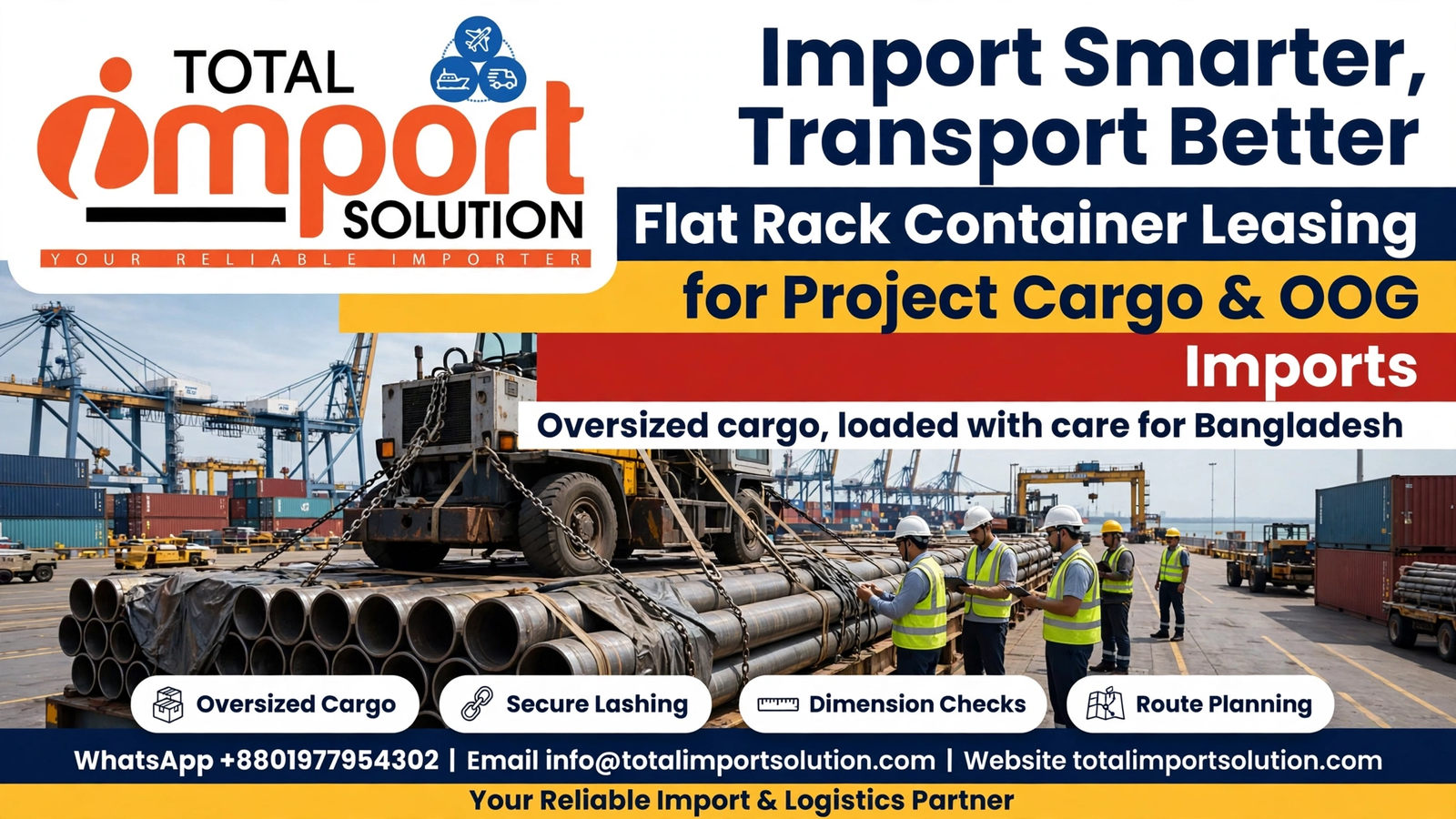
A flat rack container is built on a strong steel floor with corner posts and end walls that can fold down on many units. With the end walls folded, a flat rack becomes a flat platform, and cargo can be loaded from above with a crane or from the side with a forklift. With the end walls raised, the flat rack gives the cargo a frame at each end and a set of lashing points along the sides.
The floor of a flat rack is made to carry heavy loads, and the lashing points along the floor and the end walls are made to hold the cargo still while the container is lifted, moved by road, and loaded onto a vessel. Lashing is the set of straps, chains, and wires that tie the cargo to the flat rack.
Before you hire a flat rack, check the unit itself. Look at the floor for soft spots, cracks, or oil stains. Look at the corner posts and end walls for bends or damage. Check that the lashing points are sound and that the CSC plate on the unit is in date. Photograph the unit, note the container number, and record what you find on the inspection report. A flat rack that fails the check should not be loaded. Ask for a replacement and run the same check on the replacement.
2. What Project Cargo and OOG Mean
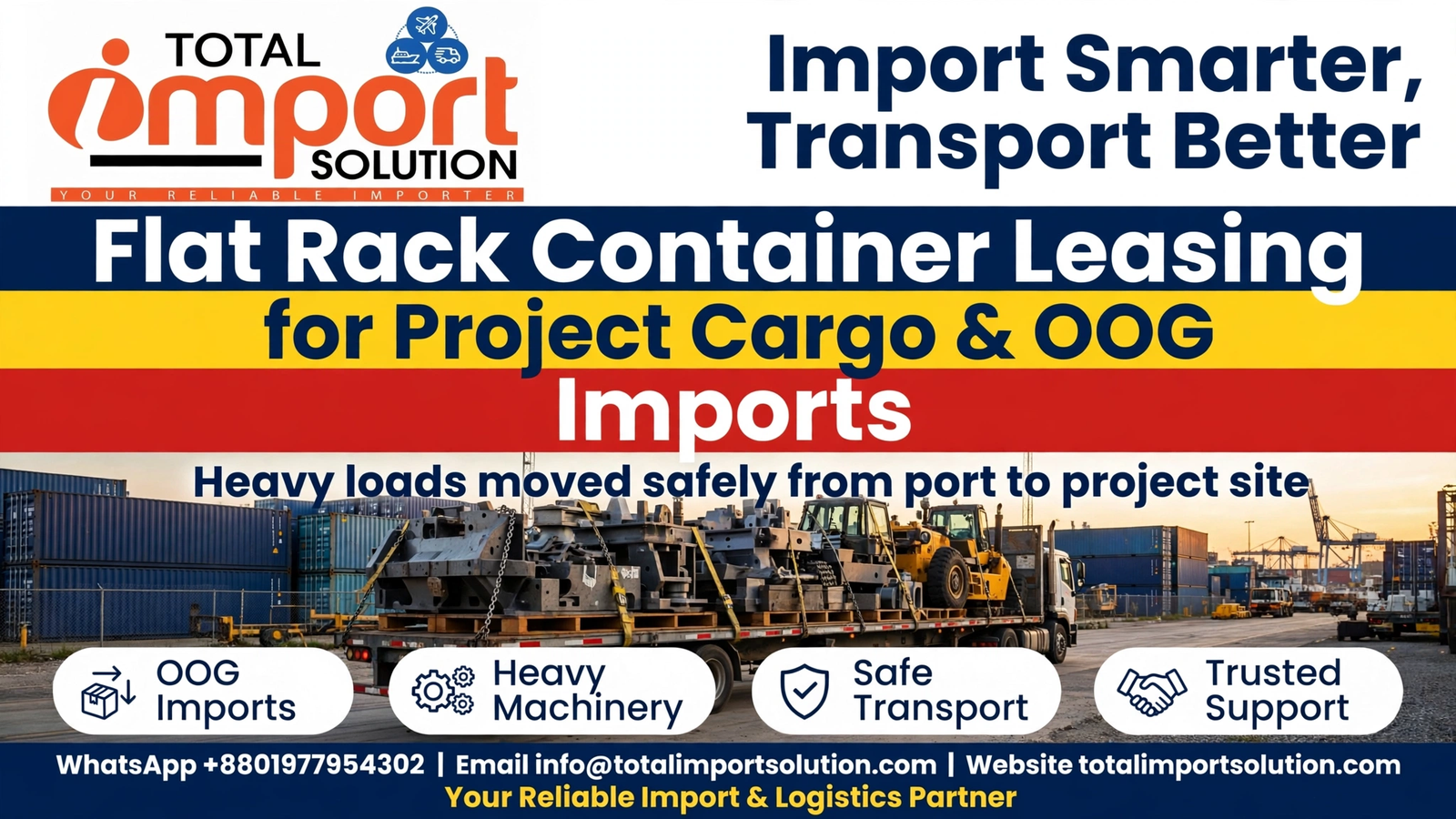
Project cargo is cargo that is moved for a specific project, such as a factory, a power plant, a construction site, or a large installation. The cargo is often a single large item or a small number of large items, and each item needs its own plan for loading, transport, and unloading.
OOG, or out-of-gauge, means cargo that is wider, taller, or longer than the inside of a standard container, so it cannot be closed inside one. A flat rack has no side walls and no roof, so cargo that sticks out beyond the floor can still be carried, as long as the overhang is measured, agreed in writing, and checked against the route and the vessel stowage plan.
The table below sets out the main kinds of cargo that importers move on flat racks, and what makes each kind different to plan.
| Cargo kind | Why it needs a flat rack | Main planning point |
|---|---|---|
| Heavy machinery | Too heavy or too tall for a closed container | Weight spread across the floor and lashing points |
| Steel structures and beams | Too long for a closed container | Length, overhang, and loading from the top or side |
| Large crates and cases | Too wide or too tall for a container door | Width and height measured at the widest and tallest points |
| Pipes, coils, and reels | Long or round, and hard to hold still | Blocking, wedging, and lashing so the load cannot roll |
3. When a Flat Rack Is the Right Choice
A flat rack is the right choice when the cargo cannot be loaded into a closed container, or when loading it that way would risk damage to the cargo or to the container. If the cargo fits through the door and inside the walls of a standard container, a dry container is usually the simpler choice.
The choice is not only about size. A flat rack is also useful when the cargo must be loaded from above, for example when a crane lifts a machine onto the platform, or when the cargo has lifting points on top that a crane must reach.
The table below compares the main container types an importer may consider, so that the choice can be made on the cargo in front of you.
| Container type | Best for | Limit to watch |
|---|---|---|
| Dry container, 20 foot or 40 foot | Boxed goods, pallets, and cargo that fits inside | Fixed door size and fixed inside measurements |
| High cube container, 40 foot | Tall boxed goods and light cargo that fills a large space | Fixed door size, with extra height inside only |
| Flat rack container | Wide, tall, long, or heavy project cargo | No side walls or roof, so lashing and cover need care |
Ask three questions before you choose. First, does the cargo fit through the door of a closed container. Second, does it fit inside the walls and under the roof once it is loaded. Third, can it be loaded safely through the door, or does it need to be lifted from above or from the side. If the answer to any of the first two questions is no, or if the third question points to top loading, a flat rack is likely the right choice.
4. Flat Rack Sizes and Approximate Capacities
Flat racks are most often supplied in 20 foot and 40 foot lengths, matching the standard lengths of other containers. A 20 foot flat rack is about 6 metres long, and a 40 foot flat rack is about 12 metres long.
For comparison, the approximate inside volumes of standard dry containers are about 33 CBM for a 20 foot container, about 67 CBM for a 40 foot container, and about 76 CBM for a 40 foot high cube container. These figures are approximate, and the payload of a standard container is about 26,000 to 28,000 kg, also approximate. A flat rack does not have an inside volume in the same way, because it has no walls and no roof, so its capacity is set by the floor size, the floor strength, and the lashing points, together with the measurements of the cargo itself.
| Flat rack size | Approximate length | What to check on the unit |
|---|---|---|
| 20 foot flat rack | About 6 metres | Floor length and width, end wall height, lashing points |
| 40 foot flat rack | About 12 metres | Floor length and width, end wall height, lashing points |
When two flat racks are joined for a long piece of cargo, the floors must sit level, the join must be made as the provider sets out in writing, and the lashing must hold the cargo across the join as well as at each end. A long cargo that is lashed only at its ends can move in the middle, so the middle needs support and lashing too.
5. How to Measure Your Cargo Before You Book
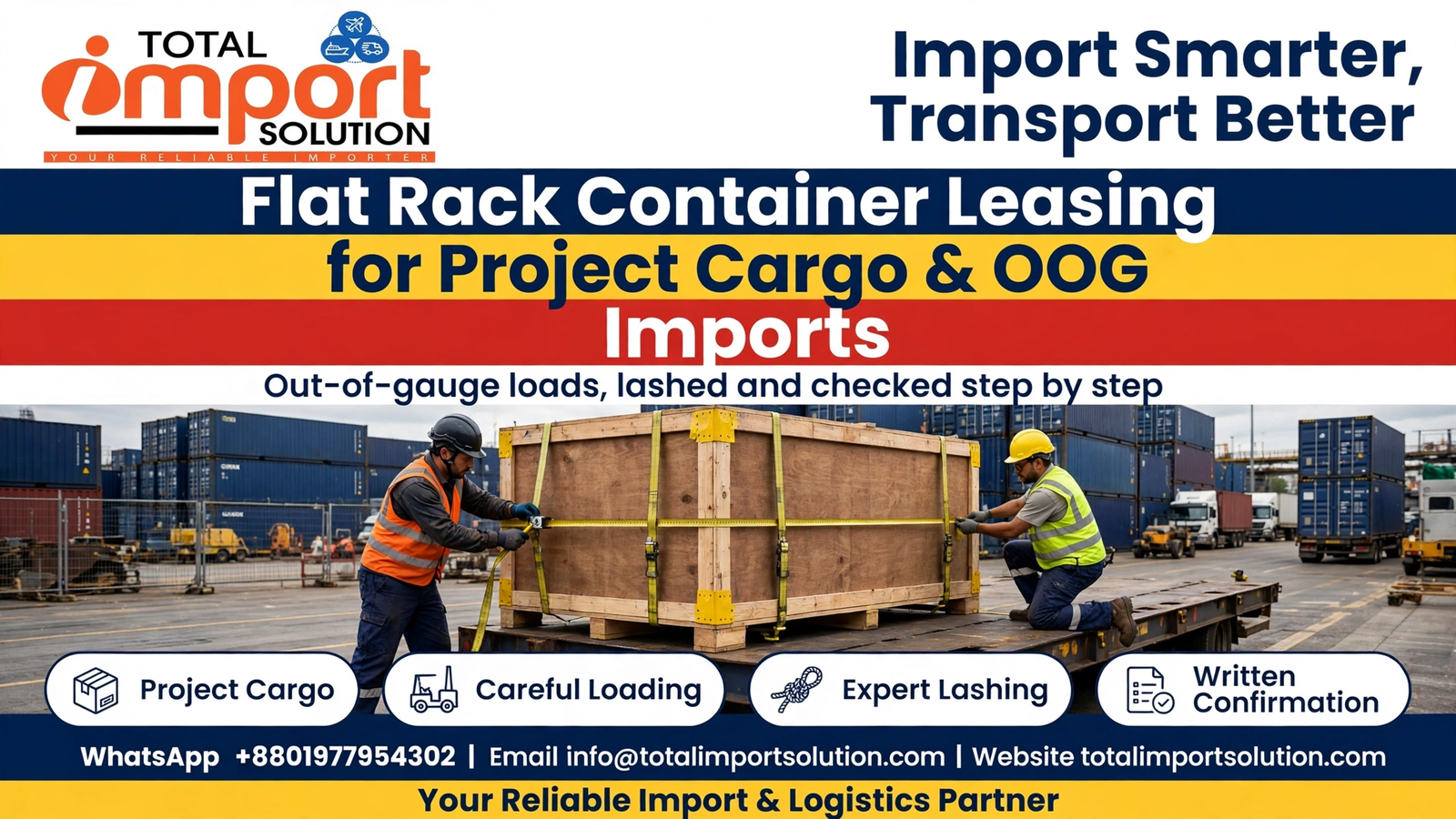
Measuring the cargo is the first practical step, and it should be done before you book the flat rack. A measurement taken from a drawing or from memory is not enough. Measure the actual cargo, or ask the supplier to measure it and send photographs with a measuring tape visible in the photograph, so that the figures can be checked.
Measure the length, the width, and the height of the cargo at its widest, tallest, and longest points. Measure at the widest point, including any handle, pipe, or fitting that sticks up.
Weigh the cargo as well, and note the weight on the same sheet as the measurements. The weight decides how the cargo must be spread across the floor and how many lashing points are needed.
Record the lifting points on the cargo, if it has any. These are the places where a crane or a forklift may safely lift the cargo. If the cargo has no lifting points, ask the supplier how it should be lifted, and write the answer down. Never lift a heavy piece of cargo from a place that was not made for lifting.
Make a simple measurement sheet for each piece of cargo, with the length, width, height, weight, lifting points, and any part that sticks out. Attach photographs from the front, the side, and the top. Send that sheet when you ask for a flat rack.
6. Lashing and Securing: The Steps That Protect Your Cargo
Lashing holds the cargo to the flat rack so that it cannot slide, tip, or lift while the flat rack is moved. A flat rack has no walls to hold the cargo in place, so the lashing is the only thing that keeps the cargo on the platform. Lashing must be planned before loading, checked during loading, and checked again after loading.
Start with the lashing points on the flat rack. Each flat rack has a set of lashing points along the floor and on the end walls. Count them, check that each one is sound, and note how many are in reach of the cargo once it is placed. A cargo that covers most of the lashing points cannot be lashed at those points, so the placing of the cargo and the placing of the lashing must be planned together.
Use lashing material that suits the cargo and the journey. Straps, chains, and wires each have their own uses, and the choice depends on the weight of the cargo, the shape of the cargo, and the surface the lashing will press against. Sharp edges on the cargo must be covered with edge protectors, so that the lashing is not cut by the edge.
Follow these steps in order when the cargo is lashed:
Step one: place the cargo as agreed on the plan, with the weight spread across the floor. Step two: block the cargo with timber or other blocking material, so that it cannot slide. Step three: fit the lashing from the cargo to the lashing points, pulling each strap or chain tight in turn. Step four: fit edge protectors wherever the lashing crosses a sharp edge. Step five: check every strap and chain by hand, and tighten any that have slack. Step six: photograph the lashed cargo from each side, and note the lashings on the loading report.
The loading report, with its photographs, is the record that the cargo was lashed as planned, and it should travel with the shipment papers.
7. Loading a Flat Rack Step by Step
Loading a flat rack needs a clear plan, a clear place to work, and people who know their part in the plan. The loading place should be flat, firm, and large enough for the flat rack, the lifting equipment, and the cargo, with room for people to walk around the flat rack without standing under a lifted load.
Work through the loading in this order:
Step one: check the flat rack, the cargo, and the measurement sheet together. Step two: check the lifting equipment and the lifting points, and agree on the lifting plan in writing. Step three: place the flat rack on firm, level ground, with the end walls in the position agreed for loading. Step four: lift the cargo slowly, place it as agreed on the plan, and check the position with a tape before the lift is released. Step five: block the cargo so that it cannot move, and fit the lashing as set out in the previous section. Step six: check the height, width, and length of the loaded flat rack, including any overhang, and write the loaded measurements down. Step seven: fit a tarpaulin cover if one is needed, in a way that does not press on the cargo or hide the lashing points. Step eight: photograph the loaded flat rack from the front, the side, and the top, and sign the loading report.
After loading, the loaded flat rack is taller, wider, or longer than an empty flat rack, and it may be wider or taller than a standard container. That is why the loaded measurements matter, and why they must be sent to the transport provider and to the port before the flat rack moves.
8. Route Checks: Roads, Bridges, Ports and Depots
A flat rack carrying out-of-gauge cargo is wider, taller, or longer than a standard container, so the route it travels must be checked in the same way as the cargo. A bridge, a gate, or a low wire that a standard container passes under may block a tall load.
Check the road route from the loading place to the port, and from the port or depot in Bangladesh to the final place of unloading. Ask about low bridges, narrow gates, sharp turns, and weight limits on the road, and confirm the answers in writing. Where the cargo overhangs the flat rack, the overhang must be marked so that other road users can see it, and the transport provider should confirm in writing how the overhang will be marked and moved.
Check the port and depot gates as well. A tall load may not pass under a gate frame, and a wide load may not pass through a narrow gate. Ask the port or depot for the gate measurements, and compare them with the loaded measurements of the flat rack. Confirm in writing that the loaded flat rack can enter and leave the port or depot, and at which gate and at which hours.
Check the stowage plan with the shipping line, so that the loaded flat rack is placed on the vessel in a position that suits its size and its overhang. Send the loaded measurements, the weight, and the lashing report early, and do not move the cargo until the stowage is confirmed in writing.
9. Documents and Papers for a Flat Rack Shipment
A flat rack shipment needs the same core papers as any import shipment, with a few extra papers that describe the cargo and the loading. The papers should be prepared before the cargo moves, and a copy should travel with the shipment while the originals are kept in the shipment file.
The table below lists the papers to prepare, and what each paper is for.
| Paper | What it is for |
|---|---|
| Commercial invoice and packing list | Description, quantity, and weight of the cargo |
| Measurement sheet | Length, width, height, and weight of each piece of cargo |
| Loading and lashing report | Photographs and notes showing how the cargo was placed and lashed |
| Booking confirmation | Flat rack size and type, pickup place, and return place |
| Hire agreement | Terms of the flat rack hire, read before signing |
| Bill of lading or transport document | Receipt for the cargo and evidence of the transport contract |
| Certificate of origin, where needed | Place where the cargo was made, for customs purposes |
| Import papers for Bangladesh | Papers required for customs clearance on arrival |
Keep the papers in one file, with a checklist on the front showing which papers are ready and which are still to come. When a paper arrives, tick it off and file it in the same order as the checklist. Share copies with the clearing agent, the transport provider, and the depot, so that each party works from the same papers.
10. Working with Ports, Depots and Inland Transport in Bangladesh
Most flat rack cargo for Bangladesh arrives through a sea port, and from there it moves by road to a depot or to the final place of unloading. Chittagong is the main sea port for container cargo, From the port, the cargo may go to an off-dock ICD near Chittagong, or to an inland depot near Dhaka, or direct to a factory or warehouse.
An off-dock ICD is a container yard outside the port where containers are received, stored, and handed over. An inland depot near Dhaka serves the same purpose closer to the factories and warehouses around the capital.
Before you send a flat rack to a port or depot, confirm in writing that the depot can receive it, with the loaded measurements, the weight, and the dates in the confirmation. Ask about the receiving hours, the papers the driver must carry, how long the flat rack may stay, and what notice is needed before pickup. Confirm the return place for the empty flat rack as well.
Road transport in Bangladesh for a wide or tall load needs a vehicle and a driver suited to the load. The vehicle must be able to carry the weight and the size of the loaded flat rack, and the driver must know the route and the height and width of the load. Tell the transport provider the loaded measurements in writing, and ask for written confirmation that the vehicle and the route suit the load.
11. Common Problems with Flat Rack Shipments and How to Plan Around Them
Flat rack shipments can face problems that a standard container shipment does not face, and most of them can be planned around if they are thought about before the cargo moves. The most common problems are wrong measurements, weak lashing, a route that does not fit the load, and papers that do not match each other.
Wrong measurements are the first problem. If the cargo is measured at its narrowest point instead of its widest, the loaded flat rack may be wider than the plan. Check the measurements again after loading, when the loaded measurements are taken.
Weak lashing is the second problem. If the lashing is fitted loosely, or if a strap is cut by a sharp edge, the cargo can move during the journey. Fit edge protectors, tighten each strap in turn, and check the lashing again after the flat rack has moved a short distance.
A route that does not fit the load is the third problem. A low bridge or a narrow gate can stop a tall or wide load. Check the road, the bridges, the gates, and the depot before the cargo moves, and confirm each part in writing.
Papers that do not match are the fourth problem. If the weight on the invoice differs from the weight on the measurement sheet, clearance can be held up. Check each paper against the others before the cargo moves, and ask for a correction in writing where two papers differ.
12. Cost Factors for Flat Rack Leasing
The cost of a flat rack hire is shaped by several factors, and each factor depends on the actual shipment. No fixed prices, rates, or fees are given here. A rate or fee is confirmed only after checking the actual shipment and documents, and that confirmation should be in writing before the cargo moves.
The hire charge for the flat rack itself is the first factor. It depends on the size of the flat rack, how long it is held, and where it is picked up and returned.
Road transport is the second factor. Moving a wide, tall, or heavy load by road needs a suitable vehicle and a checked route, and the transport charge depends on the distance, the size and weight of the load, and the vehicle needed. Lifting at the loading place and at the place of unloading is part of this factor, and the lifting plan should be agreed in writing before the cargo moves.
Port and depot charges are the third factor. A flat rack with out-of-gauge cargo may need extra handling at the port, extra space at the depot, and extra time for loading and unloading. Ask the port and the depot what charges apply to a loaded flat rack of your measurements, and get the answer in writing.
Loading, lashing, and covering are the fourth factor. Lashing material, blocking material, edge protectors, and a tarpaulin cover all have a cost, and the labour to fit them has a cost too. These costs depend on the size and shape of the cargo and on how many lashings are needed.
| Cost factor | What shapes it |
|---|---|
| Flat rack hire charge | Size, hire period, pickup and return places |
| Road transport and lifting | Distance, load size and weight, vehicle and lifting plan |
| Port and depot charges | Handling, space, and time needed for an out-of-gauge load |
| Loading, lashing, and cover | Lashing material, blocking, edge protectors, and tarpaulin |
13. A Practical Checklist Before You Confirm a Flat Rack Hire
Use this checklist before you confirm a flat rack hire, and tick each item off only when it is done.
Step one: measure the cargo at its widest, tallest, and longest points, weigh it, and write the figures on a measurement sheet with photographs. Step two: check the flat rack offered against the measurement sheet, and inspect the floor, the corner posts, the end walls, the lashing points, and the CSC plate. Step three: agree the placing of the cargo, the blocking, and the lashing, and write the plan down. Step four: agree the lifting plan in writing, with the lifting points noted. Step five: check the road route, the bridges, the gates, and the depot, and confirm each part in writing. Step six: confirm the stowage with the shipping line, with the loaded measurements and the lashing report attached. Step seven: check the papers against each other, and file them in one shipment file. Step eight: read the hire agreement before you sign it, and note the pickup place, the return place, and the dates. Step nine: confirm the cost in writing for your actual shipment. Step ten: send the loaded measurements to the transport provider, the port, and the depot.
Keep the completed checklist in the shipment file. If any item cannot be ticked off, note the reason in writing and agree with the provider what will happen instead.
Frequently Asked Questions
1. What is a flat rack container?
A flat rack container is a shipping container with a flat floor, strong end walls, and no side walls and no roof. Cargo that is too wide, too tall, or too heavy for a standard closed container can be loaded onto it from the top or from the side, and then lashed down.
2. What does OOG mean?
OOG stands for out-of-gauge, which means cargo that goes beyond the normal inside measurements of a standard container. Cargo that sticks out beyond the floor can still be carried, as long as the overhang is measured and agreed in writing.
3. When should I choose a flat rack instead of a dry container?
Choose a flat rack when the cargo cannot fit through the door of a closed container, cannot fit inside its walls and under its roof, or must be loaded from above or from the side. If the cargo fits inside a dry container, a dry container is usually the simpler choice.
4. What sizes of flat rack are available?
Flat racks are most often supplied in 20 foot and 40 foot lengths. A 20 foot flat rack is about 6 metres long, and a 40 foot flat rack is about 12 metres long. Two flat racks can be joined end to end for a very long piece of cargo.
5. How do I measure cargo for a flat rack?
Measure the length, width, and height at the widest, tallest, and longest points, and weigh the cargo as well. Note the lifting points, and photograph the cargo from the front, the side, and the top.
6. What is lashing and why does it matter?
Lashing is the set of straps, chains, and wires that tie the cargo to the flat rack. With no walls to hold the cargo in place, the lashing is what keeps the cargo on the platform.
7. How is cargo loaded onto a flat rack?
Cargo is loaded from the top with a crane or from the side with a forklift, onto a flat rack placed on firm, level ground. The cargo is placed as agreed on the plan, blocked so that it cannot move, and then lashed down.
8. What should I check on the route before the cargo moves?
Check the road route, low bridges, narrow gates, sharp turns, and weight limits on the road, and check the port and depot gates against the loaded measurements. Confirm each part of the route in writing before the cargo moves.
9. What papers do I need for a flat rack shipment?
You need the commercial invoice and packing list, a measurement sheet, a loading and lashing report, a booking confirmation, a hire agreement, a bill of lading or transport document, and the import papers for Bangladesh.
10. Can a flat rack carry a very long piece of cargo?
Yes, two flat racks can be joined end to end for a very long piece of cargo. The floors must sit level, the join must be made as the provider sets out in writing, and the lashing must hold the cargo across the join.
11. Does flat rack cargo need a cover?
A tarpaulin cover can be fitted where the cargo needs cover from rain and dust. The cover is fitted after loading and lashing, and it must be fitted in a way that does not press on the cargo or hide the lashing points that still need to be checked.
12. What shapes the cost of a flat rack hire?
The cost is shaped by the hire charge for the flat rack, road transport and lifting, port and depot charges, loading, lashing, and covering, and clearance and papers. Each part depends on your actual shipment, so ask for the cost to be confirmed in writing.
13. What should I check before I accept a flat rack?
Check the floor for soft spots, cracks, or oil stains, check the corner posts and end walls for bends or damage, check that the lashing points are sound, and check that the CSC plate is in date. Photograph the unit and note the container number.
14. What should I do if my cargo measurements change after booking?
Tell the provider in writing as soon as the measurements change, and send a new measurement sheet with photographs. The flat rack, the lashing plan, the route, and the stowage may all need to be checked again.
15. How can Total Import Solution help with flat rack leasing?
Total Import Solution has served importers in Bangladesh since 2016, supporting container rental alongside its import services. The team helps you plan the cargo, the lashing, and the route, and keep the hire papers in order.
16. How do I get a quote for my next flat rack shipment?
Send the details of your shipment on WhatsApp. Share your cargo description, the container size and type, the loading place, the date or date range, and the destination.
Contact Total Import Solution
For flat rack container leasing for project cargo and OOG imports in Bangladesh, contact Total Import Solution.
- Company: Total Import Solution — serving importers in Bangladesh since 2016
- Service: Flat Rack Container Leasing for Project Cargo & OOG Imports
- WhatsApp: +8801977954302
- WhatsApp direct link: https://wa.me/8801977954302
- Email: info@totalimportsolution.com
- Website: totalimportsolution.com
Get a quote in 1 minute: message Total Import Solution on WhatsApp at https://wa.me/8801977954302 and send these details:
- Cargo description — what the goods are and how they are packed
- Container size and type — for example, 20 foot, 40 foot, or 40 foot high cube flat rack
- Loading place — where the container will be picked up or loaded
- Date or date range — when the container is needed
- Destination — where the cargo is going
There is no embedded form. Send the details above on WhatsApp and the team will reply with the confirmed details for your shipment.
