
Electric vehicle parts shipping from China to Bangladesh
Electric vehicle parts shipping from China to Bangladesh is a practical job that rewards clear planning. More workshops, dealers, fleet owners and repair centres in Bangladesh now work with electric vehicles, and they need a steady supply of motors, battery packs, controllers, chargers, brakes, suspension parts and body parts. China is a large source for many of these parts, so a shipment often starts with a supplier in China and ends with a workshop shelf in Dhaka, Chittagong or another city in Bangladesh. This guide explains the whole route in plain steps, from the first parts list to the final check at your door. Since 2016, Total Import Solution has worked in import and logistics. This guide follows the same careful method used for other machinery shipments: describe the goods clearly, prepare the documents early, pack for the real journey, check the rules for the actual shipment, and confirm the rate and fee only after checking the actual shipment and documents. No figure in this guide is a quoted charge. A rate or fee is confirmed only after checking the actual shipment and documents, because weight, size, part type, packing and route all change the work involved.
1. What electric vehicle parts shipping from China to Bangladesh covers
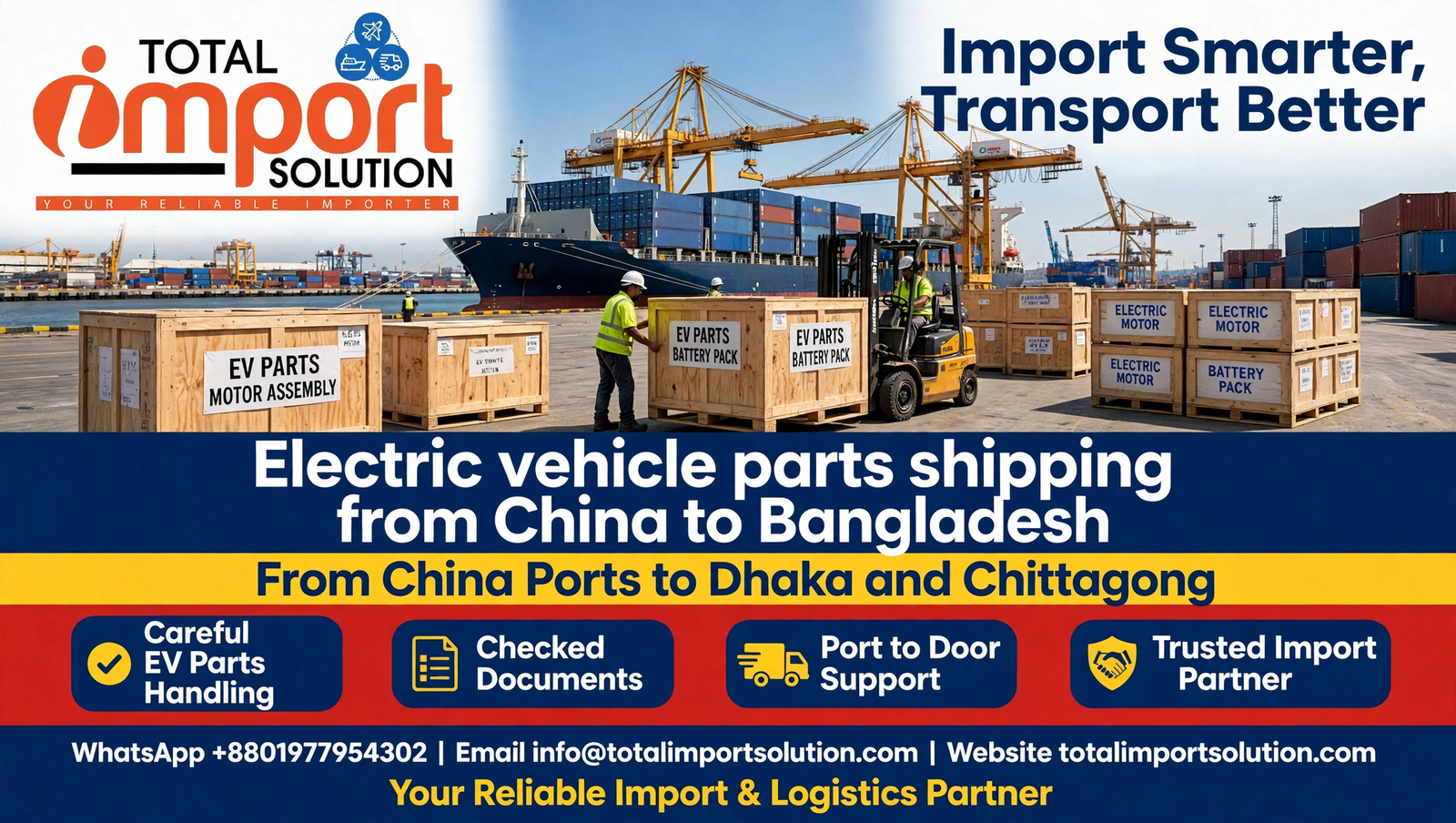
Electric vehicle parts shipping from China to Bangladesh covers the movement of spare parts and components for electric cars, electric buses, electric vans, electric three-wheelers and other electric vehicles, from a supplier or factory in China to a buyer in Bangladesh. The parts may travel by sea freight in a container, by air freight for a small and urgent load, or by a mix of sea and road transport. The service around the transport also matters: collecting the goods from the supplier, checking the packing list, preparing shipping documents, booking space, handling customs clearance in Bangladesh, and arranging delivery to the buyer. Some buyers order a full container of one type of part. Others order a mixed load with many small lines. Both kinds of orders need the same care with names, quantities and packing marks. A clear parts list is the base for everything else. This guide treats the shipment as one chain. Each link in the chain is a step you can check: order, packing, documents, booking, loading, sailing or flying, arrival, clearance and delivery. When each link is checked in turn, the shipment moves in an orderly way.
2. Who needs this service and what to plan first
This service is useful for several kinds of buyers in Bangladesh. A vehicle dealer needs original and replacement parts for the models it sells. A workshop needs motors, controllers, brake parts and suspension parts for repair work. A fleet owner needs regular stock for electric buses or delivery vans. A trader needs a mixed range of parts to sell to smaller shops. Before you place an order, plan four things. First, write down the vehicle models and the exact parts you need, with part numbers where you have them. Second, decide how much stock you want to hold, so you do not order too little and run out, and do not order too much and fill your store with slow-moving stock. Third, decide where the goods should arrive and who will receive them, with a named person and a phone number. Fourth, set aside time for documents and clearance, and keep a file for every paper connected to the order. Share the planning note with your supplier and your agent, so all three sides work from the same list. If a part name is unclear, ask the supplier for a photo, a drawing or a short description before you pay. Keep the planning note with the order.
3. Main types of electric vehicle parts you can ship
Electric vehicles use many parts, and they fall into clear groups. Drive parts include electric motors, motor controllers, inverters, gearboxes and drive shafts. Energy parts include battery packs, battery modules, battery management parts, chargers and charging cables. Control parts include wiring harnesses, connectors, switches, sensors, fuses and relays. Body and chassis parts include doors, bumpers, lights, mirrors, glass, wheels, tyres, brakes and suspension parts. Comfort parts include air conditioning parts, heaters, seats and dashboard parts. The table below gives a simple way to sort your order, so the supplier packs like parts together and the packing list is easy to read.
| Part group | Examples | Packing note |
|---|---|---|
| Drive parts | Electric motor, controller, inverter, gearbox | Heavy, needs strong crate and bracing |
| Energy parts | Battery pack, battery module, charger, cable | Check the rules for the actual shipment first |
| Control parts | Wiring harness, sensor, fuse, relay, switch | Small, needs labelled cartons and a count sheet |
| Body parts | Door, bumper, light, mirror, glass | Needs edge protection and careful stacking |
| Chassis parts | Brake parts, suspension parts, wheel, tyre | Heavy, keep weight low in the load |
| Comfort parts | Air conditioning parts, seat parts, dashboard parts | Keep dry and clean, wrap against dust |
Sort the order by group before you send it, and ask the supplier to pack each group apart and mark each carton with the group name.

4. How to describe your parts clearly to your supplier and agent
A clear description is the single most useful thing you can send with an order. For each line, write the part name, the part number if you have it, the vehicle model and year it fits, the quantity, the material or type, and the size or weight if you know it. Add a photo of the part and a photo of the label or plate on the part. If a part has a left and right version, say so in words and in the photo. If a part comes in a set, say how many pieces make one set. Send the list as one sheet, not as scattered messages, so the supplier can check each line and reply line by line. The steps below show a simple order routine you can repeat for every shipment.
- Make one parts list with names, part numbers, models and quantities.
- Add a photo for each part that could be confused with a similar part.
- Ask the supplier to confirm each line in writing, with any change marked clearly.
- Ask the supplier to confirm the packing plan for heavy and fragile parts.
- Send the confirmed list to your agent, so the documents match the goods.
- Keep the confirmed list in your order file and use it at arrival to check the goods.
When the supplier asks a question, answer in writing and keep the answer with the list.
5. Documents you need to prepare before shipping
Documents move with the goods, and a missing paper can hold a shipment at the port. Prepare the papers early, while the goods are still being packed, not after the ship has sailed. The usual set for a shipment from China to Bangladesh includes a commercial invoice, a packing list, a bill of lading or air waybill, and a certificate of origin where it applies. The invoice shows the seller, the buyer, the goods, the quantity and the value as agreed. The packing list shows how the goods are packed, carton by carton. The bill of lading or air waybill is the transport document issued by the carrier. Other papers may be needed for the actual shipment, such as a test report, a safety data sheet for a battery part, or a declaration form, and you should check the rules for the actual shipment before you book. The table below is a working checklist. Tick each line as the paper is ready and checked.
| Document | Who usually provides it | What to check |
|---|---|---|
| Commercial invoice | Supplier | Names, goods, quantity and value match the order |
| Packing list | Supplier | Carton marks, counts and weights match the goods |
| Bill of lading or air waybill | Carrier or agent | Ports, names and marks match the invoice |
| Certificate of origin | Supplier or chamber | Origin and goods description match the order |
| Battery papers where needed | Supplier | Type and handling notes match the actual parts |
| Import papers for Bangladesh | Buyer or agent | Papers match the rules for the actual shipment |
Check every name and number twice, and keep the originals in a safe place until clearance is done.
6. Packing EV parts for a sea and road journey
Good packing protects the parts and protects the people who handle them. Electric vehicle parts vary a lot in shape and weight, so one packing style does not fit all. Heavy parts such as motors and gearboxes need a strong wooden crate with bracing inside, so the part cannot move when the container turns or the truck brakes. Glass and lights need soft wrapping and edge guards, with a clear mark on the outside that the carton holds fragile goods. Small parts such as connectors and fuses need sealed bags inside labelled cartons, with a count sheet inside the top of the carton. Battery parts need the packing that the rules for the actual shipment call for, and you should ask the supplier and your agent to confirm that packing before the goods leave the factory. A simple mark such as carton 3 of 12 is easy to read and easy to check at arrival. Ask the supplier for a photo of the packed goods before loading, and keep the photo with the packing list.
7. Battery parts and safety checks in general terms
Battery parts need extra care, and the right approach is to check the rules for the actual shipment rather than assume. A battery pack, a battery module and a single cell are different items, and they may need different handling, packing and papers. Some battery parts are treated as sensitive goods for transport, and the carrier, the port and the airline each have their own checks. Before you order a battery part, ask the supplier for the product details, the type of battery, the packing used, and any safety paper that comes with it. Share those details with your agent before you book, so the agent can check the rules for the actual shipment and tell you what is needed. Do not hide a battery part inside a mixed load under a general name. A clear name on the invoice and packing list is safer for everyone, and it avoids a hold at the port when the goods are inspected. Keep battery parts dry, keep the terminals covered as the supplier advises, and follow the storage notes that come with the goods. If a battery pack shows swelling, leakage, a strange smell or heat, do not open it and do not try to charge it. Ask a trained person for advice. This guide does not set battery rules. It only asks you to check the rules for the actual shipment, to name the goods clearly, and to let trained people handle any item that looks damaged or unsafe.
8. Choosing sea freight or air freight for EV parts
Sea freight and air freight suit different orders, and the choice depends on the size, weight, value and urgency of the parts. Sea freight in a container suits a large order, a heavy order, and a regular stock order where you can plan ahead. A full container load gives you one container for your goods alone. A shared container load, often called a less than container load, suits a smaller order that shares space with other goods, but it needs extra care with marks and counts, because your cartons sit beside other goods. Air freight suits a small, light and urgent order, such as a controller or a sensor that a workshop needs to finish a repair. Air freight also has strict checks on battery parts and on size and weight, so you should check the rules for the actual shipment before you book air freight. The table below compares the two modes in general terms, without any figure for time or charge, because a rate or fee is confirmed only after checking the actual shipment and documents.
| Point | Sea freight | Air freight |
|---|---|---|
| Order size | Suits large and heavy orders | Suits small and light orders |
| Planning | Needs planning ahead | Suits an urgent small order |
| Packing | Strong crates for a long journey | Light, strong packing with clear marks |
| Battery parts | Check the rules for the actual shipment | Check the rules for the actual shipment |
| Documents | Invoice, packing list, bill of lading | Invoice, packing list, air waybill |
| Best use | Regular stock and large orders | Urgent small parts for a repair |
Ask your agent to explain both modes for your actual order, and then choose the mode that fits the order.
9. Customs clearance in Bangladesh step by step
Customs clearance in Bangladesh is a set of checks that confirm the goods, the papers and the duties for the actual shipment. The steps below give the order of work in general terms. The exact papers and checks depend on the actual shipment, so your agent should confirm the list for your order before the goods arrive. Do not wait for arrival to start. Send the invoice, packing list and transport document to your agent as soon as they are ready, so the agent can read them and ask for any missing paper in good time. When the goods arrive at the port, the agent files the entry, the papers are checked, and the goods may be examined. If a question comes up, answer it with the paper that proves the point, not with a guess. A rate or fee for duty and other charges is confirmed only after checking the actual shipment and documents, because the part type, the value and the papers all affect the assessment. Keep a copy of every clearance paper in your order file, with the date and the name of the person who handled it.
- Send the invoice, packing list and transport document to your agent early.
- Ask the agent to confirm the full paper list for the actual shipment.
- Check that names, counts and values match across all papers.
- Arrange the import papers that the buyer must provide.
- File the customs entry when the goods arrive at the port.
- Answer any query with the matching paper from your file.
- Pay the assessed charges through the proper channel and keep the receipt.
- Collect the release paper and arrange delivery from the port.
Clearance moves faster when the file is complete and the story of the shipment is easy to follow from order to arrival.
10. Delivery from port to Dhaka, Chittagong and other places
After clearance, the goods need a safe road journey to your store or workshop. Plan the delivery before the goods are released, so the truck is ready and the receiving person is present. For a full container, the seal is opened in front of your staff. For a shared load, your cartons are unloaded and then loaded onto a truck. In both cases, count the cartons before the truck leaves, and check the marks against the packing list. Take a photo of the loaded truck and keep it in your file. At your premises, unload in a clear area, check each carton for damage, and sign the delivery note only after the count is done. If a carton is missing or damaged, write the note on the delivery paper before you sign, and tell your agent the same day. Keep the delivery paper with the order file.
11. How to check your parts when they arrive
Checking the goods at arrival is a short job that saves a long dispute later. Do the check in a clean, dry area with the packing list in your hand. Open the cartons in order, count each line, and compare the count with the packing list. Look at each part for damage, rust, a bent edge, a cracked cover or a loose wire. Check the part number on the part against the part number on the list. For a battery part, look for swelling, leakage or a damaged terminal, and follow the safety notes in section 7 if anything looks wrong. The table below is a simple arrival checklist you can print and use for each shipment.
| Check | What to look for | Action if wrong |
|---|---|---|
| Carton count | Count matches the packing list | Note the gap on the delivery paper |
| Carton marks | Marks match the list | Ask the agent to check the load |
| Part number | Number on the part matches the list | Keep the part apart and tell the supplier |
| Damage | No crack, bend, rust or leak | Photograph the damage and keep the packing |
| Battery part | No swelling, leak or heat | Do not open or charge it, ask a trained person |
| Paper set | Invoice and packing list in the file | Ask the agent for the missing paper |
Write the result of the check on one sheet, with the date and a photo of any damage, and send a copy to your supplier and your agent.
12. Common problems and how to avoid them
Most problems in electric vehicle parts shipping come from a small error early in the order, not from the sea or the road. A vague part name leads to the wrong part. A missing paper leads to a hold at clearance. Weak packing leads to damage. A mixed load with no marks leads to a long search at the port. A battery part with no safety paper leads to a question that stops the booking. Each problem has a simple guard. Use a clear parts list with photos and part numbers. Prepare the papers early and check them line by line. Pack heavy parts in strong crates and mark every carton. Check the rules for the actual shipment before you book, and ask the supplier for the battery papers where they apply. Keep one order file with the list, the photos, the papers and the delivery note, and share the file with your agent. When a problem does happen, work from the file: find the paper that proves the order, take a photo of the goods as they arrived, and tell your supplier and your agent in writing on the same day. The table below lists common problems and the guard for each one.
| Problem | Why it happens | Guard |
|---|---|---|
| Wrong part arrives | Vague name or no part number | Clear list with photo and part number |
| Hold at clearance | Missing or mismatched paper | Early paper check against the order |
| Damage in transit | Weak crate or loose load | Strong crate, bracing and clear marks |
| Carton goes missing | No marks or count sheet | Mark each carton and count at each handover |
| Booking refused | Battery rules not checked | Check the rules for the actual shipment first |
| Delay at delivery | No truck or receiver planned | Plan delivery before release from the port |

13. How to judge a good import and logistics provider
A good provider is judged by clear work, not by a loud claim. Look for a provider who asks for the parts list, the photos and the papers before giving a plan. Look for clear writing, a written plan for the shipment, and a named person you can call at each stage. Ask how the provider checks the packing list, handles a battery part, and keeps you informed while the goods are on the way. A rate or fee is confirmed only after checking the actual shipment and documents, so a careful provider will ask to see the list and the papers before confirming a figure, and will explain the figure in plain words when it is confirmed. Check that the provider keeps a file for each order, with the invoice, packing list, transport document and delivery note in one place. Since 2016, Total Import Solution has worked in import and logistics, and the method in this guide is the method to judge any provider by: clear list, early papers, strong packing, checked rules for the actual shipment, honest confirmation of the rate and fee after checking the actual shipment and documents, and a full file from order to delivery. Choose the provider who shows that method in writing, and keep the written plan with your order file.
Frequently Asked Questions
1. What is electric vehicle parts shipping from China to Bangladesh?
It is the movement of electric vehicle spare parts and components from a supplier in China to a buyer in Bangladesh, by sea or by air, with documents, customs clearance and delivery to the buyer.
2. Which electric vehicle parts can I ship from China to Bangladesh?
You can ship drive parts, energy parts, control parts, body parts, chassis parts and comfort parts, including motors, controllers, battery packs, chargers, wiring harnesses, sensors, lights, brakes and suspension parts.
3. How do I start my first electric vehicle parts order?
Start with one parts list that shows the part name, part number, vehicle model, quantity and a photo for each line. Share the list with your supplier and your agent, and ask the supplier to confirm each line in writing.
4. What documents do I need for electric vehicle parts shipping?
The usual set includes a commercial invoice, a packing list, a bill of lading or air waybill, and a certificate of origin where it applies. Other papers may be needed for the actual shipment, such as a safety paper for a battery part.
5. How should electric vehicle parts be packed for shipping?
Heavy parts need a strong wooden crate with bracing inside. Fragile parts need soft wrapping and edge guards. Small parts need sealed bags inside labelled cartons with a count sheet. Every carton and crate should carry a mark with the buyer name, the carton number, the part name and the total count of cartons in the shipment.
6. Can I ship battery packs and battery modules from China to Bangladesh?
Battery parts need extra care, and you should check the rules for the actual shipment before you order or book. Ask the supplier for the battery type, the packing used and any safety paper that comes with the goods, and share those details with your agent.
7. Should I choose sea freight or air freight for electric vehicle parts?
Sea freight suits a large, heavy or regular stock order that you can plan ahead. Air freight suits a small, light and urgent order, such as a part a workshop needs to finish a repair.
8. How is the rate or fee for my shipment confirmed?
A rate or fee is confirmed only after checking the actual shipment and documents, because weight, size, part type, packing and route all change the work involved.
9. How does customs clearance work in Bangladesh for EV parts?
Send the invoice, packing list and transport document to your agent early, so the agent can confirm the full paper list for the actual shipment. When the goods arrive, the agent files the entry, the papers are checked, and the goods may be examined.
10. How long does customs clearance take for EV parts?
Clearance time depends on the actual shipment, the papers and the checks at the port, so this guide gives no fixed time. Send the papers early and answer queries with the matching paper.
11. Can I ship a mixed load of many small EV parts in one container?
Yes, a mixed load is common for small parts such as cables, connectors, switches and lights. Pack each part group apart, label each carton with the part name and count, and add a count sheet inside the top of each carton.
12. What should I do when my electric vehicle parts arrive in Bangladesh?
Check the goods in a clean, dry area with the packing list in your hand. Count each line, compare the count with the list, check the part number on each part, and look for damage, rust, a bent edge or a leak.
13. What if the wrong part arrives or a part is damaged?
Keep the part apart, photograph the part and the packing, and keep the packing list with the photo. Tell your supplier and your agent in writing on the same day, with the part name, the part number and the order number.
14. How do I judge a good import and logistics provider for EV parts?
Judge a provider by clear work: a written plan, a named contact, early questions about the parts list and papers, and a full file for each order.
15. Do I need an agent for electric vehicle parts shipping from China to Bangladesh?
An agent helps with the papers, the booking, the port work, customs clearance and delivery, and is useful for a first order and for a regular order alike.
16. How can I contact Total Import Solution about my EV parts shipment?
You can contact Total Import Solution on WhatsApp at +8801977954302, by email at info@totalimportsolution.com, or through the website at totalimportsolution.com.
Contact Total Import Solution
- Company: Total Import Solution (Since 2016, an importer)
- WhatsApp: +8801977954302
- Email: info@totalimportsolution.com
- Website: totalimportsolution.com
- Service: Electric vehicle parts shipping from China to Bangladesh
- Note: A rate or fee is confirmed only after checking the actual shipment and documents. Send your parts list first, so the team can plan your shipment step by step.
