
Door-to-Door Container Logistics: China Warehouse to Dhaka Factory
A factory in Dhaka that orders raw materials, machinery parts, packaging, or finished goods from China needs more than a ship and a truck. The goods sit in a warehouse in China, they must be collected, checked, packed, loaded into a container, moved to a port, shipped to Bangladesh, cleared through customs, carried to Dhaka, and unloaded at the factory gate. When any one of these links is weak, the factory line can wait and the order can miss its production plan. Door-to-Door Container Logistics: China Warehouse to Dhaka Factory describes a single managed service that covers the whole chain, from the warehouse door in China to the factory door in Dhaka, under one plan and one point of contact.
This service is different from a simple port-to-port shipment, where the buyer arranges the pickup in China and the delivery in Bangladesh separately. In a door-to-door service, the logistics provider joins the parts together — warehouse pickup, consolidation, container loading, export handling, sea transport, arrival at Chittagong Port, customs clearance support, inland transport, and final delivery to the factory — planned as one journey rather than as separate bookings.
This guide explains the warehouse-to-factory route in practical, step-by-step terms. It covers warehouse pickup, cargo readiness, consolidation, container choice, loading supervision, documents, customs clearance, inland transport from Chittagong to Dhaka, factory delivery, and how to judge a good logistics provider. No fixed prices, rates, duty percentages, or fees are given here. A rate or fee is confirmed only after checking the actual shipment and its documents.
Total Import Solution, since 2016, supports importers in Bangladesh with shipment planning, warehouse coordination, documentation, customs clearance support, and delivery coordination. The aim of this guide is to help a factory buyer plan a door-to-door container shipment from a warehouse in China to a factory in Dhaka, so that the goods arrive in good condition, the papers match the cargo, and the factory can plan its production around a clear delivery.
1. What Door-to-Door Container Logistics Means
Door-to-door container logistics means that the container journey is planned from the door where the goods are collected to the door where they are delivered. For a factory buyer in Dhaka, the starting door is usually a supplier warehouse or a consolidation warehouse in China, and the finishing door is the factory in Dhaka. Between those two doors, the goods pass through many hands: warehouse staff, truck drivers, port workers, shipping line staff, customs officers, clearing agents, and inland transporters. A door-to-door service joins these hands into one chain, so the buyer does not have to arrange each link separately or chase each party when a question arises. The provider covers the full chain and keeps the buyer informed at each stage.
| Stage of the chain | What happens |
|---|---|
| Warehouse pickup in China | Goods collected from the supplier warehouse and checked |
| Consolidation and loading | Goods packed, labelled, and loaded into a container |
| Inland transport and delivery | Container carried by road to Dhaka and unloaded at the factory |
2. How the Warehouse-to-Factory Chain Works
The warehouse-to-factory chain works in a fixed order, and each step depends on the step before it. The chain starts when the factory in Dhaka places an order with a supplier in China. The supplier prepares the goods and stores them in a warehouse, or sends them to a consolidation warehouse used by the logistics provider. The provider collects the goods and checks the cartons against the packing list. The goods are then packed for export, labelled clearly, and loaded into a container, which is sealed and the seal number recorded on the documents. The container is moved to the port of loading, handed to the shipping line, and loaded onto a vessel bound for Bangladesh. At Chittagong Port the container is unloaded and placed in the port yard, the clearing agent files the customs declaration, and after release the container is carried by road to Dhaka, where it is opened and the goods are counted against the packing list.
| Chain link | Main task |
|---|---|
| Order and warehouse readiness | Goods prepared, packed, and stored correctly |
| Packing and loading | Export packing, balanced load, sealed container |
| Port and sea transport | Container handed to the line and shipped |
| Inland transport and delivery | Truck to Dhaka, goods counted at the factory |
3. Warehouse Pickup and Cargo Readiness in China
Warehouse pickup is the first physical step, and it sets the tone for the whole shipment. Before the pickup truck is sent, the buyer and the provider should confirm that the goods are ready: the full quantity is in the warehouse, the cartons are packed, the marks are clear, and the supplier has issued the invoice and packing list. A pickup arranged before the goods are ready wastes a trip, and a truck that arrives late can miss the loading plan for the day. The buyer should ask the supplier for the warehouse address in full, the contact name and phone number of the warehouse keeper, the working hours of the warehouse, and the number of cartons and their total weight, so the provider can send the right vehicle and plan the collection properly.
At the warehouse, the pickup team should count the cartons and compare the count with the packing list before the goods leave. Each carton should carry a mark showing the item name, the quantity inside, the carton number, the total number of cartons, and the destination. If a carton is damaged, damp, or open, the team should note it and take a photo before loading it onto the truck. Photos taken at pickup give the buyer a record of the condition of the goods when they left the warehouse. The driver should carry a copy of the pickup note, and the warehouse keeper should sign it to confirm what was collected.
| Pickup point | What to confirm |
|---|---|
| Goods readiness | Full quantity packed and ready in the warehouse |
| Warehouse details | Full address, contact, and working hours |
| Carton count | Count matched to the packing list |
| Carton marks | Item, quantity, carton number, and destination |

4. Consolidation, Labelling and Packing at the Warehouse
Many factory shipments from China are consolidated, which means that goods from one buyer are combined with goods from other buyers in a shared container, or that goods from several suppliers for the same factory are combined into one container. Consolidation suits an order that does not fill a whole container on its own. The goods are collected at a warehouse in China, checked against the packing list, sorted by buyer and by item, and then loaded together with other cargo going to the same port in Bangladesh. A good consolidation warehouse keeps each buyer's goods separate until loading, so that one buyer's cartons are not mixed with another buyer's cartons.
Labelling is the key to a clean consolidation. Every carton should carry a clear mark with the buyer name, the item name, the quantity inside, the carton number, the total number of cartons in the shipment, and the destination factory. The packing list should list each item on its own line, with the number of cartons and the weight for that item. Export packing must protect the goods through several rounds of handling: warehouse to truck, truck to container, container to vessel, vessel to port yard, port yard to truck, and truck to factory. Cartons should be strong enough for stacking, corners should be protected where the goods are fragile, and goods that can be damaged by damp should be wrapped in a cover that keeps moisture out.
| Consolidation point | Good practice |
|---|---|
| Separation of buyers | Each buyer's goods kept apart until loading |
| Clear labels | Buyer, item, quantity, carton number, destination |
| Packing list match | Labels agree with the packing list line by line |
| Damp protection | Sealed cover for goods that suffer from moisture |
5. Container Choice and Loading Supervision
Choosing the right container depends on the size, weight, and nature of the goods. A small order may travel as a consolidated load in a shared container, while a large order may fill a whole container on its own. A full container load gives the buyer more control over the loading and the seal, and the goods are not mixed with other buyers' cargo. A shared container suits a smaller order, but the buyer should confirm how the goods will be separated from other cargo and how the loading will be recorded. The most common container sizes are the 20ft container and the 40ft container, with the 40ft high cube offering extra height for light, bulky goods. As a widely used approximate guide, a 20ft container holds about 33 cubic metres, a 40ft container holds about 67 cubic metres, and a 40ft high cube holds about 76 cubic metres. These are approximate figures only, and the buyer should check the actual container before loading, because the usable space depends on the shape of the goods and the way they are packed.
Loading supervision means that someone watches the loading and records it. The supervisor checks that the container is clean, dry, and free of damage before any goods go in, and that the doors close properly and the seal can be fixed firmly. A container with a leak, a damaged floor, or a door that does not close can let in rain or allow the load to shift. The supervisor checks the loading order: heavy cartons at the bottom, light cartons on top, cartons with the same marks kept together, and the load braced so that it does not move.
| Container point | What to check |
|---|---|
| Container size | Size matched to the volume and weight of the goods |
| Container condition | Clean, dry, no damage, doors close properly |
| Loading order | Heavy below, light above, same marks together |
| Bracing | Load braced and strapped so it cannot shift |
6. Step-by-Step Process from Warehouse to Factory
Step 1: Confirm the order and the warehouse. The factory confirms the order with the supplier in China, including the item names, quantities, packing, and the warehouse address where the goods will be ready for collection.
Step 2: Plan the door-to-door movement. The provider plans the pickup, the consolidation, the container, the port of loading, the arrival port, the customs papers, and the inland transport to Dhaka, and shares the plan with the buyer in writing.
Step 3: Collect the goods from the warehouse. The pickup team counts the cartons against the packing list, checks the marks, notes any damage, takes photos, and carries the signed pickup note.
Step 4: Consolidate, pack, and label. The goods are sorted at the warehouse, packed for export, labelled clearly, and matched line by line with the packing list.
Step 5: Load and seal the container. The container is checked, the goods are loaded in the right order, the load is braced, photos are taken, the container is sealed, and the seal number is recorded.
Step 6: Move the container to the port and ship it. The container is carried to the port of loading, handed to the shipping line, and loaded onto a vessel bound for Bangladesh. The bill of lading is issued.
Step 7: Track the shipment. The provider follows the vessel and keeps the buyer informed, so the factory can plan its production and the buyer can prepare the customs papers.
Step 8: Arrive at Chittagong Port. The container is unloaded at Chittagong Port and placed in the port yard. The buyer and the agent prepare for clearance.
Step 9: Clear customs. The agent files the customs declaration with the invoice, packing list, bill of lading, and other papers, answers any queries, and completes the clearance.
Step 10: Carry the container to Dhaka. After release, the container is loaded onto a truck or prime mover and carried by road to the factory in Dhaka.
Step 11: Deliver and check at the factory. The container is opened at the factory, the goods are counted against the packing list, the condition is checked, and the delivery is signed for.
7. Documents for a Door-to-Door Shipment
Documents are the backbone of a door-to-door shipment. Customs, the port, and the shipping line all work from the papers, so the papers must match the cargo at every stage. The most important documents are the commercial invoice, the packing list, and the bill of lading. The invoice shows the supplier, the buyer, the description of the goods, the quantity, and the value. The packing list shows what is in each carton, including the item name, the quantity, and the weight. The bill of lading shows the port of loading, the port of arrival, the container number, the seal number, and the consignee. A certificate of origin shows where the goods were made, and a letter of credit, where used, sets out the payment terms. The importer's own papers include the trade licence, the import registration certificate, and the tax identification number.
The buyer should keep copies of every document and check each one before the goods leave the warehouse in China. The description on the invoice should be clear and specific, naming the goods, their main material, and their use, because a vague description slows down customs checking. The packing list should list each type of goods on its own line, with the number of cartons and the weight for that item, and the carton numbers should match the marks on the cartons. The bill of lading should be checked as soon as it is issued: the consignee name, the port of arrival, the container number, and the seal number must all be correct. A mistake found at this stage can be corrected before the vessel arrives; a mistake found at Chittagong Port can hold the container in the yard.
| Document | What it shows |
|---|---|
| Commercial invoice | Supplier, buyer, goods description, quantity, value |
| Packing list | Contents of each carton, quantity, weight |
| Bill of lading | Ports, container number, seal number, consignee |
| Trade licence and tax papers | Importer's business registration |
8. Customs Clearance in Bangladesh
Customs clearance is the stage where the shipment is checked by the customs authority at the port of arrival. The clearing agent files a declaration that describes the goods, their quantity, their value, and their classification. Customs compares the declaration with the invoice, the packing list, and the bill of lading. If the papers disagree with each other, customs may ask for more information or open the container for physical checking. The buyer should give the agent full and honest information about the goods, because a wrong description will be found out at the port, and a corrected description at that stage takes time.
A buyer who declares the goods correctly, with clear papers, will find that clearance is a routine step. The agent files the papers correctly, answers customs queries with the facts, and keeps the buyer informed at each stage. The buyer should prepare the customs papers while the vessel is still on its way, so that the declaration can be filed promptly on arrival. Waiting until the container is already in the yard to start preparing papers adds delay, and delay at the port can lead to storage building up.
| Clearance point | What helps |
|---|---|
| Matching documents | Invoice, packing list, and bill of lading agree |
| Clear description | Goods name, material, and use stated plainly |
| Early preparation | Papers ready before the vessel arrives |
| Quick answers | Buyer and supplier reply promptly |
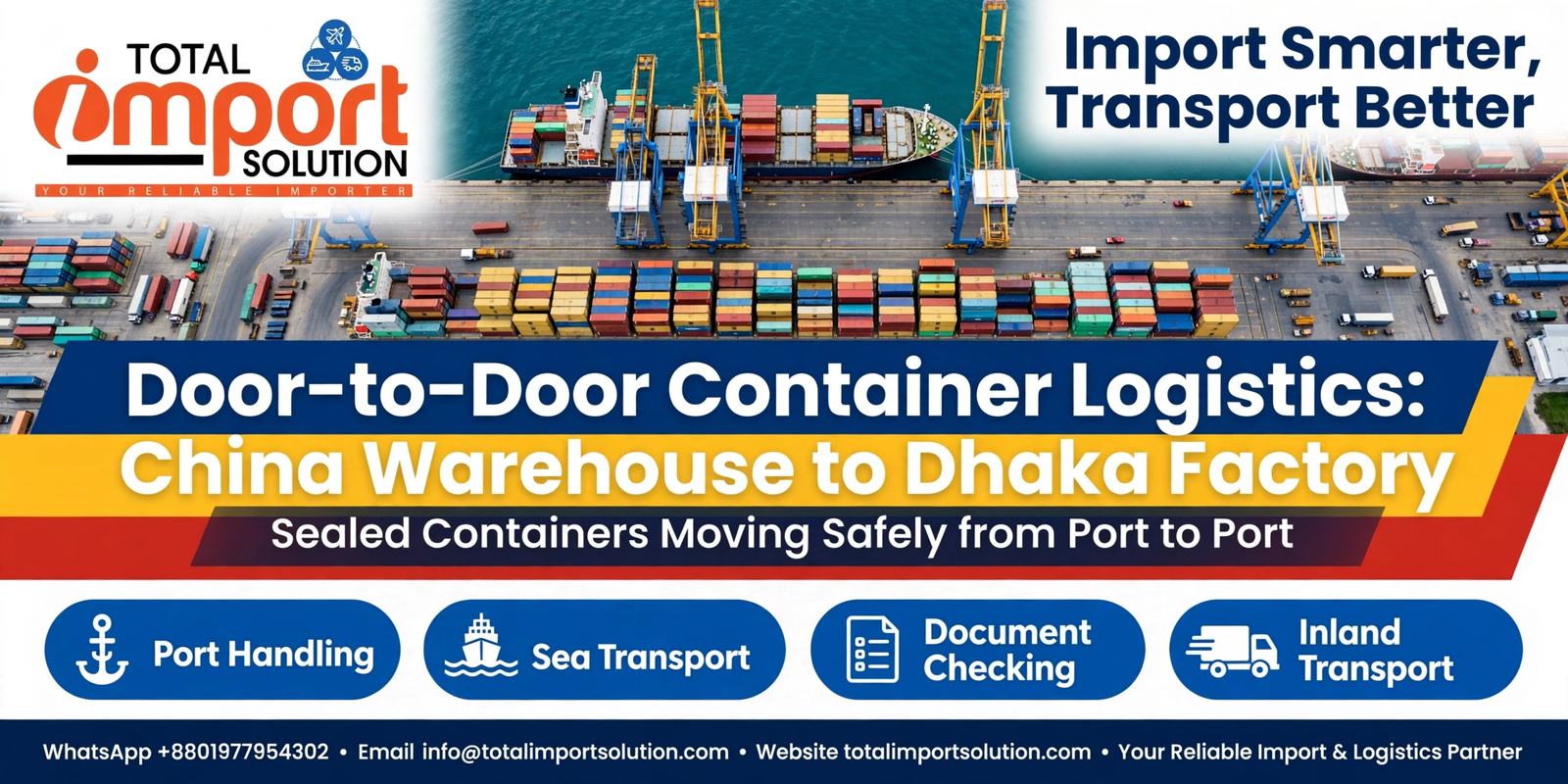
9. Moving the Container from Chittagong Port to Dhaka Factory
After customs release, the container must travel from Chittagong Port to the factory in Dhaka. This inland leg is often where a door-to-door plan succeeds or fails, because the truck must be ready on the day of release, the route must be planned, and the factory must be ready to receive the container. The provider should arrange the truck or prime mover in advance, based on the expected release day, and confirm the vehicle, the driver, and the delivery address with the factory. The factory should confirm the gate it will use, the unloading team, and the equipment available for unloading, such as a forklift or a crane, so that the container can be unloaded without waiting.
The container should be checked before it leaves the port: the seal should still be in place and should match the seal number on the documents, the container number should match the papers, and the outside should show no sign of damage. If the seal is broken or does not match, the provider should report it at once and take photos before the container moves. During the road journey, the driver should carry copies of the release papers and the delivery note. On arrival at the factory, the container should be placed where the unloading team can work safely, with enough space to open the doors fully and to move the goods into the store. A factory that plans its unloading in advance can clear a container in a single session.
| Inland transport point | What to confirm |
|---|---|
| Truck readiness | Vehicle and driver arranged before release |
| Seal check | Seal in place and matching the documents |
| Delivery address | Full factory address and gate confirmed |
| Unloading plan | Team and equipment ready at the factory |
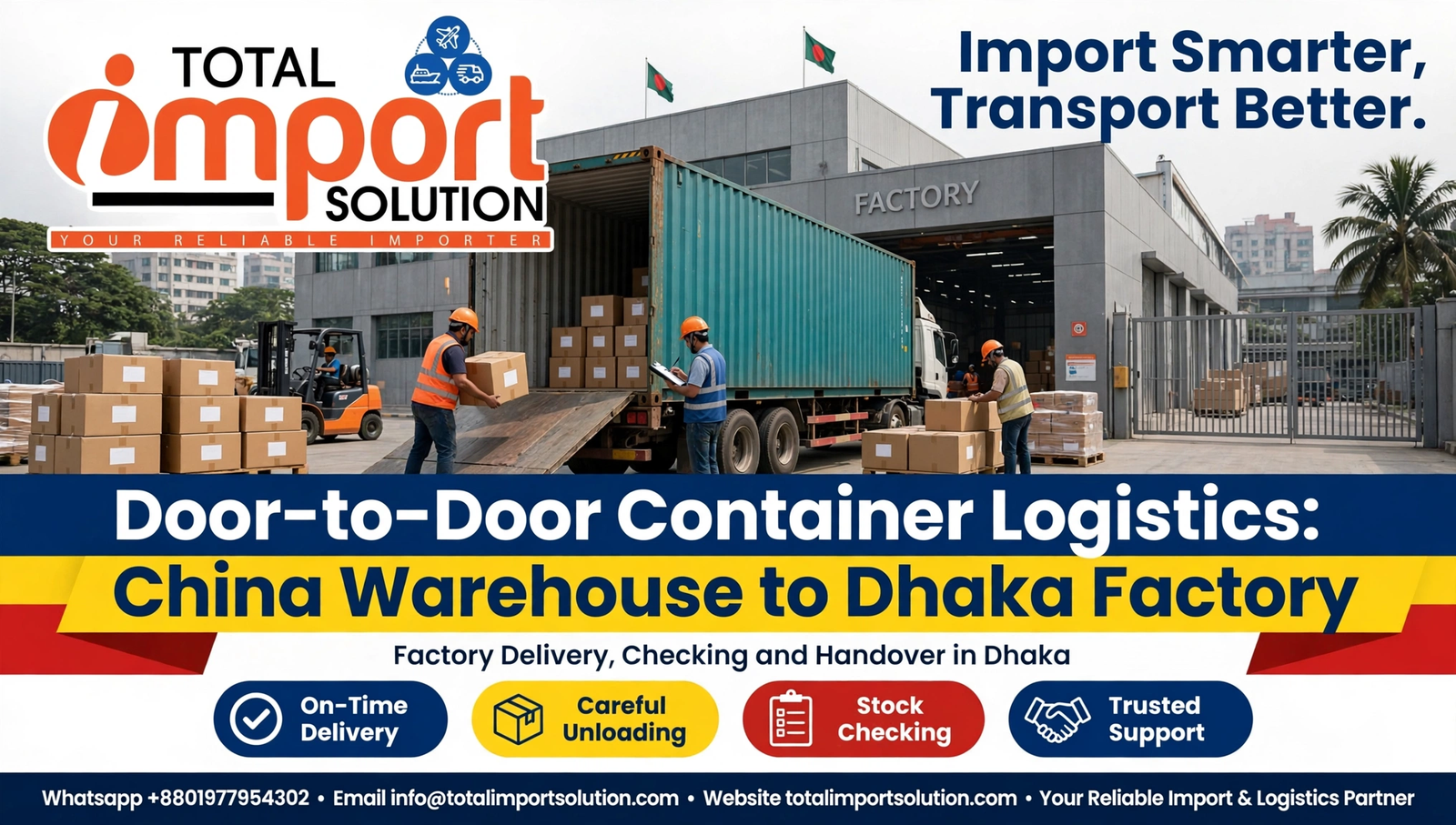
10. Delivery, Unloading and Checking at the Factory
Delivery is complete only when the goods have been unloaded, counted, and checked at the factory. The factory store team should count the cartons as they come out of the container and compare the count with the packing list, carton by carton. Each carton mark should be read and matched to the packing list line for that item. The team should check the condition of the goods as they unload: look for crushed cartons, damp marks, broken seals on inner packing, and any sign that the goods have shifted. If a carton is damaged or a quantity is short, the team should note it on the delivery receipt before signing, take photos, and inform the provider at once.
Unloading should follow a plan. Heavy cartons should be moved first to a stable place, fragile goods should be set aside where they will not be knocked, and goods that belong to different production lines should be kept apart in the store. The store team should record the receipt in the factory's stock book on the same day, so that production planning can use the new stock without delay. The empty container should be returned promptly under the provider's instructions, because a container kept at the factory beyond the agreed period can lead to extra charges. A clean handover, with the delivery receipt signed, the stock recorded, and the empty container returned, closes the door-to-door journey properly.
| Factory delivery point | What to do |
|---|---|
| Carton count | Count cartons against the packing list |
| Condition check | Look for damage, damp, and broken packing |
| Delivery receipt | Note damage or shortage before signing |
| Stock recording | Enter goods in the stock book the same day |
11. Common Problems on the Warehouse-to-Factory Route and How to Handle Them
Several problems recur on the warehouse-to-factory route, and most of them can be handled if they are spotted early. The first is goods not ready at the warehouse when the pickup truck arrives. This is handled by confirming readiness with the supplier in writing before the truck is sent, and by asking for the carton count and the packing list in advance. The second is a mismatch between the cartons and the packing list, handled by counting at pickup and by keeping the labels clear, so that a mismatch is found in China rather than at the factory in Dhaka. The third is weak packing, which shows up as crushed cartons or damaged goods on arrival, handled by agreeing the packing method with the supplier at the order stage and by checking the packing before loading.
The fourth problem is a document mistake, such as a wrong consignee name, a wrong container number, or a seal number that does not match the bill of lading. This is handled by checking every document as soon as it is issued and correcting it before the vessel arrives. The fifth problem is a hold at customs, which can happen when the description is vague or the papers disagree, handled by giving customs a clear description, with each type of goods on its own line, and by answering queries promptly. The sixth problem is a delay in inland transport, when no truck is ready on the release day, handled by arranging the truck in advance and by keeping the factory informed of the release day. In every case, the key is early information: the buyer, the provider, and the factory should share what they know as soon as they know it, rather than waiting for a problem to grow.
| Problem | How to handle it |
|---|---|
| Goods not ready | Confirm readiness in writing before sending the truck |
| Weak packing | Agree packing at the order stage, check before loading |
| Document mistake | Check each document on issue, correct before arrival |
| Customs hold | Clear description, each item on its own line |
12. How to Judge a Good Door-to-Door Logistics Provider
The buyer should judge a logistics provider by clear signs, not by promises. The first sign is a clear written plan. A good provider explains each stage of the warehouse-to-factory chain, names the ports and the documents, and gives the buyer a plan in writing before the goods leave the warehouse. The second sign is clear communication: a good provider gives regular updates, shares copies of the documents, and answers questions in plain language. A provider who is hard to reach now will be hard to reach when a problem arises at the port. The third sign is careful paperwork: the provider checks the invoice, packing list, and bill of lading against each other before the goods are shipped, and checks the seal number against the bill of lading.
The fourth sign is clear charges in writing: a good provider explains each charge separately and does not give a fixed figure without checking the actual shipment and its documents. The fifth sign is experience with the China to Bangladesh route, including warehouse pickup, consolidation, container loading, customs clearance at Chittagong Port, and inland transport to Dhaka. The sixth sign is honest problem handling: a good provider reports a problem at once, explains what it means for the delivery, and suggests a practical next step, rather than hiding the problem until it grows.
| Provider quality | Good sign |
|---|---|
| Written plan | Each stage explained in writing |
| Paperwork | Documents checked before shipping |
| Charges | Each charge explained in writing |
| Route experience | Has handled China to Dhaka factory deliveries |
13. Working with Your Provider, Mistakes to Avoid, and How Total Import Solution Helps
Working well with your provider starts with sharing full information: the exact goods, quantities, supplier details, warehouse address, the date the goods will be ready, and the date the factory needs them. Share the order, the invoice, and the packing list as soon as they are ready, so the provider can plan the pickup, the container, and the customs papers, and can spot a problem early. Keep one contact point on the factory side, so that the provider always knows who to call with an update or a question, and keep the factory store team informed of the expected delivery day, so that the unloading team and the equipment are ready.
The mistakes to avoid are simple, but they happen often. Do not send a pickup truck before confirming that the goods are ready at the warehouse, and do not skip the carton count at pickup. Do not accept weak packing to save effort, because the cost of repairing or replacing damaged goods is higher than the cost of good packing. Do not send unchecked documents, mix many types of goods in one carton without a clear list, wait until the goods arrive at the port to prepare the customs papers, or leave the inland transport and the factory unloading unplanned until the release day. Total Import Solution helps factory buyers with door-to-door container logistics at each stage. Since 2016, the company has supported importers in Bangladesh with warehouse coordination, consolidation advice, document checking, customs clearance support, inland transport planning, and delivery coordination to factories in Dhaka. The team checks the invoice and packing list against the order, follows the shipment from the warehouse in China to the factory in Dhaka, files the customs papers, and keeps the buyer informed until delivery.
Frequently Asked Questions
1. What is door-to-door container logistics from China to Dhaka?
It is a managed service that covers the whole container journey from a warehouse in China to a factory in Dhaka, including pickup, consolidation, loading, shipping, customs clearance, inland transport, and delivery.
2. How is door-to-door different from port-to-port shipping?
In port-to-port shipping, the buyer arranges the pickup in China and the delivery in Bangladesh separately. In door-to-door logistics, one provider plans and joins all the stages into a single chain.
3. Where does a door-to-door shipment start?
It starts at the warehouse in China where the goods are stored, usually a supplier warehouse or a consolidation warehouse used by the logistics provider.
4. What should I confirm before the warehouse pickup?
Confirm that the goods are ready, the carton count, the packing list, the warehouse address, the contact name, and the working hours, so the right vehicle is sent at the right time.
5. What is consolidation in a door-to-door shipment?
Consolidation means combining goods from one buyer with goods from other buyers in a shared container, or combining goods from several suppliers for the same factory into one container.
6. How do I choose between a shared container and a full container?
A shared container suits a smaller order that does not fill a container on its own. A full container suits a large order and gives the buyer more control over loading and the seal.
7. What container sizes are commonly used?
The 20ft container and the 40ft container are the most common, with the 40ft high cube offering extra height for light, bulky goods. Approximate capacities should always be checked against the actual container.
8. Why is loading supervision important?
A supervisor checks the container condition, the loading order, the bracing, and the seal, and takes photos, so the goods travel safely and the papers match the cargo on arrival.
9. What documents do I need for a door-to-door shipment?
The commercial invoice, the packing list, the bill of lading, the trade licence, the import registration certificate, and the tax papers. A certificate of origin may also be needed.
10. How does the step-by-step process work?
The buyer confirms the order and the warehouse, the provider plans the movement, the goods are collected, consolidated, loaded and sealed, shipped to Chittagong Port, cleared through customs, carried to Dhaka, and checked at the factory.
11. How does customs clearance work for this route?
The agent files a declaration with the invoice, packing list, and bill of lading. Customs compares the papers with the cargo and may open the container. Clear papers and orderly packing make the check quick.
12. What happens after customs release?
The container is loaded onto a truck or prime mover, the seal is checked against the documents, and the container is carried by road to the factory in Dhaka for unloading.
13. How should I check the goods at the factory?
Count the cartons against the packing list, check the marks and the condition, note any damage or shortage on the delivery receipt before signing, and take photos.
14. What causes delays on the warehouse-to-factory route?
Goods not ready at pickup, carton mismatches, weak packing, document mistakes, customs holds, and trucks not arranged for the release day are the most common causes.
15. How do I choose a good door-to-door logistics provider?
Look for a clear written plan, regular communication, careful paperwork, charges explained in writing, experience on the China to Dhaka route, and honest problem handling.
16. How can Total Import Solution help with my door-to-door shipment?
Total Import Solution supports factory buyers with warehouse coordination, consolidation advice, document checking, customs clearance support, inland transport planning, and delivery coordination to factories in Dhaka.
Contact Total Import Solution
- WhatsApp: +8801977954302
- Email: info@totalimportsolution.com
- Website: totalimportsolution.com
- Service: Door-to-Door Container Logistics: China Warehouse to Dhaka Factory
- Company: Total Import Solution, serving importers in Bangladesh since 2016.
