
Customs clearance agent machinery in Bangladesh
Importing machinery into Bangladesh is different from importing ordinary cargo. A machine is heavy, valuable, and often made of many parts. It may arrive in a container, in crates, or in several shipments. Before it can reach a factory, it must pass through customs clearance at the port, and that clearance depends on correct documents, correct classification, correct duty assessment, and a clean inspection.
A customs clearance agent for machinery handles that work for the importer. The agent prepares the documents, files the bill of entry, works with the customs officers, arranges examination when it is required, and helps the cargo move from the port to the factory. For machinery importers, a good agent is not a luxury. It is the difference between a machine that reaches the factory on schedule and a machine that waits at the port while documents are corrected.
This guide explains customs clearance for machinery in Bangladesh in full: what a clearance agent does, why machinery needs specialist handling, the documents, the HS code, the step-by-step clearance process, duty and cost factors, certificates, delivery to factories, how to judge an agent, and the mistakes to avoid. No fixed fees or duty figures are given here, because the duty and the total cost depend on the machine, its classification, its value, and the documents. A rate or fee is confirmed only after checking the actual shipment and documents.
Total Import Solution has supported importers in Bangladesh since 2016, including machinery importers who need customs clearance, documentation support, and delivery coordination through Chittagong Port and Dhaka Airport.
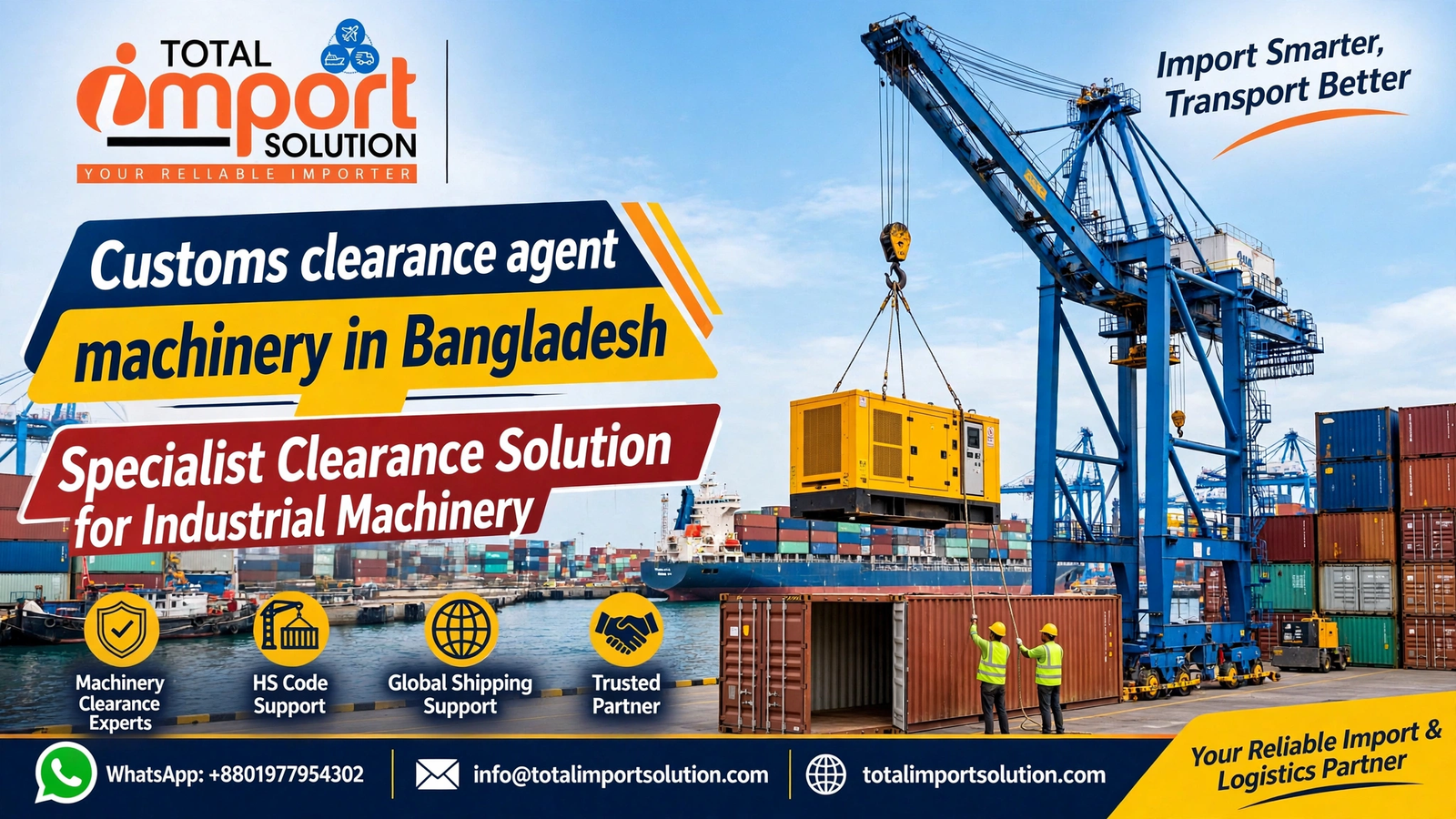
What Is a Customs Clearance Agent for Machinery?
A customs clearance agent, also called a clearing and forwarding agent, is a licensed professional who acts for the importer before the customs authority. The agent prepares and files the customs documents, pays the assessed duty and taxes on behalf of the importer where that is agreed, attends examination, and arranges release of the cargo from the port.
For machinery, the agent's work is more detailed than for general cargo. A machine has a model, a serial number, a year of manufacture, a function, and often a set of spare parts. The agent must describe the machine correctly, classify it under the right HS code, and make sure the declared value matches the supporting documents. If any of these are wrong, customs may hold the cargo for re-assessment, and the importer may face delay and extra port charges.
A machinery clearance agent also coordinates with other parties. The shipping line releases the container, the port handles the cargo, the bank handles the payment documents, and the transport company moves the machine to the factory. The agent keeps these parties in step so that no one waits for a document that another party already holds.
Why Machinery Needs Specialist Clearance
Machinery is not general cargo, and customs treats it differently for several practical reasons.
First, the value is high. A single machine can cost as much as a whole container of ordinary goods, so the duty and tax assessment matters more. A small error in classification or value can change the amount payable by a large sum, and customs officers check machinery declarations carefully.
Second, the description is technical. A machine is not described by weight alone. Its function, its power, its capacity, and its components all matter for classification. Two machines that look similar can fall under different HS codes if they do different work, and the agent must know how to describe the machine in a way that matches the code.
Third, machinery often arrives in parts. A production line may come in several containers, with the main unit in one container and the accessories, motors, and control panels in others. The agent must make sure the whole shipment is declared together where the rules allow, and that no part is left behind or declared separately by mistake.
Fourth, machinery may need extra certificates. Some machines need a certificate of origin, a pre-shipment inspection certificate, or a permission from a government department, depending on the type of machine and the country of origin. The agent checks which certificates apply before the cargo arrives, so the clearance does not stop for a missing paper.
Types of Machinery Imported into Bangladesh
Bangladesh imports many kinds of machinery for its factories, farms, and construction sites. The clearance steps are similar, but the documents and checks differ by type.
| Machinery type | Common examples | Clearance notes |
|---|---|---|
| Garment and textile machinery | Sewing machines, knitting machines, dyeing machines, cutting machines | Often imported for factories in Dhaka, Gazipur and Narayanganj; check the year of manufacture and the condition |
| Industrial and manufacturing machinery | Presses, lathes, packaging machines, printing machines | Parts and accessories may arrive separately; declare the full set together where allowed |
| Agricultural machinery | Tractors, harvesters, irrigation pumps, processing machines | Some items may need approval or a certificate from the relevant department |
| Construction machinery | Excavators, loaders, cranes, generators, compactors | Heavy and oversized; check the port handling and the road transport before booking |
| Power and electrical equipment | Generators, transformers, motors, control panels | Check the power rating and the serial numbers on the documents |
| Food processing machinery | Mills, mixers, packing lines, cold storage units | Hygiene and safety certificates may apply depending on the machine |
| Medical and laboratory equipment | Diagnostic machines, laboratory instruments | May need permission from the health authorities before import |
The HS Code: Why Classification Matters
The HS code, or Harmonized System code, is the international classification number for a product. Every item that crosses a border is classified under an HS code, and the duty and tax on that item depend on the code. For machinery, the HS code is the single most important detail in the clearance file.
A wrong HS code can cause several problems. If the code is for a different kind of machine, customs may reassess the cargo and apply a different duty. If the code does not match the invoice description, the officer may ask for clarification and hold the cargo. If the code is for a restricted item, the cargo may need a permission that was never arranged.
A good clearance agent checks the HS code before the shipment leaves the supplier. The agent reads the machine's function, its technical sheet, and its invoice, and then confirms the code with the customs tariff. When the machine has several functions, the agent looks at the main function, because the classification follows the principal use of the machine.
Importers should also keep the HS code in mind when they order. If the supplier changes the model, adds a new function, or sends a different version of the machine, the code may change too. Tell the agent about any change before the cargo is shipped, so the documents can be prepared correctly from the start.
Documents Needed for Machinery Clearance
Customs clearance runs on documents. If a document is missing or wrong, the clearance stops until it is corrected. The list below covers the documents most machinery shipments need. Some shipments need more, depending on the machine and the country of origin.
| Document | What it shows | Who provides it |
|---|---|---|
| Commercial invoice | The machine, its value, the seller and the buyer | The supplier |
| Packing list | The number of packages, their weight, and their contents | The supplier |
| Bill of lading or airway bill | The shipment, the vessel or flight, and the port of loading | The shipping line or airline |
| Certificate of origin | Where the machine was made | The supplier or chamber of commerce |
| Bill of entry | The customs declaration for the cargo | The clearance agent, filed for the importer |
| Import registration certificate (IRC) | That the importer is registered to import | The importer |
| Letter of credit or payment documents | How the machine was paid for | The importer's bank |
| Technical sheet or catalogue | The machine's model, function, and specifications | The supplier |
| Pre-shipment inspection certificate | That the machine was inspected before shipment, where required | An approved inspection agency |
| Permission or approval letter | Approval for restricted or special machinery, where required | The relevant government department |
Keep a copy of every document in one file, and share the file with the agent before the vessel arrives. The agent checks the documents against each other: the invoice against the packing list, the packing list against the bill of lading, and all three against the bill of entry. A mismatch in a model number or a serial number is easy to fix before filing and hard to fix after.
The Clearance Process Step by Step
Machinery clearance follows a clear sequence. Knowing the steps helps the importer prepare at the right time and avoid waiting at the port.
Step 1: Share the documents before the cargo arrives. Send the invoice, packing list, bill of lading, and technical sheet to the agent as soon as the supplier issues them. The agent checks the HS code, the value, and the documents, and tells the importer if anything is missing.
Step 2: The agent prepares the bill of entry. The bill of entry is the customs declaration. It lists the machine, its HS code, its value, its quantity, and the duty and taxes that apply. The agent files it through the customs system once the vessel arrives and the manifest is available.
Step 3: Assessment. A customs officer reviews the declaration and the supporting documents. The officer checks the classification, the value, and whether any permission is needed. If the officer has a question, the agent answers it with documents, not with argument.
Step 4: Payment of duty and taxes. Once the assessment is accepted, the duty and taxes are paid through the bank as the customs system directs. The amount depends on the HS code, the declared value, and the rules in force at the time of import. No agent can give a fixed duty figure before the assessment, because the assessment is the customs officer's decision.
Step 5: Examination, if ordered. Customs may order a physical examination of the machine. The officer checks that the machine in the container matches the documents: the model, the serial number, the quantity of parts, and the condition. The agent attends the examination with the importer or the transport team.
Step 6: Release. After assessment, payment, and any examination, customs releases the cargo. The agent collects the release order and hands it to the port and the transport team.
Step 7: Port handling and loading. The container or crates are moved from the yard to the truck. For heavy machinery, a crane or forklift is arranged in advance, and the machine is secured for the road journey.
Step 8: Delivery to the factory. The truck carries the machine to the factory in Dhaka, Gazipur, Narayanganj, or elsewhere. The agent shares the release documents and the delivery details with the importer, so the factory can receive the machine and check it on arrival.
Step 9: Closing the file. After delivery, the agent gives the importer a complete file: the bill of entry, the duty payment proof, the release order, and the delivery note. Keep this file. It is the record of the import, and it may be needed later for audit, for a warranty claim, or for a future import of the same machine.
The Bill of Entry and Assessment
The bill of entry is the heart of the clearance. It is the document on which the whole assessment rests, so it must be accurate.
The agent enters the importer's details, the supplier's details, the vessel and voyage, the container number, the machine description, the HS code, the quantity, the unit value, and the total value. Each field must match the supporting documents. A difference between the bill of entry and the invoice, even a small one, can lead to a query from the assessing officer.
Assessment is the officer's review of the declaration. The officer may accept the declared value, or may ask for more evidence: the letter of credit, the supplier's catalogue, or the payment record. The agent's job is to provide that evidence quickly and completely. An importer who keeps the full payment record ready will find assessment faster than one who must ask the bank for documents at the last minute.
Examination and Inspection of Machinery
Physical examination is a normal part of customs work, and machinery is examined more often than general cargo because of its value and its technical nature.
During examination, the officer may check the machine's model plate, its serial number, its year of manufacture, and the number of packages. The officer may ask for the machine to be opened or for a crate to be unpacked, so that the parts inside can be counted. The agent arranges the labour and the equipment for this, and makes sure the machine is packed again properly afterwards.
Pre-shipment inspection is a separate matter. For some machinery, an inspection certificate from an approved agency in the country of origin is required before the cargo is shipped. The certificate confirms the machine's condition, its year of manufacture, and its value. If the certificate is required and it is missing, the cargo may not be released until the inspection is done, which is slow and costly after arrival. The agent checks the inspection requirement before the supplier ships, not after.

Duty, Tax and Cost Factors
There is no single duty figure for machinery, because the duty depends on the machine and its classification. The factors below explain what the total cost is made of. None of the figures here are fixed, and an agent should not quote a duty figure without seeing the documents and the HS code.
The HS code. Different codes carry different duty rates under the customs tariff. A machine classified under one code may attract a different rate from a similar machine under another code. That is why the classification step matters so much.
The declared value. Duty is generally calculated on the value of the machine as declared and accepted by customs. The value must be supported by the invoice, the letter of credit, and the payment record. An under-declared value can lead to re-assessment and penalty, so the value should always be the real transaction value.
The type of machine. New machinery, reconditioned machinery, and used machinery may be treated differently. The condition and the year of manufacture affect both the assessment and the documents required.
Port and handling charges. The port charges for handling, storage, and container movement are separate from duty. If the cargo stays at the port longer than the free period, storage charges apply, which is another reason to clear quickly.
Transport cost. Moving a heavy machine from the port to the factory needs a suitable truck and sometimes a crane. The cost depends on the distance, the weight, the size, and the route.
Always ask for the total cost in writing, with each part listed separately. Compare quotations only when they cover the same machine, the same documents, and the same delivery point. A quotation that leaves out port charges or transport is not cheaper; it is incomplete.
Certificates, Permissions and Special Cases
Some machinery needs more than the standard documents. The agent checks these before the cargo is shipped.
Certificate of origin. Most machinery shipments need a certificate showing where the machine was made. It is issued by the supplier or the chamber of commerce in the country of origin, and it must match the invoice.
Pre-shipment inspection certificate. Required for certain machinery, especially used or reconditioned machines. The inspection confirms the condition and the value before shipment. Arrange it through an approved agency in the country of origin.
Permission from a government department. Some machines, such as medical equipment or certain agricultural machines, may need permission from the relevant department before import. The agent confirms this with the department's rules and helps the importer apply in time.
Warranty and service documents. The supplier's warranty, the service manual, and the spare parts list are not customs documents, but they matter for the factory. Ask the supplier to send them with the shipment, in English or with a translation, so the factory can install and run the machine without delay.
Second-hand machinery. Used machinery needs extra care. The year of manufacture, the working condition, and the remaining life should be stated clearly. The inspection certificate is usually required, and customs may examine the machine in detail. Never declare a used machine as new; the examination will show the truth, and the consequences are worse than the delay of declaring it correctly.
Delivery to Factories in Dhaka, Gazipur and Narayanganj
Clearance is only half the job. The machine must still reach the factory, and machinery delivery needs more planning than ordinary cargo.
First, check the route. A truck carrying a heavy machine needs a road that can take the weight, with enough clearance under bridges and wires. The agent and the transport team confirm the route from the port to the factory before the truck leaves.
Second, check the factory gate and yard. The gate must be wide enough for the truck, and the yard must have space for the truck to turn and for a crane or forklift to unload. If the machine is tall, check the height of the gate and any roof over the entrance.
Third, plan the unloading. A heavy machine needs a crane or a forklift of the right capacity, and trained workers to guide it. The factory should have its engineer present at delivery, so the machine can be checked against the invoice on the spot.
Fourth, keep the documents with the cargo. The release order, the bill of entry copy, and the delivery note should travel with the truck. If the truck is stopped on the road, the driver can show that the machine has been cleared and is on its way to the factory.
Factories in Dhaka, Gazipur, and Narayanganj receive most of the imported machinery in Bangladesh. The distance from Chittagong Port is long, so the delivery should be planned for the same day as the release where possible, to avoid extra storage at the port. For machinery arriving by air at Dhaka Airport, the delivery is shorter, but the same checks apply: the gate, the yard, and the unloading equipment.
How to Judge a Good Machinery Clearance Agent
Not every agent is equally suited to machinery. The table below gives a practical way to compare agents before choosing one.
| What to check | A good sign | A warning sign |
|---|---|---|
| Machinery experience | The agent has cleared machines like yours before and can name the documents they needed | The agent treats your machine like general cargo and asks no technical questions |
| HS code knowledge | The agent checks the code from the technical sheet and explains the classification | The agent gives a code without reading the machine's details |
| Document checking | The agent reviews your documents before filing and lists what is missing | The agent files first and asks for documents later |
| Clear charges | The service fee, port charges, and transport are listed separately in writing | The agent quotes one figure with no breakdown |
| Communication | The agent updates you at each step: filing, assessment, examination, release | You have to chase the agent for news |
| Delivery planning | The agent arranges the truck and the unloading before release | The agent releases the cargo and leaves the delivery to you |
| Record keeping | The agent gives you a complete file after delivery | The agent keeps the documents and gives you only a receipt |
Working with Your Agent
Clearance works best when the importer and the agent share information early.
Send the documents as soon as the supplier issues them. Do not wait for the vessel to arrive. The agent needs time to check the HS code and the value, and to tell you about any missing certificate before the cargo is shipped.
Tell the agent about any change. If the supplier changes the model, adds a part, or ships in two containers instead of one, the agent must know at once. A change that is small for the supplier can be large for the customs declaration.
Keep the payment record ready. The bank documents, the letter of credit, and the payment proof are often needed during assessment. If the bank is slow, ask for the documents early, not on the day of assessment.
Agree the charges in writing before the work starts. The list should cover the agent's service fee, the port charges, the transport, and any extra charge for examination or storage. If a new charge appears during clearance, ask the agent to explain it before you agree to pay it.
Common Mistakes to Avoid
Mistake 1: Sending documents late. When the documents arrive after the vessel, the agent has no time to check them, and the cargo waits at the port while corrections are made. Send the documents as soon as the supplier issues them.
Mistake 2: A wrong HS code. A code chosen without reading the technical sheet is the most common cause of re-assessment. The code must follow the machine's function, not the importer's preference.
Mistake 3: Under-declaring the value. A value lower than the real transaction value invites re-assessment and penalty. Declare the real value with the invoice and the payment record to support it.
Mistake 4: Forgetting a certificate. A missing pre-shipment inspection certificate or permission can hold a cargo for weeks. Check the certificate list before the supplier ships.
Mistake 5: Declaring a used machine as new. Customs examination will show the true condition. Declare the condition honestly from the start.
Mistake 6: No delivery plan. A machine released from the port still needs a truck, a crane, and a route. Plan the delivery before the release, not after.
Mistake 7: Comparing incomplete quotations. A quotation that leaves out port charges or transport looks cheaper but is not. Compare only quotations that cover the same machine, the same documents, and the same delivery point.

Frequently Asked Questions (FAQs)
1. What does a customs clearance agent do for machinery imports? The agent prepares the documents, files the bill of entry, works with customs during assessment and examination, arranges payment of the assessed duty and taxes, and helps release and deliver the machine to the factory.
2. Why does machinery need a specialist clearance agent? Machinery is high in value, technical in description, often shipped in parts, and sometimes needs extra certificates. A specialist agent knows how to classify it, document it, and clear it without delay.
3. What is an HS code, and why does it matter for machinery? The HS code is the international classification number for the machine. The duty and tax depend on the code, so a wrong code can change the amount payable and cause re-assessment.
4. Which documents are needed to clear machinery in Bangladesh? The commercial invoice, packing list, bill of lading or airway bill, certificate of origin, bill of entry, import registration certificate, payment documents, technical sheet, and, where required, a pre-shipment inspection certificate and any permission letter.
5. How long does machinery customs clearance take? The time depends on the documents, the assessment, whether an examination is ordered, and how quickly the duty is paid. Complete and correct documents make the process faster; missing papers slow it down.
6. What is a bill of entry? It is the customs declaration filed by the agent for the cargo. It lists the machine, its HS code, its value, and the duty and taxes that apply, and it is the basis of the assessment.
7. What happens during customs examination of machinery? The officer checks that the machine in the container matches the documents: the model, the serial number, the quantity of parts, and the condition. The agent attends the examination and arranges any unpacking and repacking.
8. How is the duty on machinery calculated? The duty depends on the HS code, the declared value, and the rules in force at the time of import. No fixed figure can be given before the assessment, because the assessment is the customs officer's decision.
9. Do I need a pre-shipment inspection certificate for machinery? It depends on the machine, especially if it is used or reconditioned. The agent checks the requirement before the supplier ships, so the certificate can be arranged in the country of origin.
10. Can used or reconditioned machinery be imported into Bangladesh? It can, but the condition and the year of manufacture must be declared honestly, and an inspection certificate is usually required. The agent checks the rules for the specific machine before shipment.
11. What should I do if customs disagrees with my HS code? The agent explains the machine's function with the technical sheet and the tariff. Classification follows the machine's nature, and the agent follows the customs process for a second opinion where that applies.
12. How is machinery delivered to a factory after clearance? The agent arranges a suitable truck and, where needed, a crane or forklift, confirms the route, and sends the machine to the factory with the release documents. The factory checks the machine against the invoice on arrival.
13. What charges are there besides duty? Port handling and storage charges, transport to the factory, and the agent's service fee. These are separate from duty and should be listed in writing before the work starts.
14. How do I choose a good machinery clearance agent? Check the agent's machinery experience, HS code knowledge, document checking, clear charges, communication, delivery planning, and record keeping. Ask which machinery shipments the agent has cleared before.
15. What is the most common cause of delay in machinery clearance? Missing or mismatched documents, a wrong HS code, and a missing certificate. Sending complete documents early is the best way to avoid delay.
16. How do I arrange customs clearance for machinery with Total Import Solution? Contact Total Import Solution by WhatsApp or email with the machine type, model, supplier documents, port of arrival, and factory location. The team will review the documents and explain the clearance steps for your shipment.
Total Import Solution — Contact Us
Total Import Solution, since 2016, provides sourcing and import support for businesses in Bangladesh, including customs clearance support for machinery imports through Chittagong Port and Dhaka Airport. For a review of your documents and the clearance steps for your machine, contact us:
- WhatsApp: +8801977954302
- Email: info@totalimportsolution.com
- Website: totalimportsolution.com
