
CSC Plate Validity: What Importers Must Check on Leased Containers
Every shipping container that travels by sea carries a small metal plate on its door, and that plate decides whether the container is allowed to travel at all. The plate is the CSC plate, issued under the Convention for Safe Containers, and it shows that the container was built to an approved design and has been examined for safety. An importer who hires a container without checking the plate can face a refused loading, a delay at the port, or a container held back at the depot.
This guide explains CSC plate validity for importers in Bangladesh: what the plate shows, how to read the examination date, what the weight figures mean, what happens when a plate expires, and what to check at pickup before you sign. No fixed prices, rates, fees, duty figures or transit times are given here. A rate or fee is confirmed only after checking the actual shipment and documents.
Total Import Solution, an importer and logistics partner serving importers in Bangladesh since 2016, supports container hiring alongside its import services, and the CSC plate check is one of the first steps the team applies at pickup.
1. What Is a CSC Plate and Why It Matters
The CSC plate is a metal plate fixed to the door of a shipping container, usually the left door, that records the container's approval under the Convention for Safe Containers. The Convention is an international agreement that sets safety standards for containers used in international transport, so that a container loaded in one country can be handled safely in another. The plate is the visible proof that the container meets those standards.
The plate matters because ports, terminals and shipping lines check it. A container without a valid plate, or with a plate whose examination date has passed, may be refused for loading onto a vessel. The refusal does not depend on how good the container looks. A container can look clean and solid and still be unusable for sea transport if its safety examination has expired. For an importer in Bangladesh, that refusal can mean a missed vessel, a delayed delivery to a buyer, and extra handling at the port.
The plate also matters for safety. Containers are stacked several high on vessels and in yards, and lifted by cranes using the corner castings. The plate records the weights the container was designed to carry, and the examination confirms that the structure is still sound enough to carry them. Checking the plate is therefore not a formality. It is a safety check and a travel check in one, and it takes only a few minutes at pickup.
2. What the CSC Plate Shows: Reading Every Line
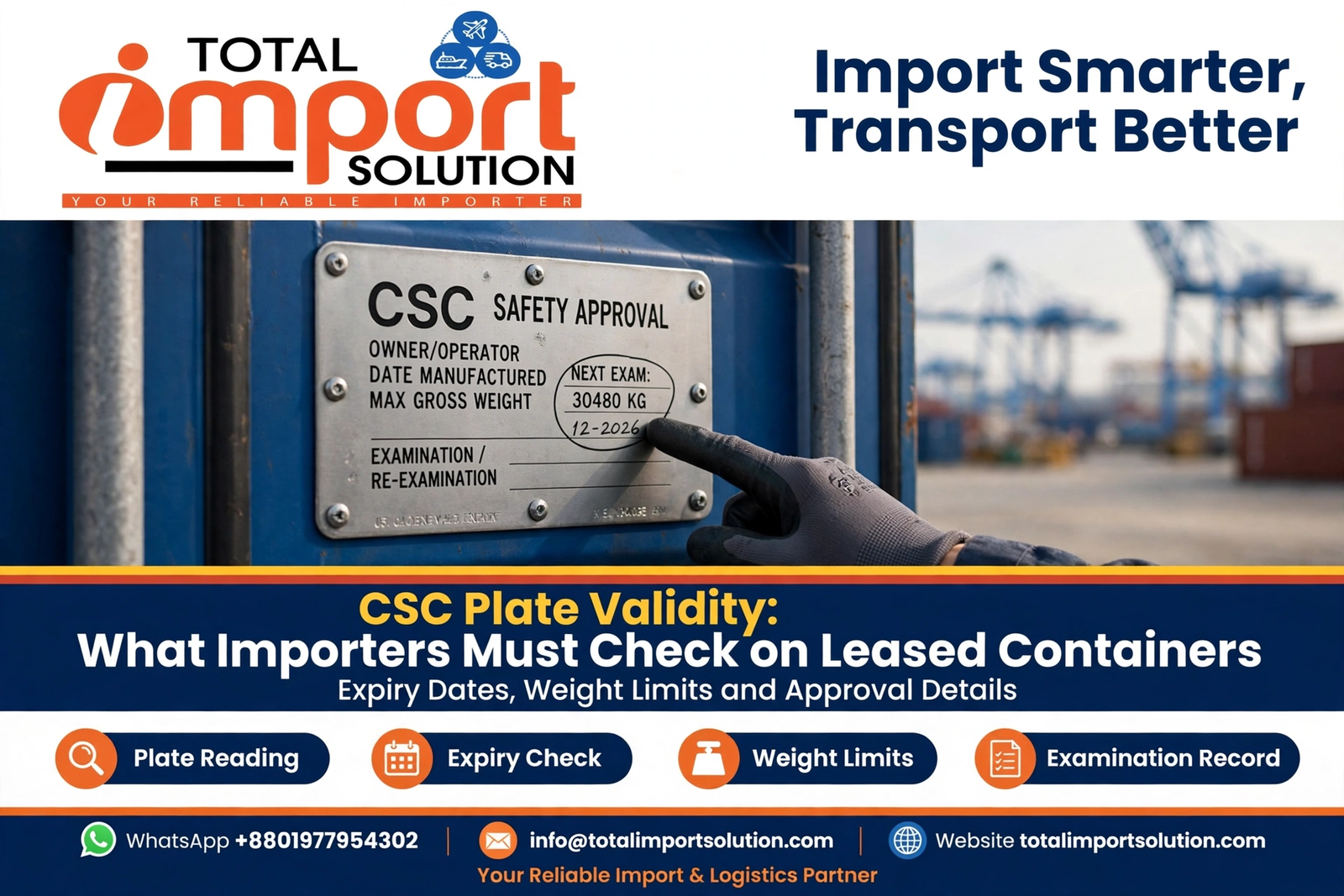
A CSC plate carries several lines of information, and each one is worth reading. The first line usually shows the approval reference, which identifies the country and the authority that approved the container design. Below it, the plate shows the date of manufacture, which tells you how old the container is. The date is useful, but age alone does not decide whether a container is fit to travel, because a well-maintained older container can be sound while a poorly kept newer one can be weak.
The plate also shows the maximum gross weight, which is the heaviest the container and its cargo may weigh together. It shows the allowable stacking weight, which is the weight the container can safely carry on top of it when stacked. It may show the racking test load, which relates to the sideways forces a container faces when a vessel rolls at sea. Some plates also show the date of the first examination and the date of the next examination, which is the line that decides validity.
Read the plate slowly, and photograph it so you can read it again later in your office. The letters and numbers are stamped into the metal and can be hard to read in poor light, so use a torch and wipe away dust before you read. If any line is unreadable, note it on the inspection report, because an unreadable plate is a plate that cannot be checked, and a checker at the port may treat it the same way.
3. The Examination Date: The Check That Decides Validity
The single most important line on the CSC plate is the date of the next examination. A container must be examined at set intervals after manufacture, and the plate shows when the next examination is due. If that date has passed and no new examination has been recorded, the plate is no longer valid, and the container should not be used for international transport until it has been re-examined.
The first examination usually falls five years after the date of manufacture, and later examinations usually fall at intervals of about two and a half years, but the exact interval depends on the examination programme the container follows. Do not rely on memory for these intervals. Read the date on the plate itself, and compare it with the date of your shipment. If your shipment will sail after the examination date, the container needs re-examination before loading, even if it is still in date on the day you pick it up.
Ask the depot or the leasing provider to show the examination record when the date is close. The record shows that the examination was carried out, by whom, and what was found. Keep a photograph of the plate and a copy of the record with your hire documents. If the depot cannot show a record for a container whose date has passed, do not accept that container for a sea journey. Ask for a replacement with a plate that is clearly in date.
4. Types of Examination: Periodic and Continuous Programmes
Containers are examined under one of two programmes, and the plate shows which one applies. Under a periodic examination programme, the container is examined at fixed intervals, and the plate shows the date of the next examination. The owner must arrange the examination before that date, and the new date is then marked on the plate or on a new plate.
Under a continuous examination programme, the container is examined each time it passes through a depot or repair facility, and the plate carries a mark showing that it follows this programme. The examination is not tied to a single fixed date in the same way, but the container must still be examined regularly, and the depot should be able to show the examination history. If the plate carries the continuous programme mark, ask the depot for the last examination record and the date of the next planned examination.
Neither programme is better in itself. What matters is that the programme is followed and the records exist. A container under a periodic programme with an expired date is not valid, and a container under a continuous programme with no recent examination record is equally doubtful. When you hire, ask which programme the container follows, and ask to see the record. A provider who can show the record quickly is a provider who manages the fleet properly. A provider who cannot show it should be asked for a different container.
5. Maximum Gross Weight and Stacking Weight
The weight figures on the CSC plate are safety limits, not suggestions. The maximum gross weight is the total weight of the container plus its cargo, and it must never be exceeded. Before you load, work out the weight of your cargo, add the empty weight of the container, and check the total against the plate. The empty weight, known as the tare weight, is painted on the container door, usually near the CSC plate, so you can do this check at the depot.
The allowable stacking weight is the weight the container can carry on top of it when stacked in a yard or on a vessel. This matters when your container will sit under other containers, which is normal in a port yard and on a ship. A container with a damaged roof or weakened corner posts may not safely carry the stacking weight on its plate, even if the plate itself is in date, so the weight check goes together with the physical inspection of the roof and corners.
Overloading is a serious problem. An overloaded container can damage the vessel, the crane, and the container itself, and it can lead to the container being held at the port. Weigh your cargo before loading, keep the weight record with your documents, and plan the load so the total stays within the plate figure. If your cargo is close to the limit, speak to your provider before loading, because a larger container or a second container may be the right answer.
6. What Happens When a CSC Plate Expires
When the examination date on a CSC plate passes without a new examination, the container loses its approval for international transport. The container does not become scrap, and it can still be used for storage or for a local move, but it should not be loaded onto a vessel until it has been re-examined and the plate updated.
The practical result of an expired plate is usually found at the port. The container may be refused at the gate, or it may be loaded and then held when the documents are checked. Either way, the shipment is delayed, and the cargo may need to be moved to another container. That move costs time, labour, and extra handling, and it can mean a missed vessel. The cost of the delay is almost always greater than the cost of checking the plate at pickup.
Re-examination is a job for the container owner or the leasing provider, not for the importer. The examination is carried out by an approved examiner, who checks the structure, the doors, the floor and the fittings, and records the result. If the container passes, the plate is updated with the new examination date. If it fails, the container must be repaired and re-examined. When you find an expired plate at pickup, do not try to arrange the examination yourself. Ask the provider for a replacement container with a valid plate, and note the expired plate on your report.
7. Checking the CSC Plate at Pickup: A Step-by-Step Routine
Make the CSC plate check part of every pickup, in the same order each time, so nothing is missed. Start by finding the plate on the door and wiping it clean. Read the container number on the plate and compare it with the number painted on the container and the number on your booking papers. All three must match. A plate that belongs to a different container is not a valid plate for the container in front of you.
Next, read the date of manufacture and the date of the next examination. Compare the next examination date with the date of your planned shipment. If the shipment sails after that date, the container needs re-examination before loading. Note the date in your inspection report, and photograph the plate so the date is readable in the photograph.
Then read the maximum gross weight and the stacking weight, and compare the maximum gross weight with your planned load. Check that the plate is firmly fixed to the door and not loose, bent, or held on with a temporary fixing. Check that every line is readable. If a line is worn or damaged, note it, and ask the depot whether a replacement plate or a readable record exists.
Finally, ask for the examination record if the date is close to expiry or if anything on the plate is unclear. A record that matches the plate, with the examiner's details and the date of the examination, confirms the plate. Keep the photograph and the record with your hire documents, and do not sign the pickup document until the plate check is complete.
8. Common CSC Plate Problems Importers Face
Importers face a small set of CSC plate problems again and again, and knowing them in advance makes them easy to spot. The most common is the expired examination date. The container looks fine, the doors work, the floor is firm, but the date on the plate passed months ago. This happens when a container has been used for storage or local work, where the plate is not checked, and is then offered for a sea shipment. The fix is a replacement container, not a discussion.
The second common problem is a plate that is unreadable. Years of weather, paint, and handling wear the stamped letters down until the date or the weight figures cannot be read. A plate that cannot be read cannot be checked, and a port checker may refuse the container on that ground alone. Ask the depot for the examination record, and if the record does not match the container clearly, ask for a replacement.
The third problem is a missing plate. A plate can be lost when a door is repaired or replaced, and a container without a plate has no visible proof of approval. Do not accept a container without a plate for international transport, even if the provider says the approval exists on paper. The paper record must be matched to the container, and the plate must be fitted before the container travels.
The fourth problem is a mismatch. The plate shows one container number and the container shows another, often because a door was swapped from a different container during repair. A mismatched plate is not valid for the container it sits on. Note the mismatch, photograph both numbers, and ask for a replacement.
9. CSC Plate, Container Age and Condition: What Age Does Not Tell You
The date of manufacture on the CSC plate tells you the age of the container, but age alone is a poor guide to condition. A container built many years ago and kept in good repair, with regular examinations and prompt repairs, can be sound and safe. A newer container that has been damaged, overloaded, or left unrepaired can be weak. The plate check and the physical inspection must go together, and neither one replaces the other.
When you read the age, use it as a prompt to look more closely, not as a decision on its own. On an older container, spend extra time on the roof, the floor, the door seals and the corner posts, because these are the parts that wear with age. On a newer container, do not skip the same checks, because a single hard journey can damage a new container badly.
The examination history is more useful than the age. A container with a full record of examinations, each passed and each on time, has been looked after. A container with gaps in its record, or with an examination date that has been missed more than once, should be treated with care. Ask the provider for the history when you hire for a long period or for a heavy cargo, and keep the history with your documents. Age is a number on the plate. Condition is what you find when you look, and the examination record is the proof that someone has looked before you.
10. Documents to Ask For: Examination Records and Certificates
The CSC plate is a summary, and the documents behind it are the proof. When you hire a container, you can ask the leasing provider or the depot for the examination record, which shows when the container was last examined, who examined it, and what was found. The record should match the plate: the same container number, the same examination date, and the same programme.
For a container under a periodic programme, ask for the record of the most recent examination and the date of the next one. For a container under a continuous programme, ask for the record of the most recent examination and the date of the next planned examination. Keep a copy of the record with the hire documents, and keep the photograph of the plate beside it, so the two can be checked together later.
You may also be asked for the CSC documents at the port or by the shipping line, so keep them in the same file as the booking, the bill of lading, and the pickup receipt. If a document is missing, ask for it before the container is loaded, not after it reaches the port. A missing record at the port is harder to obtain than a missing record at the depot, and the delay falls on your shipment.
If the provider cannot produce any examination record for a container, treat that as a warning. A well-managed fleet keeps these records, and a provider who cannot show them may not be managing the fleet at all. In that case, ask for a different container from a provider who can show the record.
11. CSC Checks for Leased Containers vs Owned Containers
The CSC plate check is the same whether the container is leased or owned, but the responsibility for it is different. When you own a container, you are responsible for arranging its examinations and keeping its records. When you lease, the owner or the leasing provider is responsible, and your job is to check that they have done it before you accept the container.
For a leased container, the check at pickup is your main protection. Read the plate, check the date, ask for the record, and photograph both. If the plate is expired or the record is missing, the provider must fix it or replace the container, because the hire agreement covers a container fit for the journey you booked. Note the problem on the pickup document, and do not sign until the replacement is checked in the same way.
For a long lease, the plate check is not a one-time job. A container hired for many months may pass its examination date during the hire period. When you sign a long lease, note the examination date in your calendar, and ask the provider in writing who will arrange the re-examination and when. A container that was valid at pickup can become invalid during a long hire, and the responsibility for the re-examination should be clear in the lease before you sign.
Total Import Solution has worked with importers in Bangladesh since 2016, and the team applies the same plate check to leased containers as to any container the company handles, because the risk of a refused loading is the same either way.
12. What to Do When the Plate Is Missing, Damaged or Unreadable
A missing, damaged or unreadable plate should be treated as a failed check, not as a minor detail. The first step is to photograph the door where the plate should be, or the damaged plate as it is, so the condition is recorded. The second step is to ask the depot for the examination record for that container number. If the record exists and matches the container, the provider may be able to fit a replacement plate or provide a written statement, but the container should not travel until the plate is fitted and readable.
If the record does not exist, or does not match the container number, do not accept the container for international transport. Ask for a replacement, and note the reason on the pickup document. A replacement plate fitted in a hurry, without a matching record, is not proof of approval, and a port checker may still refuse the container.
When the plate is damaged but partly readable, read what you can and record it, then ask the depot to confirm the rest from the record. If the examination date is the unreadable part, the plate cannot be confirmed as valid, and the same rule applies: ask for the record, and if the record is not available, ask for a replacement. Do not accept a verbal assurance that the plate is valid when the plate itself cannot be read. The assurance cannot be shown at the port, but the plate can.
13. CSC Plate Checklist for Every Leased Container
Use the checklist below at every pickup, and keep a copy in your office for the team that collects containers. The checklist takes only a few minutes, and it prevents the most common cause of a refused loading.
| Check | What to look for | Pass or fail |
|---|---|---|
| Plate present | Metal plate fixed to the door | Fail if missing |
| Plate readable | Every line can be read with a torch | Fail on any unreadable line |
| Container number | Plate number matches container and booking | Fail on any mismatch |
| Approval reference | Reference shown on the plate | Fail if absent |
| Manufacture date | Date shown and noted | Note only |
| Next examination date | Date is after the planned sailing date | Fail if before sailing |
| Examination record | Record shown and matches the plate | Fail if missing or mismatched |
| Programme | Periodic or continuous programme noted | Note only |
| Maximum gross weight | Planned load is within the plate figure | Fail if load exceeds it |
| Stacking weight | Noted for yard and vessel stacking | Note only |
| Plate fixing | Plate firmly fixed, not loose or bent | Fail if loose |
| Photograph | Plate photographed clearly | Fail if not taken |
| Report | Plate details noted and signed by depot | Fail if unsigned |
Work through the list in order, and do not sign the pickup document until every item is passed. A container that fails any item in this list should be replaced or repaired before it is loaded, and the replacement should be checked in the same way.
Frequently Asked Questions
1. What is a CSC plate?
A CSC plate is a metal plate fixed to a container door that shows the container has been approved under the Convention for Safe Containers for international transport.
2. Where is the CSC plate on a container?
It is usually fixed to the left door of the container, where it can be read at pickup and at the port.
3. What is the most important line on the CSC plate?
The date of the next examination is the most important line, because it decides whether the plate is still valid for international transport.
4. What happens if the examination date has passed?
The container loses its approval for international transport until it has been re-examined and the plate updated. It should not be loaded onto a vessel.
5. How often must a container be examined?
The interval depends on the examination programme. Under a periodic programme the first examination usually falls five years after manufacture, with later examinations at intervals of about two and a half years. Always read the date on the plate itself.
6. What is the difference between periodic and continuous examination?
Under a periodic programme the container is examined at fixed intervals and the plate shows the next date. Under a continuous programme the container is examined each time it passes through a depot, and the plate carries a mark showing that programme.
7. What is maximum gross weight?
It is the heaviest the container and its cargo may weigh together, as shown on the CSC plate. It must never be exceeded.
8. What is stacking weight?
It is the weight the container can safely carry on top of it when stacked in a yard or on a vessel.
9. Can I use a container with an expired CSC plate for storage?
An expired plate stops the container being used for international transport, but it may still be used for storage or a local move. Check with the provider before any use.
10. What should I do if the CSC plate is missing?
Photograph the door, ask the depot for the examination record, and do not accept the container for international transport until a plate is fitted and readable.
11. What if the plate number does not match the container number?
Treat it as a failed check. Note the mismatch, photograph both numbers, and ask for a replacement container.
12. Who arranges the CSC re-examination of a leased container?
The container owner or the leasing provider arranges it. Your job is to check the plate at pickup and to ask for a replacement if the examination has expired.
13. Should I check the CSC plate on a long lease more than once?
Yes. A container hired for many months may pass its examination date during the hire, so note the date in your calendar and confirm in writing who will arrange the re-examination.
14. What documents should I ask for with the CSC plate?
Ask for the examination record, which should show the container number, the date of the examination, who carried it out, and the date of the next examination.
15. How can Total Import Solution help with CSC plate checks?
Total Import Solution supports importers in Bangladesh with container hiring and inspection guidance, helping you read the plate, check the examination date, and raise problems with the depot before you sign.
16. What should I keep after a CSC plate check?
Keep the photograph of the plate, the examination record, the signed inspection report, and the pickup receipt together in one file for the hire.
Contact Total Import Solution
For CSC plate checks and container hiring support in Bangladesh, contact Total Import Solution.
- Company: Total Import Solution — Since 2016
- Service: CSC Plate Validity: What Importers Must Check on Leased Containers
- WhatsApp: +8801977954302
- Email: info@totalimportsolution.com
- Website: totalimportsolution.com
Share your cargo, container size, pickup location, and the dates you need, and the team will help you check the CSC plate before you sign.
