
China’s export license supports Bangladesh importers
Many importers in Bangladesh buy goods from China every month: machinery, raw materials, spare parts, consumer goods, and factory equipment, arriving through Chittagong port and other entry points. Behind every smooth shipment there is a set of papers, and one of the most important on the China side is the export license. When it is correct and matches the goods, the shipment moves through export customs, loading, and sailing without trouble. When it is missing, incomplete, or mismatched, the shipment can be held, delayed, or returned.
This guide explains China’s export license supports Bangladesh importers in plain, practical terms: what an export license is, which goods need one, which documents a buyer should ask for before paying, how an agent checks those documents, how the license connects with the packing list, invoice, and bill of lading, and what happens at customs on both sides. It also gives step-by-step processes, checklists, and tables you can use for your own orders. No fixed prices, rates, duty percentages, or fees are given here. A rate or fee is confirmed only after checking the actual shipment and its documents, because the amount depends on the goods, their weight and volume, their classification, their value, and the rules in force at the time of import.
Since 2016, Total Import Solution has supported importers in Bangladesh with shipment planning, document checks, customs clearance support, and delivery coordination. This guide will help you ask your supplier the right questions, check the papers before the goods leave China, and receive your shipment without document problems at the port.
1. What an Export License Is
An export license is a document issued by the authorities in the exporting country that permits certain goods to leave that country. Many ordinary goods can be exported under a general export declaration, but some goods need a specific license because of their type, their use, or the rules that apply to them. The license states which goods may be exported, in what quantity, by which exporter, and to which destination, and it is the exporter’s responsibility to hold the correct license for the goods being shipped.
For a buyer in Bangladesh, the export license matters because it is part of the paper chain that proves the goods left China in a lawful way. Customs officers check it before loading, and if it is missing for goods that need one, the shipment is not cleared for export. A buyer should never treat it as the supplier’s private matter: it directly affects whether your goods will sail on time.
Four points matter. First, the license belongs to the exporter, but the buyer may ask for proof that it exists and covers the goods ordered. Second, a license covers specific goods and quantities, so it cannot be used for a different product. Third, it must be valid at the time of shipment. Fourth, its details must match the commercial invoice, the packing list, and the export declaration.
| Point to understand | What it means for the buyer |
|---|---|
| License holder | The exporter holds the license; the buyer asks for proof |
| Goods covered | The license names specific goods and quantities |
| Validity | The license must be valid on the shipment date |
| Matching details | License, invoice, packing list, and declaration must agree |
| Goods that need one | Some goods need a specific license; others use a general declaration |
2. Why China’s Export License Matters for Bangladesh Importers
Bangladesh imports a large range of goods from China, and the distance between the two countries means that a document problem discovered late is expensive to fix. If a shipment is held at a Chinese port because the export license is wrong, the buyer cannot simply walk into the factory and correct it. Messages, calls, and corrected papers take time, the vessel may sail without the cargo, and the goods may wait for the next sailing, adding storage, handling, and planning problems at the Bangladesh end as well.
The export license also protects the buyer. A supplier who can show a valid license for the goods ordered has gone through the proper export process. A supplier who cannot show one, or who avoids the question, is a warning sign. The license check is therefore part of supplier checking, not only paperwork.
A buyer who understands this chain can plan better. Ask for the license details before you pay the balance, ask for copies of the export documents before loading, and keep your own file of every document for every shipment. These simple habits cost little and prevent the most common document delays.
3. The Main Export Documents a Buyer Should Ask For
An export license is one document in a set. A buyer should ask for the full set, because each paper checks a different part of the shipment. The table below lists the main documents, what each one does, and what to check on it.
| Document | What it does | What the buyer should check |
|---|---|---|
| Export license | Permits the named goods to leave China | Goods, quantity, exporter name, validity dates |
| Commercial invoice | States the goods, quantities, and values | Matches the order and the packing list |
| Packing list | Lists cartons, weights, and marks | Carton count and marks match the goods |
| Certificate of origin | States where the goods were made | Country, exporter, and goods description |
| Bill of lading | Proves the goods were loaded on the vessel | Consignee, port, container number, and seal |
| Inspection certificate | Reports checks done before shipment | Goods description and inspection result |
| Export declaration | Declares the shipment to export customs | Goods, value, and classification match the invoice |
| Quality certificate | Confirms the goods meet the agreed standard | Standard named and goods described correctly |
Ask for these documents in stages. Before ordering, ask whether a license is needed and ask the supplier to confirm in writing. Before paying the balance, ask for a copy of the license and the draft invoice and packing list. Before loading, ask for the final invoice, packing list, and export declaration details. After loading, ask for the bill of lading and the certificate of origin. Checking each paper in stages means there is still time to correct it.
Keep copies of everything. A file for each shipment should hold the order, the license copy, the invoice, the packing list, the certificate of origin, the bill of lading, and any inspection or quality papers. If a question comes up at Chittagong port, you can answer it from your own file, and when you order the same goods again you can compare the new documents with the old ones and spot changes quickly.

4. How to Read an Export License Document
An export license looks like an official form, and most buyers first see it as a scanned copy from their supplier. Reading it is not difficult once you know which fields matter: the exporter name, the goods description, the quantity, the destination country, the validity dates, and the issuing authority. Each field must agree with your order and with the other documents in the set.
Start with the exporter name. It should match the name on the commercial invoice and the company you are dealing with. Some suppliers export through a trading company, which is a normal arrangement, but the buyer should know who the exporter is. A mismatch that no one can explain is a reason to pause and ask more questions.
Next, read the goods description and the quantity. The description should match the goods you ordered, and the quantity should cover the full amount you are buying. A license for different goods, or for a smaller quantity, does not cover your order. Check the destination country as well: it should name Bangladesh, or the license should permit export there.
Then check the validity dates and any conditions printed on the license, such as a limit on the number of shipments. The license must be valid on the date the goods are shipped: an expired license cannot be used, and one that starts after the shipment date does not cover it. If anything is unclear, ask your agent to read it and explain it before the goods move.
5. Checking the Supplier Before You Order
The export license check starts before the order, with the supplier check. A buyer should confirm that the supplier is a real business set up to export the goods in question, using simple steps that any buyer can follow.
First, ask for the supplier’s business details: company name, address, and business registration information, and compare the name with the name on the invoice and the license. Second, ask whether the supplier exports directly or through a trading company, and if so, ask for its name, so every name in the document set is known in advance. Third, ask whether a license is needed for your goods and whether the supplier holds one. A clear, written answer is worth more than a verbal promise.
Fourth, ask in general terms how long the supplier has exported the same type of goods and which markets they serve. Fifth, ask for photos or a video of the goods and the packing area. Sixth, if the order is large, consider a third-party inspection before shipment: an inspector can check the goods, the packing, and the documents on site and report back to you.
| Supplier check step | What it tells you |
|---|---|
| Business details | The supplier is a real, named company |
| Direct or trading export | Who the exporter on the papers will be |
| License confirmation | Whether a license is needed and held |
| Export history | The supplier has exported these goods before |
| Goods photos or video | The goods exist and are being prepared |
| Third-party inspection | An independent check of goods and papers |
A supplier who answers clearly and provides documents on time is a good sign. One who avoids the license question, sends blurry or incomplete papers, or changes the company name between documents is a reason to slow down. It is better to delay an order by a few days than to pay for a shipment that cannot clear export customs.
6. Matching Documents to the Goods
One of the most common document problems is a mismatch between the papers and the cargo: the invoice says one thing, the packing list says another, and the goods in the cartons say a third. Customs officers on both sides compare the documents with the goods, and a mismatch leads to questions, inspection, and delay. Check the set as a whole before the goods are loaded.
The check is simple. Take the commercial invoice, the packing list, the export license, and the export declaration together. Compare the goods description on each one. Compare the quantities. Compare the number of cartons and the weights. Compare the marks printed on the cartons with the marks written on the packing list. Every figure should agree across the set. Small differences in wording are normal, but differences in goods, quantity, or weight are not.
Pay special attention to the model, size, and specification. If you ordered a specific model, its name or number should appear on the invoice and the packing list. If the goods come in different sizes or colours, the packing list should show the breakdown, and if they are packed in sets, it should show how many sets are in each carton. These details are what an inspector checks when the cartons are opened.
Check the value as well. The value on the invoice should match the value agreed in the order and the value declared for export. Keep your order, your payment record, and the invoice together so that you can show the agreed value if it is ever questioned.
| Item to compare | Invoice | Packing list | License | Declaration |
|---|---|---|---|---|
| Goods description | Must match | Must match | Must match | Must match |
| Quantity | Must match | Must match | Must cover | Must match |
| Carton count | Not shown | Must match marks | Not shown | Not shown |
| Gross weight | Often shown | Must match | Not shown | Often shown |
| Value | Must match order | Not shown | Not shown | Must match |
7. Packing, Marking and the Packing List
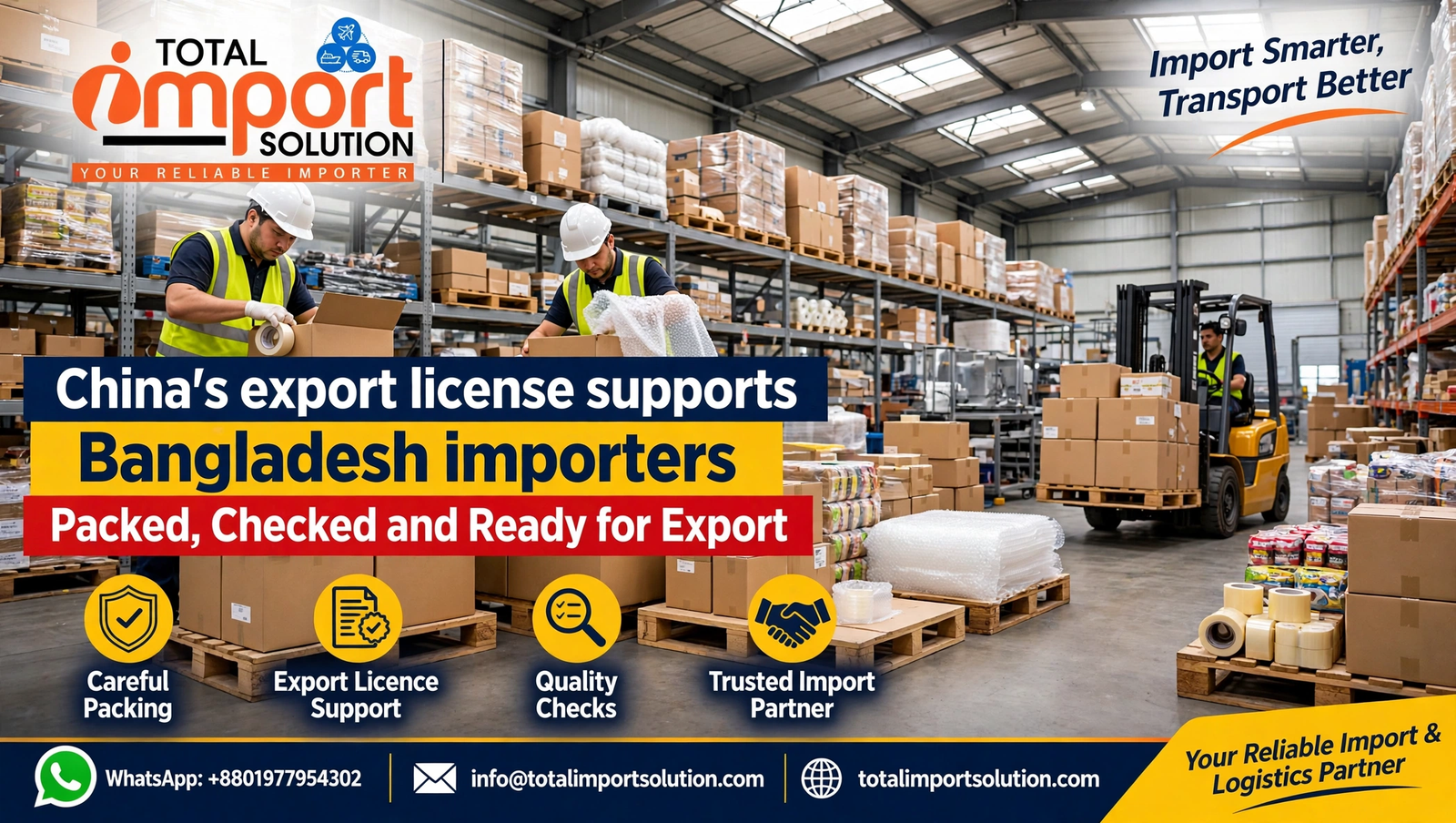
Good packing protects the goods, and a good packing list proves what is inside each carton. When the packing is strong and the list is accurate, loading is smooth, inspection is quick, and unloading in Bangladesh is simple. When the packing is weak or the list is wrong, cartons break, goods are damaged, and customs checks take longer.
Ask the supplier how the goods will be packed. Cartons should be strong enough for the weight of the goods and for stacking in the container, fragile goods need inner protection, and heavy goods need reinforced cartons or wooden cases. Each carton should be marked with the carton number, the goods code, the quantity inside, and the destination mark agreed with the buyer. Marks should be clear and printed, not handwritten, so they can be read at the port.
The packing list should be prepared from the actual packing, not from the order: the supplier counts the cartons after packing and writes the real numbers, weights, and marks. A list copied from the order before packing is a common source of errors. Ask for the packing list after packing is finished, with photos of the packed cartons and their marks.
8. Booking the Shipment and the Bill of Lading
Once the goods are packed and the documents are checked, the shipment is booked: space is arranged on a vessel sailing from a Chinese port to Chittagong, through the shipping line or a freight forwarder. The booking records the port of loading, the port of discharge, the container type and number, and the sailing schedule. The buyer should receive these details so the arrival can be planned.
After the container is loaded and the vessel sails, the shipping line issues the bill of lading, one of the most important documents in the set. It proves the goods were received for shipment and loaded on the named vessel, and it names the shipper, the consignee, the ports, the container number, the seal number, and the number of packages. The buyer in Bangladesh needs it to claim the goods at Chittagong port.
Check the bill of lading carefully when you receive it. The consignee name should be the buyer or the buyer’s agent, exactly as it will appear on the import documents. The port of discharge should be Chittagong, the container and seal numbers should match the numbers recorded at loading, and the number of packages should match the packing list. If any detail is wrong, ask for a corrected bill of lading at once, because corrections are much harder after the vessel arrives.
The steps below show the booking and loading sequence in order.
- Confirm the goods are packed and the documents are ready.
- Confirm the booking, the port of loading, and the sailing schedule.
- Deliver the container to the port and load the goods under supervision.
- Record the container number and the seal number at loading.
- Receive the draft bill of lading and check every field.
- Ask for corrections before the final bill of lading is issued.
- Receive the final bill of lading and file it with the invoice and packing list.
- Share the bill of lading details with your agent in Bangladesh.
9. Customs Declaration in China
Before the goods leave China, the exporter files an export declaration with Chinese customs, stating the goods, their classification code, their quantity, their value, and the exporter. Customs officers check it when the container arrives at the port. If the declaration is correct and the export license covers the goods, the container is cleared for loading. If it is wrong, the container is held for correction.
The buyer cannot file this declaration, because it is the exporter’s duty, but the buyer can ask for the details and check them against the invoice and packing list. The goods description, quantity, and value should match the invoice, and the classification code should be the code that applies to the goods ordered. A wrong classification code is a common cause of delay, because customs officers compare the code with the goods and question any mismatch.
Ask when the declaration will be filed. It should be filed in good time before the vessel sails, so that any question from customs can be answered while the container is still at the port. Ask your supplier or agent for the declaration number once it is filed, and keep it in your shipment file.
10. Customs Clearance in Bangladesh
When the vessel arrives at Chittagong port, the goods pass through Bangladesh customs. The importer or the importer’s agent files the import documents, and officers check them against the goods. The documents needed include the bill of lading, the commercial invoice, the packing list, the certificate of origin, and the import papers required by the rules in force at the time. The export license from China is not filed in Bangladesh, but the accuracy of the export papers shows in the import papers, because the same goods, quantities, and values run through both sets.
Clearance goes smoothly when the documents agree with each other and with the cargo. The officers check the consignee name, the goods description, the quantity, the carton marks, and the value. If everything matches, the shipment is assessed and released. If there is a mismatch, the officers may ask for clarification, open cartons for inspection, or ask for corrected papers, and the container stays at the port while the questions are answered.
Prepare for clearance before the vessel arrives. Share the bill of lading, invoice, packing list, and certificate of origin with your agent as soon as you receive them, make sure your import papers are ready, and confirm who will handle the clearance and the delivery from the port. Your agent can then start at once when the vessel arrives instead of waiting for papers.
| Clearance step | Who handles it | What is needed |
|---|---|---|
| Documents received | Buyer shares with agent | Bill of lading, invoice, packing list, certificate of origin |
| Import filing | Agent files | Import papers and the shipping documents |
| Customs check | Officers check | Documents compared with the goods |
| Assessment | Officers assess | Value and classification as declared |
| Release | Port releases | Clearance complete and delivery arranged |
| Delivery | Agent arranges | Transport from the port to the buyer |
11. Common Document Problems and How to Fix Them
Even with careful planning, document problems happen. The table below lists the most common problems, what causes them, and how to fix them. The key point is to find the problem early, while the goods are still in China, because a fix at that stage is far simpler than a fix after arrival in Bangladesh.
| Problem | Common cause | How to fix it |
|---|---|---|
| License does not cover the goods | Wrong license or wrong goods description | Ask the supplier for the correct license before shipping |
| License expired | Shipment delayed past the validity dates | Ask the supplier to renew or replace the license |
| Invoice and packing list differ | List copied from the order, not the real packing | Ask for a corrected list made from the packed cartons |
| Bill of lading has a wrong name | Typing error in the consignee or shipper name | Ask for a corrected bill of lading before arrival |
| Container or seal number wrong | Number recorded incorrectly at loading | Check against the loading record and ask for correction |
| Certificate of origin missing | Not requested before shipment | Ask the supplier to issue it and send the original |
| Classification code wrong | Wrong code used on the declaration | Ask the supplier to check and correct the declaration |
| Carton marks unclear | Handwritten or missing marks | Ask for clear printed marks and photos before loading |
When a problem is found, act in this order: find the correct information from the order and the real goods, ask the party who issued the document to correct it, receive the corrected document and check it again, then share it with your agent in Bangladesh. Never send a shipment forward with a known document error and hope it will not be noticed. Customs officers on both sides check the papers carefully, and an ignored error usually becomes a delay at the port.
12. Step-by-Step Process from Order to Delivery
Since 2016, Total Import Solution has followed this process with importers in Bangladesh. It brings together everything in this guide: follow it for each order, keep a file for each shipment with every document listed, and each step will check the step before it.
- Confirm the order: goods, model, quantity, packing, and value.
- Ask whether an export license is needed, and ask for written confirmation.
- Ask for a copy of the license and check the exporter, goods, quantity, destination, and validity dates.
- Check the supplier’s business details and confirm who the exporter will be.
- Pay the agreed deposit and ask for the draft invoice and packing list.
- Check the draft invoice and packing list against the order, and ask for corrections.
- Arrange inspection of the goods and packing before loading, where the order calls for it.
- Confirm the packing, carton marks, and weights, and ask for photos of the packed cartons.
- Receive the final invoice, packing list, and declaration details, and check that all figures agree.
- Confirm the booking, the port of loading, and the sailing schedule.
- Load the container, record the container and seal numbers, and check the draft bill of lading.
- Receive the final bill of lading and certificate of origin, and file the full document set.
- Share the documents with your agent in Bangladesh and prepare the import papers.
- Track the vessel and confirm the arrival date at Chittagong port.
- Clear customs in Bangladesh with the full document set and arrange delivery.
13. How Total Import Solution Supports Your Import
Total Import Solution is an importer and logistics partner based in Bangladesh. Since 2016, the company has helped importers plan shipments from China, check export documents, coordinate with suppliers and shipping lines, support customs clearance, and arrange delivery. The work is practical: checking papers before the goods move, keeping the document set in order, and following the shipment from order to delivery.
The support starts with the order. The team helps the buyer confirm the goods, the supplier, and the documents needed, checks the export license details against the order, reads the invoice and packing list for mismatches before the goods are loaded, and follows the booking, the bill of lading, the sailing, and the arrival date.
At the Bangladesh end, the team supports customs clearance with the full document set and coordinates delivery from the port. Because the documents were checked at the start, clearance usually proceeds without the delays that come from missing or mismatched papers. The buyer receives the goods with a complete file of documents, which is useful for records and for repeat orders.
If you are planning an import from China and want the export license and documents checked before the goods move, contact Total Import Solution. Share the order details, the supplier’s papers, and the shipment plan, and the team will go through the document set with you step by step, so your goods leave China with the right papers and arrive in Bangladesh without document problems at the port.
Frequently Asked Questions
1. What is an export license in China?
An export license is a document issued by the authorities in China that permits certain named goods to leave the country. It states the exporter, the goods, the quantity, the destination, and the validity dates. Not every product needs one, but goods that do cannot be exported without it.
2. Does every shipment from China to Bangladesh need an export license?
No. Many ordinary goods are exported under a general export declaration, while some goods need a specific license because of their type or the rules that apply to them. Ask your supplier in writing whether a license is needed for your goods before you place the order.
3. Who holds the export license, the buyer or the supplier?
The exporter holds the license. The buyer in Bangladesh cannot hold a Chinese export license, but may ask for proof that it exists and covers the goods ordered.
4. What should I ask my supplier about the export license?
Ask whether a license is needed for your goods, ask for a copy, and check the exporter name, goods description, quantity, destination, and validity dates. Ask for the answer in writing so you have a record.
5. What happens if the export license is missing or expired?
The shipment cannot clear export customs in China. The container may be held at the port, the vessel may sail without the cargo, and the goods will wait for a corrected or renewed license. Check the license before loading.
6. How do I check that the license covers my goods?
Compare the goods description and quantity on the license with your order. The description should match the goods you ordered, and the quantity should cover the full amount. A license for different goods or a smaller quantity does not cover your order.
7. What other documents should I ask for with the license?
Ask for the commercial invoice, the packing list, the certificate of origin, the bill of lading, the export declaration details, and any inspection or quality certificates. Each checks a different part of the shipment, and together they form one set.
8. Why do the invoice, packing list, and license need to match?
Customs officers on both sides compare the documents with each other and with the goods. When the goods, quantities, and values agree, clearance is smooth. When they differ, officers ask questions, open cartons, and delay the shipment.
9. What is the bill of lading and why is it important?
The bill of lading is issued by the shipping line after the goods are loaded. It proves the goods were received for shipment and names the shipper, the consignee, the ports, and the container and seal numbers. The buyer needs it to claim the goods at Chittagong port.
10. What should I check on the bill of lading?
Check the consignee name, the port of discharge, the container number, the seal number, and the number of packages. Every field should match the packing list and the import documents. Ask for corrections before the vessel arrives.
11. How can I check a supplier before I order?
Ask for the company name, address, and business registration details, and whether the supplier exports directly or through a trading company. Ask whether a license is needed and held. Ask for photos or video of the goods, and consider a third-party inspection for larger orders.
12. What is the packing list and why does it matter?
The packing list shows what is inside each carton: the carton number, the quantity, the marks, and the weights. It should be written from the real packed cartons, not copied from the order. Customs officers use it to check the cargo against the invoice.
13. What are the most common document problems?
The most common problems are a license that does not cover the goods, an expired license, an invoice and packing list that differ, a wrong name on the bill of lading, a wrong container or seal number, and a missing certificate of origin. Most can be fixed easily if found before the vessel sails.
14. When should I share documents with my agent in Bangladesh?
Share the bill of lading, invoice, packing list, and certificate of origin as soon as you receive them. Your agent can then prepare the import papers before the vessel arrives, so clearance can start at once when the goods reach Chittagong port.
15. How does Total Import Solution help with export licenses?
Total Import Solution checks the export license details against the order, reads the invoice and packing list for mismatches, follows the booking and the bill of lading, and supports customs clearance in Bangladesh with the full document set, so document problems are caught before the goods move.
16. How do I start an import from China with Total Import Solution?
Contact Total Import Solution with your order details, the supplier’s papers, and the shipment plan. The team will go through the document set with you step by step, check the license and the other papers, and support the shipment from order to delivery.
Contact Total Import Solution
- WhatsApp: +8801977954302
- Email: info@totalimportsolution.com
- Website: totalimportsolution.com
- Service: China’s export license supports Bangladesh importers — export document checks, shipment planning, customs clearance support, and delivery coordination for importers in Bangladesh.
