
Boiler import customs clearance in Bangladesh
Introduction
A boiler is one of the most important machines in many factories in Bangladesh. It makes steam and hot water for dyeing, washing, processing, heating and power work. When a factory needs a new boiler, or a bigger one, the machine often comes from another country. That is where boiler import customs clearance in Bangladesh becomes important. Customs clearance is the official process that allows an imported boiler to enter the country, pass inspection, pay the duty and taxes that apply, and then move to the factory.
This guide explains that process in plain language, step by step, for factory owners, managers, engineers and import teams who want to understand what happens, what documents are needed, and what can go wrong. It does not promise a result, and it does not quote a rate or a fee. A rate or a fee is confirmed only after checking the actual shipment and the actual documents, because every boiler is different in size, type, value and use.
Since 2016, Total Import Solution has been helping importers in Bangladesh, and this guide follows the same practical approach used in real import work: check the documents first, check the machine details second, and keep every step in order.
1. What a Boiler Is and Why Customs Clearance Is Special
A boiler is a closed vessel that heats water to make steam or hot water. The steam then runs machines, heats process lines, dries fabric, or drives other factory work. Boilers are used in textile and garment factories, dyeing units, food processing plants, paper mills, chemical plants, pharmaceutical units and many other industries across Bangladesh.
Boiler import customs clearance is special for several reasons. First, a boiler is a large and heavy machine. It may arrive in parts, in more than one container, or as one large unit that needs special handling at the port, so the packing list and the shipping documents must match the physical cargo, piece by piece.
Second, a boiler works under pressure. That means safety matters. Customs and other authorities may want to see inspection papers, test certificates and details about the design, the material and the safety fittings. A missing certificate can hold up the release, even when all other documents are ready.
Third, a boiler is a high-value capital machine. The declared value, the country of origin, the model and the year of manufacture all matter for assessment, so clear and honest paperwork helps the assessment move in an orderly way.
For all of these reasons, boiler clearance needs more care than a simple shipment of raw material. Plan early, keep one file for all documents, and check every paper against the cargo before the vessel arrives.
2. Types of Boilers Imported into Bangladesh
Not all boilers are the same. The type decides which documents matter most, how it is packed, how it is handled at the port, and what the factory engineers need to check when it arrives, so write down the exact type, fuel, capacity and use before you order.
| Boiler type | Common use | What to check before ordering |
|---|---|---|
| Fire tube boiler | Textile, dyeing and small process work | Tube layout, fuel type and rated capacity |
| Water tube boiler | Large factories and high steam demand | Design pressure, material and safety fittings |
| Gas fired boiler | Factories with a gas supply | Burner details and gas connection size |
| Oil fired boiler | Factories using liquid fuel | Burner details and fuel storage plan |
| Coal fired boiler | Plants set up for solid fuel | Grate, ash handling and fuel supply |
| Electric boiler | Small and clean process work | Power load and electrical connection |
| Waste heat boiler | Plants that reuse hot exhaust gas | Heat source, connection and output |
| Used or reconditioned boiler | Budget replacement work | Age, condition, test papers and inspection |
A new boiler usually comes with full factory papers from the maker, while a used boiler needs extra care. Ask for the year of manufacture, the service history, the last test report and clear photos of the nameplate, the tubes, the burner and the safety valves, and ask in writing about anything unclear before you pay or ship.
Also think about spare parts. A boiler needs valves, gaskets, tubes, burners and controls over its working life. Ask whether spare parts are included and listed on the packing list on their own line, because parts that are not listed can cause questions at customs.
3. How to Plan Your Boiler Import Before You Order
Good clearance starts before the order is placed. Many delays happen because the buyer, the supplier and the agent were not working from the same details. A short planning stage at the start saves long waiting later.
Start with the factory need. Ask your engineer to write down the steam demand, the working pressure, the fuel you will use, the space available in the boiler house, and the chimney and water treatment you already have. This note becomes the base for the order, and it helps the supplier send the right boiler.
Next, confirm the supplier details in writing: the full name of the maker, the model, the serial number plan, the country of origin, the packing plan, and the list of documents the supplier will send. Ask the supplier to mark every package with the same marks shown on the packing list, so the port team can match cargo and paper.
Then talk to your customs clearance agent early. Share the boiler details, the expected port of arrival, and the draft documents, so the agent can point out a missing paper or a mismatch before the cargo sails, when it is still easy to fix.
Finally, set up one import file. Keep the order, the invoice, the packing list, the bill of lading, the inspection papers, the certificates and all messages in one place, and give one person in your team the job of keeping this file complete.

4. Documents You Need for Boiler Import Customs Clearance
Documents are the heart of boiler import customs clearance in Bangladesh. Customs works from paper first and cargo second. If a paper is missing, unclear or different from the cargo, the file stops until the paper is fixed. Prepare the full set before the vessel arrives.
| Document | Why it matters | Check this before shipping |
|---|---|---|
| Commercial invoice | Shows the seller, buyer, value and machine details | Value, model and quantity match the order |
| Packing list | Shows every package, weight and content | Package marks match the physical cargo |
| Bill of lading | Proves the cargo was loaded for shipment | Consignee, port and package count are correct |
| Certificate of origin | Shows where the boiler was made | Country, maker and model are stated clearly |
| Inspection certificate | Shows the boiler was checked before shipment | Inspector, date and result are clear |
| Test certificate | Shows pressure and safety checks | Test details match the boiler nameplate |
| Catalogue and technical sheet | Explains the design and capacity | Model and capacity match the invoice |
| Import registration papers | Shows the importer is registered | Registration details are current |
| Letter of credit papers | Shows the payment terms, where used | Terms match the invoice and shipment |
| Delivery order | Allows the port to release the cargo | Issued to the correct importer |
Keep the original documents safe and keep clear copies in your import file, and check names and numbers word by word. A single wrong letter in a name, a wrong serial number, or a different package count can cause a query, so ask your agent to read the draft documents before the supplier sends the final set.
If the boiler arrives in parts, the packing list must show each part. List the main unit, the burner, the control panel, the valves, the pipes and the spare parts on separate lines where possible, and ask the supplier to send photos of the packing taken before loading.
5. HS Classification in General Terms
HS classification is the system customs uses to place a machine in the right group in the tariff schedule. The classification of a boiler is based on what the machine is, how it works, what fuel it uses, and what it is used for. It is not based on the brand name alone.
Your agent will study the technical sheet, the catalogue and the invoice, and then work out the classification from the official tariff schedule. The details that matter most are the boiler type, whether it makes steam or hot water, the fuel, the capacity, and whether it is new or used, so the technical sheet must be clear and complete.
Do not guess the classification from a similar machine. Two boilers that look the same can fall into different groups if one is fired by gas and the other by oil, or if one makes steam and the other makes hot water. Give your agent the full technical sheet, not a short summary, and let the agent check the schedule.
If customs asks why a certain classification was used, your agent should be able to explain it from the technical sheet and the tariff schedule. Keep the catalogue, the test papers and the maker details in the import file, ready to show, and do not change the machine details after the documents are made.
6. Approvals, Inspection and Testing Before Shipment
A boiler is a pressure machine, so inspection before shipment is an important step. Pre-shipment inspection checks the condition of the boiler, the nameplate details, the safety fittings and the general working order. For a used boiler, this step is even more important, because the age and the condition of the machine must be clear.
Ask the supplier for the inspection plan in writing: who will inspect the boiler, what will be checked, and which certificate will be issued. The certificate should show the maker, the model, the serial number, the year of manufacture, the capacity and the result of the check, so keep the original in your import file.
Testing is a separate step. A pressure test and a check of the safety valves, the controls and the burner help show that the boiler is safe to use, so ask for the test report and check that its details match the nameplate on the boiler. If they do not match, ask the supplier to explain the difference before shipment.
Some boilers also need approval from a local authority before they can be used in the factory. Ask your agent and your engineer about this early, so you know which approval applies and what papers it needs, and start it while the cargo is still on the water, not after it arrives.
7. Step-by-Step Customs Clearance from Vessel Arrival to Release
The clearance process has many steps, and each step depends on the one before it. When you know the order of the steps, you can prepare for each one and avoid waiting for a paper that should have been ready earlier.
| Step | What happens | Who handles it |
|---|---|---|
| 1. Vessel arrival | The vessel reaches the port and the cargo is listed | Shipping line and port |
| 2. Document check | The agent checks all papers against the cargo details | Agent and importer |
| 3. Bill of entry | The import declaration is filed with customs | Agent |
| 4. Assessment | Customs checks value, classification and documents | Customs and agent |
| 5. Inspection | The cargo is checked, where customs asks for it | Customs, port and agent |
| 6. Duty and tax payment | The amount assessed is paid through the bank | Importer and bank |
| 7. Release order | Customs gives the order to release the cargo | Customs |
| 8. Port release | The port allows the cargo to leave | Port and agent |
| 9. Transport | The boiler is loaded and moved to the factory | Transport team |
| 10. Factory receipt | The factory checks the cargo on arrival | Factory team |
Step one starts with the shipping line. The agent collects the delivery order and confirms the cargo details. Step two is the document check. This is the step where a missing paper is found, so do it as soon as the draft documents arrive, not on the day of arrival.
Step three is the bill of entry, filed with the details from the invoice, packing list and bill of lading. Step four is assessment, where customs checks the value and the classification. Step five is inspection, where customs may open a package or check the cargo, so keep the packing list ready.
Step six is payment of the duty and taxes that apply, and steps seven and eight are the release orders from customs and the port. Step nine is transport, and step ten is the factory receipt check, where you count the packages, check the nameplate against the invoice, and note any damage in writing before the transport team leaves.
8. Duty and Taxes in General Terms
Duty and taxes on a boiler import are worked out from the assessed value, the classification and the rules that apply at the time of import. The amount is not fixed in advance, and it is not the same for every boiler. That is why no article can quote a correct figure for your shipment.
A rate or a fee is confirmed only after checking the actual shipment and the actual documents. Your agent will work out the amount from the invoice, the classification, the tariff schedule and the current rules, and will show you the working in writing before payment.
| Charge type | What it is based on | Where the figure comes from |
|---|---|---|
| Customs duty | Assessed value and classification | Tariff schedule and assessment |
| Other taxes on import | Rules that apply at the time of import | Current rules and assessment |
| Port charges | Cargo handling and storage at the port | Port tariff and actual handling |
| Shipping line charges | Delivery order and container use | Shipping line and actual use |
| Agent service charge | Work done by the clearance agent | Agent quotation for the job |
Keep every payment receipt in the import file, as proof that a charge was paid. Do not pay a charge without a receipt, and do not accept a figure given only by word of mouth. Ask for the amount in writing, with the basis shown, before you pay.
If you want to plan your budget, ask your agent for an estimate based on the actual invoice and the actual technical sheet, and ask the agent to show which details the estimate is based on. An estimate made from real papers is useful. An estimate made without papers is not.
9. Delivery from the Port to Your Factory
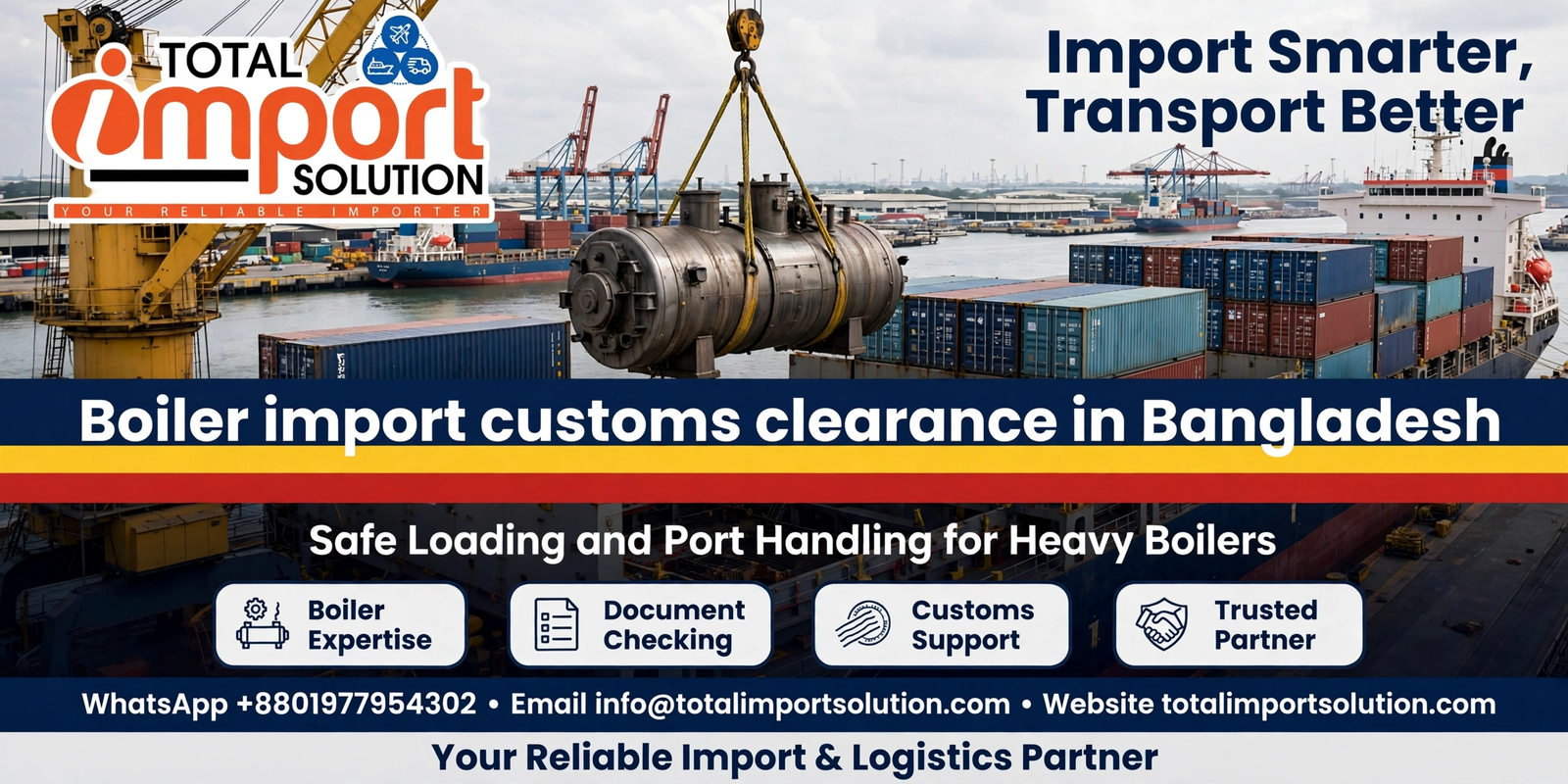
Release from customs is not the end of the job. The boiler still has to travel from the port to your factory in safe condition. A boiler is heavy, wide and easy to damage if it is lifted or loaded in the wrong way, so transport needs the same care as clearance.
First, confirm the size and weight of each package from the packing list. Share these details with the transport team before the truck is booked. A truck that is too small, or a crane that is too light, will cause delay at the port and may damage the cargo.
Second, check the route to your factory. Ask whether the road, the bridge and the factory gate can take the size and weight of the load, and if the boiler is very large, whether the transport team needs a special trailer and a planned route. Check this before the release day, not after the cargo is already loaded.
Third, be present at loading. Check that the boiler is lifted by the right points, that it is packed and covered, and that loose parts are fixed in place, and take photos of the loading and of the cargo on the truck, which help if a damage claim comes up later.
At the factory, unload the boiler onto a prepared area, count the packages against the packing list, check the nameplate against the invoice, and look for damage. Note any problem in writing on the delivery note, then store the boiler under cover until installation starts, and keep the documents with the machine.
10. Common Problems and How to Fix Them
Most boiler clearance problems come from the same few causes: a paper that does not match the cargo, a missing certificate, or a detail that was not checked before shipment. The table below shows the common problems and the practical fix for each one.
| Problem | Why it happens | Practical fix |
|---|---|---|
| Name or model mismatch | Invoice and nameplate use different details | Ask the supplier to correct the paper before shipment |
| Missing inspection paper | Inspection was not arranged in time | Arrange inspection before loading, not after |
| Packing list does not match cargo | Parts were added or left out | List every part and check the list at loading |
| Wrong classification | Technical sheet was unclear | Give the agent the full catalogue and sheet |
| Value question | Invoice details are unclear | Keep the order, payment papers and invoice together |
| Port storage build-up | Release was delayed by a missing paper | Prepare the full file before vessel arrival |
| Damage on arrival | Lifting or packing was not planned | Use the right crane, trailer and packing |
| Spare parts not listed | Parts were packed without a line on the list | List spare parts on the packing list |
When a problem comes up, work from the papers. Ask customs or the port what paper or check is needed, and then supply that paper or arrange that check. A clear paper answers a question faster than a long explanation.
Keep a note of every problem and every fix in your import file, so your team can avoid the same problem on the next import.
11. How to Judge a Good Customs Clearance Agent
A good agent makes boiler clearance smooth. A weak agent makes it slow and costly. Judge an agent by work and by communication, not by words alone.
First, ask about boiler work. Has the agent cleared boilers and heavy machines before? Can the agent explain the documents, the classification and the inspection steps for a boiler in plain language? An agent who knows boilers will ask for the technical sheet and the test papers early.
Second, check communication. A good agent replies to messages, gives updates without being asked, and tells you about a problem as soon as it is found, because clearance moves step by step and a missed message can mean a missed day.
Third, ask for clear charges. A good agent gives the service charge in writing, explains what it covers, shows the duty and tax working separately, and gives receipts for every payment made for you.
Fourth, ask how the agent keeps records. A good agent keeps a file for your shipment, with copies of every paper and every receipt, shares the file with you, and can use it if a question comes up after release.
Finally, ask for a reference from a factory or importer the agent has served. A short talk with a past client tells you more than a long sales talk, so choose an agent who is clear, honest and organised.
12. Working with Your Agent, Step by Step
Working well with your agent is a shared job. The importer supplies the papers and the decisions, and the agent handles the filing, the follow-up and the port work. When both sides do their part on time, clearance moves in order.
Step one is the first meeting. Share the boiler details, the supplier name, the expected arrival, and the draft documents. Agree on who will do what, and agree on how often you will get an update. Put the agreed points in a short message so both sides have the same record.
Step two is the document check. Send every paper to the agent as soon as you receive it, and do not hold back a paper because it looks small. A small paper, such as a catalogue page or a test report, can be the paper customs asks for.
Step three is the arrival stage. Be ready to answer questions, sign papers and arrange payment, keep your phone open, and keep the import file with you, because a quick answer at this stage can save a day at the port.
Step four is the release and transport stage. Confirm the transport plan with the agent, be present at loading where possible, check the factory receipt after delivery, and ask the agent for the full file of papers and receipts when the job is done.
If a problem comes up, ask the agent to explain it in plain language: what is needed, who needs it, and by when. Then supply what is needed and ask for an update.
13. Mistakes to Avoid and How Total Import Solution Helps
The most common mistake in boiler import is starting too late. The buyer orders the boiler, the cargo sails, and only then does someone ask about documents, inspection or approval, when a missing paper is hard to fix. Start the clearance plan at the order stage, not at the arrival stage.
The second mistake is trusting a short summary instead of the full papers. A one-line description of a boiler is not enough for classification, assessment or inspection. Always work from the full technical sheet, the full invoice and the full packing list.
The third mistake is changing the machine after the papers are made. If the model, the fuel or the capacity changes, the papers must change too. Tell your agent about any change at once, in writing, and ask what new paper is needed.
The fourth mistake is poor packing and poor transport planning. A boiler that is not packed for the sea and the road can arrive damaged, and a damaged boiler is a loss for the factory. Check packing, lifting and transport before loading.
Total Import Solution helps importers avoid these mistakes by working in the same order as this guide. Since 2016, the team has been serving importers in Bangladesh, and the work starts with the documents, not with the port. The team checks the invoice, packing list, bill of lading, inspection papers and technical sheet, talks to the supplier where a paper needs a correction, and keeps the importer updated at each step.
The team also helps with the port work, the assessment follow-up, the release and the transport plan to the factory, and after delivery the importer receives the file of papers and receipts for the factory records. If you are planning a boiler import, share the boiler details and the draft documents first, and ask for a clear plan before the cargo sails.
Frequently Asked Questions
1. What is boiler import customs clearance in Bangladesh?
It is the official process that allows an imported boiler to enter Bangladesh, pass document checks and inspection, pay the duty and taxes that apply, and move from the port to the factory.
2. Which documents are needed for boiler clearance?
The main documents are the commercial invoice, packing list, bill of lading, certificate of origin, inspection certificate, test certificate, catalogue and technical sheet, import registration papers, and the delivery order.
3. Why is a boiler harder to clear than a small machine?
A boiler is large, heavy and works under pressure, so customs may check the packing, the inspection papers, the test papers and the value more closely than for a small machine.
4. Can I import a used boiler into Bangladesh?
A used boiler needs extra care. Ask for the year of manufacture, service history, test report and inspection certificate, and share them with your agent before you order.
5. What is HS classification for a boiler?
It is the group given to the boiler in the tariff schedule, based on its type, fuel, capacity and use. Your agent works it out from the technical sheet and the official schedule.
6. Do I need an inspection before shipment?
Yes, in most cases. Pre-shipment inspection checks the condition, nameplate, safety fittings and working order of the boiler, and the certificate is part of the clearance file.
7. What happens when the vessel arrives at the port?
The agent collects the delivery order, checks the documents, files the bill of entry, and follows the assessment, inspection, payment and release steps in order.
8. How is the duty and tax amount worked out?
It is worked out from the assessed value, the classification and the rules that apply at the time of import. A rate or a fee is confirmed only after checking the actual shipment and the actual documents.
9. What if a document does not match the cargo?
Customs may ask for a correction or an explanation. Ask the supplier to correct the paper before shipment where possible, and keep photos and the packing list ready to show the match.
10. How should spare parts be listed?
List spare parts on the packing list on their own lines, with the part name and quantity, so customs can match them with the cargo at inspection.
11. Who pays the port charges and shipping line charges?
These charges are paid by the importer, through the agent or directly, and each payment should have a receipt kept in the import file.
12. What should I check when the boiler reaches my factory?
Count the packages against the packing list, check the nameplate against the invoice, look for damage, and note any problem in writing on the delivery note.
13. How do I choose a customs clearance agent for a boiler?
Choose an agent with boiler and heavy machine experience, clear written charges, good communication, organised records, and a reference from a past client.
14. What is the biggest mistake in boiler import?
Starting the clearance plan too late. The documents, inspection and approval checks should start at the order stage, not when the vessel arrives.
15. Can Total Import Solution help with boiler import customs clearance?
Yes. The team checks the documents, follows the clearance steps, helps with release and transport, and gives the importer the full file of papers and receipts after delivery.
16. How do I start a boiler import with Total Import Solution?
Share the boiler type, fuel, capacity, supplier details and draft documents first, so the team can check them and give you a clear plan for your shipment.
Contact Total Import Solution
- WhatsApp: +8801977954302
- Email: info@totalimportsolution.com
- Website: totalimportsolution.com
- Service: Boiler import customs clearance in Bangladesh, with document checking, customs support, port release and factory delivery planning.
- Since 2016, Total Import Solution has been serving importers in Bangladesh.
