
Agricultural machinery shipping from China to Bangladesh is a practical job that rewards careful planning. A tractor, a harvester, a power tiller or a rice transplanter is large, heavy and valuable. It cannot be packed like a small parcel, and it cannot be loaded in a hurry. Every step matters: the choice of machine, the condition check before loading, the packing, the shipping documents, the customs clearance in Bangladesh, and the final delivery to the farm, the dealer showroom or the project site. When one step is missed, the whole shipment can stop. When every step is planned in order, the machine arrives in the condition it left in, the papers match the cargo, and the buyer knows what to check at delivery.
This guide explains the full process in plain language for farmers, farm owners, dealers, importers, cooperatives and project buyers. Since 2016, Total Import Solution has served importers, and this guide follows the same working order used in a real shipment: plan first, check the machine, prepare the documents, pack and load with care, ship, clear customs, deliver, and check again after delivery.
1. What Agricultural Machinery Shipping from China to Bangladesh Means in Practice
Shipping agricultural machinery is not only booking space on a vessel. It is a chain of linked tasks, and each task depends on the one before it. The chain starts with a clear description of the machine: its type, make and model, year of manufacture, dimensions, weight, and whether it is new or used. It continues with the supplier in China, the packing and loading plan, the shipping documents, the customs process in Bangladesh, and the road transport from the port to the final destination.
Write everything down before the machine moves. Keep one file for the shipment, with the supplier quotation, the machine description, the photos and video of the machine, the packing list, the invoice, the shipping documents, and every message about the shipment. When a question comes up at the port or at customs, the answer is in that file. A shipment with a complete file moves more smoothly than one where the papers are scattered across different phones and chats.
| Stage | What happens | Who is involved |
|---|---|---|
| Planning | Machine details, supplier check, shipment plan | Buyer, supplier, import agent |
| Preparation | Inspection, packing, loading, documents | Supplier, loading team, agent |
| Shipping | Sea freight, tracking, arrival notice | Shipping line, agent, buyer |
| Customs | Document check, assessment, release | Customs, C and F agent, buyer |
| Delivery | Port handling, road transport, handover | Transport team, buyer, agent |
2. Types of Agricultural Machinery Commonly Shipped from China to Bangladesh
China supplies a wide range of farm machines, and Bangladesh buyers use them for rice farming, vegetable farming, land preparation, harvesting and post-harvest work. Tractors are the most common. They come in different sizes and power levels, and the right size depends on the land, the soil and the implements the buyer plans to use. A tractor that is too large for small plots is hard to turn, while a tractor that is too small for heavy tillage work will struggle, so the buyer should be clear about the work the tractor will do every season.
Power tillers and two-wheel tractors are widely used on smaller plots. They are lighter and easier to move, but they still need careful packing because their handles, wheels and blades can be damaged in transit. Rice transplanters, seeders and planters are precision machines. Their moving parts need protection, and their settings should be recorded before dismantling so they can be set up again after delivery. Combine harvesters and reapers are large machines with wide cutting heads. The header is often removed for shipping and packed separately, and every bolt, belt and guard that is removed should be listed and labelled.
Other machines in this trade include water pumps, threshers, sprayers, rotavators, ploughs, trailers and grain dryers. A pump with a fragile casing needs cushioning, a thresher belt needs protection from oil and sharp edges, and a sprayer tank needs to be clean and dry before packing. The rule is the same for every machine: understand its weak points, protect those points, and label the parts that were removed.
3. How to Plan Your Shipment Step by Step
Good planning starts with the end use, not with the vessel. First, write down what the machine will do, where it will work, and who will operate it. Then match the machine to that work. Ask the supplier for the full specification sheet, clear photos from all sides, and a short video of the machine running. If the machine is used, ask for its service history and a video of a cold start, so you can see how it behaves when it has not been running.
Second, confirm the condition of the machine in writing. The condition, the year of manufacture, the hours of use if the machine records them, and the list of accessories should all be written in the order. A verbal promise is easy to forget. A written order is easy to check at delivery. Keep a copy of every page of the order, and ask the supplier to confirm the order in writing before any packing starts.
Step by step, the planning order is:
- Define the work the machine will do and the size you need.
- Ask the supplier for the specification sheet, photos and video.
- Confirm the machine, the accessories and the condition in writing.
- Agree on responsibilities for China and for Bangladesh.
- Prepare the document list and the shipment file.
- Agree on the packing and loading plan.
- Confirm the shipping plan and the port of arrival.
- Plan customs clearance and road transport in advance.
Prepare a shipment timeline that follows the real order of work, with the inspection, packing, loading, sailing, arrival and delivery dates. Keep the timeline realistic and leave room for a delay at any stage, because ports and customs can ask for extra checks. A realistic plan is more useful than an optimistic plan that falls apart at the first delay, and a timeline that is shared with the supplier and the agent keeps everyone working to the same dates.

4. Choosing a Supplier in China and Checking the Machine Before Shipment
A good supplier is judged by evidence, not by words alone. Start by asking for the business licence of the supplier, the factory or showroom address, and references from earlier buyers. A supplier who can show a real address, a real workshop and earlier shipments is easier to trust than a supplier who only sends a few photos. If possible, arrange an independent inspection before the machine is packed. An inspector can check the machine in person, take photos and video, and send a written report to the buyer.
The inspection should cover the engine, the gearbox, the hydraulics, the tyres or tracks, the brakes, the lights, the cabin and the body. The inspector should start the engine, listen for unusual noise, check for leaks, test the gears and the hydraulics, and look at the underside of the machine for damage or rust. For a used machine, the inspector should note every scratch, dent and worn part, so the buyer knows the true condition. The inspection report becomes part of the shipment file, and it is the reference for the delivery check in Bangladesh.
| Check | What to look for | Why it matters |
|---|---|---|
| Supplier identity | Licence, address, references | Confirms the supplier is real |
| Machine identity | Serial number, engine number | Confirms the machine is the ordered one |
| Engine and gearbox | Start, noise, leaks, gears | Shows the machine works as described |
| Hydraulics | Lift, steering, hoses | Shows the working parts are sound |
| Body and tyres | Dents, rust, wear, glass | Shows the true condition |
| Accessories | List of every item included | Prevents a missing part at delivery |
5. Documents You Need for Agricultural Machinery Shipping from China to Bangladesh
Documents are the backbone of an import shipment. Without the right documents, a machine can sit at the port while the buyer waits. The document list should be prepared before the machine is loaded, and every document should be checked against the machine and against the other documents. A single spelling difference in a name, a serial number or a port name can cause a delay, so the check should be done word by word.
The core documents usually include the commercial invoice, the packing list, the bill of lading, the certificate of origin, and the import registration and related trade documents required in Bangladesh. The invoice shows the seller, the buyer, the machine description, the quantity and the value as agreed. The packing list shows every package, its contents, its weight and its dimensions. The bill of lading is the transport document issued by the shipping line, and it shows the shipper, the consignee, the port of loading, the port of discharge and the description of the cargo.
| Document | What it shows | Check before loading |
|---|---|---|
| Commercial invoice | Seller, buyer, machine, value | Names, serial number, value as agreed |
| Packing list | Packages, contents, weight | Every package listed, weights match |
| Bill of lading | Shipper, consignee, ports, cargo | Consignee name, port names, cargo description |
| Certificate of origin | Country where the machine was made | Country, machine description, stamp |
| Import registration papers | Buyer registration for import | Registration details, validity |
| Inspection report | Condition of the machine | Serial number, condition notes, photos |
6. Packing, Loading and Lashing for Farm Machines
Packing for a farm machine is about protection and stability. The machine is heavy, it has sharp edges, glass, mirrors, lights and moving parts, and it will move with the vessel at sea. The packing plan should protect the weak points, keep the machine from moving inside the container or on the deck, and keep rain and sea spray away from sensitive parts.
Start by cleaning the machine. Remove mud, loose soil and plant material, because a dirty machine can cause problems at inspection. Drain fuel and water as instructed by the shipping line, and protect the fuel cap and the battery terminals. Cover the exhaust, the air intake and any open pipe with a secure cap or cover, so that water and dust cannot enter. Remove the mirrors if they can be removed safely, wrap them, and pack them inside the container. Cover the cabin glass with a protective sheet and fix it so it cannot flap in the wind.
| Packing step | Action | Reason |
|---|---|---|
| Clean | Remove mud and plant material | Avoids inspection problems |
| Protect openings | Cap exhaust and intake | Keeps water and dust out |
| Cover glass | Protect cabin glass and lights | Prevents breakage |
| Remove and label parts | Wrap mirrors and small parts | Prevents loss and damage |
| Pack spares in boxes | List every spare part | Makes the packing list complete |
| Lash and chock | Fix the machine firmly in place | Prevents movement at sea |
7. Sea Freight Options for Agricultural Machinery
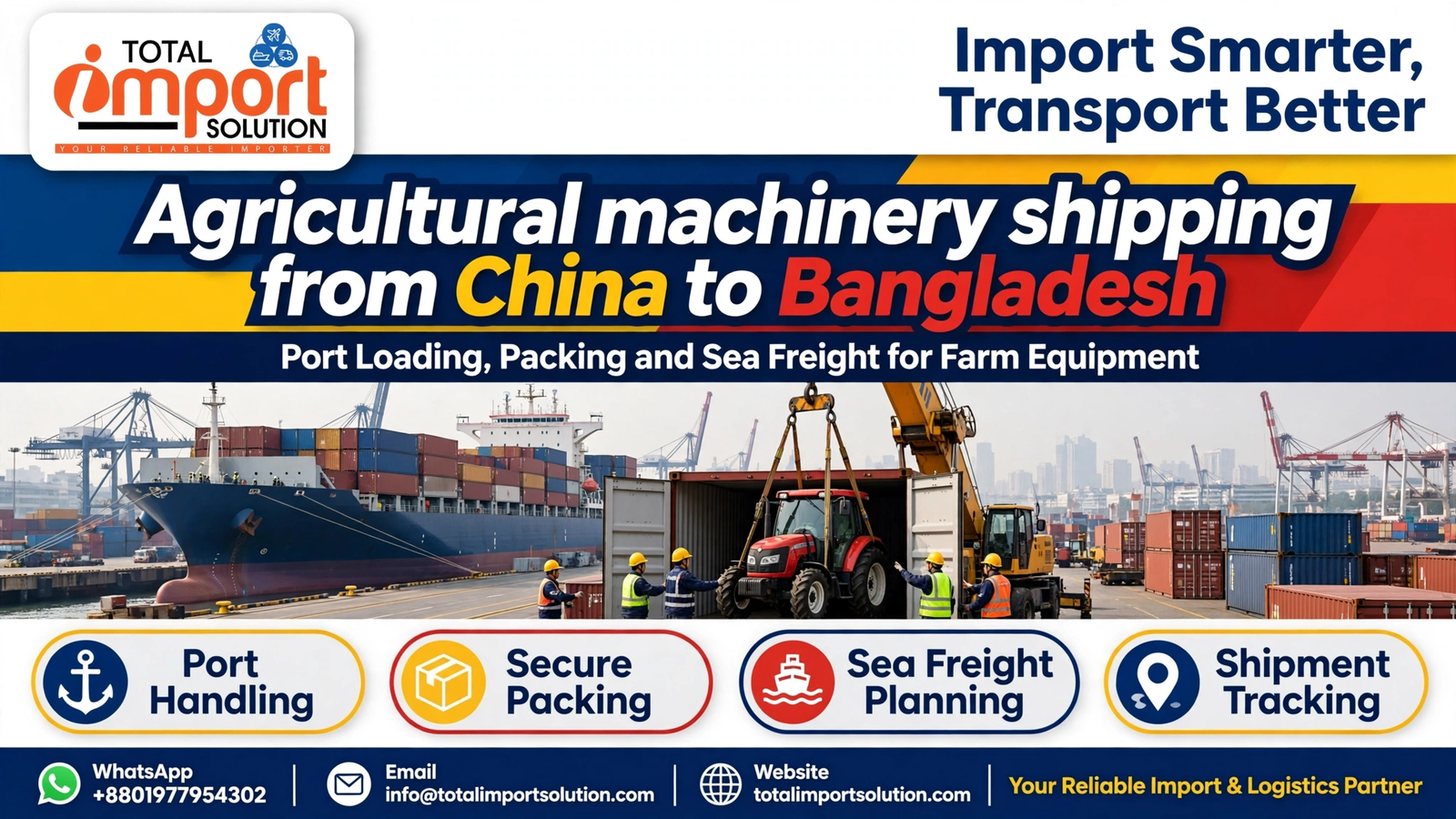
Most agricultural machinery from China to Bangladesh travels by sea. The choice of sea freight method depends on the size of the machine, the number of machines in the shipment, and the loading plan. A single small machine can travel in a container. A large machine, or a shipment of several machines, may need a different arrangement. The right choice is the one that fits the machine safely, not the one that looks simplest on paper.
A container gives the machine protection from rain and sea spray, and it keeps the machine and its parts together. The container should be clean, dry and free from damage before loading. The door should close fully after loading, and the seal should be recorded. The container number and the seal number go on the shipping documents, and the buyer should keep a note of both numbers. If the container is opened at any point, the seal number will show that it was opened, and the buyer should be told.
8. Customs Clearance in Bangladesh Step by Step
Customs clearance in Bangladesh is a step-by-step process, and it works best when the documents are ready before the vessel arrives. The first step is to send the scanned documents to the C and F agent, so the agent can check them and prepare the customs declaration. The agent checks the invoice, the packing list, the bill of lading, the certificate of origin and the import registration papers, and asks for any missing paper before the vessel reaches the port.
The third step is the payment of the applicable duties and charges as assessed by customs, and the completion of any other formalities that apply to the machine. A rate or fee is confirmed only after checking the actual shipment and documents, so no figure is quoted here. Ask the agent for a written statement of the assessed amount before payment, and keep the payment receipts in the shipment file. The statement should show each item separately, so the buyer can see what was paid and why. The fourth step is the release of the cargo. After the assessment and the formalities are complete, customs releases the machine for delivery. Check the release paper, the container number and the seal number, and confirm that the machine described on the release paper matches the machine that was ordered, before arranging road transport.
Step by step, the customs order is:
- Send scanned documents to the agent before arrival.
- Agent checks the documents and prepares the declaration.
- Customs checks the documents and may inspect the machine.
- Assessment is completed and the statement is given in writing.
- Applicable duties and charges are paid as assessed, with receipts kept.
- Release paper is issued and checked against the machine details.
- Port handling and road transport are arranged.
9. Delivery from the Port to the Farm, Showroom or Project Site
Delivery is the last part of the journey, and it needs the same care as loading. The road from the port to the farm or showroom may be narrow, a bridge may have a weight limit, and the final site may have soft ground after rain. The transport plan should be made before the machine is released, so that a suitable truck or trailer is ready at the port. Tell the transport team the exact delivery address, the condition of the road, and any turning or parking limit at the site.
Before the machine leaves the port, check it in the presence of the transport team. Look at the body, the glass, the tyres, the lights and the parts that were removed for shipping. Check the serial number and the engine number against the order and the inspection report. If there is damage, note it in writing and take photos before the machine is moved. A damage note made at the port is clear evidence. A damage note made after delivery is harder to prove.
| Delivery step | Action | Check |
|---|---|---|
| Plan the route | Confirm address, road and site access | Truck and trailer suit the road |
| Check at the port | Inspect body, glass, tyres, serial number | Damage noted in writing with photos |
| Load for the road | Lash the machine firmly | Straps, chains and chocks checked |
| Unload at the site | Firm, level ground, space to turn | Safe unloading area |
| Handover | Checklist of machine, parts, manuals, keys | Every item ticked off and signed |
10. Common Problems and How to Prevent Them
Most problems in agricultural machinery shipping can be prevented by a check made earlier in the process. The first common problem is a document mismatch: the serial number on the invoice does not match the serial number on the machine, or the consignee name is spelled differently on two documents. The prevention is a word-by-word check of every document against the machine and against the other documents, before the machine is loaded and again before the vessel arrives.
The second common problem is damage during loading or at sea. A machine that is not lashed firmly can move, and a moving machine can damage itself and the container. The prevention is a proper lashing plan, strong straps and chocks, and photos of the loading from all sides. The third common problem is a missing part. A mirror, a filter, a belt or a tool kit that was removed for packing can be left behind if it is not listed. The prevention is a packing list that names every part, a label on every removed part, and a box for small parts that is listed on the packing list. At delivery, the same list is used to check that every part has arrived.
11. Spare Parts, Manuals and After-Delivery Checks
A farm machine is only useful if it can be maintained, and maintenance starts with spare parts and manuals. Order the spare parts that wear out first, such as filters, belts and blades, together with the machine, so that they arrive in the same shipment. Pack them in labelled boxes, and list the boxes on the packing list. A spare part that is ordered later takes extra time and extra shipping, so ordering the common spares with the machine saves time in the first season.
After delivery, check the machine before it is put to work. Check the engine oil, the hydraulic oil, the coolant and the fuel. Check the tyres, the brakes, the lights and the steering. Refit every part that was removed for shipping, and check that every bolt is tight. Run the engine, test the gears and the hydraulics, and listen for any unusual noise. If the machine was dismantled for shipping, reassembly should follow the supplier instructions, and the settings recorded before dismantling should be restored. Keep a service record from the first day, with the date of delivery, the hours of use, the first service, and every part that is replaced.
Keep a service record from the first day, with the date of delivery, the hours of use, the first service, and every part that is replaced. A service record helps the operator to service the machine on time, and it helps a future buyer to see that the machine was looked after. A machine with a clear service record is easier to maintain than a machine with no record at all.
12. How to Judge a Good Import and Shipping Provider
A good provider is judged by how they work, not by how they describe themselves. Start with their process. A good provider can explain the full process in plain language: the document list, the packing plan, the shipping method, the customs steps and the delivery plan. If a provider cannot explain the process step by step, they may not have a clear process. Ask them to walk through a recent shipment of a similar machine, and listen for the detail: what documents were needed, how the machine was packed, what happened at customs, and how delivery was arranged.
Finally, look at their honesty about figures. A good provider does not quote a rate or fee without checking the actual shipment and documents. They ask for the machine details, the weight, the dimensions, the port of loading and the port of arrival before they give a confirmed figure. They explain what is included and what is not included. They do not make promises about the outcome of customs, because customs is decided by the customs authority on the basis of the documents and the cargo. A provider who is honest about what they can control, and clear about what they cannot control, is a provider the buyer can trust. Since 2016, Total Import Solution has worked to this standard with importers.
13. A Complete Checklist Before You Confirm Your Shipment
Use this checklist before you confirm any agricultural machinery shipment from China to Bangladesh. Go through it in order, and do not confirm the shipment until every item is ticked. The checklist is a summary of this guide, and it is meant to be used with the shipment file, not instead of it. Print it, keep it with the file, and ask the supplier and the agent to confirm each item in writing.
First, the machine: the type, make, model, year of manufacture, serial number and engine number are written in the order, and the condition is confirmed by an inspection report with photos and video. Second, the supplier: the business licence and address are checked, and the order terms, including what is included and what is not included, are written down. Third, the documents: the invoice, packing list, bill of lading, certificate of origin and import registration papers are prepared, and every name and number is checked word by word.
| Checklist area | Items to tick | Confirmed |
|---|---|---|
| Machine | Type, model, serial number, engine number, condition | Yes or no |
| Supplier | Licence, address, order terms in writing | Yes or no |
| Documents | Invoice, packing list, bill of lading, origin, registration | Yes or no |
| Packing and loading | Cleaning, protection, labelling, lashing, photos | Yes or no |
| Shipping | Freight method, vessel, sailing and arrival dates, tracking | Yes or no |
| Customs | Agent has scans, steps understood, statement in writing | Yes or no |
| Delivery | Transport planned, site checked, handover checklist ready | Yes or no |
| After delivery | Spares, manuals, reassembly, first service planned | Yes or no |
Frequently Asked Questions
1. What is agricultural machinery shipping from China to Bangladesh?
It is the full process of bringing a farm machine from a supplier in China to a buyer in Bangladesh.
2. Which farm machines can be shipped from China to Bangladesh?
Tractors, power tillers, combine harvesters, rice transplanters, threshers, water pumps, rotavators, ploughs, sprayers, seeders and grain dryers are commonly shipped. The packing and loading plan depends on the size and shape of each machine.
3. How do I choose the right tractor size for my land?
Start with the work the tractor will do, the size of your plots and the soil condition.
4. Should I inspect a used machine before shipment?
Yes. Arrange an independent inspection before packing. The inspector should check the engine, gearbox, hydraulics, tyres, brakes, lights and body, and send a written report with photos and video to the buyer.
5. What documents do I need for the shipment?
The core documents are the commercial invoice, the packing list, the bill of lading, the certificate of origin and the import registration papers.
6. Why must the serial number and engine number match on every document?
Customs and the delivery check use these numbers to confirm that the machine that arrives is the machine that was ordered. A difference in a number or a name can cause a delay, so check every document word by word.
7. How should a tractor be packed for sea freight?
Clean the machine, protect the glass and lights, cap the exhaust and air intake, remove and label detachable parts, pack small parts in labelled boxes, and lash the machine firmly with straps, chains and chocks.
8. Can a large harvester travel in a container?
It depends on the size and shape of the machine. A machine that fits safely can travel in a container. A wider or taller machine may need a flat rack or break bulk loading, with a careful lashing plan and a cover for sensitive parts.
9. What is a bill of lading?
It is the transport document issued by the shipping line.
10. How does customs clearance work in Bangladesh?
Send the scanned documents to your agent before the vessel arrives. The agent prepares the declaration, customs checks the documents and may inspect the machine, the assessment is completed, the applicable duties and charges are paid as assessed, and the cargo is released for delivery.
11. How is the duty or fee for my shipment confirmed?
A rate or fee is confirmed only after checking the actual shipment and documents.
12. What should I check at the port before delivery?
Check the body, glass, tyres, lights and serial number against the order and the inspection report. Note any damage in writing and take photos before the machine is moved. Check the release paper, container number and seal number as well.
13. How is the machine delivered from the port to my farm?
Road transport is planned before the machine is released.
14. What spare parts should I order with the machine?
Order the parts that wear out first, such as filters, belts and blades, together with the machine. Pack them in labelled boxes and list them on the packing list, so they arrive with the machine and are ready for the first season.
15. What should I do after the machine is delivered?
Check the oils, coolant, fuel, tyres, brakes, lights and steering.
16. How do I judge a good import and shipping provider?
Judge them by their process, communication, paperwork and honesty about figures. A good provider explains every step in plain language, updates you in writing, keeps a complete shipment file, and confirms a rate or fee only after checking the actual shipment and documents.
Contact Total Import Solution
Since 2016, Total Import Solution has served importers. For help with agricultural machinery shipping from China to Bangladesh, including planning, documents, packing, customs support and delivery, contact the team with your machine details and your delivery address.
- WhatsApp: +8801977954302
- Email: info@totalimportsolution.com
- Website: totalimportsolution.com
- Company: Total Import Solution — Your Reliable Import and Logistics Partner
