
1688 Alibaba shipping agent Dhaka
Many buyers in Dhaka order goods from 1688 and Alibaba every week. These two online platforms connect buyers with thousands of suppliers in China, and they are a popular source for shop owners, wholesalers, online sellers, and small businesses in Bangladesh. The order itself is only the first step: after it is placed, the goods still have to be collected from the supplier, checked, packed, shipped to Bangladesh, cleared through customs, and delivered to the buyer in Dhaka.
A 1688 Alibaba shipping agent in Dhaka handles the middle part of that journey. The agent receives your parcels at a warehouse in China, checks them against your order, combines them into one shipment when you have bought from several suppliers, prepares the packing and the labels, arranges the transport to Bangladesh, supports the customs clearance, and delivers the goods to you in Dhaka.
This guide explains what a shipping agent does, how an order moves from a supplier in China to a buyer in Dhaka, how to choose an agent, the documents you need, how consolidation, packing, customs clearance and delivery work, the common problems buyers face, and the questions to ask about charges before you ship. No fixed prices, rates, duty percentages, fees, or transit times are given here, because a rate or fee is confirmed only after checking the actual shipment and its documents.
Total Import Solution, an importer and logistics partner based in Bangladesh Since 2016, supports importers and online buyers in Bangladesh, helping with 1688 and Alibaba orders from the supplier’s warehouse in China through to delivery in Dhaka.
1. What Is a 1688 Alibaba Shipping Agent in Dhaka?
A shipping agent is a service provider that manages the shipping part of an online order. When you buy from 1688 or Alibaba, the supplier usually delivers the goods only to an address inside China. The supplier does not arrange international shipping to Bangladesh, and the platform itself does not deliver the goods to your shop in Dhaka. Someone has to receive the parcels in China, bring them together, and send them onward. That is the agent’s job.
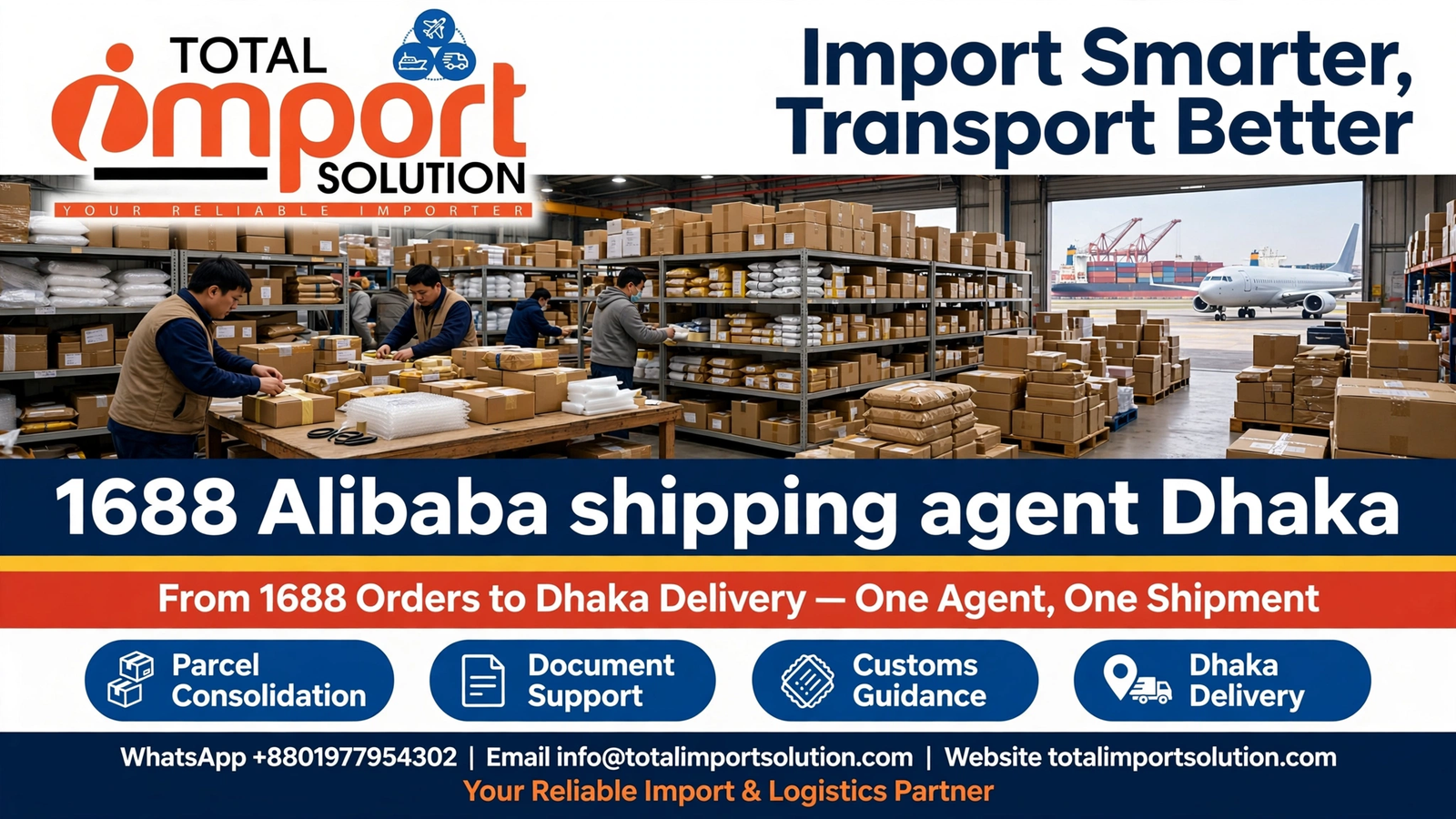
The agent gives you a warehouse address in China to use as the delivery address when you place your order. When the supplier sends the parcel, it arrives at the agent’s warehouse. The agent signs for it, records it against your name or order number, and stores it until the rest of your orders arrive.
A shipping agent is different from a supplier: the agent does not sell the goods or set the product price, and the work starts after you have chosen the product and agreed the price. A Dhaka-based agent is useful because you can speak with the agent in your own language, visit the Dhaka office or warehouse, and collect your goods locally when they arrive. For many small buyers, the agent is the only practical way to order from 1688 and Alibaba, because without one a buyer would need a delivery address in China, a way to combine the parcels, and a way to clear customs in Bangladesh.
2. How 1688 and Alibaba Orders Reach Dhaka
An order from 1688 or Alibaba reaches Dhaka in stages, and a problem at any stage can hold up the whole order. Understanding the stages helps you follow your shipment and ask the right questions when something is unclear.
The first stage is the order itself. You find the product on the platform, check the supplier’s details, agree on the quantity, the colour or model, and the price, and you pay for the goods. Keep the payment record, the order number, and the supplier’s name for every order you place.
The second stage is delivery inside China. The supplier packs the goods and sends them to the agent’s warehouse address, tracked with a tracking number that the agent uses to match the parcel to your order.
The third stage is receiving and checking at the warehouse. The agent records the parcel, checks the quantity against your order, and notes any visible damage to the outer packing. If the parcel does not match the order, this is the stage where the problem is found, while the goods are still in China and the supplier can still be contacted.
The fourth stage is consolidation and packing. Parcels from several suppliers are combined into one shipment, re-packed for international transport, labelled for Dhaka, and weighed and measured so the shipping charge can be worked out from the actual shipment.
The fifth stage is transport to Bangladesh, by sea or by air, depending on the size, the weight, and the buyer’s need. The agent arranges this leg and keeps the shipping documents in order.
The sixth stage is customs clearance in Bangladesh. The shipment arrives at the port or the airport, the import documents are filed, customs assesses the duty and tax, the assessed amount is paid, and the cargo is released.
| Stage | What happens | Who handles it |
|---|---|---|
| Order | Buyer chooses and pays | Buyer and supplier |
| China delivery | Supplier sends parcel to warehouse | Supplier |
| Warehouse check | Parcel received and checked | Shipping agent |
| Consolidation | Parcels combined, packed, labelled | Shipping agent |
| Transport | Shipment travels to Bangladesh | Shipping agent |
| Customs clearance | Documents filed, amount paid | Agent with the buyer |
| Dhaka delivery | Goods handed to the buyer | Shipping agent |
3. What a Shipping Agent Does for You
A shipping agent’s work covers the whole journey after the order is placed. The table below lists the main services, so you can compare agents by the work they actually do.
| Service | What it covers |
|---|---|
| China warehouse address | Delivery address in China for your orders |
| Parcel receiving | Receiving, recording and storing parcels |
| Quantity checking | Counting goods against your order |
| Consolidation | Combining parcels into one shipment |
| Re-packing | Re-packing for international transport |
| Labelling | Labelling parcels for Dhaka |
| Weighing and measuring | Recording weight and size for the charge |
| Export documents | Papers needed to send goods out of China |
| Transport booking | Booking the sea or air leg to Bangladesh |
| Import documents | Papers needed for customs clearance |
| Customs support | Filing, assessment and release support |
| Dhaka delivery | Delivery to the Dhaka warehouse or your shop |
Not every agent offers every service in this list. Before you start, ask the agent which of these services are included, how the agent records your parcels, and how you can check what has arrived at the warehouse.
Total Import Solution, serving buyers Since 2016, has worked with importers and online buyers in Bangladesh, and the services above describe the kind of end-to-end support a Dhaka buyer should expect from a shipping agent for 1688 and Alibaba orders.
4. Who Needs a Shipping Agent in Dhaka?
A shipping agent is useful for many kinds of buyers in Dhaka. The need is not limited to large importers. Small buyers often need an agent more, because they order in small quantities from several suppliers and cannot manage the shipping chain on their own.
Shop owners in Dhaka order stock from 1688 and Alibaba for their shops in markets such as New Market, Gulistan, Elephant Road, and Islampur. A shop owner may order clothes, shoes, bags, phone accessories, or home goods from five or six suppliers in one week. The agent collects those parcels in China, combines them into one shipment, and delivers them to the shop.
Online sellers need an agent because they order in small batches and sell through Facebook pages, websites, and marketplaces. An online seller cannot keep a warehouse in China, and cannot visit the port for every small order. The agent handles the warehouse work in China and the delivery work in Dhaka, so the seller can focus on taking orders and serving customers.
Small businesses and new importers use an agent for their first orders. A first-time buyer often does not know which documents are needed, how the parcels should be labelled, or how customs clearance works. The agent explains each step, checks the documents, and helps the buyer avoid the mistakes that first-time importers often make.
5. How to Choose a Shipping Agent
Choosing a shipping agent is a decision that affects every order you place. A good agent saves you time and trouble. A poor agent can lose parcels, delay your stock, or leave you with unclear charges. The checks below help you judge an agent before you trust the agent with your goods.
First, check how long the agent has been working with China imports. An agent with years of experience will have a settled warehouse process, settled document routines, and settled delivery routines in Dhaka. Ask how many years the agent has handled 1688 and Alibaba orders, and whether the agent has a real office or warehouse in Dhaka that you can visit.
Second, check the warehouse process in China. Ask for the warehouse address, ask how parcels are recorded when they arrive, and ask how you can see the record of your parcels.
Third, check the Dhaka side. Ask where the Dhaka warehouse is, how the goods are handed over, and what you need to bring when you collect your goods. Visit the Dhaka office or warehouse before your first big order, if you can.
Fourth, check how the agent handles problems. Ask what happens if a parcel arrives damaged, if the quantity is wrong, or if the supplier sends the wrong product. Ask who contacts the supplier and what proof the agent gives you.
Fifth, check the charges in writing. Ask for the full list of charges that apply to your kind of shipment, and ask which charges are worked out from the actual shipment and which are fixed. A rate or fee is confirmed only after checking the actual shipment and its documents, so be careful with any agent who quotes a firm figure for a shipment the agent has not seen.
Sixth, check how the agent describes its own standing. Some agents use words like verified partner or official agent. Do not take such words at face value. Ask the agent to show what the claim is based on, and check it yourself where you can. Total Import Solution does not claim to be an official Alibaba or 1688 partner, and does not claim to be verified by them. Ask for the basis of any such claim and check it before relying on it.
| Check | What to ask | Good sign |
|---|---|---|
| Experience | How long have you handled 1688 and Alibaba orders? | Clear answer |
| Warehouse | How are parcels recorded on arrival? | A record you can check |
| Dhaka office | Where do I collect my goods? | A real address |
| Problem handling | What happens if a parcel is wrong or damaged? | A clear process |
| Charges | What are the full charges for my shipment? | A written list |
| Standing | What is your standing with the platforms? | Evidence you can check |
6. Step-by-Step: Placing Your First Order Through an Agent
A first order through a shipping agent follows a clear sequence. Following the sequence in order keeps the work simple and avoids the mistakes that come from skipping a step.
Step 1: Talk to the agent before you order. Share the kind of goods you plan to buy, the number of suppliers, and the rough size of the order. Ask for the warehouse address in China and the agent’s instructions for marking your parcels.
Step 2: Place your order on 1688 or Alibaba. Use the agent’s warehouse address as the delivery address. Check the product details, the quantity, the colour or model, and the supplier’s name before you pay. Save the order number, the payment record, and the supplier’s name for every order.
Step 3: Send the order details to the agent and wait for the parcels to arrive at the warehouse. Share the order number, the supplier’s name, and the tracking number, so the agent can match each parcel to your order. If you ordered from several suppliers, tell the agent which parcels to ship together.
Step 4: Ask the agent to check the parcels. The agent counts the goods and matches them with your order. If you want photos, ask for them before the goods are packed. Check the photos and the count, and tell the agent if anything is wrong.
Step 5: Follow the transport and the clearance. The agent gives you updates as the shipment moves, and when it reaches Bangladesh, the agent supports the clearance while you pay the assessed duty and tax through the proper channel.
Step 6: Collect or receive your goods in Dhaka. Bring the reference the agent asks for, check the parcels at handover, count the cartons, and note any damage on the spot. Keep the delivery record with your order papers.
7. Consolidation: Combining Many Parcels into One Shipment
Consolidation is one of the main reasons buyers use a shipping agent. Most buyers on 1688 and Alibaba order from several suppliers at once, and each supplier sends a separate parcel. Sending each parcel to Dhaka separately would mean many small shipments, many sets of documents, and many deliveries. Consolidation brings the parcels together into one shipment.
The process starts at the warehouse in China. Each parcel arrives separately and is recorded under the buyer’s name, then stored on shelves marked with the buyer’s name or order number, so parcels from different buyers are not mixed. When the buyer says the order is complete, the agent takes the parcels out of storage for packing.
The agent then checks the parcels together, counting each product again and sorting the goods by the buyer’s order list. If two suppliers sent the same kind of product, the agent keeps them separate by supplier and by order.
Buyers should tell the agent clearly which parcels belong together. If you want some parcels shipped now and others held for the next shipment, say so in writing, with the order numbers. If you want all parcels held until the last one arrives, say that too. A written instruction avoids the mistake of shipping a parcel too early or holding a parcel too long.
8. Packing and Labelling for Dhaka
Packing and labelling decide whether your goods arrive in Dhaka in good condition and whether the Dhaka team can sort them without confusion. Good packing protects the goods. Good labelling protects the order.
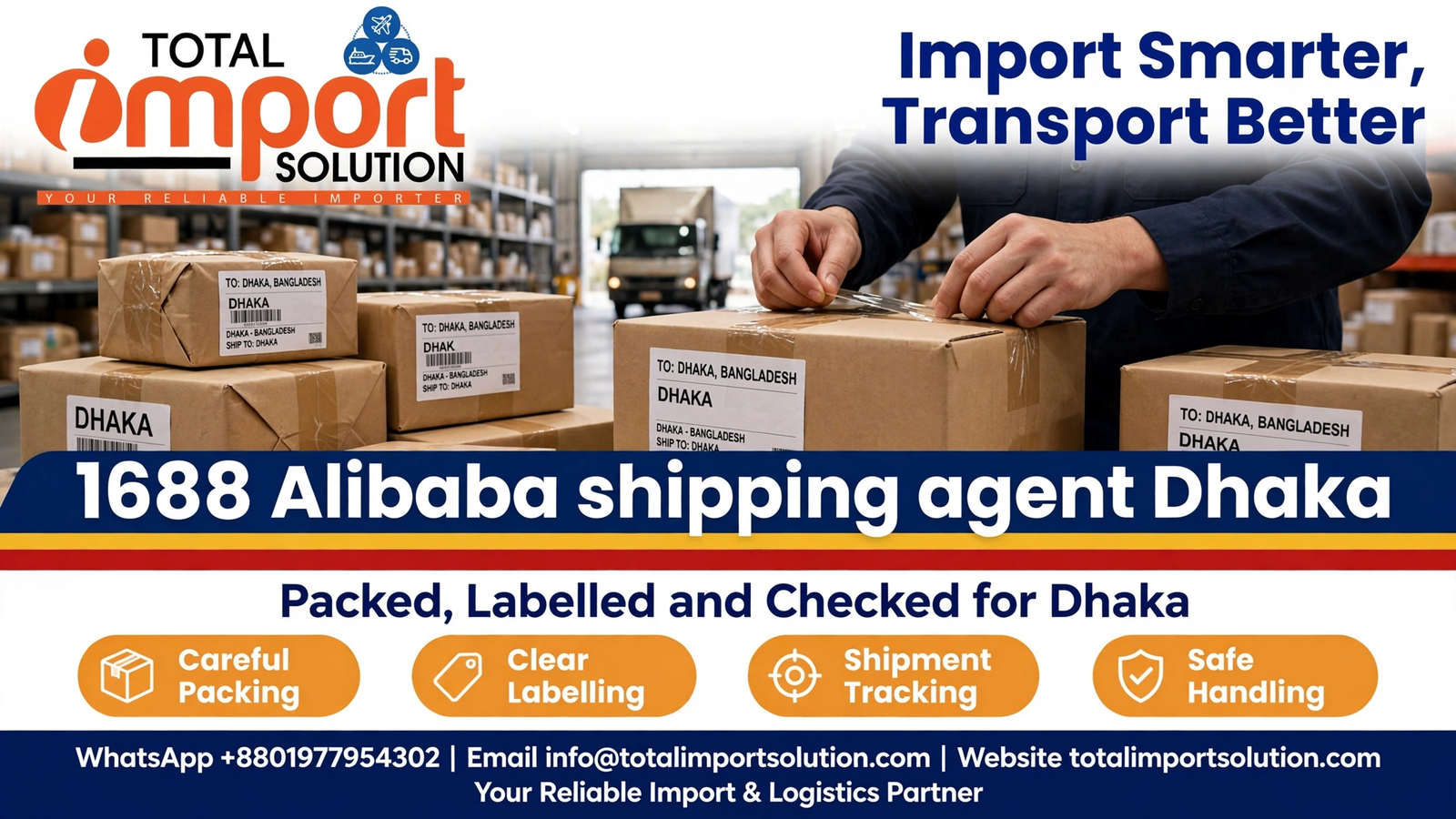
Packing for international transport is different from the packing the supplier uses for delivery inside China. The supplier’s packing is made for a short trip to a warehouse in the same country. International packing must survive loading, transport by sea or air, unloading at the port or airport, customs checking, and the road trip to Dhaka. Cartons must be strong, tape must hold, and fragile goods must have protective material inside the carton.
Labelling is just as important. Each carton should carry a label with the buyer’s name, the destination Dhaka, the carton number, and the total number of cartons, for example carton 2 of 5, so the Dhaka team can count the cartons on arrival and find a missing carton at once.
Inside the shipment, the agent should keep a packing list that names the goods in each carton. When the goods reach Dhaka, the buyer or the Dhaka team can open a carton and check its contents against the list, instead of opening every carton to find one product.
| Packing step | What is checked | Why it matters |
|---|---|---|
| Carton choice | Strength and size | Stops bursting or collapsing |
| Fragile wrapping | Protection around fragile goods | Stops breakage |
| Weight balance | Heavy items below | Stops crushing |
| Sealing | Tape all edges | Stops cartons opening |
| Labelling | Name, Dhaka, carton number | Lets the team count and sort |
| Packing list | Goods per carton | Fast contents check |
9. Documents You Need for Import
Every shipment from China to Bangladesh needs documents. They prove what the goods are, where they came from, what they are worth, and who is importing them. Customs uses them to assess the shipment, and the agent uses them to file the clearance. Missing or wrong documents are the most common cause of delay at the port.
The buyer should prepare the basic import documents before the goods leave China. The agent can explain which documents apply to your shipment, because the list depends on the kind of goods and the way they are shipped.
| Document | What it shows | Who provides it |
|---|---|---|
| Commercial invoice | Goods, quantity and agreed price | Supplier |
| Packing list | Contents of each carton, total weight | Agent or supplier |
| Bill of lading or air waybill | Transport contract and shipment details | Transport carrier |
| Certificate of origin | Country of origin, where required | Supplier or issuing body |
| Import registration | Import registration, where required | Buyer |
| Product certificates | Test reports or certificates | Supplier or testing body |
| Payment record | Proof of payment to the supplier | Buyer |
| Order records | Order numbers and supplier details | Buyer |
Keep a copy of every document. Keep the invoice and the packing list together with the order records, because the three must match. If the invoice says one quantity and the packing list says another, customs will ask questions, and the clearance will stop until the mismatch is explained.
Some goods need extra certificates or permissions before they can be imported. Electronics, food items, medicines, and chemicals are examples of goods that often need extra papers. Ask the agent before you order whether your goods need any certificate, and ask the supplier to provide it.
Total Import Solution, serving buyers Since 2016, has helped buyers prepare and check import documents for China shipments, and the document list above is the starting point for any 1688 or Alibaba order sent to Dhaka.
10. Customs Clearance in Bangladesh — How It Works
Customs clearance is the process by which imported goods are checked, assessed, and released at the port or the airport in Bangladesh. Every shipment from China must pass through it before delivery in Dhaka.
When the shipment arrives in Bangladesh, the agent files the import declaration with customs, listing the goods, their classification code, their quantity, and their value, supported by the invoice, the packing list, and the transport document. Customs checks the declaration against the documents and the goods themselves.
Customs then assesses the shipment. Assessment means working out the duty and tax that apply to the goods, from the classification of the goods, the declared value, and the rules in force at the time of import. No fixed duty percentage can be given in a guide, because the assessment depends on the actual goods and the actual documents. A rate or fee is confirmed only after checking the actual shipment and its documents.
After assessment, the importer pays the assessed amount through the proper channel and keeps the payment receipt. The cargo is then released, and the agent collects it and brings it to Dhaka. Keep the release papers and the receipt with the order records.
Delays in clearance usually come from documents: a missing invoice, a packing list that does not match the goods, a wrong classification, or a value that does not match the payment record. Prepare the documents carefully before the goods leave China, and answer any question from customs with the correct paper at once. Customs may also open and check the cartons, which is a normal part of the process.
| Clearance step | What happens | What the buyer provides |
|---|---|---|
| Arrival | Shipment reaches port or airport | Nothing at this stage |
| Filing | Declaration filed with customs | Invoice, packing list, transport document |
| Checking | Customs checks declaration and goods | Extra papers if asked |
| Assessment | Duty and tax worked out | Assessed amount paid |
| Payment | Paid through the proper channel | Receipt kept on record |
| Release | Cargo released to the agent | Papers kept with the order |
| Dhaka transport | Goods brought to Dhaka warehouse | Collection reference |
11. Delivery in Dhaka: Warehouse Pickup and Shop Delivery
Delivery in Dhaka is the last stage of the order. After the cargo is released, the agent brings it to the Dhaka warehouse, and from there the goods reach the buyer by pickup or by delivery to the buyer’s address.
Warehouse pickup is the usual method. The agent tells the buyer that the goods have arrived at the Dhaka warehouse and gives a collection reference. The buyer visits the warehouse, shows the reference, and collects the cartons. At handover, count the cartons, check the labels, and open any carton that looks damaged. Note any damage or missing carton on the delivery record at once, while still at the warehouse.
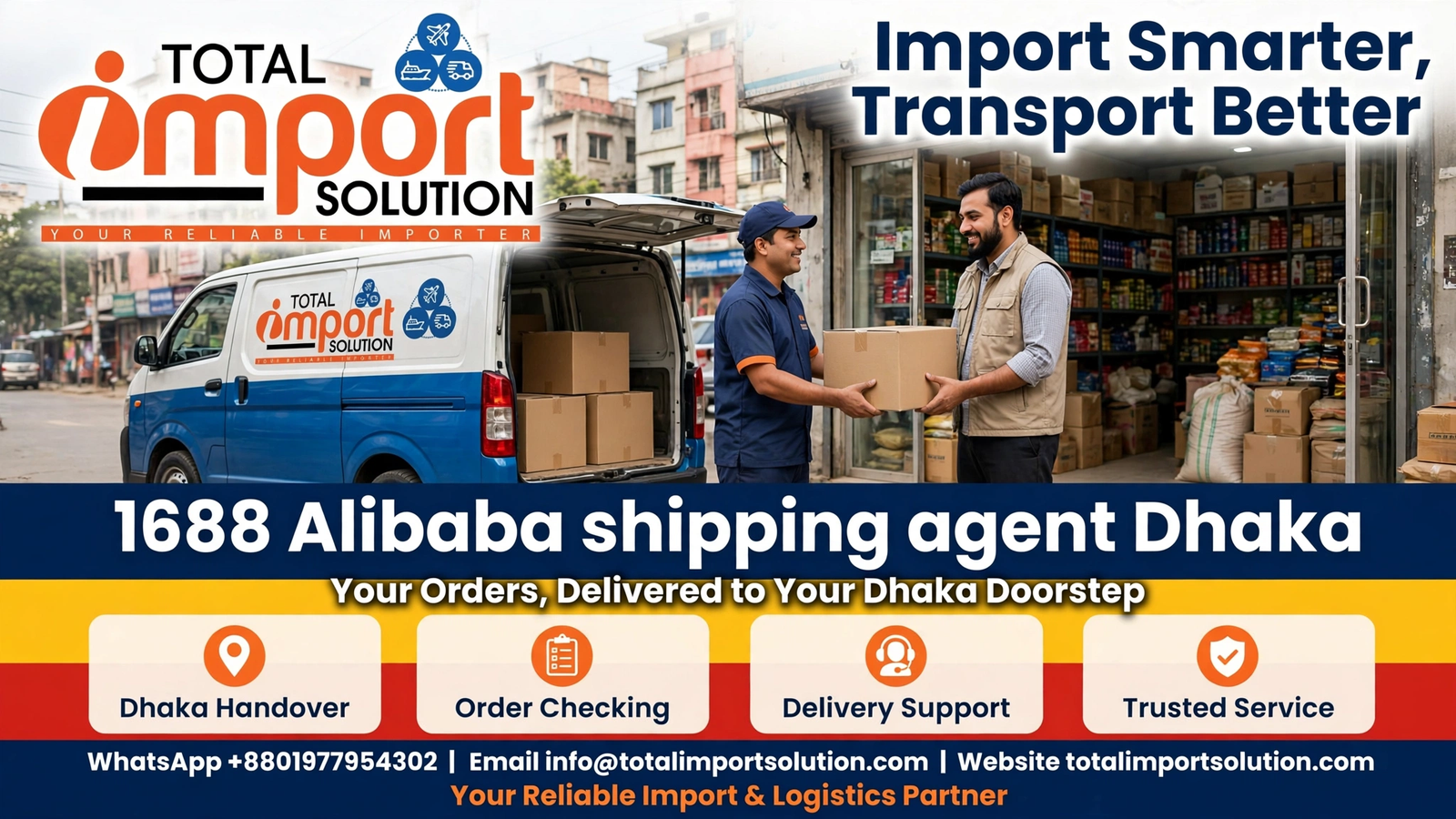
Shop delivery is offered for buyers who cannot visit the warehouse. The agent loads the cartons onto a delivery vehicle and brings them to the buyer’s shop or business address in Dhaka. The buyer should be present at delivery, count the cartons, and check the labels before signing the delivery record. Signing the record means the buyer has received the goods as listed, so the check should happen before the signature, not after.
Keep the delivery record with your order papers. It names the cartons received, the date of handover, and any damage noted at the time.
12. Common Problems and How to Avoid Them
Most problems with 1688 and Alibaba orders can be avoided with care at the start.
| Problem | Why it happens | How to avoid it |
|---|---|---|
| Wrong product received | Wrong model or colour sent | Check the order and ask for a photo first |
| Short quantity | Fewer pieces packed than ordered | Ask the agent to count the goods |
| Damaged goods | Weak packing or rough handling | Ask for strong packing |
| Mixed parcels | Parcels from different buyers mixed | Name and order number on every parcel |
| Missing documents | Invoice or packing list not ready | Prepare documents before shipping |
| Mismatched papers | Invoice and packing list differ | Check all documents match first |
| Clearance delay | Papers do not match the goods | Keep declaration, invoice and goods in agreement |
| Wrong carton count | Cartons not labelled or counted | Label and count each carton |
| Extra charges | Charges not explained first | Ask for the full list in writing |
| Damage found late | Buyer signed the delivery record without checking | Check the cartons before signing at handover |
When a problem does appear, act at once. Tell the agent in writing, share the photos and the order number, and keep a copy of every message. A problem reported on the day it is found is much easier to solve than a problem reported a week later.
Do not accept a damaged carton without noting the damage, sign a delivery record that lists more cartons than you received, or pay a charge that was never explained to you without asking for its basis in writing.
13. Costs and Charges — What to Ask Before You Ship
The cost of using a shipping agent is made up of several parts, each worked out from the actual shipment — its weight, size, kind of goods, transport route, and documents. A rate or fee is confirmed only after checking the actual shipment and its documents.
The table below lists the parts of the charge and what each one depends on, so you know which questions to ask before you ship.
| Charge part | What it depends on | What to ask |
|---|---|---|
| China warehouse handling | Parcels and checking work | What is included? |
| Consolidation and packing | Cartons and packing material | How is packing charged? |
| International transport | Weight, size and route | How is transport charged? |
| Import documents | Papers needed for your goods | Which document charges apply? |
| Customs assessment | Classification and declared value | How is it worked out? |
| Dhaka delivery | Address and carton count | Delivery charge to my address? |
| Storage | Time goods stay at a warehouse | Storage charge, and from when? |
Ask for the full list in writing before the goods leave China. Ask which parts are charged by the agent and which parts are paid to customs or to the transport provider. Ask when each part is paid, and ask for a receipt for every payment. Keep the receipts with your order records.
Finally, compare agents by the full list of charges, not by one number. An agent who quotes a small transport figure but leaves out the handling, the packing, and the delivery may cost more in total than an agent who lists every part at the start.
Frequently Asked Questions
1. What does a 1688 Alibaba shipping agent in Dhaka do?
A shipping agent receives your parcels at a warehouse in China, checks them against your order, combines parcels from several suppliers into one shipment, packs and labels the goods, arranges transport to Bangladesh, supports the customs clearance, and delivers the goods to you in Dhaka.
2. Do I need an agent to order from 1688 or Alibaba?
You can order without an agent, but the supplier usually delivers only to an address inside China. An agent gives you that address and handles the warehouse work, the documents, and the delivery in Dhaka, which most buyers in Bangladesh cannot manage on their own.
3. How do I send my order to the agent’s warehouse in China?
The agent gives you a warehouse address in China. Use it as the delivery address when you place your order, and share the order number, supplier name, and tracking number with the agent so the parcel can be matched to your order.
4. Can the agent combine parcels from different suppliers?
Yes. This is called consolidation. The agent receives the separate parcels at the warehouse, records each one under your name, and packs them together into one shipment for Dhaka.
5. How does the agent check my goods?
The agent counts the goods when the parcel arrives and matches the count with your order. On request, the agent can take photos so you can see what arrived before the goods are packed.
6. What documents do I need for a 1688 or Alibaba shipment?
The usual documents are the commercial invoice, the packing list, the bill of lading or air waybill, and your import registration where required. Some goods need extra certificates, and the agent can explain which apply to your shipment.
7. Who pays the customs duty and tax?
Duty and tax are assessed by customs at clearance, based on the classification, the declared value, and the rules in force at the time of import. The importer pays the assessed amount through the proper channel and keeps the receipt.
8. How is the shipping charge worked out?
The shipping charge is worked out from the actual shipment — its weight, size, kind of goods, and transport route. A rate or fee is confirmed only after checking the actual shipment and its documents.
9. Can I order small quantities through an agent?
Yes. Small buyers, online sellers, and shop owners often order small quantities from several suppliers. The agent combines the small parcels into one shipment, which is simpler than managing many separate deliveries.
10. How do I collect my goods in Dhaka?
The agent tells you when the goods have arrived at the Dhaka warehouse and gives you a collection reference. Visit the warehouse, show the reference, count the cartons, check the labels, and note any damage before signing.
11. What happens if the supplier sends the wrong product?
Tell the agent at once, in writing, with the order number and photos. The agent can show the warehouse photos and the order details to the supplier, and the outcome depends on the supplier and on the proof available.
12. What happens if a parcel arrives damaged at the warehouse?
The agent notes the damage when the parcel is received and tells you before the goods are packed. You can then decide, with the agent’s help, whether to contact the supplier or ask for a replacement.
13. Is Total Import Solution an official Alibaba or 1688 partner?
No. Total Import Solution does not claim to be an official Alibaba or 1688 partner and does not claim to be verified by them. Ask for the basis of any such claim and check it before relying on it.
14. How long do parcels stay at the China warehouse?
Parcels are stored at the warehouse until the buyer tells the agent which parcels to ship. Give the agent your shipping plan in writing, and ask how long goods can be held without a storage charge.
15. What should I check when my goods are delivered in Dhaka?
Count the cartons, check the labels against your order, and open any carton that looks damaged. Note any damage or missing carton on the delivery record at once, before you sign.
16. How do I start my first order with Total Import Solution?
Contact Total Import Solution with the details of the goods you plan to buy, the number of suppliers, and the rough size of the order. The team will give you the warehouse address in China, explain the documents you need, and guide you through the steps to delivery in Dhaka.
Contact Total Import Solution
- Service: 1688 Alibaba shipping agent Dhaka
- WhatsApp: +8801977954302
- Email: info@totalimportsolution.com
- Website: totalimportsolution.com
- Company: Total Import Solution, an importer and logistics partner based in Bangladesh.
