
Bulk shipment from China to Bangladesh service
Moving a large consignment from China to Bangladesh is a job that rewards careful planning. When cargo is bulky, heavy, or made up of a large number of cartons, pallets, sacks, crates, or loose items, every stage needs to be thought through before loading begins. A bulk shipment from China to Bangladesh service brings those stages together into one planned flow, from the first discussion about the cargo to the point where the goods are ready for onward movement in Bangladesh. Total Import Solution, serving importers in Bangladesh since 2016, works with importers who need that kind of steady, step-by-step support for large-volume cargo.
This article explains what a bulk shipment service covers, who it suits, how the work is organised, and what an importer should prepare before the cargo moves. It covers planning, loading, packing, paperwork, port handling, and communication, in plain language, so that an importer can follow the process and know what to ask at each stage. The aim is not to rush a large consignment, but to move it in an orderly way, with the cargo checked, the loading planned, the papers in order, and the importer kept informed as the work proceeds.
A bulk shipment is different from a small parcel or a single carton order. The volume is larger, the loading takes longer, the handling needs more care, and the consequences of a mistake are greater. A carton placed in the wrong position, a pallet left unsecured, a label that cannot be read, or a document that does not match the cargo can slow the whole consignment down. That is why a service built around bulk cargo puts so much weight on preparation. When the preparation is done well, the loading is smoother, the handling is safer, and the importer has a clear record of what was shipped and how it was packed.
1. What a bulk shipment from China to Bangladesh service covers
A bulk shipment service covers the movement of a large-volume consignment from a loading place in China to a delivery point in Bangladesh, with the stages in between handled as part of one service. The starting point is the cargo itself. Before anything is loaded, the importer and the service team discuss what the cargo is, how it is packed, how much space it takes up, and how it should be handled. That discussion shapes the loading plan, the packing advice, and the order in which items are placed.
The service then covers the practical work around loading. Cargo is received at the loading place, checked against the list provided by the importer, grouped by type or by destination, and prepared for loading. Workers place the cargo in a planned order, secure it where needed, and keep a record of how it was loaded. The aim is to use the available space sensibly while keeping the cargo stable and protected during movement. Loading a bulk consignment is not a matter of placing items wherever they fit. The order matters, the weight distribution matters, and the protection of fragile or sensitive items matters.
2. Who this service is for
This service is for importers in Bangladesh who bring in large volumes of goods from China and want the shipment handled in a planned and orderly way. It suits importers who order in bulk because their customers need a steady supply, and it suits importers who place large orders for a project, a season, or a stock build-up. It also suits importers who have ordered a mix of items that need to travel together and be received together in Bangladesh.
Traders and shop owners who stock a wide range of goods often use a bulk shipment service when a single order fills a large part of a container or a full container. Rather than splitting the order into many small parcels, they send it as one bulk consignment, with the cargo grouped and listed in a clear way. That makes receiving the goods simpler, because the importer can check the consignment against one list and one loading record.
Businesses that supply other businesses also use this service. A supplier who delivers goods to retailers, workshops, or project sites needs the cargo to arrive in good order and in the right quantities. A bulk shipment service helps by keeping the cargo grouped, labelled, and listed, so that the importer can hand the goods onward without first sorting out a confused load.
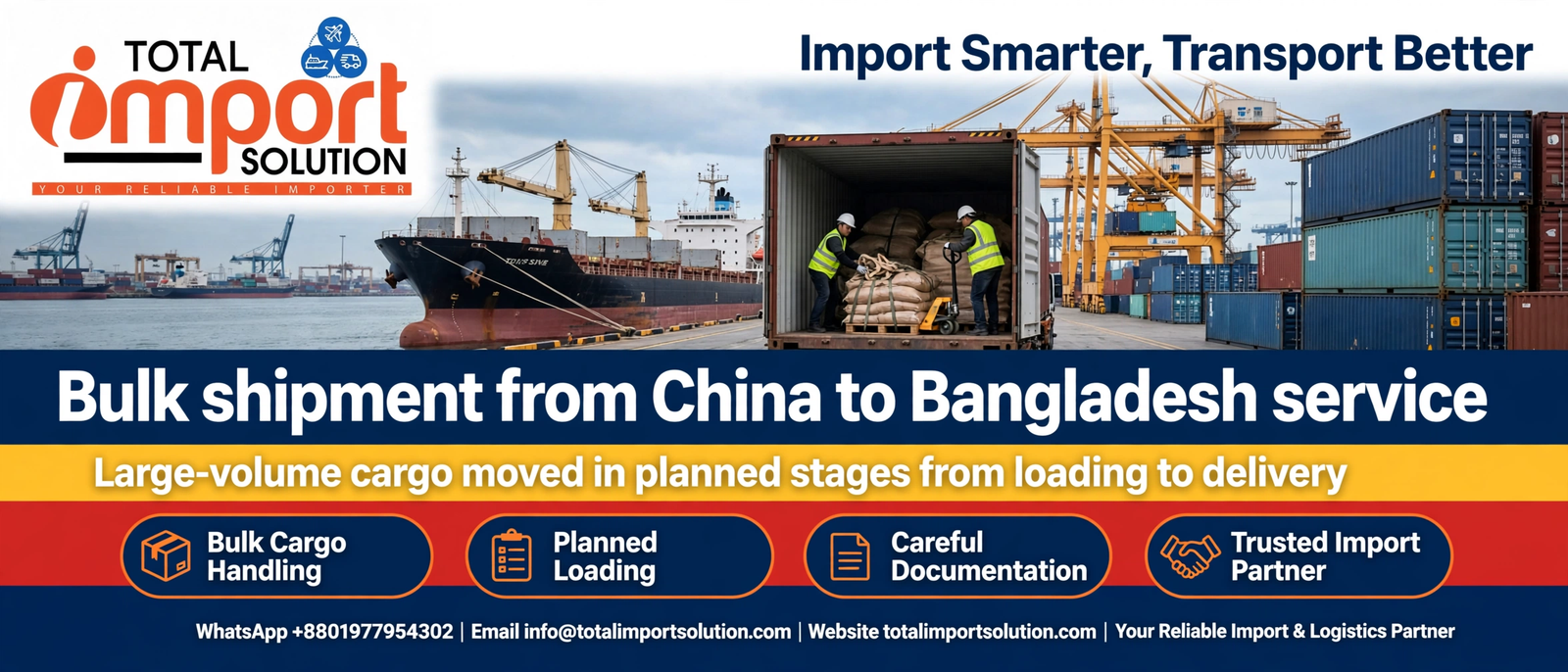
3. How the service works, step by step
The service begins with a discussion. The importer describes the cargo, the loading place in China, the destination in Bangladesh, and the date range in which the cargo should move. The service team asks about the type of goods, the packing, the number of cartons or pallets, and any handling needs, such as fragile items, heavy items, or items that need to stay dry. This first discussion is the foundation of the whole plan, because the loading plan, the packing advice, and the paperwork all depend on what the cargo actually is.
Once the cargo details are clear, the team prepares a plan for the consignment. The plan covers the order of loading, the grouping of the cargo, the protection needed for sensitive items, and the checks that will be carried out at the loading place. The importer is told what to prepare and what information is needed, so that nothing is left until the last moment. A plan prepared in advance is far easier to follow than a plan made on the day of loading, when the cargo is already waiting.
The next step is the preparation of the cargo at the loading place. The goods are received, counted, and checked against the list. Any damage to outer packing is noted. Cartons are grouped by type, pallets are prepared, and sacks and crates are placed where they can be loaded in the planned order. Labels and marks are checked so that each group can be identified during loading and again on arrival. This preparation stage is where many problems are caught early, while there is still time to fix them.
- Share the cargo details, loading place, destination, and date range.
- Agree the loading and handling plan.
- Receive, check, and group the cargo at the loading place.
- Load in the planned order and secure the cargo.
- Check the paperwork against the loaded cargo.
- Receive the cargo in Bangladesh and prepare onward movement.
4. Planning a bulk consignment before loading
Planning is the stage that decides how well the rest of the shipment goes. A bulk consignment has many parts, and those parts need to fit together. The cargo list, the packing, the loading order, and the papers all need to agree with each other. When the planning is done properly, the loading team knows what to expect, the importer knows what to prepare, and the receiving team in Bangladesh knows what is coming.
The first part of planning is the cargo list. The importer should prepare a list that describes each type of goods, the number of cartons, pallets, sacks, or crates, and the packing for each group. The list should be clear enough that a worker at the loading place can identify each group without guessing. A vague list leads to confusion at loading, while a clear list leads to a smooth load. The list should also note any special handling needs, such as items that are fragile, heavy, or sensitive to moisture.
The second part of planning is the loading order. The team decides which items go in first, which items go in last, and how the weight should be spread across the load. Items that need to come out first are loaded last, so that they are easy to reach on arrival. Heavy items are placed low and in a stable position. Fragile items are placed where they will not bear the weight of heavier goods. Awkward items are given a place that suits their shape. A loading order that is agreed in advance is much easier to follow than one decided while the cargo is being moved.
5. Cargo types, packing, and handling needs
Bulk cargo from China to Bangladesh covers many kinds of goods, and each kind has its own handling needs. Some goods arrive in cartons that are light and easy to stack. Some arrive in sacks that need to be kept dry and placed on pallets. Some arrive in wooden crates that protect the contents but are heavy and awkward to move. Some arrive as loose items that need to be grouped and secured. The handling plan for a consignment should take account of what the cargo actually is, rather than treating every load in the same way.
Cartons are the most common form of packing for bulk orders. They are easy to count, easy to label, and easy to stack when they are strong enough. Cartons should be sealed properly, labelled clearly, and stacked in a way that does not crush the cartons at the bottom. The label on each carton should show what is inside and which group it belongs to, so that the carton can be identified during loading and again on arrival. A carton with a clear label is much easier to handle than a carton with no marking at all.
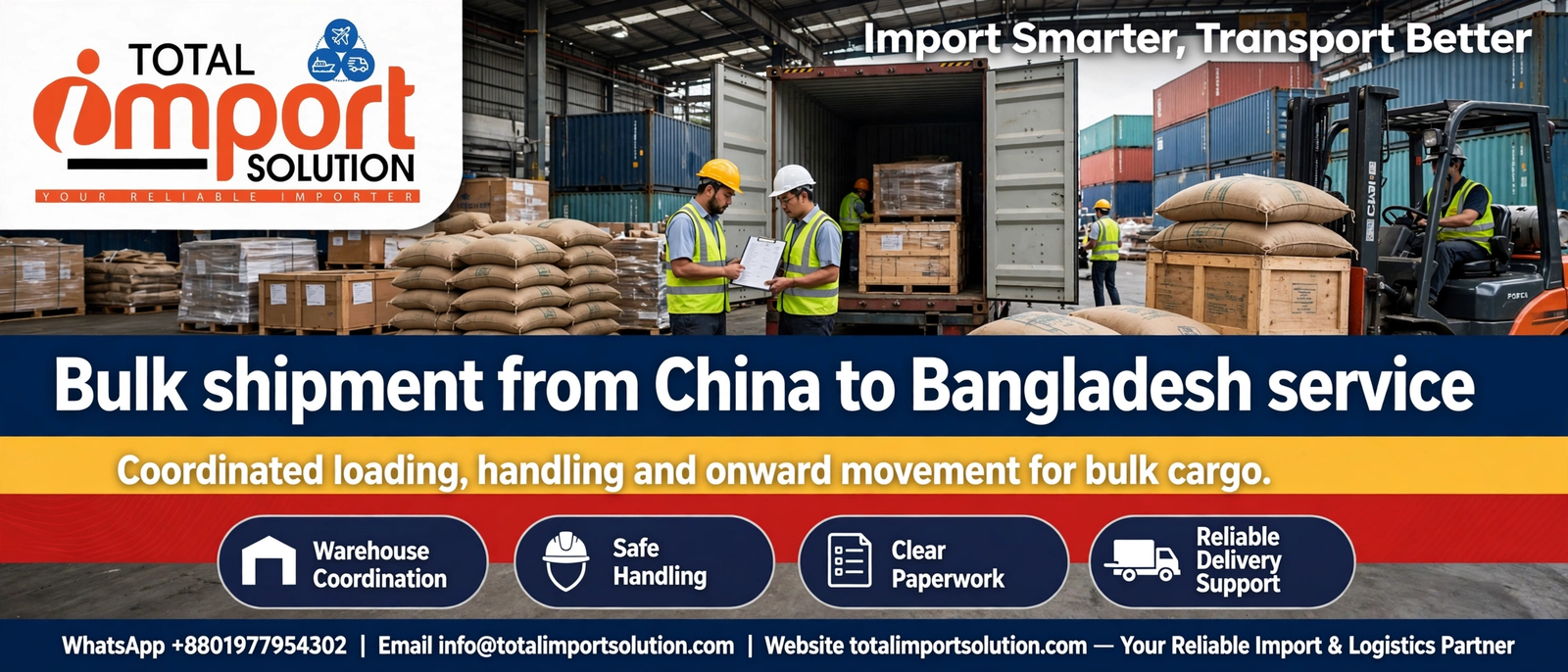
6. Loading in China: order, safety, and checking
Loading is the most practical part of a bulk shipment, and it is also the part where good preparation shows most clearly. At the loading place, the cargo is already grouped, the loading order is already agreed, and the workers know what should go in first and what should go in last. The loading then proceeds in a steady sequence, with each group placed, checked, and recorded before the next group is loaded.
The order of loading is decided by the plan. Items that will be needed first on arrival are loaded last, so that they can be reached without moving the rest of the load. Items that are heavy are placed low and spread across the floor, so that the weight sits evenly. Items that are light are placed above, where they will not be crushed. Fragile items are placed where they are protected, and they are marked so that the workers handling them know to take care. The plan is followed step by step, and any change to the plan is noted so that the loading record stays accurate.
Safety during loading matters for the workers and for the cargo. Workers should use the right equipment for the cargo they are moving, and they should handle heavy items with the help they need. The loading area should be kept clear, with a path for moving cargo and space for checking each group. A loading area that is crowded or rushed is more likely to see damage to the cargo or a mistake in the loading order. A steady pace, with time for checking, is better than a hurried pace that has to be corrected later. Total Import Solution, serving importers in Bangladesh since 2016, keeps that steady pace as part of the loading plan.
7. Documentation and paperwork that travels with the cargo
Paperwork is the part of a bulk shipment that many importers find least familiar, yet it is one of the most important. The documents that travel with the cargo describe what the goods are, how they are packed, where they came from, and where they are going. The people who handle the cargo at each stage rely on those documents, so the papers need to be clear, complete, and consistent with the cargo that was actually loaded.
The packing list is the central document for a bulk consignment. It lists each group of goods, the number of cartons, pallets, sacks, or crates in each group, and the packing for each group. The packing list should match the cargo list that was used for planning, and it should match the loading record that was made during loading. When those three records agree, the cargo can be checked quickly at each stage. When they disagree, the cargo has to be checked again in detail, which takes time.
The cargo description is also important. It should describe the goods in plain and accurate terms, so that anyone reading the documents can tell what the consignment contains. A vague description leads to questions, while a clear description leads to smooth handling. The importer should share the cargo description with the service team early, so that any questions about the description can be answered before loading, when the cargo is still available to check.
8. Packing, marking, and protection for bulk cargo
Packing protects the goods during loading, movement, and unloading. For a bulk consignment, the packing needs to suit the type of goods, the distance the cargo will travel, and the handling it will receive at each stage. Packing that is too weak can break, packing that is too loose can let the goods move inside, and packing that is not marked can lead to confusion when the cargo is received. The importer and the service team should agree on the packing before loading, so that any weak packing can be improved while there is still time.
The outer packing should be strong enough for the weight inside it. A carton that is overfilled is more likely to burst, and a carton that is underfilled is more likely to collapse under the weight of the cartons above it. The carton should be sealed properly, with the flaps closed and the tape or strapping in place. Sacks should be sealed and free of tears. Crates should be sound, with no broken boards or loose fittings. A quick check of the outer packing before loading can prevent damage that would be hard to repair later.
9. Container choices and loading plans for large volumes
A bulk consignment needs a loading plan that matches the volume of the cargo. The importer and the service team should discuss how much space the cargo will take up, how it should be grouped, and which type of container or loading arrangement suits it best. The choice should be based on the cargo itself: its volume, its weight, its shape, and its handling needs. A plan made from the real cargo details is far more useful than a plan made from a guess.
For many bulk orders, the cargo is loaded into standard containers. The containers are grouped by type, and the loading follows the plan for each container. The team decides which groups go into which container, so that each container holds a sensible mix of goods and the receiving team can check each container against its own list. When a consignment fills more than one container, each container should have its own packing list and loading record, so that the cargo in each one can be checked separately.
For cargo that is very large, very heavy, or awkward in shape, the loading plan needs extra care. The team should look at the size and shape of each item, decide where it should sit, and check that it can be loaded and unloaded safely. Awkward items should be given a clear place in the plan, rather than being left until the end, when the remaining space may not suit them. The importer should share the details of any awkward items early, so that the plan can take them into account from the start.
10. Arrival in Bangladesh: port handling and onward movement
Arrival in Bangladesh is the stage where the planning and the loading record are put to use. When the cargo arrives, the receiving team uses the packing list and the loading record to check the consignment. The team checks the number of cartons, pallets, sacks, and crates, compares the count with the list, and notes the condition of the outer packing. A cargo that was grouped and listed clearly at loading is much easier to check on arrival, because the team can work through the list group by group.
Port handling is part of the arrival stage. The cargo is moved from the vessel to the port area, and then prepared for onward movement. The handling needs to be carried out with care, so that the cargo is not damaged after it has travelled so far. The team should handle the cargo in the order shown by the loading plan, taking out the groups that are needed first and keeping the rest in a safe place. The importer should be kept informed about the arrival and about the steps that follow, so that the importer can plan the onward movement.
11. Communication, updates, and keeping the importer informed
A bulk shipment involves many stages and many people, and the importer needs to know what is happening at each stage. Good communication is therefore part of the service, not an extra. The importer should receive updates when the plan is ready, when the loading is complete, when the cargo is on its way, and when it has arrived in Bangladesh. Each update should be clear and specific, so that the importer knows what has been done and what remains to be done.
The first update comes after the planning stage. The importer is told what the plan covers, what needs to be prepared, and what information is still needed. This is the time for the importer to raise questions, share missing details, and confirm the loading place, the destination, and the date range. A plan that has been shared and agreed is much easier to follow than a plan that the importer has not seen.
The second update comes during loading. The importer is told when the loading has started, how it is proceeding, and when it is complete. If a problem arises during loading, such as a carton that is damaged or a group that does not match the list, the importer is told at once, while the cargo is still at the loading place and the problem can be fixed. An importer who hears about a problem early can help to solve it. An importer who hears about it late can only deal with the result.

12. Common problems in bulk shipments and how planning helps
Bulk shipments can run into problems, and most of those problems can be traced back to a stage where the preparation was incomplete. The most common problem is a cargo list that does not match the cargo that arrives at the loading place. A carton is missing, a group is larger than listed, or a type of goods is different from the description. When the list and the cargo do not agree, the loading has to stop while the difference is checked. A clear and accurate cargo list, shared early and checked at the loading place, prevents most of these delays.
Another common problem is weak packing. A carton that bursts, a sack that tears, or a crate that breaks can damage the goods inside and slow the loading while the packing is repaired or replaced. The problem is worse when the weak packing is only found during loading, when the cargo is already being moved. A check of the outer packing before loading, with time to repair or replace weak packing, is the best way to avoid this problem.
A third problem is a loading order that was never agreed. When the workers do not know which items should go in first, they have to stop and ask, or they place the cargo wherever it fits. The result is a load that is hard to unload in the right order on arrival, with items that are needed first buried behind items that are needed later. A loading plan agreed in advance, with the order written down, prevents this problem and makes both loading and unloading simpler.
13. Choosing a service partner and getting started
Choosing a service partner for a bulk shipment is a decision that should be based on how the partner works, rather than on promises alone. An importer should look for a partner who explains the process clearly, who asks about the cargo in detail, who prepares a written plan, and who keeps the importer informed at each stage. Those are the signs of a service that is organised around the cargo, rather than a service that simply moves goods from one place to another.
The importer should also look for a partner who is honest about what the service covers and what the importer needs to prepare. A partner who explains the paperwork, the packing, and the loading plan in plain language is more useful than a partner who gives only general reassurance. The importer should be able to ask questions and receive clear answers, and should be able to see the plan, the cargo list, and the loading record for the consignment.
Experience with bulk cargo matters too. A partner who has handled many bulk consignments will know the common problems and the planning steps that prevent them. The partner will know how to group cargo, how to plan a load, how to check papers, and how to handle the arrival in Bangladesh. The importer can ask the partner how a consignment like theirs would be handled, and can judge from the answer whether the partner has a clear and practical approach.
Frequently Asked Questions
1. What is a bulk shipment from China to Bangladesh service?
It is a service that moves a large-volume consignment from a loading place in China to a destination in Bangladesh, with planning, loading, paperwork, and arrival handling organised as one flow. The cargo is checked, grouped, loaded in a planned order, and listed clearly, so that it can be received and moved onward in Bangladesh without confusion.
2. Who should use a bulk shipment service?
Importers in Bangladesh who bring in large volumes of goods from China should use it, including traders, shop owners, suppliers, and businesses that order in bulk for stock, for a project, or for a season. It also suits importers who are placing a large order for the first time and want the process explained and planned step by step.
3. What details should I share to start a bulk shipment?
Share a description of the cargo, the number of cartons, pallets, sacks, or crates, the packing for each group, the loading place in China, the destination in Bangladesh, and the date range for the shipment. Also share any special handling needs, such as fragile items, heavy items, or goods that need to stay dry.
4. How is a bulk consignment planned before loading?
The cargo list is prepared, the loading order is agreed, the timing is discussed, and the paperwork is gathered and checked. The plan covers which groups go in first, how the weight is spread, where fragile and awkward items sit, and which groups should come out first on arrival in Bangladesh.
5. How is the cargo checked at the loading place?
The cargo is received, counted, and compared with the cargo list. The outer packing is checked, labels and marks are checked, and any difference or damage is noted while the cargo is still at the loading place. Each group is checked as it is loaded, and the loading record is updated as the work proceeds.
6. How should cartons be packed and marked for a bulk shipment?
Cartons should be sealed properly, strong enough for the weight inside, and stacked so that lower cartons are not crushed. Each carton should carry a clear mark showing its contents and its group, so that it can be identified during loading and again on arrival in Bangladesh.
7. How are pallets, sacks, and crates handled?
Pallets should carry a stable and secure load, marked with the contents and the group. Sacks should be sealed, kept dry, and stacked stably. Crates should be checked for damage, placed where heavy items sit securely, and marked with the contents and any handling needs.
8. What is a loading plan and why does it matter?
A loading plan is a written plan that shows the order in which the cargo is loaded, the grouping of the goods, the spread of weight, and the order in which groups should come out on arrival. It matters because it makes loading smoother, keeps the load stable, and makes unloading in Bangladesh simpler and faster.
9. Which documents travel with a bulk shipment?
The cargo list, the packing list, the loading record, and the cargo description are the main documents. Other documents may be needed depending on the type of goods. The importer should ask the service team which documents are needed and gather them in good time, so that they can be checked before loading.
10. Why should the papers match the loaded cargo?
The people who handle the cargo at each stage rely on the papers to know what the consignment contains. When the papers match the cargo, the consignment can be checked quickly and handled with fewer questions. When the papers do not match, the cargo has to be checked again in detail, which takes time and can delay the later stages.
11. What happens when the cargo arrives in Bangladesh?
The cargo is received and checked against the packing list and the loading record. The port handling is carried out in the order shown by the loading plan, and the cargo is prepared for onward movement to its destination. The importer is told what has arrived and what the next steps are.
12. How is onward movement in Bangladesh arranged?
Onward movement depends on the destination and the type of cargo. Some cargo goes to a warehouse, some goes straight to a shop, a workshop, or a project site, and some is split between several destinations. The grouping done at loading makes the onward movement simpler, because the cargo can be handed onward group by group.
13. How will I know the progress of my shipment?
The importer receives updates when the plan is ready, when loading is complete, when the cargo is on its way, and when it has arrived in Bangladesh. Each update is clear and specific, so that the importer knows what has been done and what remains to be done.
14. What are the most common problems in bulk shipments?
The most common problems are a cargo list that does not match the cargo, weak packing that breaks during loading, a loading order that was never agreed, papers that do not match the loaded cargo, and timing that was not shared early. Each of these can be prevented by the planning steps described in this article.
15. How can I prepare my cargo for a bulk shipment?
Prepare a clear cargo list, check the outer packing, mark each unit with its contents and group, cushion fragile items, separate heavy items from light items, and group the cargo by type or by onward destination. Share the cargo list and the paperwork with the service team in good time, so that the loading plan can be agreed before loading.
16. How do I get a quote for a bulk shipment from China to Bangladesh service?
Contact Total Import Solution on WhatsApp at +8801977954302 and share the cargo description, container size and type, loading place, date range, and destination. The team will discuss the consignment with you and explain the next steps for planning the shipment.
Contact Total Import Solution
- Company: Total Import Solution, serving importers in Bangladesh since 2016
- Service: Bulk shipment from China to Bangladesh service
- WhatsApp: +8801977954302
- WhatsApp direct link: https://wa.me/8801977954302
- Phone: +8801977954302
- Email: info@totalimportsolution.com
- Website: totalimportsolution.com
Get a quote in 1 minute:
- Cargo description
- Container size/type
- Loading place
- Date range
- Destination
