
ISO Tank Container Hire for Chemical & Liquid Cargo to Bangladesh
Liquid cargo does not behave like boxed cargo. It moves, it finds a gap, it reacts with a surface it should not touch, and it cannot be repacked on the road if the container was wrong. That is why importers who bring liquid cargo into Bangladesh hire an ISO tank container, a steel tank held inside a standard container frame, built to carry liquid safely by road, rail and sea. The tank, the frame, the fittings and the papers work together, and every one of them needs to be checked before loading begins.
This guide explains ISO tank container hire for chemical and liquid cargo to Bangladesh in plain, practical words: what an ISO tank is, why liquid cargo needs one, how to check the tank lining against the cargo, what cleaning and inspection records to ask for, how booking, loading, port handling and delivery work, and what mistakes to avoid. No prices, rates, fees, duty figures, statistics or transit times are given here, because a rate or a fee is confirmed only after checking the actual shipment and its documents. Container sizes and capacities are given only as widely used approximate figures, clearly labelled approximate, and the figures that decide any load are the ones on the plate and the documents of the actual tank you hire.
Total Import Solution, an importer and logistics provider serving importers in Bangladesh since 2016, supports ISO tank container hire alongside its import services, and applies the checks in this guide before a tank is accepted for a customer.
1. What an ISO Tank Container Is
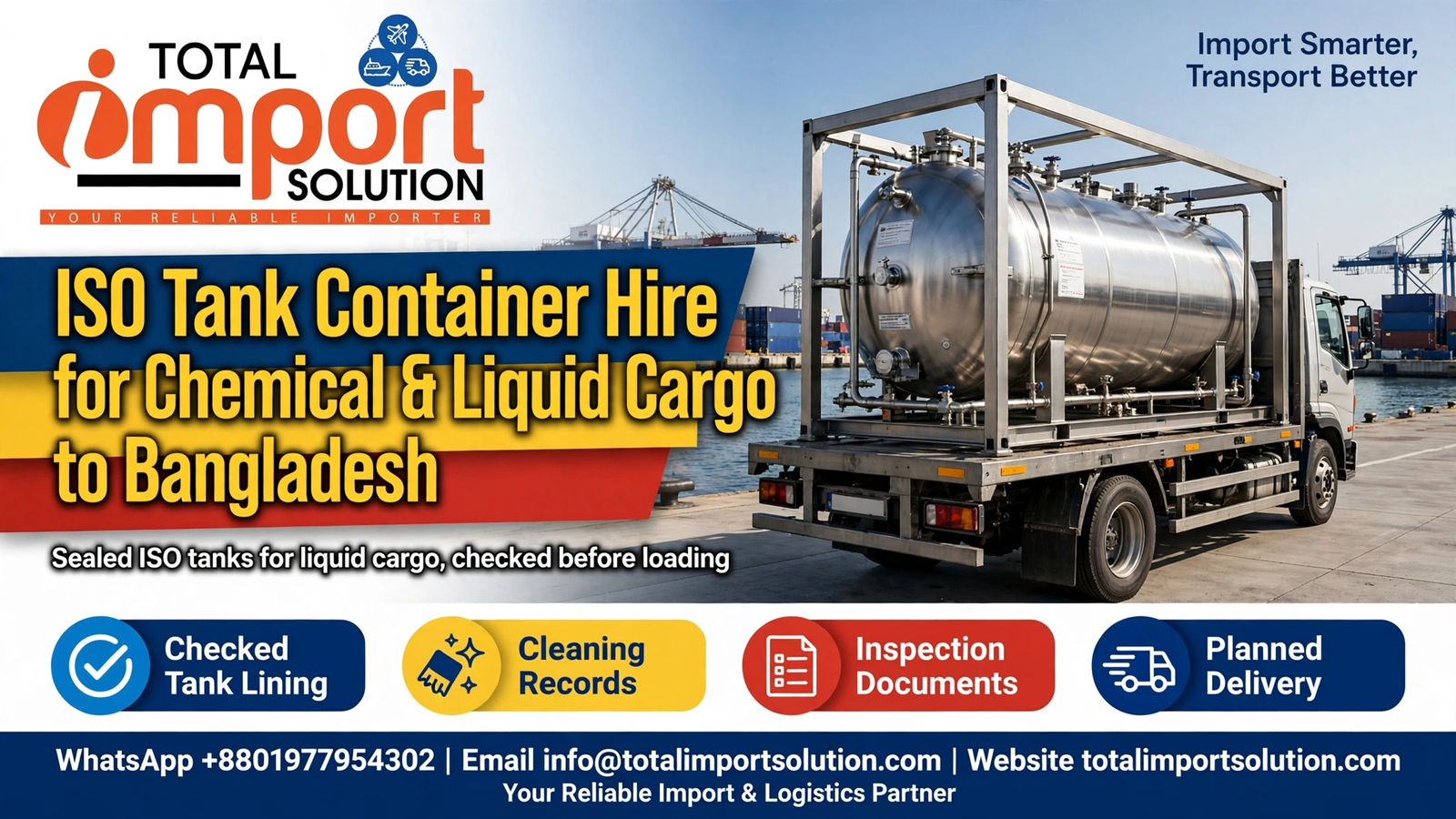
An ISO tank container is a cylindrical steel tank mounted inside a rectangular steel frame. The frame is the same size and shape as a standard shipping container, so the tank can be lifted by the same cranes, carried on the same vessels and trucks, and stacked in the same yards as an ordinary box. The tank itself is sealed, with a manhole on top for loading and inspection, valves and fittings for filling and discharge, and a frame that protects the tank during lifting and transport.
Most ISO tanks used for liquid cargo to Bangladesh are built on a 20ft frame. The exact capacity, weight and fittings differ from one tank to another, so the only figures that decide your load are the ones on the plate and in the documents of the actual tank. Always check the actual tank before you load.
2. Why Liquid Cargo Needs a Tank, Not a Dry Box
A dry container is built for boxes, bags, drums and pallets. It is not built to hold liquid. Liquid poured into a dry box would move with every turn and brake, press against the doors, find a seam, and leak onto the road or into the hold of a vessel. Drums inside a dry box are a different method, and they suit some cargo, but they need their own checks: drum condition, sealing, bracing and labelling. An ISO tank is the method used when the cargo is liquid in bulk and needs a sealed, purpose-built vessel for the whole journey.
A tank holds the liquid in one sealed body, so there is no shifting of separate drums and no loose load inside a box. The liquid is filled through a controlled fitting, carried in a closed tank, and discharged through a controlled valve at the destination. That closed system protects the cargo from air and dust, protects the people handling it from contact with the liquid, and protects the road and the port from a spill.
Liquid cargo also needs a tank because the tank can be cleaned, checked and recorded between loads. A dry box can be swept, but a tank can be washed, dried, inspected from the inside and recorded load by load, so the next cargo is not spoiled by what the tank carried before. That record is one of the most important documents in ISO tank hire, and this guide returns to it in section 5.
3. Tank Types, Frames and Approximate Sizes
ISO tanks are not all the same. They differ in the steel of the tank, the lining inside the tank, the fittings on top and at the bottom, and the frame around them. The right tank for your cargo is the one whose lining, fittings and records match the cargo you plan to load. The wrong tank is one that looks the same from the outside but has a lining or a history that does not suit your cargo. That is why the checks in this guide are about documents and records, not only about appearance.
| Container type | Approximate internal volume | Approximate maximum payload |
|---|---|---|
| 20ft standard dry container | About 33 CBM | About 26,000 to 28,000 kg |
| 40ft standard dry container | About 67 CBM | About 26,000 to 28,000 kg |
| 40ft high cube dry container | About 76 CBM | About 26,000 to 28,000 kg |
4. Compatibility: Tank Lining, Cargo and Previous Loads
Compatibility is the first and most important check in ISO tank hire. It asks a simple question: does this tank, with this lining and this history, suit this cargo? The lining is the inner surface of the tank, and it is the surface the cargo touches for the whole journey. Some linings suit a wide range of liquid cargo, and some suit only a narrow range. The only safe way to answer the question is to check the lining against the cargo details, in writing, before loading.
Start with the cargo details: the full description as it appears in the shipping documents, the form of the cargo, and any handling notes that come with it. Then ask the hire provider for the lining of the tank offered and the record of the cargoes it has carried before. Compare the three together, and if any one does not fit the others, ask for a different tank.
Previous loads matter as much as the lining. A tank that carried a cargo that leaves a residue can spoil the next cargo even after cleaning, if the cleaning was not the right cleaning for that residue. That is why the cleaning record must name the previous cargo and the cleaning method used, and why the record must be checked, not assumed. A tank with no previous-load record is a tank whose history you cannot check, and it should not be loaded until that record is provided.
Approvals are also a check, not a promise. Some cargo needs an approval or a written confirmation before it can be carried in a particular tank, and that confirmation must be in writing before loading. Do not load on a verbal assurance that an approval will follow. Ask for the approval, or the written confirmation, and keep it with the hire documents. If the approval cannot be shown, the tank should not be loaded with that cargo, and a different plan should be made.
5. Cleaning Records and Previous Cargo History
A clean tank is not a tank that looks clean from the outside. It is a tank whose inside has been washed, dried and inspected after its last load, and whose cleaning is recorded in a document you can read. The cleaning record is the proof that the tank is ready for your cargo, and it should be checked as carefully as the tank itself.
Ask for the cleaning record before you confirm the booking, and check it line by line. The record should name the tank number, the date of cleaning, the place where it was cleaned, the previous cargo, the cleaning method used, and the name of the person or depot that carried out the cleaning. It should also note whether the tank was inspected after cleaning, and whether the inspection found the tank ready for the next load. If any of these lines is missing, ask for it to be completed before you confirm.
Keep the cleaning record with your hire documents, and keep a copy at the loading place. When the tank arrives for loading, check that the tank number on the record matches the tank number on the tank and on the booking papers. If the numbers do not match, stop and ask for the correct record. A record that belongs to a different tank is not a record for your tank, and loading on the strength of it would mean loading without a checked history.
6. Inspection Documents and the Tank Plate
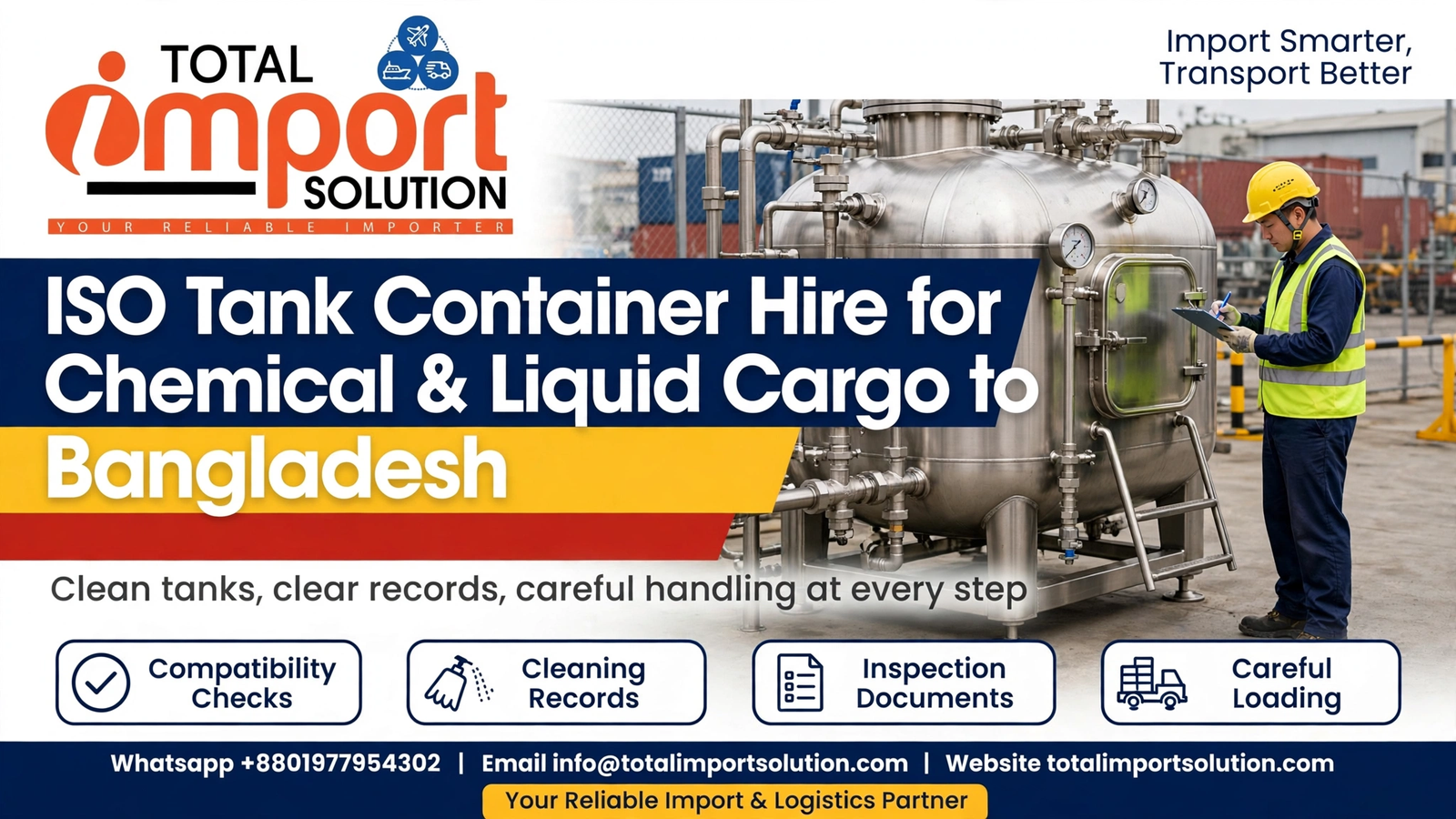
Every ISO tank carries a plate fixed to its frame, and the plate is the visible record of the tank. It shows the tank number, the date of manufacture, the capacity, the weight limits and the date of the next inspection. Read the plate at the depot, photograph it, and check the photograph on the spot, because a blurred photograph is no better than no photograph at all. If the plate is missing, loose or unreadable, note it at once and ask for the inspection record for that tank number.
The inspection record is the document behind the plate. It should show the same tank number and the same inspection date as the plate, and it should show what was inspected and what was found. Ask for it before you sign the hire agreement, and check it against the plate and against the tank in front of you. If the record shows a different tank number or a different date from the plate, treat it as a failed check, photograph both, and ask for a replacement tank or a corrected record.
| Document | What to check on it |
|---|---|
| Tank inspection record | Same tank number and same inspection date as the plate |
| Cleaning record | Tank number, date, place, previous cargo, cleaning method, inspection after cleaning |
| Hire agreement | Tank number, hire period, pickup and return place, cleaning and inspection responsibilities |
| Booking confirmation | Tank number matches the plate and the number on the frame |
| Cargo documents | Cargo description matches the cargo you plan to load |
| Pickup receipt | Tank number, date of pickup, and the condition noted at pickup |
| Return receipt | Tank number, date of return, and the condition noted at return |
7. How to Book an ISO Tank, Step by Step
Booking an ISO tank is a sequence of checks, and each step should be finished before the next one begins. A booking made in a hurry, with the checks left for the loading day, is a booking that can fail at the gate, at the port, or at the loading place, when there is no time left to find a replacement tank. Follow the steps below in order, and keep a written record of each one.
Step 1: Write down the cargo details. Note the full cargo description as it appears in the shipping documents, the form of the cargo, the loading place, the destination in Bangladesh, and the date or date range when the cargo will be ready. These details decide which tank can be offered, so they must be written down before any tank is named.
Step 2: Send the cargo details to Total Import Solution and ask for a tank offer. Ask for the tank number, the tank type, the lining, the capacity and weight from the plate, the cleaning record, and the inspection record, all in writing. Do not accept a tank offer that names no tank number and shows no documents.
Step 3: Check the tank documents against the cargo. Compare the lining with the cargo details, the cleaning record with the previous cargo, and the inspection record with the plate. If any check fails, ask for a different tank, and check the replacement in the same way.
Step 4: Confirm the hire terms in writing. The confirmation should name the tank number, the hire period, the pickup place, the return place, the loading date or date range, and who is responsible for cleaning and inspection at each stage. Read the confirmation before you agree to it, and keep a copy with your hire documents.
Step 5: Check the tank again on arrival at the loading place. Read the plate, match the tank number with the booking papers, and walk around the tank to check the frame, the fittings and the seals. If anything does not match the documents, stop and ask for the correct tank or the correct documents before loading begins.
8. Loading an ISO Tank, Step by Step
Loading is the stage where a good plan becomes a safe shipment, and it is also the stage where a rushed job can spoil a good tank and a good cargo. Loading should be done by people who know the tank and the cargo, at a place with the right fittings, and with the checks in this section carried out in order, not skipped.
Step 1: Check the tank before any liquid is moved. Read the plate, match the tank number with the booking papers and the cleaning record, and check the frame, the manhole seal, the valves and the fittings. Look for damage, wear or leaking around the fittings, and ask for any fault to be noted in writing before loading begins.
Step 2: Check the cargo documents at the loading place. The cargo description on the documents should match the cargo that is ready to load. If the documents and the cargo do not agree, stop and ask for the documents to be corrected before loading.
Step 3: Connect the loading fittings with care. The fittings used for loading must match the fittings on the tank, and they must be clean and in good condition. A fitting that does not match, or that is dirty or worn, should not be used. Ask the loading team to show the fittings before they are connected, and to confirm that they are the right fittings for the tank.
Step 4: Seal the tank and record the load. When loading is finished, close and seal the manhole and the valves, check each seal, and record the tank number, the date and time of loading, the cargo loaded, and the names of the people present. Photograph the sealed fittings and keep the photographs with the hire documents.
9. Documents to Prepare for Customs and the Port
Documents are the part of a liquid cargo shipment that is most often left until the last day, and they are the part that can hold a shipment at the port if they are wrong. Prepare the documents early, check them against each other, and keep a complete file that travels with the shipment in copy form, with the originals kept where they can be produced when asked for.
| Paper | What it is for |
|---|---|
| Commercial invoice | Shows the cargo, the seller and the buyer, and the details of the sale |
| Packing list | Shows the cargo, the tank number and the load details |
| Bill of lading | Shows the shipment, the vessel, the loading port and the discharge port |
| Certificate of origin | Shows where the cargo comes from |
| Tank inspection record | Shows the tank has been inspected and the plate is in date |
| Cleaning record | Shows the tank was cleaned after its last load and inspected after cleaning |
| Cargo handling notes | Shows how the cargo should be handled, loaded and discharged |
| Hire agreement and booking confirmation | Shows the tank number, the hire period and the pickup and return places |
10. Port Handling and Arrival in Bangladesh
When an ISO tank reaches Bangladesh, it is handled at the port like other containers, but with extra care for the fittings and the seals. The tank is lifted by crane, placed in the yard, and checked before it is released for onward transport. The checks at this stage are the same checks that were made at loading: the tank number, the plate, the seals and the documents, all matched against each other.
The main sea port for container cargo in Bangladesh is Chittagong, and some cargo also arrives through Mongla. From the port, the tank travels by road to the discharge place, which may be a factory, a warehouse or a depot in Dhaka or elsewhere in the country. The road journey needs a truck and a driver who know how to carry a tank, and the tank must be secured on the truck so that it cannot shift during the journey.
Total Import Solution has served importers in Bangladesh since 2016, and its port and delivery work follows the same step-by-step approach as the rest of this guide: check the documents, check the tank, and only then move it onward. If a document is missing or a seal does not match the record, the tank should be held where it is until the matter is put right in writing, rather than moved onward with a question still open.
11. Discharge, Delivery and Tank Return
Discharge is the reverse of loading, and it needs the same care. The tank should be discharged at a place with the right fittings, by people who know the cargo and the tank, and with the checks in this section carried out in order. A careful discharge protects the cargo, the people handling it, and the tank for its next load.
Step 1: Check the tank on arrival at the discharge place. Read the plate, match the tank number with the booking papers, and check the seals against the loading record. If a seal does not match, note it in writing before the tank is opened, and ask Total Import Solution what should be done next.
Step 2: Check the discharge fittings. The fittings used for discharge must match the fittings on the tank, and they must be clean and in good condition. Ask the discharge team to show the fittings before they are connected, and to confirm that they are the right fittings for the tank.
Step 3: Discharge slowly and watch the tank throughout. The person in charge should watch the fittings, the seals and the flow of liquid during the whole discharge, and should be able to stop the flow at once if anything is wrong. Discharge should never be left unwatched.
Step 4: Return the tank as agreed. The hire agreement names the return place and the condition in which the tank should be returned. The tank should be returned in that condition, with the return receipt noting the tank number, the date and time of return, and the condition at return. Keep a copy of the return receipt, because it closes the hire and proves the tank was returned as agreed.

12. Common Mistakes and How to Avoid Them
Most problems with ISO tank hire come from a small set of mistakes, and most of them can be avoided by checking the documents before loading, not after. The table below lists the mistakes seen most often, what can follow from each one, and the check that avoids it. Read the table before you book, and use it as a checklist at each stage of the hire.
| Mistake | What can follow | The check that avoids it |
|---|---|---|
| Booking a tank without naming the lining | A tank whose lining does not suit the cargo | Ask for the lining in writing and check it against the cargo details |
| Loading without the cleaning record | A cargo spoiled by the previous load | Ask for the cleaning record before you confirm the booking |
| Loading without the inspection record | A tank whose plate is out of date | Ask for the inspection record and compare it with the plate |
| Accepting a tank number that does not match the papers | A hire file that does not describe the tank in front of you | Match the tank number on the plate, the frame and the papers at pickup |
| Loading on a verbal assurance about an approval | A load that cannot be shown to be approved | Ask for the approval in writing before loading |
| Leaving documents until the port stage | A shipment held while papers are corrected | Prepare and check the documents before the tank leaves the loading place |
| Breaking a seal without a written record | A discharge dispute about when the tank was opened | Record every seal break with date, time and name |
| Returning the tank without a return receipt | A hire that cannot be shown to be closed | Ask for the return receipt and keep a copy |
13. How to Judge a Hire Provider and Work with Total Import Solution
A good ISO tank hire provider can be judged by the same standard as a good tank: by what can be shown in writing. A provider who can name the tank, show the lining, produce the cleaning record and the inspection record, and confirm the hire terms in writing is a provider who can be checked. A provider who cannot show these things, or who asks you to load on a verbal assurance, is a provider whose work cannot be checked, and that is a risk you should not take with liquid cargo.
Total Import Solution works with importers in Bangladesh in the way this guide describes. The company has served importers in Bangladesh since 2016, and its ISO tank work follows the checks in this guide: the lining checked against the cargo, the cleaning record and the inspection record checked before booking, the tank number matched at pickup, loading and discharge, and the documents prepared and checked before the tank moves. If you are planning a liquid cargo shipment and want the tank, the documents and the delivery planned step by step, contact Total Import Solution with the details listed in the contact section below, and the team will check your shipment with you before any booking is made.
Frequently Asked Questions
1. What is an ISO tank container?
An ISO tank container is a steel tank held inside a standard container frame. The frame lets the tank be lifted and carried like an ordinary container, while the sealed tank holds the liquid, with a manhole for loading and valves for filling and discharge.
2. Why should liquid cargo travel in an ISO tank instead of a dry container?
A dry container is built for boxes, bags, drums and pallets, not for liquid in bulk, which would move, press against the doors and leak. An ISO tank holds the liquid in one sealed body, with controlled filling and discharge, and it can be cleaned and recorded between loads.
3. What should I check first when hiring an ISO tank?
Check compatibility first. Ask for the lining, the record of cargoes the tank has carried before, and the cleaning record, and compare all three with the cargo details in your shipping documents. If any one does not fit, ask for a different tank.
4. What is tank lining, and why does it matter?
The lining is the inner surface of the tank, and it is the surface the cargo touches for the whole journey. Some linings suit a wide range of liquid cargo, and some suit only a narrow range, so check the lining against the cargo details in writing before loading.
5. What should a cleaning record show?
A cleaning record should name the tank number, the date and place of cleaning, the previous cargo, the cleaning method used, and who carried out the cleaning. It should also note whether the tank was inspected after cleaning and found ready for the next load.
6. What should I do if the cleaning record is missing?
Do not confirm the booking until the record is provided. A tank with no cleaning record is a tank whose history you cannot check, so ask for it in writing, and if it cannot be provided, ask for a different tank.
7. What is the tank plate, and where do I find it?
The tank plate is a metal plate fixed to the frame of the tank, showing the tank number, the date of manufacture, the capacity, the weight limits and the date of the next inspection. Read it at the depot, photograph it, and check the photograph on the spot.
8. What should I do if the inspection date on the plate has passed?
The tank should not be loaded for a sea journey until it has been re-inspected and the plate updated. Compare the inspection date with the date your cargo will sail, not the pickup date, and ask for a replacement tank if the date has passed.
9. What documents do I need for an ISO tank shipment to Bangladesh?
The papers most often needed are the commercial invoice, the packing list, the bill of lading, the certificate of origin, the tank inspection record, the cleaning record, the cargo handling notes, and the hire agreement with the booking confirmation. The exact papers for your shipment depend on the cargo, so ask Total Import Solution to check the list for your shipment.
10. How do I book an ISO tank step by step?
Write down the cargo details, send them to Total Import Solution and ask for a tank offer in writing, check the tank documents against the cargo, confirm the hire terms in writing, and check the tank again on arrival at the loading place before any liquid is moved.
11. How is an ISO tank loaded?
Loading is done by people who know the tank and the cargo, at a place with the right fittings. The tank and the cargo documents are checked first, the fittings are connected with care, the liquid is loaded slowly while the tank is watched, and the tank is sealed and the load recorded before it leaves.
12. How is an ISO tank discharged in Bangladesh?
Discharge follows the same care as loading. The tank is checked on arrival, the seals are matched against the loading record, the fittings are checked, the liquid is discharged slowly while the tank is watched, and the discharge is recorded before the tank is returned.
13. What happens if a seal does not match the loading record?
Note it in writing before the tank is opened, with the date, the time and the name of the person who found it, and ask Total Import Solution what should be done next. Do not open the tank and move on as if the seal had matched.
14. Can an ISO tank be hired for one journey only?
Yes, hire can be for one journey, or for a set hire period, as agreed in the hire papers. The hire agreement should name the tank number, the hire period, the pickup place, the return place, and who is responsible for cleaning and inspection at each stage.
15. What should I do if a document is missing at the port?
Hold the tank where it is until the matter is put right in writing, rather than moving it onward with a question still open. A delay while a paper is corrected is a smaller problem than a shipment held at the port.
16. How do I get a quote for ISO tank container hire to Bangladesh?
Contact Total Import Solution with the details listed in the contact section below: the cargo description, the container size and type, the loading place, the date or date range, and the destination. A rate or a fee is confirmed only after checking the actual shipment and its documents.
Contact Total Import Solution
- WhatsApp: +8801977954302
- WhatsApp direct link: https://wa.me/8801977954302
- Phone / WhatsApp: +8801977954302
- Email: info@totalimportsolution.com
- Website: totalimportsolution.com
- Service: ISO Tank Container Hire for Chemical & Liquid Cargo to Bangladesh
- Company: Total Import Solution
Get a quote in 1 minute — send these details:
- Cargo description
- Container size and type
- Loading place
- Date or date range
- Destination
