
Customized Modified Container Rental for On-Site Storage
A customized modified container is a standard shipping container that has been fitted out for a particular job, and then rented for on-site storage at a factory, warehouse, or yard in Bangladesh. The changes are practical ones: an extra side door, a window for daylight, shelves and racking, insulation and vents, lighting, a ramp for trolleys, or a partition that splits the box into a store and a work area. The container stays where it is needed, the goods stay close to the work, and the store can be returned when the need ends.
This guide explains how to rent a modified container for on-site storage in a proper and safe way. It covers written permission, the choice of base container, allowed and banned changes, ground preparation, fitting work, care of the goods, safety and inspection, and return at the end of the rental. No fixed charge, fee, or rental figure is given here, because a rate or fee is confirmed only after checking the actual shipment and documents.
Since 2016, Total Import Solution has supported importers in Bangladesh with container leasing guidance, shipment planning, yard and warehouse coordination, documentation, and delivery support. The team works with buyers who need extra storage space at a factory or warehouse, and with first-time renters of modified containers. This guide gives practical steps only, and stresses one point throughout: a rented container is the leasing company's property, so every change must be agreed in writing before work starts.
1. What a Customized Modified Container Rental Means
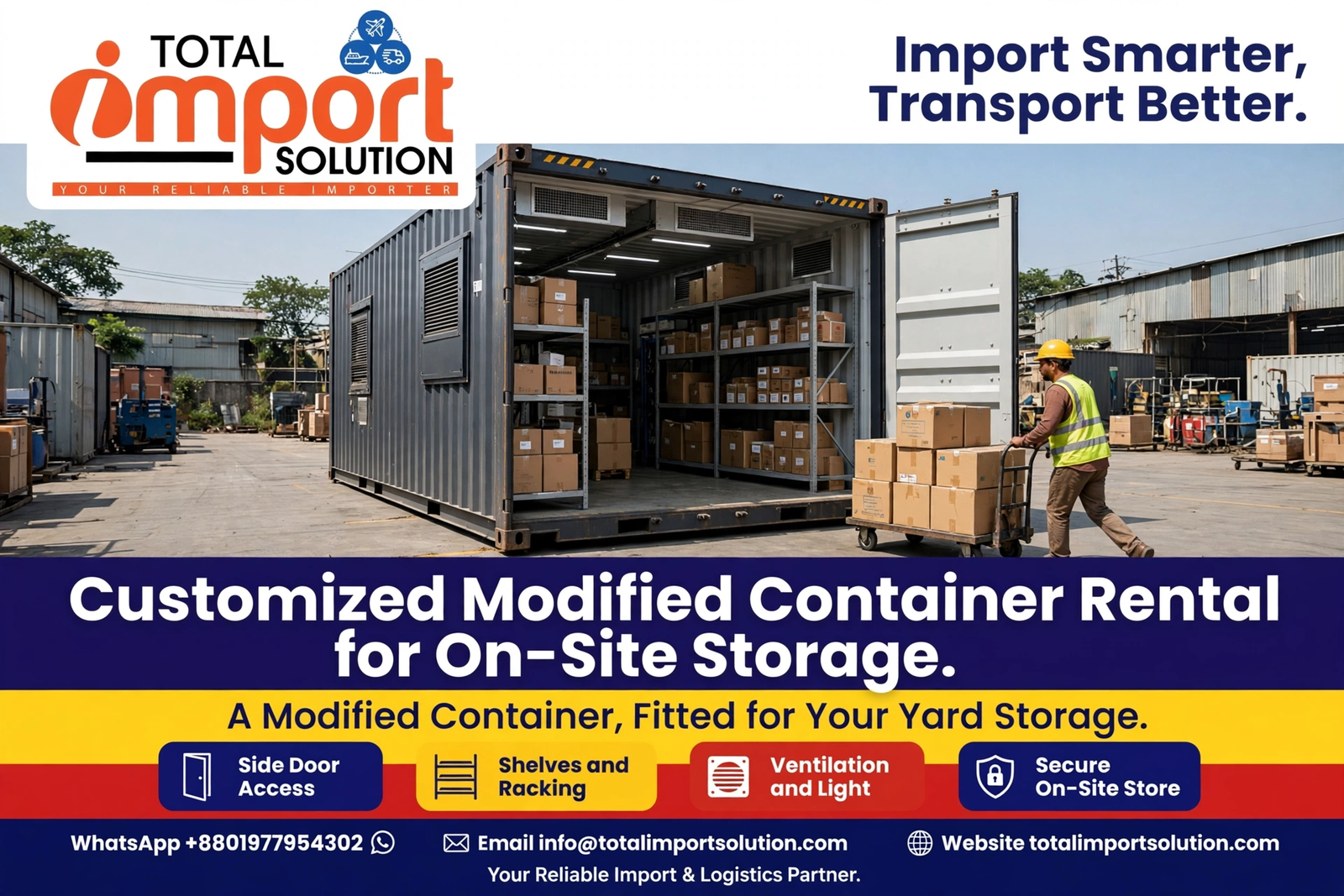
A customized modified container rental means hiring a shipping container that has been changed from its standard form to suit storage on your own site. The container is delivered to the yard, placed on prepared ground, fitted out for the goods it will hold, and used as a lockable store room for the rental period. At the end of the period it is emptied, the agreed fittings are dealt with as the lease says, and the container is returned to the leasing company. The importer does not own the box, and the lease decides what changes may be made, how long the container may stay, and what condition it must be in on return.
No two storage jobs are the same, so the fitting plan should start from the goods. A spare parts store needs small shelves and labels, a packing store needs tall racking and a wide door, and a tool store needs a workbench and a lockable cabinet. Every change should be agreed in writing before the container leaves the depot.
| Modification | What it does | Who it suits |
|---|---|---|
| Extra side door | Easy access without opening the end doors | Stores with frequent picking |
| Shelves and racking | Cartons stored in order, off the floor | Spare parts and small goods |
| Insulation lining | Softens heat and reduces damp on walls | Goods kept for several months |
| Vents and fans | Air movement through the box | Stores in warm and humid yards |
| Ramp | Trolleys and hand trucks roll in and out | Heavy cartons and pallet goods |
2. When On-Site Storage in a Modified Container Makes Sense
On-site storage in a modified container makes sense when a business needs extra space quickly, close to where the work happens, without building a new store room. It suits seasonal stock, packing material, spare parts, tools, and goods waiting for dispatch. It suits a factory yard, a warehouse yard, or a shop yard where a container can be placed on firm ground with room for a truck and for workers to move around it safely. The fitting work is what turns a plain steel box into a usable store, and the rental model suits a need that may last a few months.
It does not suit every good. Goods that need cool air or a steady temperature do not suit a steel container, even with insulation, because the box heats up in the sun and cools down at night. Goods that need daily handling by many people may suit a warehouse room better, because a container door is narrow and the inside is a single long space. Flammable goods, chemicals, gas cylinders, and fuel must never be kept in a closed steel box.
| Situation | Why a modified container suits it | What to watch |
|---|---|---|
| Seasonal stock overflow | Quick extra space in a busy season | Return date agreed in advance |
| Spare parts store | Shelves and labels near the work area | Lock and access control planned |
| Packing material store | Tall racking and a wide door | Keep material off the floor |
3. Getting Lease Permission in Writing
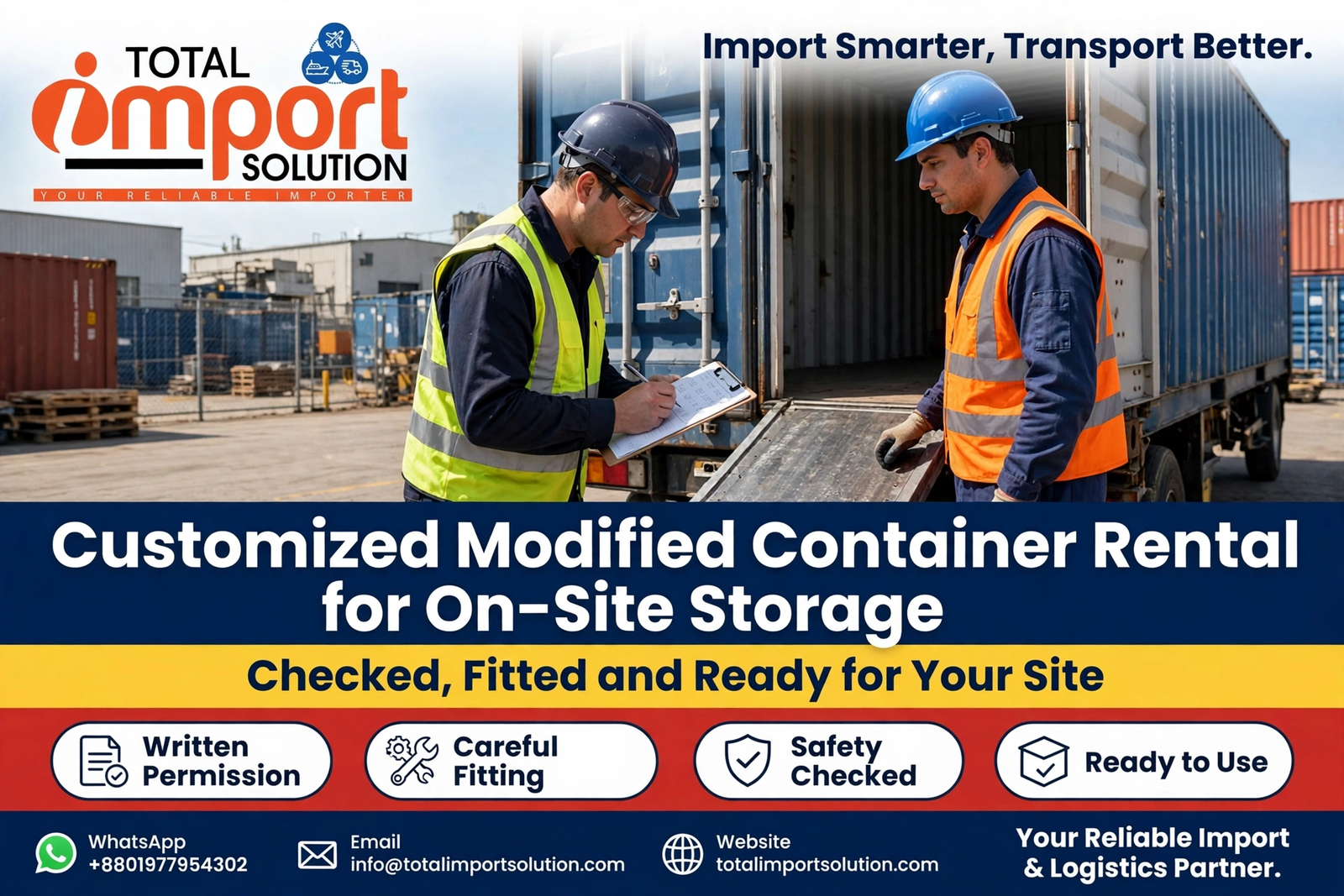
The first step is to ask the leasing company for permission, in writing, for both the storage use and the changes to the box. A transport lease and a storage lease are not always the same, and the agreement may limit where the container can be kept, how long it may stay, and what may be changed. Some leasing companies supply containers that are already modified, while others allow the importer to arrange the fitting work, and others allow no changes at all. Keep the written answer with the shipment file.
Ask in writing whether storage use is allowed at the yard address, for how long, and at what terms. Ask which changes are allowed, such as shelves, a side door, a window, or a partition, and which are not. Ask who owns the fittings at the end of the rental, and what condition the container must be in on return. Get the answers in writing before the container is placed and before any fitting work begins.
Step 1: Read the lease agreement. Check where the container can be kept, for how long, and what changes may be made.
Step 2: Ask for storage permission in writing. Tell the leasing company the yard address and the planned rental period.
Step 3: Ask about each change. List every fitting you want and ask which are allowed.
Step 4: Agree who owns the fittings. Confirm in writing whether fittings stay or are removed at return.
Step 5: Keep the written permission. File it with the lease agreement and the pick-up condition report.
4. Choosing the Right Base Container
The base container decides how well the finished store will work, so it should be chosen with care. Choose a container that is dry, clean, and sound, with doors that close well and seals that hold. Check the roof for dents or holes, the floor for soft spots or cracks, and the door seals for gaps. Walk around the container with the condition report before accepting it, and photograph all four sides, the doors, and the floor. A container that is already damaged will only cause trouble once shelves are added, because every fitting depends on a sound box.
Size is the next decision. A 20 foot container, about 6 metres long, suits a small yard and a modest amount of stock. A 40 foot container, about 12 metres long, suits a larger amount of stock but needs more yard space and a wider access route. A high cube container gives extra height for tall items, with an inside height of about 2.7 metres against about 2.4 metres in a standard height box. These figures are approximate, so check the actual container and its door plate before planning shelves.
| Container point | What to check | Why it matters for a modified store |
|---|---|---|
| Roof | Dents, holes, or rust | A sound roof keeps rain out |
| Doors | Close well, seal holds | Security and weather protection |
| Floor | No soft spots or cracks | Shelving and goods need a firm floor |
| Size | 20 foot or 40 foot to suit the yard | Must fit the yard and the stock |
5. What Modifications Are Allowed and What Are Not
The lease agreement decides which changes are allowed, and the list differs from one leasing company to another. In general, fittings that stand on the floor and can be removed without a trace are the easiest to agree, because they leave the box as it was. Floor standing shelves, free standing racking, a workbench, a lockable cabinet, and a ramp at the door usually fall into this group. Fittings that are bolted to the walls may be allowed if the leasing company agrees to the fixing method in writing, and the agreement should say who repairs the fixing points at return.
Cutting and drilling are different, because they change the box itself. Cutting a side door or a window, drilling holes for vents, fans, or cables, and welding a partition frame to the walls all alter the steel structure, and they must never be done without the leasing company's written agreement. An unapproved cut can weaken the box, let rain in, and leave the importer paying for repairs. Where cutting is agreed, the agreement should say who does the work and whether the opening stays or is closed at return.
| Change | Usually allowed | What to agree in writing |
|---|---|---|
| Free standing shelves | Yes, in most cases | Fittings removed at return |
| Bolted racking | Often, with agreement | Fixing method and repair at return |
| Side door cut | Only with written agreement | Who cuts, standard, and return state |
| Window cut | Only with written agreement | Sealing, security bars, return state |
| Vent or fan holes | Only with written agreement | Size, position, and sealing |
6. Planning the Layout: Doors, Windows, Shelving and Partitions
A good layout starts with how the store will be used each day. Put the goods that are needed most often near the door, and the goods that are needed rarely at the back. Keep a clear walkway from the door to the back of the container, wide enough for one person carrying a carton, and keep heavy items low and light items high. Plan the shelves before they are built, with each shelf given a purpose and a label. A plan drawn on paper, with the door, the shelves, the workbench, and the walkway marked, saves far more time than it takes to draw.
Doors and windows should be planned together. A side door near the middle of the box shortens the walk to the back shelves. A window gives daylight, but it also needs a security bar or shutter, and it should be placed where it lights the work area without letting rain blow in. A partition wall can split the box into a store at the back and a packing area near the door, but both parts then need light and air.
Step 1: List the goods. Write down what will be stored and how often each item is needed.
Step 2: Draw the plan. Mark the door, shelves, walkway, and partition on paper.
Step 3: Place the door first. Put the main access where picking is quickest.
Step 4: Plan the shelves. Give each shelf a purpose and a label.
Step 5: Check light and air. Make sure every part of the box has light and air.
7. Ground Preparation and Placement
The yard ground must be firm, level, and well drained before a modified container is placed on it. A container on soft or sloping ground can tilt, which strains the doors and makes them hard to close, and a fitted side door will jam first. A container on ground that floods in rain will have water at the door, and a ramp will sit in mud. Prepare a level area of hard ground, concrete, or compacted gravel, and allow space for a truck to reach the doors, for people to walk around the container, and for the ramp to sit flat.
Place the container so the doors face the yard road, with room to open them fully and to roll a trolley down the ramp. Keep the area around the container clear of rubbish and standing water. If the ground needs levelling, use blocks or sleepers under the corners, and check with a level that the box sits true before fitting work starts, because shelves built into a tilted box will lean.
Step 1: Pick the spot. Choose firm, level ground with truck access to the doors.
Step 2: Prepare the surface. Use concrete, compacted gravel, or firm hard ground.
Step 3: Check the drainage. Make sure rain water runs away from the container, not under it.
Step 4: Place the container level. Use blocks or sleepers under the corners if the ground needs levelling.
Step 5: Keep access clear. Leave room to open the doors, use the ramp, and walk around the box.
8. Fitting Work: Insulation, Ventilation, Lighting and Ramps
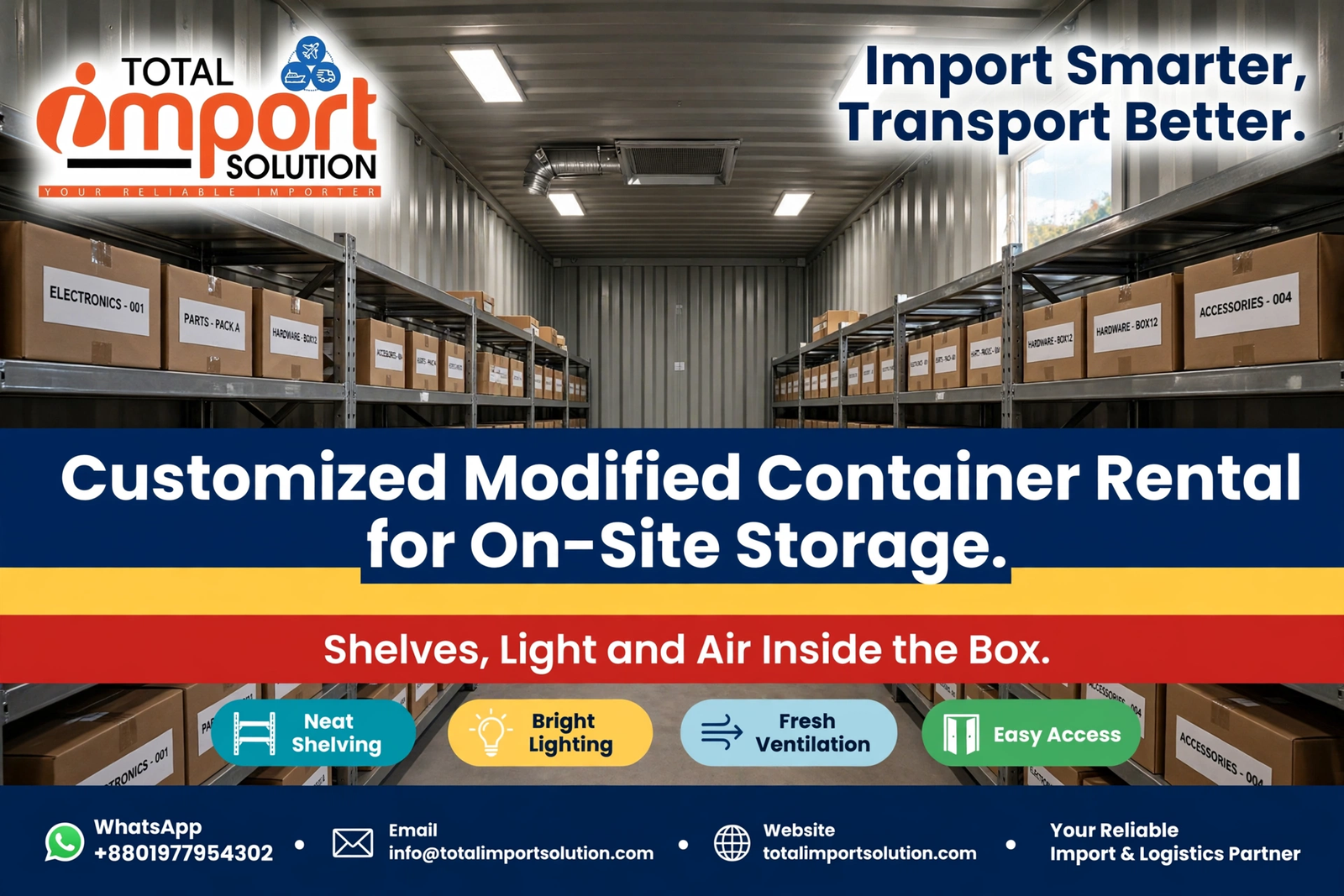
Fitting work should follow the agreed plan and the written permission. Insulation lining is fitted first, because it sits behind the shelves and is hard to reach later. A lining softens the heat of the day and reduces the water drops that form on the roof and walls. It must be fixed in the way the leasing company agreed, and it must not block the vents. Ventilation comes next, with vents kept clear and any fan fitted to move air without blowing dust onto the goods. Lighting follows, with lamps placed so the shelves and bench are lit, and cables run safely out of the way of trolleys.
Shelves and racking are built to the plan, standing on the floor where possible, with each shelf level and braced, and with a clear label on each bay. A ramp is set at the door last, so its slope and grip can be checked with a loaded trolley before the goods are moved in. Every fitting should be tested before loading: open and close each door, check each lamp, run any fan, and roll a trolley up the ramp.
| Fitting | What good work looks like | What to test before loading |
|---|---|---|
| Insulation lining | Fitted flat, vents left clear | No gaps, no loose panels |
| Vents and fans | Air moves through the box | Fan runs, vents not blocked |
| Shelves and racking | Level, braced, labelled | Each shelf steady under load |
| Ramp | Firm slope with grip | Trolley rolls up and down safely |
9. Moisture, Heat and Ventilation in a Modified Box
Moisture is the main enemy of goods stored in a steel container. Warm air in the day and cool air at night can cause water drops to form on the roof and walls, and those drops can fall on the goods. Keep the vents clear so air can move through the container, and do not block them with cartons or insulation. Keep goods off the floor on pallets, and keep a gap between the goods and the walls so air can move. Open the doors on dry days to let fresh air in, and check inside after heavy rain, paying close attention to the roof, the window seals, and any new opening cut into the box.
Heat needs the same attention. A steel container in the sun heats up quickly, and insulation only softens the rise. Goods that suffer in heat should not be stored in a container at all, and the store should be checked in the hottest part of the day when first used. A fan moves air but does not cool the box. Any leak or damp patch should be reported to the leasing company at once.
| Moisture and heat point | What to do | Why it matters |
|---|---|---|
| Vents | Keep them clear of cartons and lining | Air flow reduces moisture inside |
| Floor | Keep goods on pallets or low shelves | Water at the door cannot reach the goods |
| Wall gaps | Leave a gap between goods and walls | Air can move and water drops can dry |
| Rain check | Check inside after heavy rain | A leak is found early |
10. Security, Locks and Access Control
A modified container in a yard holds goods that must be kept safe, and the extra doors and windows mean security needs more thought than a plain box. Fit a strong lock on every door, including any side door, and use a lock box or shroud to protect the lock from cutting tools. Fit a security bar or shutter on any window, and keep the window closed and locked when the store is not in use. Keep the number of keys small, record who holds each key, and change the lock if a key is lost. Keep the yard gate locked at night, and place the container where it can be seen from the office.
Check the lock and the door seals each week, and note any sign of tampering at once. Keep a log of who opens the container and when, so any missing item can be traced. A locked container in a watched yard, with every opening secured and every key accounted for, is a strong store room.
| Security point | What to do | Why it matters |
|---|---|---|
| Strong locks | Fit a good lock on every door | Stops casual tampering |
| Side door lock | Lock the side door as well as the end doors | An extra door is an extra way in |
| Window bars | Fit a bar or shutter on any window | Daylight should not mean easy entry |
| Key control | Few keys, record who holds each one | Missing goods can be traced |
| Access log | Record who opens the container and when | Every opening is accounted for |
11. Safety Checks and Regular Inspection
A modified container needs a regular inspection, just as a building does, and the fittings add items to the list. Check the container once a week, and after every period of heavy rain or strong wind. Look at the roof for new dents or standing water, the doors for smooth closing, the floor for soft spots, and the inside for moisture or pests. Check the side door and the window seals, because a new opening is the first place to leak. Check that the shelves are still level and braced, that the ramp is firm, and that the lights and any fan still work. Check that the container still sits level, and that the blocks under the corners have not sunk.
Check the goods for damp, damage, or pests, and move any affected cartons at once. Keep a written inspection note with the date and what was found, and keep it with the shipment file, next to the lease agreement and the pick-up condition report. Over several months, the notes build a clear record of the container's state, which is useful at return.
Step 1: Inspect weekly. Check the roof, doors, floor, and fittings once a week.
Step 2: Inspect after bad weather. Check again after heavy rain or strong wind.
Step 3: Check the openings. Look at the side door, window seals, and vents for leaks.
Step 4: Check the fittings. Make sure shelves are level, the ramp is firm, and lights work.
Step 5: Keep a written note. Record the date and what was found at each inspection.
12. Return Condition and End of Rental
Returning a modified container needs the same care as the pick-up, and the written agreement decides what happens to the fittings. Empty the container fully, sweep the floor, and remove all shelves and fittings that were added, unless the leasing company has agreed in writing that they may stay. Where a side door or a window was cut with permission, the agreement will say whether the opening stays, is closed, or is left as it is, and that instruction must be followed exactly. Do not arrange a repair or a change to the box without asking the leasing company first.
Compare the container with the pick-up condition report, and note any new marks or damage, with photos. Report any damage to the leasing company before the return, and follow the lease agreement on repairs. Return the container by the agreed date, because a late return can bring extra charges under the lease. Ask the depot to sign a return condition report, and keep a copy with the shipment file.
Step 1: Empty the container fully. Remove all goods, shelves, and fittings added during the rental.
Step 2: Clean the container. Sweep the floor and remove all rubbish.
Step 3: Deal with the openings. Follow the agreement on any side door, window, or vent that was cut.
Step 4: Check for damage. Compare the container with the pick-up report and photograph any new marks.
Step 5: Return on time. Return by the agreed date and get a signed return condition report.
13. How to Judge a Good Provider for Modified Container Rental
A good provider for modified container rental is judged by clear lease terms, a sound container, honest communication, and fitting work done to the agreed standard. Look for a provider that gives storage and fitting permission in writing, supplies a dry and clean container, provides a full condition report at pick-up, and explains the return standard in plain language. Check that the provider answers questions about fittings, damage, and return dates without delay, and that it checks the container at return and signs the return report.
The fitting work itself is a good test of a provider. Ask to see a container the provider has already modified, and look at the door seals, the window sealing, the shelf bracing, and the ramp. Ask who does the cutting and fitting, and what standard the work must meet. Total Import Solution has worked with importers in Bangladesh since 2016, and the team aims to give that kind of clear, steady support on every modified container rental.
| Quality to look for | What it looks like in practice | How to check it |
|---|---|---|
| Written fitting permission | Permission given in writing before work starts | Ask for the permission letter |
| Sound container | Dry, clean, doors closing well | Walk around it with the condition report |
| Full condition report | Every mark listed at pick-up | Check the report against the container |
| Clear return standard | Return state explained in plain language | Ask what must be done before return |
| Good fitting work | Seals hold, shelves braced, ramp firm | See a finished container before ordering |
Frequently Asked Questions
1. What is a customized modified container rental?
It is a rental of a shipping container fitted out for a particular storage job, such as an extra side door, shelves, lighting, or a partition, and placed at your factory or warehouse yard for on-site storage.
2. Do I need written permission to modify a rented container?
Yes. A rented container belongs to the leasing company, so every change, from shelves to cutting a door, must be agreed in writing first.
3. Which changes are usually allowed without cutting the box?
Free standing shelves, racking, a workbench, a lockable cabinet, and a ramp at the door are usually allowed, because they can be removed without changing the box.
4. Can I cut a side door or a window into a rented container?
Only if the leasing company agrees in writing. The agreement should say who does the cutting, what standard the work must meet, and what happens at return.
5. Which container size suits on-site storage?
A 20 foot container, about 6 metres long, suits a small yard and a modest amount of stock. A 40 foot container, about 12 metres long, suits more stock but needs more yard space.
6. What is a high cube container?
It is a container with extra height, about 2.7 metres inside against about 2.4 metres in a standard height box. These figures are approximate, so check the actual container.
7. What ground does a modified container need?
Firm, level, well drained ground, such as concrete or compacted gravel, with room for a truck to reach the doors, for the ramp to sit flat, and for people to walk around the container.
8. How do I stop moisture damaging goods in a modified container?
Keep the vents clear, keep goods on pallets off the floor, leave a gap at the walls, open the doors on dry days, and check inside after heavy rain.
9. How should goods be arranged inside a modified container?
Put the most needed goods near the door, heavy items at the bottom, label every carton and shelf, keep a written list of what is inside and where it sits, and leave gaps at the walls.
10. How often should a modified container be inspected?
Once a week, and again after heavy rain or strong wind. Check the roof, doors, floor, side door, window seals, shelves, ramp, and the goods, and keep a written note of each inspection.
11. How do I keep a modified container secure?
Fit a strong lock on every door, fit a bar or shutter on any window, keep the keys few, keep the yard gate locked at night, place the container where it can be seen, and keep a log of who opens it.
12. What should I do before returning a modified container?
Empty it fully, remove added fittings unless the leasing company has agreed they may stay, follow the agreement on any cut opening, clean the container, and return it by the agreed date with a signed return condition report.
13. What if the container is damaged during the rental?
Report it to the leasing company with photos before the return, and follow the lease agreement on repairs. Do not arrange a repair without asking the leasing company first.
14. Can a modified container be used for storage in the rainy season?
Yes, if it is sound, level, and well drained, with the vents clear, the seals checked, and the goods kept off the floor. Check inside after heavy rain and report any leak at once.
15. How do I choose a good provider for a modified container?
Look for written fitting permission, a dry and clean container, a full condition report, a clear return standard, good fitting work you can see, and a signed return report.
16. How can Total Import Solution help with modified container rental?
Total Import Solution supports importers with lease guidance, container selection, fitting plans, yard planning, document checking, and delivery coordination in Bangladesh, with one team from order to delivery.
Contact Total Import Solution
- WhatsApp: +8801977954302
- Email: info@totalimportsolution.com
- Website: totalimportsolution.com
- Service: Customized Modified Container Rental for On-Site Storage
- Company: Total Import Solution — Since 2016, serving importers in Bangladesh.
