
Complete Guide to Container Cargo Weight Limits in Bangladesh
Every container has a weight limit, and every importer in Bangladesh who ships by sea needs to understand it. The limit decides how much cargo can be loaded into a container, how the load must be planned, and what happens if the cargo is too heavy. A container that is loaded past its limit can be refused at the port, held for checking, or reloaded at the importer's cost. Worse, it can be unsafe on the road and at sea. This guide explains the limits in plain terms, how to check them, and how to plan a load that stays within them.
All figures in this guide are widely standard approximate figures, clearly labelled as approximate. The actual limit for a container depends on the plate fixed to that container and on the rules in force at the time of the shipment. The importer should always check the actual container and documents for the shipment in hand, and ask the agent to confirm the limit in writing. No fixed charge, fee, or penalty figure is given here, because a rate or fee is confirmed only after checking the actual shipment and documents.
Since 2016, Total Import Solution has supported importers in Bangladesh with container planning, weight checking advice, documentation, customs clearance support, and delivery coordination. The team works with buyers who import heavy machinery, raw materials, and consumer goods, and with buyers who are shipping a full container for the first time. This guide gives practical steps only, using approximate standard figures, and it advises checking the actual container in every case.
1. What Container Cargo Weight Limits Mean
A container cargo weight limit is the heaviest load of cargo that a container is built to carry. It is not a suggestion. It is set by the maker of the container, shown on the plate fixed to the container door, and applied by the carrier, the port, and the road authorities. The limit protects the container structure, the lifting equipment, the vessel, and the people who handle the box. It also protects the cargo, because a container loaded past its limit can suffer floor damage, door damage, or a shifted load. The importer who understands the limit can plan the order, the packing, and the number of containers with care.
| Weight term | What it means | Where to find it |
|---|---|---|
| Payload | The weight of cargo the container can carry | On the container plate |
| Tare weight | The weight of the empty container | On the container plate |
| Gross weight | Payload plus tare weight together | On the container plate |
| Verified gross mass | The weighed gross weight given to the carrier | On the weighing record |
| Axle load | The weight carried by each axle of the truck | In the road rules in force |
2. The Main Container Sizes Used in Bangladesh Imports
Most imports into Bangladesh move in two standard container sizes, the 20 foot container and the 40 foot container, with the 40 foot high cube used for light, bulky cargo that needs extra height. The 20 foot container is the workhorse for heavy cargo, because its shorter length suits dense goods such as machinery parts, metal goods, and stone products. The 40 foot container suits larger volumes of lighter goods, such as furniture, textiles, and household products. The choice of size affects the payload, because a larger container does not always carry a larger weight of cargo. The importer should match the container size to the cargo, not to the volume alone.
| Container size | Usual cargo type | What to remember |
|---|---|---|
| 20 foot standard | Heavy, dense cargo | Shorter box, suited to heavy loads |
| 40 foot standard | Larger volumes of lighter cargo | More space, payload near the 20 foot figure |
| 40 foot high cube | Light, bulky cargo needing height | Extra height, not extra payload |
| Open top | Tall cargo loaded from above | Weight limit still applies |
| Flat rack | Wide or heavy cargo without walls | Lashing and weight distribution matter |
The size decision should be made with the supplier and the agent together, before the order is packed. The supplier knows the size and weight of each carton, and the agent knows which sizes are available on the route and at the port of loading. A buyer who books a 40 foot container for a dense cargo may find that the weight limit is reached while half the space is still empty, which wastes space and money. A buyer who books a 20 foot container for a light, bulky cargo may find that the box is full long before the weight limit is reached, which means a second container is needed. The right choice comes from adding up the real carton weights and the real carton sizes, and matching both figures to the container. When the cargo is mixed, with some heavy items and some light items, the load plan should put the heavy items in one container and the light items in another, so that neither container is wasted.
3. Payload, Tare Weight and Gross Weight Explained
Three weights matter for every container, and they are easy to confuse. The payload is the weight of the cargo alone, and it is the figure the importer must watch most closely. The tare weight is the weight of the empty container, and it varies a little from one container to another. The gross weight is the payload plus the tare weight, and it is the figure the carrier and the port use for lifting and stowage. As a widely standard approximate guide, a 20 foot container has a payload of about 28,000 kg, and a 40 foot container has a payload of about 26,000 to 28,000 kg. These are approximate figures only. The tare weight of a 20 foot container is about 2,300 kg as an approximate figure, and the tare weight of a 40 foot container is about 3,800 kg as an approximate figure. The actual figures for the container in hand are on its plate, and the plate is the authority.
| Container size | Approximate payload | Approximate tare weight | Approximate gross weight |
|---|---|---|---|
| 20 foot standard | About 28,000 kg | About 2,300 kg | About 30,300 kg |
| 40 foot standard | About 26,000 to 28,000 kg | About 3,800 kg | About 30,000 to 32,000 kg |
| 40 foot high cube | About 26,000 to 28,000 kg | About 3,900 kg | About 30,000 to 32,000 kg |
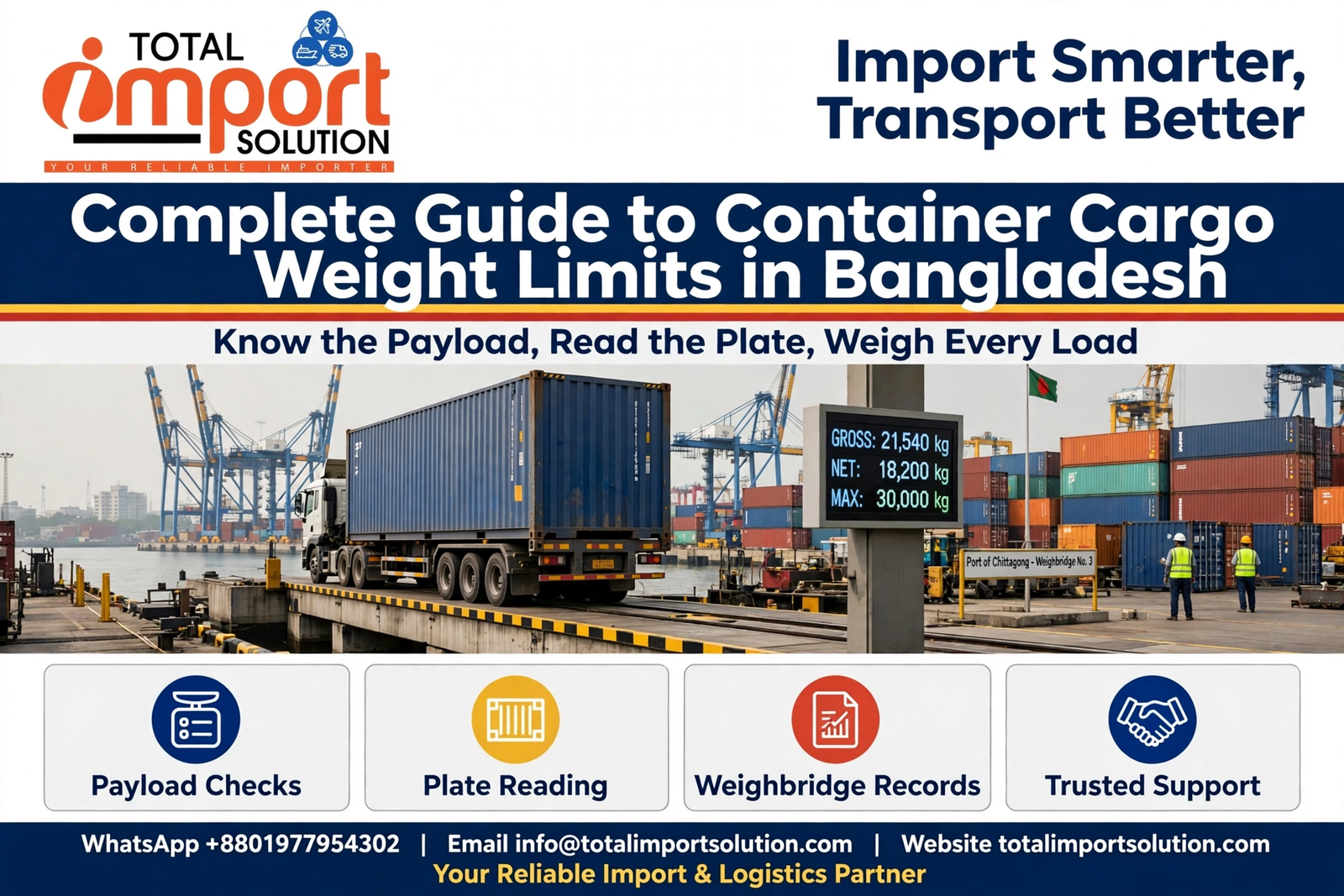
4. How to Read the Weight Plate on a Container
Every container carries a plate, usually fixed to the door, that shows its key figures. The plate shows the maximum gross weight, the tare weight, and the maximum payload, together with the container number, the size and type code, and the inspection dates. The importer, or the person loading the container, should read the plate before loading starts and write the figures down. If the plate is damaged, missing, or hard to read, the container should not be loaded until the agent or the depot confirms the figures in writing. The plate is the authority for that container, and it overrides any general guide, including the approximate figures in this article.
Step 1: Find the plate. Look on the container door for the fixed metal plate.
Step 2: Read the gross weight. Note the maximum gross weight shown on the plate.
Step 3: Read the tare weight. Note the weight of the empty container.
Step 4: Work out the payload. Subtract the tare weight from the gross weight to find the payload for that container.
Step 5: Write it down. Record the figures with the container number in the loading plan.
5. Why the Limit Depends on the Actual Container
Two containers of the same size can have different limits. The maker, the age, the design, and the condition of the container all affect the figures on the plate. A newer container may have a higher gross weight than an older one. A container that has been repaired may have a revised plate. A special container, such as a flat rack or an open top, has its own limits. The rules in force also matter, because the carrier, the port, and the road authorities each apply their own limits, and the strictest one decides what can move. That is why a general guide can only give approximate figures, and why the importer must check the actual container and documents for each shipment.
| Factor | How it changes the limit | What the importer should do |
|---|---|---|
| Container maker and design | Different designs have different plates | Read the plate on the actual container |
| Age and condition | Older or repaired boxes may differ | Ask the depot if the plate is unclear |
| Container type | Open top and flat rack have their own limits | Check the plate for that type |
| Carrier rules | The carrier applies its own limit | Ask the agent for the carrier limit |
| Port rules | The port may set a handling limit | Ask the agent for the port limit |
| Road rules | Road limits may be lower than the sea limit | Ask the agent for the road limit |
6. Overweight Cargo and the Risks It Brings
Loading past the limit brings risks at every stage. At the port of loading, the container may be refused, weighed, and held until part of the cargo is removed. At sea, an overweight container can affect the stability of the vessel and the safety of the crew. At the port of discharge in Bangladesh, an overweight container can be held for checking, which delays customs clearance and delivery. On the road, an overweight container can damage the truck, the road, and the container itself, and it can be stopped by the authorities. The cargo inside can also suffer, because a floor loaded past its limit can bend or break, and a shifted load can damage the goods. The cost of fixing these problems is always higher than the cost of planning the load correctly.
| Stage | What can happen with an overweight container | How to avoid it |
|---|---|---|
| Port of loading | Container refused, weighed, or held | Weigh the cargo before loading |
| At sea | Vessel stability and safety affected | Stay within the plate limit |
| Port of discharge | Container held for checking | Give the correct weight on the documents |
| Customs clearance | Delay while the weight is checked | Keep the weighing record with the file |
| Road transport | Truck stopped or container damaged | Plan the road load within the road limit |
| Delivery | Floor damage or shifted cargo found | Spread the load evenly and brace it |
7. How to Weigh Cargo Before Loading
Cargo should be weighed before it is loaded, not guessed. The supplier should give the weight of each carton or item, and the importer should check those figures against the packing list. Where possible, the packed cartons should be weighed on a scale at the factory or warehouse, and the total should be added up before the container is booked. After loading, the packed container should be weighed at a weighbridge, and the verified gross mass should be recorded and given to the carrier. A weighed container with a written record is accepted smoothly, while a guessed weight can be challenged at any stage. Keep the weighing record with the shipment file.
Step 1: Ask the supplier for weights. Get the weight of each carton or item in writing.
Step 2: Check the packing list. Add up the carton weights and compare the total with the supplier figure.
Step 3: Weigh the cartons. Weigh packed cartons on a scale at the factory or warehouse where possible.
Step 4: Weigh the packed container. Use a weighbridge after loading and record the verified gross mass.
Step 5: Give the weight to the carrier. Send the verified gross mass to the agent and the carrier in writing.
8. Packing and Load Planning Within the Limit
A good load plan starts with the payload on the plate and works back to the order. Add up the weight of all the cargo, including the packing, the pallets, and the bracing, and compare the total with the payload. If the total is near the limit, split the cargo across two containers or reduce the order for that shipment. Spread the weight evenly across the floor, with the heaviest items at the bottom and near the centre, and brace the load so it cannot shift. Keep a written load plan that shows the carton count, the weight of each group of cartons, and the total weight. A clear load plan helps the loading team, the agent, and the customs checker.
| Load planning point | What to do | Why it matters |
|---|---|---|
| Total weight | Add cargo, packing, pallets, and bracing | The payload covers everything inside |
| Near the limit | Split the cargo or reduce the order | Staying within the limit avoids a hold |
| Even spread | Heaviest items at the bottom, near the centre | Protects the floor and the balance |
| Bracing | Brace the load so it cannot shift | A shifted load damages cargo and the box |
| Written plan | Carton count and weights in writing | Helps the loading team and the checker |
| Final check | Compare the plan with the weighbridge figure | Catches an error before the port |

9. Weight Rules at Ports in Bangladesh
Ports in Bangladesh apply weight rules when a container arrives, and the importer should know the general course of events. The container is checked against the documents, and the weight shown on the bill of lading and the packing list is compared with the actual weight where a check is made. If the weights do not match, the container can be held while the difference is sorted out. The port may weigh the container, and the importer may be asked for the weighing record from the port of loading. Keeping the verified gross mass record, the packing list, and the bill of lading in agreement is the best way to keep this stage moving. The agent should explain the port process for the shipment in hand.
| Port stage | What happens | What the importer should prepare |
|---|---|---|
| Arrival and berthing | Container unloaded and moved to the yard | Container number and bill of lading |
| Weight check | Weight compared with the documents | Verified gross mass record |
| Document check | Packing list and bill of lading compared | Papers in agreement with each other |
| Hold for checking | Container held if weights do not match | Weighing record from the port of loading |
| Release | Container released for customs clearance | All papers ready before this stage |
| Movement from the port | Container moved by truck to the warehouse | Road transport arranged in advance |
The importer can make this stage smoother by preparing the papers before the vessel arrives, rather than waiting for the arrival notice. The agent should receive the bill of lading, the packing list, and the weighing record in good time, so the declaration can be prepared and the truck can be booked. A buyer who waits until the container is already in the yard will lose days while the papers are gathered and the transport is arranged. The port yard is a busy place, and a container that sits there while papers are prepared can also face storage pressure. Early preparation, with all four weight papers in agreement, is the simplest way to keep the port stage short.
10. Road Weight Rules After the Port
The sea limit and the road limit are not the same, and the road limit can be lower. After discharge, the container travels by truck from the port to the warehouse or factory, and the truck, the trailer, and the road all have their own limits. The weight on each axle matters, because a load that is within the container limit can still overload one axle if it is packed to one end. The importer should ask the agent or the trucking company about the road limit for the route in hand, and plan the packing so the weight is spread evenly. A container that cannot travel by road as loaded may need to be stripped at the port, which takes time and adds handling. Planning the road stage before the container sails avoids this problem.
| Road point | What to check | Why it matters |
|---|---|---|
| Truck and trailer limit | The limit for the truck and trailer in use | The road limit can be lower than the sea limit |
| Axle load | The weight on each axle | A load packed to one end can overload an axle |
| Even spread | Weight spread across the floor | Protects the truck, the road, and the cargo |
| Route | Bridges and road conditions on the route | Some routes suit heavy loads better |
| Stripping at the port | Cargo removed from the container at the port | Takes time if the container cannot travel as loaded |
| Delivery plan | Truck booked before the container is released | Avoids waiting at the port |
11. Documents That Carry the Weight
The weight of a shipment appears on several documents, and they must agree with each other. The commercial invoice shows the goods and their value. The packing list shows the carton count, the item names, and the weights. The bill of lading shows the container number, the ports, and the gross weight. The verified gross mass record shows the weighed gross weight given to the carrier. If these papers disagree, the shipment can be held at the port of loading or at discharge while the difference is sorted out. The importer should compare the weights on all four papers before the container sails, and ask the supplier to correct any difference at once.
| Document | Weight shown | What to check |
|---|---|---|
| Commercial invoice | Goods, quantity, and value | Item names match the packing list |
| Packing list | Carton count and weights | Total weight matches the invoice |
| Bill of lading | Container number and gross weight | Gross weight matches the weighing record |
| Verified gross mass record | Weighed gross weight | Given to the carrier in writing |
| Delivery note | Container number and condition on delivery | Weight and seal noted on arrival |
12. Common Mistakes With Container Weight
Several common mistakes cause weight problems. The first is guessing the weight instead of weighing the cargo, which leaves the documents open to challenge. The second is counting only the cargo and forgetting the packing, the pallets, and the bracing, which all add weight. The third is using a general guide figure instead of the plate on the actual container. The fourth is loading the heaviest items at one end, which overloads one axle on the road. The fifth is letting the invoice, the packing list, and the bill of lading disagree on the weight. The sixth is planning the sea stage only and forgetting the road stage. Each of these can be avoided by weighing the cargo, reading the plate, and keeping the papers in agreement.
| Mistake | Why it causes trouble | What to do instead |
|---|---|---|
| Guessing the weight | Documents can be challenged at any stage | Weigh the cargo and keep the record |
| Forgetting packing weight | Pallets and bracing add weight | Add packing, pallets, and bracing to the total |
| Using a guide figure only | The actual container may differ | Read the plate on the actual container |
| Packing heavy items at one end | One axle is overloaded on the road | Spread the weight evenly across the floor |
| Papers that disagree | Shipment held while the difference is sorted | Compare all weights before the container sails |
| Forgetting the road stage | Container cannot travel as loaded | Plan the road limit before the container sails |

13. How to Judge a Good Logistics Provider for Heavy Cargo
A good provider for heavy cargo is judged by careful weight planning, clear paperwork, and honest communication. Look for a provider that asks for the cargo weights before booking, reads the plate on the actual container, gives the verified gross mass in writing to the carrier, and keeps the invoice, packing list, and bill of lading in agreement. Check that the provider plans the road stage as well as the sea stage, and reports a weight problem at once with a suggested fix. Ask other importers about their experience, and look for a provider that has worked with Bangladesh importers on a regular basis. Total Import Solution has worked with importers in Bangladesh since 2016, and the team aims to give that kind of careful, steady support on every heavy shipment.
| Quality to look for | What it looks like in practice | How to check it |
|---|---|---|
| Weight planning | Cargo weights asked for before booking | Ask how the load is planned |
| Plate checking | Plate read on the actual container | Ask for the plate figures in writing |
| Written verified weight | Verified gross mass given to the carrier | Ask for the weighing record |
| Papers in agreement | Invoice, packing list, and bill of lading agree | Compare the weights on all papers |
| Road planning | Road limit planned before sailing | Ask about the road route and limit |
| Fast reporting | Weight problems reported at once | Ask how problems are reported |
| Bangladesh experience | Regular work with Bangladesh importers | Ask about past shipments to Bangladesh |
Frequently Asked Questions
1. What is a container payload?
The payload is the weight of cargo a container can carry, shown on the plate fixed to the container door. It is the figure the importer must watch most closely when planning a load.
2. What is the approximate payload of a 20 foot container?
As a widely standard approximate figure, about 28,000 kg. This is approximate only, and the actual payload for the container in hand is on its plate.
3. What is the approximate payload of a 40 foot container?
As a widely standard approximate figure, about 26,000 to 28,000 kg. This is approximate only, and the actual payload for the container in hand is on its plate.
4. What is tare weight?
Tare weight is the weight of the empty container. As an approximate figure, a 20 foot container weighs about 2,300 kg empty, and a 40 foot container weighs about 3,800 kg empty.
5. What is gross weight?
Gross weight is the payload plus the tare weight. It is the figure the carrier and the port use for lifting and stowage, and it is shown on the container plate.
6. Where do I find the actual weight limit for my container?
On the plate fixed to the container door. The plate shows the maximum gross weight, the tare weight, and the maximum payload for that container, and it is the authority for that box.
7. Why do two containers of the same size have different limits?
The maker, the age, the design, and the condition of the container all affect the figures on the plate. A newer container may have a higher gross weight than an older one, and a repaired container may have a revised plate.
8. What happens if a container is loaded past its limit?
It can be refused or held at the port of loading, held for checking at discharge in Bangladesh, delayed at customs clearance, or stopped on the road. The cargo and the container can also suffer damage.
9. How should cargo be weighed before loading?
Ask the supplier for the weight of each carton in writing, check the packing list total, weigh packed cartons on a scale where possible, and weigh the packed container at a weighbridge after loading.
10. What is verified gross mass?
It is the weighed gross weight of the packed container, recorded in writing and given to the carrier. A weighed container with a written record is accepted smoothly, while a guessed weight can be challenged.
11. Do packing, pallets, and bracing count toward the payload?
Yes. The payload covers everything inside the container, including the cargo, the packing, the pallets, and the bracing, so all of it must be added to the total.
12. Is the road weight limit the same as the sea weight limit?
No, the road limit can be lower. The truck, the trailer, and the road have their own limits, and the weight on each axle matters, so the importer should ask the agent about the road limit for the route in hand.
13. Which documents carry the weight of a shipment?
The commercial invoice, the packing list, the bill of lading, and the verified gross mass record. The weights on all four papers must agree with each other.
14. What mistakes cause the most weight problems?
Guessing the weight instead of weighing, forgetting the packing weight, using a guide figure instead of the plate, packing heavy items at one end, letting the papers disagree, and forgetting the road stage.
15. How should heavy cargo be packed inside a container?
Spread the weight evenly across the floor, put the heaviest items at the bottom and near the centre, brace the load so it cannot shift, and keep a written load plan with the carton count and weights.
16. How can Total Import Solution help with container weight limits in Bangladesh?
Total Import Solution supports importers with load planning, weight checking advice, document checking, booking, customs clearance support, and delivery coordination in Bangladesh, with one team from order to delivery.
Contact Total Import Solution
- WhatsApp: +8801977954302
- Email: info@totalimportsolution.com
- Website: totalimportsolution.com
- Service: Complete Guide to Container Cargo Weight Limits in Bangladesh
- Company: Total Import Solution — Since 2016, serving importers in Bangladesh.
