
How to Inspect a Leased Shipping Container for Damage & Leaks
A leased shipping container may look solid from a distance, yet carry damage that only shows up when cargo is loaded, when rain falls, or when the container reaches customs. A dented door that will not close, a small hole in the roof, a soft floorboard, or a worn door seal can each turn into wet cargo, a delayed shipment, or a repair charge at return. The inspection at pickup is the one moment when you can find these problems, record them, and have them fixed or noted before the container becomes your responsibility.
This guide explains how to inspect a leased shipping container for damage and leaks, step by step, for importers in Bangladesh. It covers the outside and inside checks, the leak test, the doors and seals, the CSC plate, the floor, rust and repairs, and how to record what you find and decide whether to accept the container. No fixed prices, rates, fees, duty figures or transit times are given here. A rate or fee is confirmed only after checking the actual shipment and documents.
Total Import Solution, an importer and logistics partner serving importers in Bangladesh since 2016, supports container hiring alongside its import services, and this guide follows the same careful checking the team applies at pickup.
1. Why Inspect Before You Accept a Leased Container
The inspection matters because the handover is the point where responsibility changes hands. Before you sign the pickup document, any damage on the container belongs to the depot or the leasing provider. After you sign without noting it, the same damage can be treated as if it happened while the container was in your care. A careful inspection, with photographs and written notes, protects you from that change.
Damage also affects the cargo. A container is a steel box that must keep rain, dust and sea spray away from the goods inside. A hole the size of a coin in the roof can let in enough water during a rainy journey to damage cartons at the top of a stack. A door seal that has hardened with age can let in fine dust on a long road journey. A floor that is soft in one corner can break under a heavy pallet and damage both the cargo and the container.
A third reason is time. Finding a problem at the depot takes minutes to record and raise. Finding the same problem after loading means unloading the cargo, waiting for a replacement container, and reloading everything.
2. Tools and Documents to Bring to the Inspection
A good inspection needs only a few simple tools, but they should be ready before you reach the depot. Bring a torch, a camera or a phone with a charged battery, a measuring tape, a pen and a notebook or the inspection form from your provider. A pair of work gloves is useful for checking door gear and floor edges, and a small ladder or step can help you see the roof edge if the depot allows it.
Bring the hire documents too. You need the container number from the booking, the size and type of container you hired, the pickup receipt or gate-out document, and the lease or rental agreement. Check that the container number painted on the container matches the number on your papers before you start. A container with the wrong number is a different container, even if it looks the same size, and accepting it can cause confusion at the port and at return.
Also bring the CSC plate details if you have them, and the contact number of the person who can approve a replacement container. If you find a problem that needs a decision, you will want to reach that person while you are still at the depot, not after you have driven away. Finally, agree with the depot staff before you begin that you will photograph the container inside and outside. Most depots expect this, and a short explanation at the start avoids any misunderstanding later.
3. The Outside Check: Walls, Roof, Doors and Corner Castings
Start outside, and walk slowly around all four sides of the container. Look at each wall panel from top to bottom. The corrugated steel walls should run in straight lines, without deep dents that push the panel inward or outward. A shallow dent on a wall is often only cosmetic, but a deep dent that has bent the panel can reduce the space inside and may have cracked the paint, which lets rust start. Note the position of every dent you find.
Look at the roof from the ground, and from a step if one is available and the depot allows it. The roof should be level, without any sagging section where rainwater could collect. A sagging roof is a warning sign, because standing water finds its way through even a small weakness in the steel. Check the roof edges and the top rails for bends or gaps, and look for patches from earlier repairs. A patch is not automatically a problem, but it should be flat, sealed at the edges, and free of rust around the join.
Check the corner castings at all eight corners. These are the strong steel fittings that cranes and twistlocks grip, and they must be whole and undamaged. A cracked or bent corner casting is a serious defect, because it affects safe lifting. Check the corner posts too, the vertical steel members at each corner, which should be straight and firmly joined to the walls and the roof.
Finally, look at the doors from outside before you open them. The door panels should sit flat in the frame, the hinges should be whole, and the locking rods should be straight. Note the container number, the size marking, and the CSC plate, which sits on the left door in most cases, and check that they are readable. If any marking is missing or unreadable, note it on the inspection report.

4. The Inside Check: Floor, Walls and the Light Test
Open the doors and step inside with your torch. First, look at the floor. The floor of most dry containers is made of wooden planks or plywood panels fixed to steel cross members. Walk across the whole floor slowly, feeling for soft spots, loose boards, or areas that move under your weight. A soft spot means the wood has weakened, often from earlier water damage, and it may not hold a heavy pallet. Look for stains, cracks, and gaps between the boards, and for any nails or screws sticking up that could tear packaging.
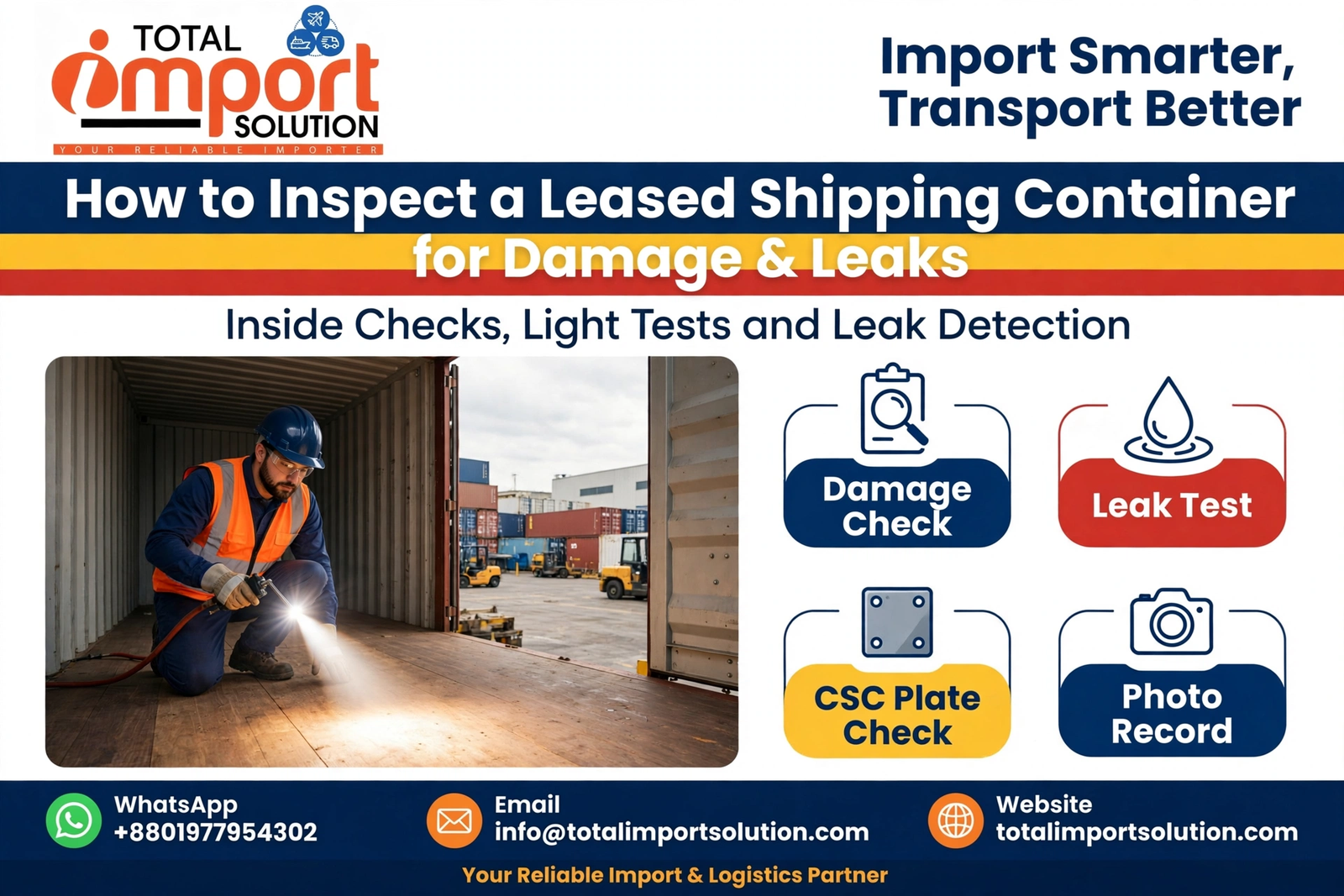
Next, check the inside walls and roof. Run the torch along each wall from floor to ceiling. You are looking for daylight coming through, which is the simplest sign of a hole. This is the light test: close the doors behind you so the inside is dark, then look carefully for any point of light from outside. Even a pinhole of light means a hole that rain can pass through. Check the roof seams, the top corners, and the joins where the walls meet the floor, because these are the places where leaks most often begin. Mark every point of light you find, and note its position.
Also check for contamination. Sniff the air inside the container. A strong chemical smell, a smell of fuel, or a smell of rotting cargo from an earlier load can affect your goods, and some smells are hard to remove. Look for stains, powder, oil marks, or old labels stuck to the walls. A container that carried chemicals or loose cargo before may need cleaning before it is safe for your goods.
5. How to Test for Leaks: Water, Light and Seal Checks
A leak test is worth doing on every leased container, not only on one that looks damaged. Rain during a sea voyage or a monsoon road journey is heavy, and a container that passes a quick look can still let water in through a worn seal or a hairline gap.
The light test from the previous section is the first leak test, and it costs nothing. Close the doors, wait for your eyes to adjust to the dark, and look for daylight at the roof seams, the door edges, the wall joins and the corner posts. Have someone outside shine a torch along the roof and walls while you watch from inside, if the depot allows it, because a moving light is easier to spot than still daylight.
The second check is the door seal check. With the doors closed, run your fingers along the rubber seals around all four edges of each door. The seals should be soft and springy, not hard, cracked or missing in sections. A seal that has gone hard with age will not press tightly against the frame, and water can pass through the gap. Look for daylight along the door edges from inside as well, because a gap at the door shows up clearly in the dark.
The third check is a water check, where the depot allows it. Pouring or spraying water over the roof and door seals while someone watches from inside will show a leak at once. Not every depot permits this, so ask first.
6. Doors, Seals and Locking Gear: What Must Move Freely
Doors that do not open and close smoothly cause trouble at every stage of the hire. At loading, a stiff door slows the forklift work. At the port, a door that will not seal properly can fail an inspection. At return, a damaged door can lead to a repair charge. So test every door before you accept the container.
Open each door fully and close it again. The hinges should turn without grinding or sticking, and the door should swing in a straight line without dropping at the outer edge. A door that drops has a worn or bent hinge, and it will not sit squarely in the frame when closed. Check each hinge for cracks, missing pins, and rust that has eaten into the metal.
Next, work the locking rods. Each door usually has four vertical rods with handles that turn to lock the door to the top and bottom of the frame. Turn each handle through its full movement. The rods should move freely, and the cams at the top and bottom should engage cleanly with their keepers. A rod that is bent, a handle that is missing, or a cam that does not engage means the door cannot be locked properly. Try the seal: with the door closed and locked, the rubber seal should press evenly against the frame all the way around, without a gap at any corner.
Check the customs seal facility too. The doors should have a seal bracket or hasp where a customs or security seal can be fitted, and it should be whole and able to close. If the bracket is bent or broken, a seal cannot be fitted, and the container cannot be secured for the journey. Note every stiff hinge, bent rod or damaged seal on the inspection report before you sign.
7. The CSC Plate and Safety Approval: First Checks
Every shipping container that travels internationally carries a CSC plate, a metal plate fixed to the door that shows the container has been approved under the Convention for Safe Containers. The plate is your quick check that the container is fit for international transport, and it should be part of every inspection.
Find the plate, usually on the left door, and read it. It shows the approval reference, the date the container was manufactured, the maximum gross weight, the stacking weight, and the date of the next examination. Check that the next examination date has not passed. A container whose examination date has passed should not be used for an international journey until it has been re-examined, and the depot should be able to show the re-examination record.
Check that the plate is firmly fixed, readable, and matches the container number painted on the container. A plate that is loose, unreadable, or belongs to a different container is a problem to raise before you sign. Also check the maximum gross weight and the stacking weight on the plate, and compare them with your cargo plan. The maximum gross weight is the heaviest the container and its cargo may weigh together, and the stacking weight is the weight the container can carry on top of it when stacked. Never plan a load heavier than the plate allows.
If the container is hired only for storage or for a local move inside Bangladesh, the CSC plate still matters as a record of the container's condition and examination history. Ask the depot for the examination record if the plate date is close to expiry, and keep a photograph of the plate with your inspection photos.
8. Floor Damage, Contamination and Smell
The floor carries the whole weight of your cargo, so it deserves a careful check of its own. Walk the floor in a grid, stepping on every board, and press down with your foot on any board that looks stained or worn. A sound board feels firm and does not move. A damaged board feels soft, springy, or hollow, and may crack under a pallet jack. Look at the floor from a low angle with the torch, because a low light shows dips and raised edges that are hard to see from above.
Check the edges of the floor where it meets the walls. Gaps along the edges let in dust and water, and they can trap cargo or catch a forklift wheel. Look for nails, screws or staples sticking up from the floor, and for patches where a board has been replaced. A replaced board is fine if it is level with the rest of the floor and firmly fixed, but note it on the report so it is not mistaken for damage at return.
Contamination is the other floor risk. Look for oil stains, chemical stains, powder, loose fibres, or food residue. Smell the floor area closely, because a spill that has soaked into the wood may not be visible but will still smell. A container that carried loose chemicals, fertiliser, or strong-smelling cargo may need a deep clean before it is safe for food, garments, or other sensitive goods. If you find contamination, ask the depot whether the container can be cleaned, or ask for a different container. Do not accept a contaminated container for sensitive cargo on the hope that the smell will fade, because it usually does not.
9. Rust, Dents and Previous Repairs: What Is Acceptable
Steel containers rust, and some rust is normal for a container that has worked at sea for years. The inspection question is not whether rust exists, but whether it has weakened the steel. Surface rust is a thin orange-brown layer on the paint that can be brushed off, and it does not usually affect the strength of the panel. Deep rust is different: it pits the steel, flakes away in layers, and leaves thin or holed metal behind. Press a rusted area gently with a gloved hand or a tool handle. If the metal feels thin, crumbles, or gives way, the panel needs repair.
Check the places where rust starts first: the bottom rails, the door bottoms, the corner posts near the floor, and any place where paint has been scraped off. Look at the roof seams and the top rails too, because rust there can open a leak path.
Dents need the same judgement. A shallow dent that has not cracked the paint is usually acceptable, and most leased containers carry a few. A deep dent that has bent the panel, cracked the paint, or pushed the wall inward is different, because it may have weakened the panel and it reduces the space inside. Previous repairs also need a look. A welded patch should be flat, sealed at the edges, and free of rust around the join. A patch that is raised, cracked, or rusting at the edges may leak. Note every deep dent, every area of deep rust, and every patch on the report, with a photograph, so the depot and the leasing provider can see exactly what was there at pickup.
10. Recording Damage: Photos, Notes and the Inspection Report
An inspection is only useful if it is recorded. Without photographs and written notes, a defect found at pickup becomes a matter of memory, and memory is hard to prove at return. Record everything in a way that another person can follow later.
Photograph the container in a set order. Start with the container number and the CSC plate, then photograph each side from the outside, then the roof edge, then the doors open and closed, then the inside walls, the roof from inside, and the floor. Then photograph each defect close up, with something in the frame that shows its position, such as the door handle or a floor board edge. Take the close-up after the wide shot, so the two photographs together show where the defect sits on the container.
Write a note for each photograph: the container number, the date, the position of the defect, and a short description. Use the inspection report or the pickup document for these notes, and write clearly enough that the depot staff can read them. Ask the depot staff to sign or stamp the report, or at least to note the defects on their own copy. Keep a copy of the signed report with your hire documents, and keep the photographs in a folder named with the container number and the date.
11. What to Do When You Find Damage or a Leak
Finding damage does not always mean refusing the container. It means deciding, with the depot, what happens next. The right step depends on how serious the problem is and whether it can be fixed quickly.
For a small problem, such as a shallow dent, a stiff hinge, or a small area of surface rust, note it on the inspection report, photograph it, and have the depot staff confirm the note. Then accept the container, because the defect is recorded and cannot be blamed on you at return.
For a problem that affects the cargo, such as a leak, a hole found by the light test, a soft floorboard, a door that will not seal, or a strong smell, ask the depot to fix it or to give you a different container. A leak can sometimes be repaired at the depot in a short time, and a floorboard can be replaced. If the repair is quick and you can watch the re-test, accepting the repaired container is reasonable. If the repair will take a long time, or the depot cannot say when it will be done, ask for a replacement container and inspect that one in the same way.
For a serious problem, such as a cracked corner casting, a bent corner post, a badly rusted roof, or a CSC plate whose examination date has passed, do not accept the container. These defects affect safety and the right to travel, and they are not fixed with a quick repair. Ask for a replacement, and note the reason on the report. If the depot disagrees, contact your leasing provider while you are still at the depot, and follow their instruction.
12. Accept, Ask for Repair or Reject: Making the Decision
The decision at the end of an inspection has three options, and each one should be clear to everyone involved. Accept the container when it is sound, or when the only defects are small and fully recorded on the signed report. Before you accept, walk through your own checklist once more: light test done, doors working, seals soft, floor firm, CSC plate in date, and photographs taken. If every item is checked, sign the pickup document and keep your copy.
Ask for repair when the defect can be fixed at the depot and the fix can be checked. Agree in writing what will be repaired, how long it will take, and who will re-test the container. Do not sign the pickup document until the repair is done and you have checked the result yourself. A repair that is promised but not checked is not a repair you can rely on.
Reject the container when the defect affects safety, the right to travel, or the protection of your cargo, and cannot be fixed quickly. A cracked corner casting, a holed roof, a failed CSC examination, or heavy contamination are reasons to reject. When you reject, write the reason on the report, take photographs, and ask the depot to record the rejection. Then ask for a replacement container, and inspect it from the start in the same way. A rejected container is not a wasted visit; it is a problem found before it could damage your cargo.
Keep the decision calm and factual. State what you found, show the photograph, and ask for the fix or the replacement in writing.

13. Inspection Checklist for Every Leased Container
Use the checklist below at every pickup, and keep a copy in your office for the team that collects containers. The checklist works for any dry container, and it takes only a short time once the team is used to it.
| Check | What to look for | Pass or fail |
|---|---|---|
| Container number | Number on container matches the booking | Pass only if it matches |
| CSC plate | Plate fixed, readable, examination date in date | Pass only if in date |
| Outside walls | No deep dents, no cracked paint, no holes | Fail on deep dent or hole |
| Roof | Level, no sag, no patches leaking, no deep rust | Fail on sag or hole |
| Corner castings | Whole, not cracked or bent | Fail on any crack |
| Doors | Open and close smoothly, hinges whole | Fail on dropped door |
| Locking rods | All rods move, cams engage, handles present | Fail on bent rod |
| Door seals | Soft, complete, no gaps, no daylight at edges | Fail on hard or missing seal |
| Light test | No daylight inside with doors closed | Fail on any point of light |
| Floor | Firm underfoot, no soft boards, no nails up | Fail on soft board |
| Smell and stains | No strong chemical or rotten smell | Fail on strong smell |
| Previous repairs | Patches flat, sealed, no rust at joins | Fail on cracked patch |
| Photographs | Number, plate, each side, each defect | Fail if any set is missing |
| Report | All defects noted and signed by depot | Fail if unsigned |
Work through the list in order, and do not skip a step because the container looks new. A new-looking container can still carry a worn seal or a soft floorboard, and the checklist is what catches it. When the whole list is passed, sign the pickup document and keep your copy with the photographs.
Frequently Asked Questions
1. When should I inspect a leased container?
Inspect it at pickup, before you sign the pickup document and before the container leaves the depot. That is the moment when damage can still be recorded as existing before your hire began.
2. What is the light test?
Close the doors so the inside is dark, then look for daylight coming through the roof, walls or door edges. Any point of light means a hole that rain can pass through.
3. How do I check for leaks if I cannot use water?
Use the light test, then run your fingers along the door seals and look for daylight at the door edges from inside. Together these two checks give a reliable result without water.
4. What should I check on the CSC plate?
Check that the plate is firmly fixed and readable, that it matches the container number, and that the next examination date has not passed.
5. What is a corner casting, and why does it matter?
A corner casting is the strong steel fitting at each corner of the container that cranes and twistlocks grip. A cracked or bent casting affects safe lifting, so it is a serious defect.
6. How do I check the container floor?
Walk across the whole floor slowly, feeling for soft spots, loose boards or movement under your weight. Look for stains, cracks, gaps and nails sticking up.
7. What kind of rust is a problem?
Surface rust is a thin layer on the paint and is usually harmless. Deep rust that pits the steel, flakes away in layers, or leaves thin metal behind is a problem.
8. Should I accept a container with a small dent?
A shallow dent that has not cracked the paint is usually acceptable if it is noted on the signed inspection report and photographed. A deep dent that has bent the panel should be raised with the depot.
9. What should I do if the door seal is hard or cracked?
Raise it with the depot before you sign. A hard or cracked seal will not press tightly against the frame, and water can pass through the gap.
10. What if the container smells of chemicals?
Do not accept it for sensitive cargo such as food or garments. Ask the depot whether it can be cleaned, or ask for a different container.
11. What photographs should I take at pickup?
Photograph the container number and CSC plate, each side from outside, the doors open and closed, the inside walls and roof, the floor, and a close-up of each defect with its position visible.
12. Who should sign the inspection report?
You and the depot staff should both sign or stamp the report, so the defects noted at pickup are agreed by both sides.
13. Can a leak be repaired at the depot?
Some leaks can be repaired quickly at the depot, such as a seal replacement or a small patch. Ask for the repair in writing, and re-test the container yourself before you sign.
14. When should I reject a container?
Reject it when the defect affects safety or the right to travel, such as a cracked corner casting or an expired CSC examination, or when it cannot be fixed quickly and would put your cargo at risk.
15. How can Total Import Solution help with container inspection?
Total Import Solution supports importers in Bangladesh since 2016 with container hiring and inspection guidance, helping you check the container at pickup, record any damage, and raise problems with the depot before you sign.
16. What documents should I keep after the inspection?
Keep the signed inspection report, the pickup receipt, the photographs, the lease or rental agreement, and the CSC plate photograph together in one file for the hire.
Contact Total Import Solution
For leased shipping container inspection support and container hiring in Bangladesh, contact Total Import Solution.
- Company: Total Import Solution — Since 2016
- Service: How to Inspect a Leased Shipping Container for Damage & Leaks
- WhatsApp: +8801977954302
- Email: info@totalimportsolution.com
- Website: totalimportsolution.com
Share your cargo, container size, pickup location, and the dates you need, and the team will help you check the container before you sign.
