
Construction Equipment Transport: Oversized Container Solutions
Construction work in Bangladesh depends on heavy machines: excavators dig foundations, cranes lift steel and concrete, wheel loaders move earth, bulldozers shape land, and road rollers compact new roads. When a machine is too tall, too wide, or too heavy for a standard closed container, it becomes an oversized load, and it needs a different kind of planning. This guide explains how to measure a machine, choose between a flat rack and an open top container, lash and secure the load, prepare the documents, clear customs, and arrange delivery to a project site.
This guide is for importers, contractors, and project managers bringing construction equipment into Bangladesh. It does not repeat the earlier Open Top Container Hire for Heavy Machinery Transport post, which covers hiring an open top container for heavy machinery in general. No fixed prices, rates, duty percentages, or fees are given here, because a rate or fee is confirmed only after checking the actual shipment and its documents. Total Import Solution, since 2016, supports importers in Bangladesh with shipment planning, documentation, customs clearance support, and delivery coordination.
1. What Oversized Construction Equipment Transport Means
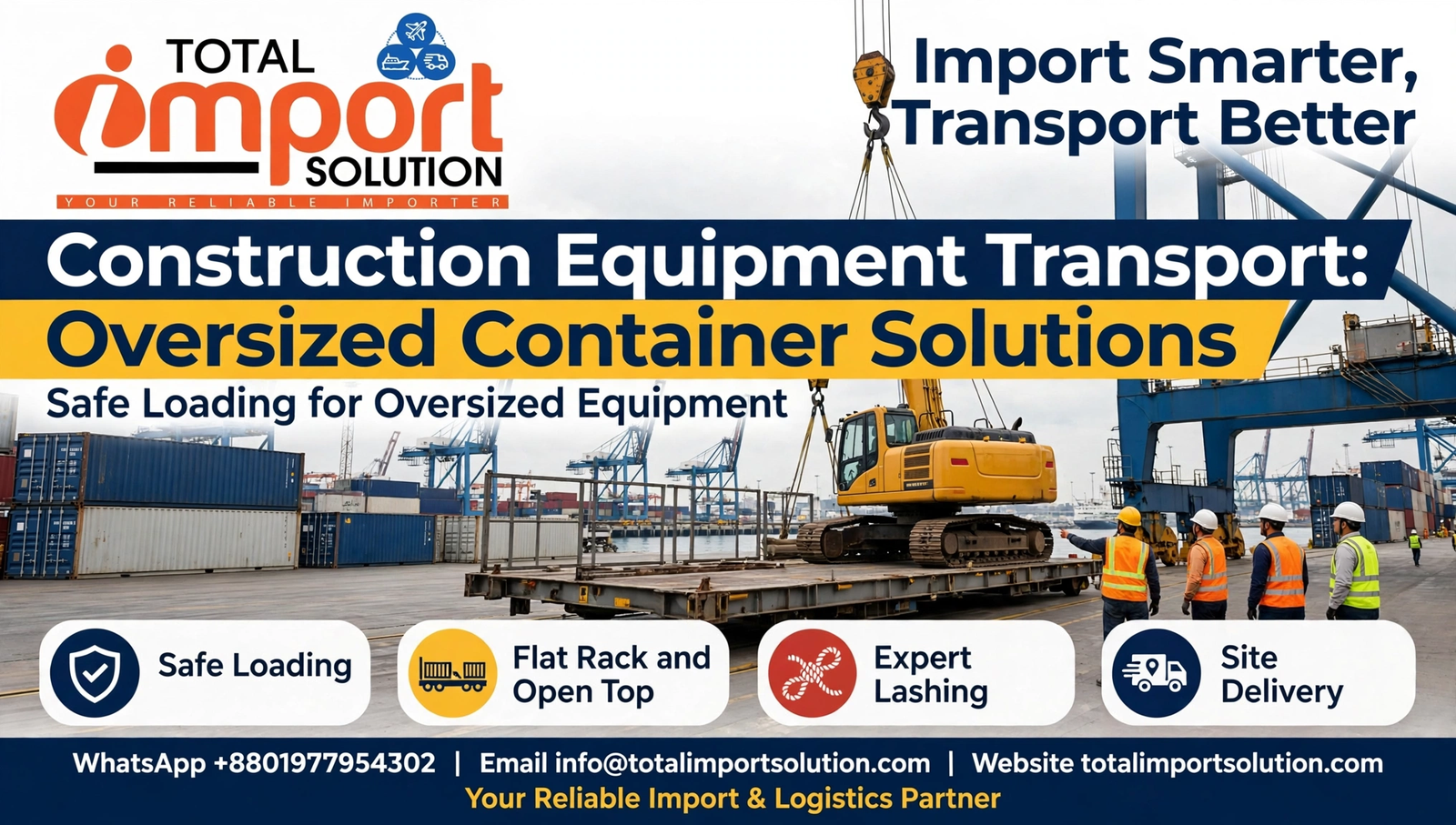
Oversized construction equipment transport means moving a machine that does not fit inside a standard closed container, or that cannot be loaded through its doors. In these cases the machine travels on a flat rack container, which has a floor and end walls but no side walls or roof, or in an open top container, which has solid walls but an open roof covered by a tarpaulin.
The work starts long before the machine reaches the port. The buyer must know the exact machine, its size, its weight, and which parts can be removed. The supplier prepares the machine, and the shipping team books the right container, lifting equipment, and route.
| Machine type | Why it is often oversized | What to check first |
|---|---|---|
| Excavator | Boom, arm and bucket add height and length | Boom position, bucket removed or fixed |
| Mobile crane | Long jib and outriggers add length and width | Jib length, outrigger width, counterweight |
| Wheel loader | Wide tyres and raised bucket add width and height | Tyre width, bucket position |
| Bulldozer | Broad blade adds width | Blade width, blade removal |
| Road roller | Heavy drum and frame add weight | Drum width, total weight |
2. Measuring Your Equipment Before You Book Anything
Nothing in oversized transport should be booked before the machine is measured: a booking made on a guess can lead to a container that is too small, a crane that cannot lift the load, or a port that refuses the cargo. Measure the machine in the position it will travel in, not in its working position — a lowered excavator boom is shorter than a raised one, and a folded crane jib is shorter than an extended one. Measure the length from the furthest front point to the furthest back point, the width across the widest part, including tyres, tracks, blades, and mirrors, and the height from the ground to the highest fixed point.
Record the weight from the machine plate or the supplier's sheet, and check whether it includes fuel, attachments, and the bucket. Take clear photos from the front, the back, and both sides, and list every removable part, such as the bucket, blade, counterweight, mirrors, and exhaust stacks, with the size and weight of each.
| Measurement | How to take it | Why it matters |
|---|---|---|
| Length | Furthest front point to furthest back point | Decides the container length |
| Width | Across the widest part, including tyres and blade | Decides flat rack or open top |
| Height | Ground to the highest fixed point | Decides roof clearance and tarpaulin |
| Weight | Machine plate or supplier sheet, fuel and attachments noted | Decides lifting and lashing |
| Removable parts | List each part with its own size and weight | May reduce the size of the load |
3. Flat Rack or Open Top: Choosing the Right Container
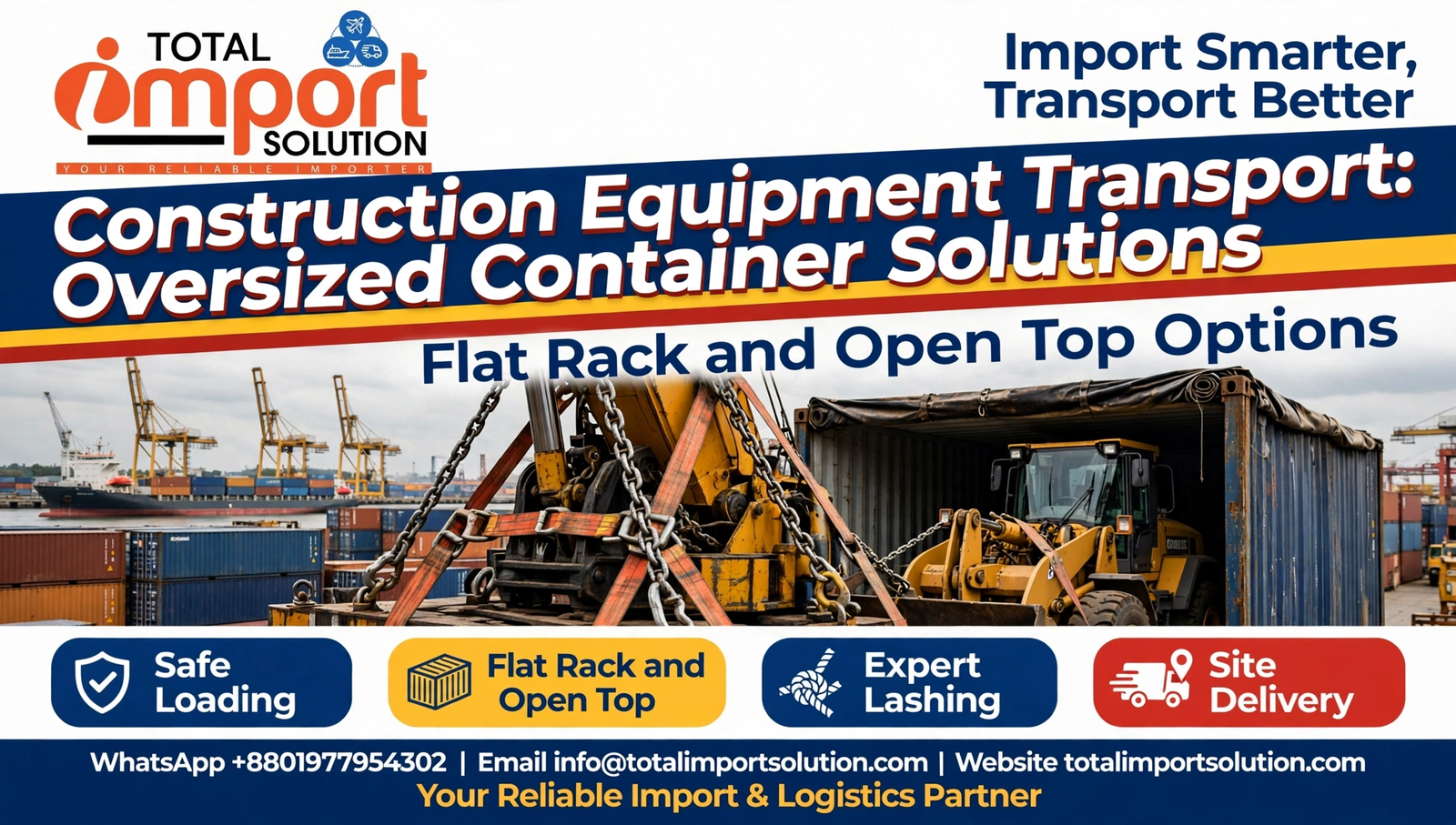
The two main container solutions are the flat rack and the open top container, and the choice depends on the size and shape of the machine. A flat rack has a strong floor and two end walls, with no side walls and no roof. The machine can be loaded from the top by crane or from the side, and parts that stick out beyond the floor can be carried if the port and the shipping line accept the overhang.
An open top container has solid side walls, end walls, and a floor, with an open roof covered by a removable tarpaulin. The machine is loaded from above by crane, and the walls protect its lower part during the journey. The tarpaulin must be fitted tightly, with no gaps where rain can enter, and the load must not press against it from below.
Container sizes are widely standard, and the figures here are approximate only: a 20-foot container is approximately 6 metres long, and a 40-foot container is approximately 12 metres long. Always check the actual container before loading, because the figures on the container plate are the ones that count on the day.
| Container option | Best for | Loading method | Watch out for |
|---|---|---|---|
| Flat rack, 20-foot size | Wide or tall single machines | Crane from above, or side loading | Overhang needs approval and strong lashing |
| Flat rack, 40-foot size | Long machines such as cranes | Crane from above | Centre of gravity must sit over the floor |
| Open top, 20-foot size | Tall machines that fit the width | Crane from above | Tarpaulin must fit tightly |
| Open top, 40-foot size | Long and tall machines | Crane from above | Load must not press the tarpaulin |
4. Preparing Equipment for Loading: Cleaning, Dismantling and Protection
A machine should arrive at the loading point clean and ready to be lifted. Clean the tracks, tyres, undercarriage, and bucket so soil, mud, and loose debris do not fall during lifting or travel. Remove loose items from the cab, lock the doors and windows, and fix any part that can swing or rattle, such as mirrors, hoses, and steps.
Dismantle the parts that make the machine oversized where the manual allows it: remove the bucket, unbolt the blade, lift off the counterweight, and fold or remove mirrors, lights, and exhaust stacks. Label every removed part and list each one on the packing list, so nothing is lost and reassembly is straightforward. Protect exposed surfaces: wrap glass and lights, cover the cab and hydraulic rams, and pad sharp edges that could cut a strap or the tarpaulin.
| Preparation step | What to do | Why it matters |
|---|---|---|
| Clean the machine | Wash tracks, tyres, bucket and undercarriage | Clear inspection, no loose soil |
| Lock the cab | Lock doors and windows, remove loose items | Stops damage and loss inside |
| Dismantle where allowed | Remove bucket, blade, counterweight, mirrors | Reduces size and height |
| Label removed parts | Mark each part with machine and part name | Easy reassembly, nothing lost |
| Protect surfaces | Wrap glass, cover rams, pad sharp edges | Prevents damage and cut straps |
5. Lashing and Securing: How Equipment Stays Safe at Sea
Lashing is the work that holds a machine still on a flat rack or inside an open top container while the ship moves. A machine that shifts during the voyage can damage itself, damage the container, and put other cargo at risk. Lashing must be planned before loading, not improvised on the day. The plan should name the lashing points on the machine, the number and type of straps or chains, the direction of each lashing, and the order in which they are tightened.
Chains, wire ropes, and heavy webbing straps are the usual lashing materials, and the choice depends on the weight of the machine and the lashing points available. Chains suit heavy machines with strong steel lashing points. Every lashing should pull the machine down and inwards, so it cannot slide or tip. Wooden chocks should be placed against the wheels or tracks to stop rolling, and timber dunnage under the machine should spread the weight across the container floor.
After loading, walk around the machine and check every lashing: each strap or chain tight, no strap twisted, no edge cutting into a strap, and the chocks firm.
| Lashing point | What to check | Common mistake |
|---|---|---|
| Machine lashing points | Use the points named in the manual | Fixing to a weak or moving part |
| Chains | Rated for the weight, no damaged links | Using a chain with a cracked link |
| Webbing straps | Rated for the load, no cuts or wear | Strap over a sharp edge without padding |
| Chocks and blocks | Firm against wheels or tracks | Chocks too small or loose |
| Dunnage | Timber under the machine, weight spread | Machine resting on one point |
6. Loading at Origin: Cranes, Ramps and Supervision
Loading is the moment when the plan meets the real machine, and it needs the right equipment, the right people, and enough time. A crane lifts a machine onto a flat rack or into an open top container from above, and it must be able to lift the full weight of the machine, including attachments, at the reach needed. A ramp allows a machine to be driven onto a flat rack under its own power, but the ramp must be strong enough, the angle must be safe, and a banksman must guide the driver.
Supervision matters as much as the crane. One person should be in charge, with a clear view of the machine, the crane, and the container, and a radio or clear hand signals to the operator and the driver. The supervisor re-checks the measurements, confirms the centre of gravity, and stops the work if anything looks wrong.
| Loading step | What happens | Who checks it |
|---|---|---|
| Step 1: Prepare the area | Flat ground, clear space, crane in position | Loading supervisor |
| Step 2: Check the machine | Measurements, weight, lashing points confirmed | Supervisor and crane operator |
| Step 3: Lift or drive on | Slow lift, or guided drive up the ramp | Crane operator and banksman |
| Step 4: Position the machine | Centre of gravity over the floor, clear of edges | Supervisor |
| Step 5: Lash and chock | Straps, chains, chocks and dunnage fitted | Loading team |
| Step 6: Final check and photos | Walk-around, sign-off, photos from all sides | Supervisor |
7. Port Handling and Stowage for Oversized Loads
After loading, the container travels to the port, where it is handled by port equipment and stowed on the ship. Oversized loads need more care at the port than standard containers, because they may be wider or taller than the space around them, and the lashings and tarpaulin must not be damaged by handling. Tell the port and the shipping line in advance that the load is oversized, with the exact measurements and the container type, so the right handling equipment and stowage position are planned.
At the port, the container is lifted by spreaders or slings, and the port team checks the container number, the seal, the lashings, and the tarpaulin before it is moved. A loose lashing or a torn tarpaulin should be fixed at the port before the ship sails. On arrival in Bangladesh, the container is unloaded in the same careful way.
| Port stage | What happens | What to confirm |
|---|---|---|
| Arrival at port | Container received, number and seal checked | Measurements shared in advance |
| Handling | Lifted by spreader or slings, moved to the quay | Lifting points match the container |
| Pre-sailing check | Lashings, tarpaulin and seal inspected | Loose lashing fixed before sailing |
| Stowage on ship | Placed in a protected position | Oversized position planned |
| Voyage checks | Crew checks lashings during the voyage | Movement reported and noted |
| Unloading in Bangladesh | Lifted off the ship, checked again | Tarpaulin and lashings intact |
8. Documents You Need for Construction Equipment Imports
Documents decide whether a machine clears customs smoothly or waits at the port. Prepare them before the machine is shipped, and check that every document matches the cargo. The commercial invoice names the seller, the buyer, the machine, and the value. The packing list names every item in the shipment, including removed parts such as the bucket, the blade, and the counterweight, with the weight and size of each item. The bill of lading is the transport document issued by the shipping line, naming the shipper, the consignee, the port of loading, the port of discharge, and the container number.
Other papers may be needed depending on the machine and the rules in force at the time, such as the import registration certificate, the trade licence, the tax papers, a catalogue showing the machine model, and a letter explaining the use of the machine. Keep a full set of copies, and share it with the agent before the ship arrives, so any mismatch can be fixed in time.
| Document | What it shows | Check before shipping |
|---|---|---|
| Commercial invoice | Seller, buyer, machine, value | Machine model and value match the order |
| Packing list | Every item, weight and size | Removed parts listed separately |
| Bill of lading | Shipper, consignee, ports, container number | Container number correct |
| Certificate of origin | Country where the machine was made | Required for this shipment or not |
| Import registration certificate | Buyer registered as an importer | Valid and in the buyer name |
| Trade licence and tax papers | Buyer business and tax details | Names match the invoice |
9. Customs Clearance in Bangladesh: Steps and Checks
Customs clearance is the formal process at the port in Bangladesh where the shipment is declared, checked, and released. The agent files a customs declaration, called a bill of entry, with the invoice, packing list, bill of lading, and the other papers listed in the previous section. Customs officers compare the papers with the cargo, checking the machine model, the serial number, the number of items, and the declared value. Clear papers and an orderly load make this check quick, while a mismatch can lead to questions, re-checking, and delay.
Duty and other charges are assessed by customs under the rules in force at the time of import, depending on the classification of the machine and the declared value. No fixed duty figure is given in this guide, and a rate or fee is confirmed only after checking the actual shipment and its documents. Total Import Solution, since 2016, has supported importers through this stage by checking the documents before filing and keeping the buyer informed until release.
| Clearance step | What happens | Buyer action |
|---|---|---|
| Step 1: Documents received | Agent receives the full document set | Share papers before the ship arrives |
| Step 2: Declaration filed | Bill of entry filed with customs | Check names and numbers match |
| Step 3: Assessment | Customs checks classification and value | Answer questions with papers |
| Step 4: Inspection | Officers inspect the machine and parts | Machine accessible, parts listed |
| Step 5: Charges settled | Assessed charges settled as advised | Ask for a written statement |
| Step 6: Release | Machine released from the port | Arrange transport promptly |
10. Route Planning and Delivery to Project Sites in Bangladesh
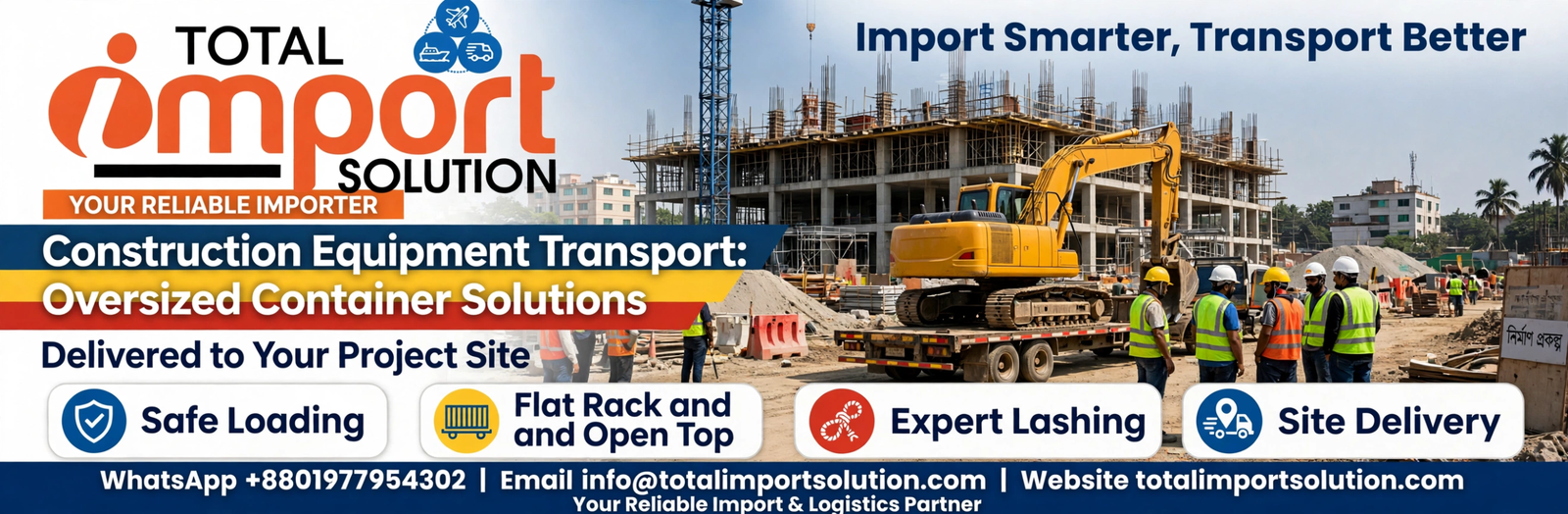
Delivery is the last leg of the journey, and it needs the same care as the sea voyage. A machine on a flat rack or in an open top container is moved from the port to the project site by road, usually on a low-bed trailer or a flatbed truck that can carry the weight and the size of the load. Plan the route before the machine is released from the port. Check the road width, the bridge limits, the height of overhead lines and bridges, and the turning space at the site entrance.
Talk to the project site team before delivery day about the access road, the unloading space, the crane or ramp at the site, and the time the site can receive a delivery. On delivery day, the truck parks on flat ground, the lashings are released only when the machine is ready to be unloaded, and the machine is driven or lifted off slowly, with a banksman guiding the movement.
| Delivery point | What to check | Why it matters |
|---|---|---|
| Route | Road width, bridges, overhead lines | Wide or heavy load needs a clear route |
| Trailer | Low-bed or flatbed, rated for the weight | Wrong trailer risks damage |
| Site access | Access road, turning space, ground firmness | Truck must reach the unloading point |
| Unloading equipment | Crane or ramp at the site | Machine must come off safely |
| Final check | Compare with loading photos, refit parts | Damage found early is easier to fix |
11. Permits, Road Limits and Site Access in General Terms
Oversized loads on the road are subject to rules about size, weight, and movement, and these rules should be checked in general terms before delivery, not assumed. The rules can cover the maximum width and height of a load on a public road, the maximum weight on an axle or on a bridge, the times when a wide load may move, and whether an escort vehicle is needed.
Site access is the other half of the same question. A site may have a narrow gate, a soft access road, a low overhead cable, or a slope that a loaded trailer cannot climb. Visit the site before delivery day where possible, or ask the site team for photos and measurements of the gate, the road, and the unloading area.
| Rule or limit | What it covers | How to handle it |
|---|---|---|
| Road width limit | Maximum width of a load on a road | Check the route, choose a wider road where needed |
| Road height limit | Bridges and overhead lines | Measure the loaded height, avoid low crossings |
| Weight limit | Axle weight and bridge weight | Check the trailer and the route |
| Movement time | When a wide load may travel | Plan delivery for an allowed time |
| Site access | Gate, road, unloading space | Visit the site or ask for photos |
12. Common Mistakes and How to Avoid Them
Most problems in oversized equipment transport come from a small set of repeated mistakes, and each one is easy to avoid with a little planning. The first mistake is booking the container before measuring the machine, which leads to a container that does not fit. The second mistake is forgetting a removable part in the measurements, such as a bucket left on the machine or a blade that was meant to be removed, which adds width or height that was not planned. The third mistake is weak lashing, where straps are loose, chains are fixed to the wrong points, or chocks are missing, so the machine shifts during the voyage.
The fifth mistake is leaving delivery planning until the machine is already at the port, which leads to a trailer that cannot carry the load, a route that cannot take the width, or a site that is not ready. The sixth mistake is rushing the loading to meet a closing time. Avoid these mistakes by following a simple order: measure first, choose the container second, prepare and lash third, check the documents fourth, and plan the delivery fifth.
| Mistake | What goes wrong | How to avoid it |
|---|---|---|
| Booking before measuring | Container does not fit the machine | Measure first, book second |
| Forgetting a removable part | Extra width or height not planned | List every part, check the list |
| Weak lashing | Machine shifts during the voyage | Plan lashings, check every strap |
| Poor documents | Customs questions and delay | Check papers against the cargo |
| Late delivery planning | Wrong trailer, wrong route, site not ready | Plan the route before release |
| Rushed loading | Hurried lift, missed check | Hurried lift, missed check |
13. Working with Your Agent and How Total Import Solution Helps
Working well with your agent starts with sharing full information: the exact machine, its size and weight, the supplier details, the order, the invoice, and the packing list, as soon as they are ready. Share the photos and the measurements too, so the agent can plan the container, the lashing, and the delivery before the machine leaves the supplier.
Ask the agent for a written plan covering the container type, the loading method, the documents, the customs steps, and the delivery route, and a written statement of the charges that may apply. Total Import Solution helps importers of construction equipment at each stage, from measuring and container choice to documents, customs clearance support, and delivery coordination to project sites in Bangladesh.
Frequently Asked Questions
1. What is oversized construction equipment transport?
It is the movement of a construction machine that is too tall, too wide, or too heavy for a standard closed container, using a flat rack or an open top container, with careful measuring, lashing, documents, and delivery planning.
2. Which machines are usually oversized?
Excavators, mobile cranes, wheel loaders, bulldozers, road rollers, and piling rigs are often oversized because of their boom, jib, blade, tyres, tracks, or mast, which add height, width, or weight beyond a closed container.
3. How do I measure my machine before booking?
Measure the length, width, and height in the travelling position, record the weight from the machine plate or supplier sheet, list every removable part, and take photos from all sides to share with your shipping agent.
4. What is a flat rack container?
A flat rack is a container with a strong floor and two end walls, but no side walls and no roof, so a wide or tall machine can be loaded from above or from the side, with parts that stick out carried under an approved plan.
5. What is an open top container?
An open top container has solid walls and a floor with an open roof covered by a tarpaulin, so a tall machine can be loaded from above by crane while the walls protect the lower part of the machine.
6. How do I choose between a flat rack and an open top container?
Choose a flat rack for a very wide or very tall machine that needs open sides, and an open top for a tall machine that fits within the width of the walls, after checking the measurements against the actual container.
7. Which parts of a machine can be removed for transport?
A bucket, a blade, a counterweight, mirrors, lights, and an exhaust stack can often be removed where the manual allows it, and each removed part should be labelled and listed on the packing list.
8. How is a machine lashed and secured?
The machine is fixed to the container with chains, wire ropes, or heavy webbing straps attached to the lashing points named in the manual, with chocks against the wheels or tracks and timber dunnage under the machine to spread the weight.
9. What documents do I need to import construction equipment?
The commercial invoice, the packing list, the bill of lading, the certificate of origin where required, the import registration certificate, the trade licence, and the tax papers, with every name, number, and model matching the cargo.
10. How does customs clearance work in Bangladesh?
The agent files a bill of entry with the documents, customs compares the papers with the cargo and may inspect the machine, and the machine is released once the checks are done and the assessed charges are settled as advised.
11. How is duty on construction equipment decided?
Duty depends on the classification of the machine, the declared value, and the rules in force at the time of import, and a rate or fee is confirmed only after checking the actual shipment and its documents.
12. How is the machine delivered to a project site?
The machine is moved from the port by road on a low-bed trailer or a flatbed truck, along a route checked for width, height, and weight limits, and unloaded at the site with a crane or a ramp under supervision.
13. Do I need a permit for an oversized load on the road?
Rules about size, weight, movement times, and escort vehicles can apply to an oversized load, so the rules for the planned route and date should be checked in advance and time allowed for any permission that may be needed.
14. What causes damage to equipment during transport?
Weak lashing, a rushed lift, missing protection on glass and hydraulic rams, a damp container, and a machine resting on one point of the floor can all cause damage, so careful preparation, lashing, and checking matter at every stage.
15. How do I choose a good provider for oversized equipment transport?
Look for clear communication, a written plan for measuring, container choice, lashing, and delivery, careful paperwork, charges stated in writing, and experience with the type of machine you are importing.
16. How can Total Import Solution help with my oversized equipment shipment?
Total Import Solution supports importers with shipment planning, measuring advice, container choice, documentation, customs clearance support, and delivery coordination to project sites in Bangladesh.
Contact Total Import Solution
- WhatsApp: +8801977954302
- Email: info@totalimportsolution.com
- Website: totalimportsolution.com
- Service: Construction Equipment Transport: Oversized Container Solutions
- Company: Total Import Solution — Since 2016, serving importers in Bangladesh.
