
Factory audit in China for Bangladesh companies
Many companies in Bangladesh buy goods from factories in China. The buyer and the factory are far apart, and the buyer often cannot visit the factory in person before the order is placed. A factory audit in China for Bangladesh companies is a practical way to close that gap. An auditor visits the factory, checks what is really there, and writes a report that the buyer in Bangladesh can read and act on.
This guide explains the factory audit in plain language, step by step, for owners, managers, buying teams, and import teams who want to understand what an audit covers, what it does not cover, how to arrange one, and how to use the report. It does not promise a result, and it does not quote a rate or a fee. A rate or a fee is confirmed only after checking the actual shipment and the actual documents, because every order is different in product, quantity, factory location, and scope.
Since 2016, Total Import Solution has been helping importers in Bangladesh, and this guide follows the same practical approach used in real import work: check the factory first, check the documents second, and keep every step in writing.
1. What a Factory Audit in China Is and Why Bangladesh Companies Use One
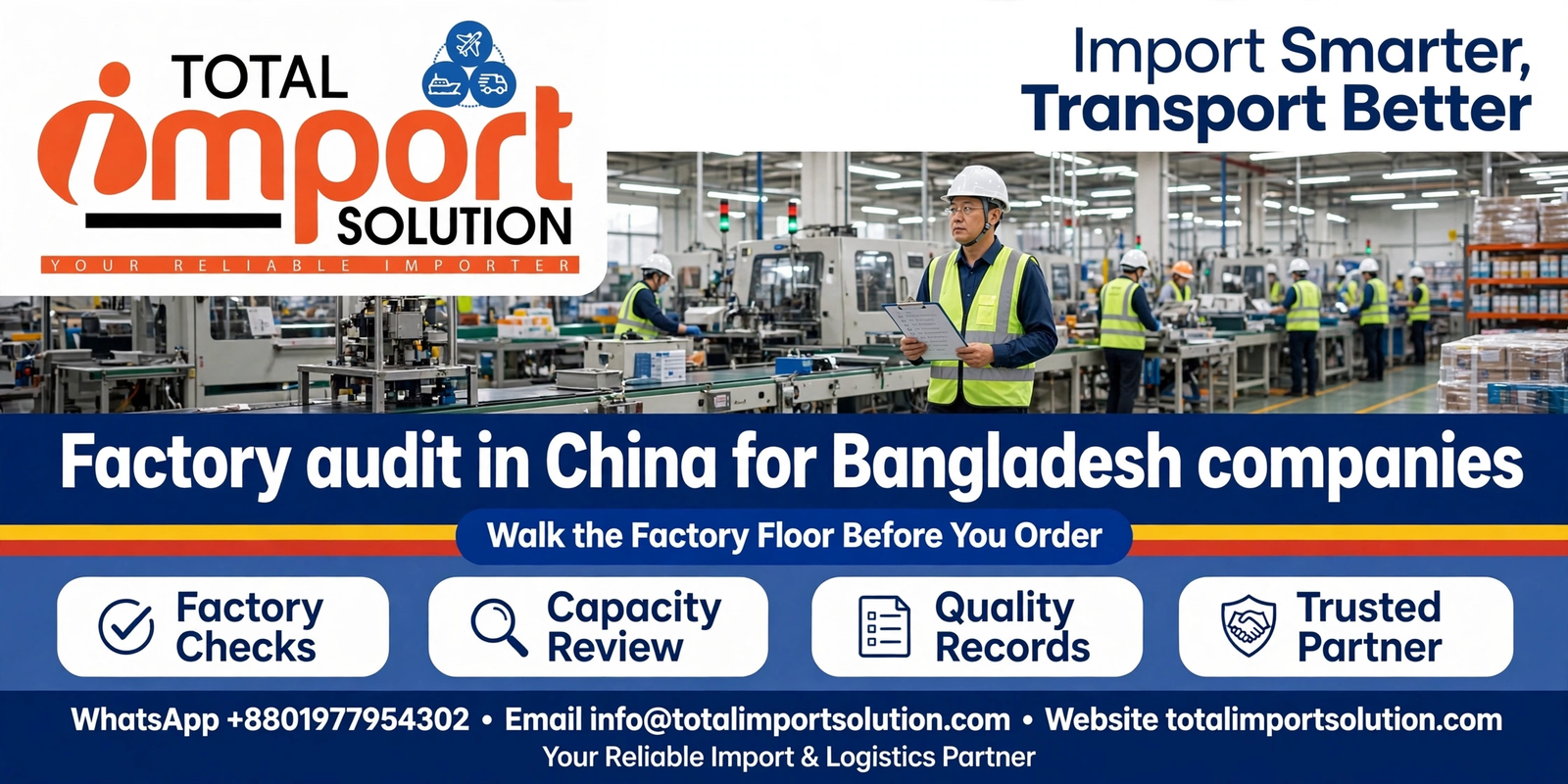
A factory audit is a visit to a supplier factory by an auditor who checks the factory against a list of points agreed in advance. The auditor looks at the factory building, the production area, the machines, the workers at work, the raw material store, the finished goods store, and the records the factory keeps. The auditor takes photos, notes what is seen, asks questions, and writes a report. The report goes to the buyer, who reads it before making a decision about the order.
Bangladesh companies use a factory audit for a simple reason: a website, a catalogue, and a chat message do not show the full picture. A supplier may be a real factory, a trading company that works with several factories, or a small workshop. Each of these can be a fair supplier, but the buyer needs to know which one it is, because the type of supplier changes how the order is managed, how quality is checked, and who is responsible when a problem appears.
2. Types of Factory Audits a Bangladesh Buyer May Ask For
Not every audit is the same. The type of audit depends on what the buyer wants to know. A buyer who is meeting a supplier for the first time needs a different check from a buyer who has worked with the same factory for years and wants to check one new product line. Agree on the audit type before the visit, so the auditor checks the right things.
| Audit type | What it mainly checks | When a buyer asks for it |
|---|---|---|
| General factory audit | Factory size, machines, workers, and organisation | Before a first order with a new supplier |
| Production capacity audit | Machines, workers, material, and output ability | Before a large order or a repeat order |
| Quality system audit | Quality checks, records, and testing | When product quality matters most |
| Product line audit | One product line, its machines, and its workers | Before ordering a new product from a known factory |
| Social and workplace audit | Working conditions, safety, and housekeeping | When the buyer or the buyer customer asks for it |
| Follow-up audit | Whether earlier findings were fixed | After a first audit found problems to fix |
3. When to Order a Factory Audit
Timing matters. An audit ordered at the right time can stop a problem before money moves. An audit ordered too late can only record a problem that has already happened. Plan the audit at the stage where its findings can still change the decision.
The most useful time for a first audit is before the order is placed and before any payment is sent. At this stage, the buyer can still choose another supplier, change the order, or ask the factory to fix a problem first. The audit report is then part of the decision, not an afterthought.
A second useful time is before production starts, when the buyer wants to check that the factory has the material, the machines, and the workers ready for the order. This check is helpful for a large order, a new product, or a product with a tight quality need. If the material is not in the store, or a key machine is under repair, the buyer learns it before production begins.
Order the audit early enough for the report to reach you, for you to read it, and for the factory to answer any questions. Keep the audit in your order plan from the start, not as a last step before shipment.
4. What to Agree in Writing Before the Audit
An audit works best when the auditor, the factory, and the buyer all know the plan in advance. Put the plan in writing before the visit, and share it with the auditor and the factory. A written plan avoids confusion on the day and makes the report easier to read.
First, agree on the audit type and the checklist. Write down the points the auditor must check, such as the factory licence, the production area, the machines, the quality checks, the material store, and the finished goods store. If your product has a special need, such as a test, a material grade, or a packing rule, write that need on the list too.
Second, agree on the factory address and the contact person. The auditor must visit the factory that will actually make the order, not a showroom or a different site. Ask for the full address, the name of the person who will meet the auditor, and the working hours of the factory, and pass these details to the auditor in writing.
Third, agree on what the auditor may see and photograph. The auditor needs to see the production area, the machines in use, the material store, and the quality records. Ask the factory to allow photos of these areas, and note any area the factory says is closed. A factory that refuses to show the production area is a point the buyer needs to know about.
5. Documents and Information to Share with the Auditor
The auditor can only check what the auditor knows about. Share the order details, the product details, and the supplier details before the visit, so the auditor arrives with the right questions. Send the information in one message or one file, and keep a copy in your order file.
| Information to share | Why the auditor needs it | Check before you send it |
|---|---|---|
| Product name and description | To check the right product line and material | Description matches your order |
| Product drawings or photos | To compare the product with the sample | Drawings are the latest version |
| Order quantity | To judge whether the factory can make the volume | Quantity matches your plan |
| Material and parts list | To check the material in the store | Material names are clear |
| Quality needs and test needs | To check the factory testing and records | Needs are written in plain words |
| Supplier name and factory address | To visit the correct factory | Address matches the supplier message |
| Supplier business papers | To check the factory name and registration | Papers are the ones the supplier sent |
| Sample and reference product | To compare the factory product with your sample | Sample is marked with your reference |
Send the product specification in plain words. A specification that only says “good quality” does not help the auditor, because the auditor cannot measure it. Write down the material, the size, the colour, the finish, the packing, and any test you expect. If you have a sample, tell the auditor, and ask the auditor to compare the factory product with it.
6. How the Auditor Checks the Factory, Step by Step
A factory audit follows a clear order. Knowing the order helps the buyer read the report, because the report usually follows the same steps. The steps below describe a general factory audit, and your auditor may add points that fit your product.
Step one is the arrival and the opening meeting. The auditor meets the factory contact, explains the audit plan, and asks for the factory papers. The auditor notes the factory name, the address, the contact person, and the number of workers present on the day.
Step two is the document check. The auditor looks at the business papers, the factory licence, and any certificate the supplier has shown. The auditor checks the name on the papers against the factory name, the address on the papers against the factory address, and the dates on the papers. If a certificate is shown, the auditor notes who issued it, what it covers, and when it is valid until, so the buyer can check it further.
Step three is the walk through the factory. The auditor walks the production area, the material store, the finished goods store, and the packing area. The auditor notes whether the area is clean and organised, whether material is stored in order, whether machines are running, and whether workers are at work on the product you want.
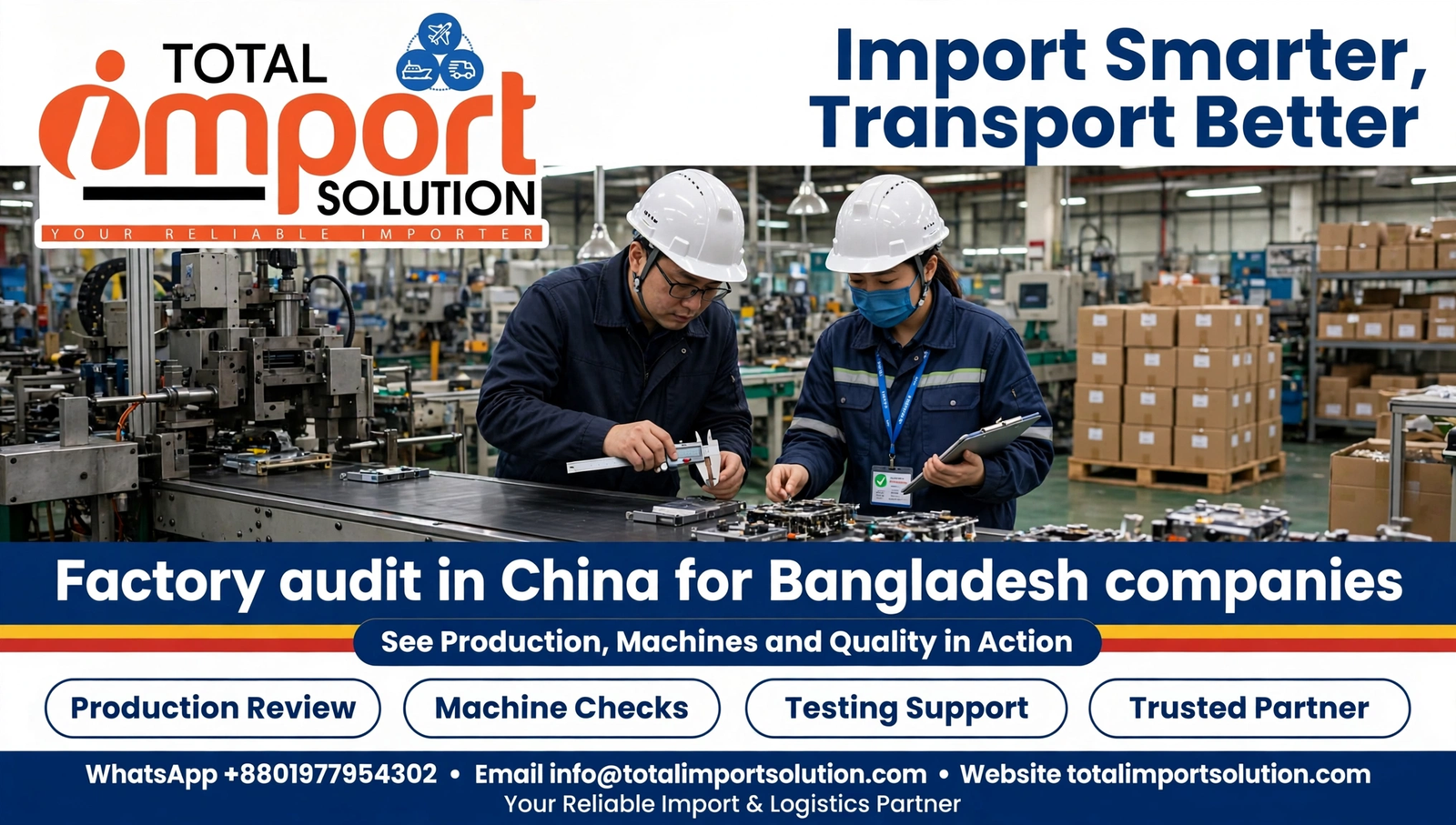
Step four is the machine and capacity check. The auditor lists the main machines, notes their condition, and asks how the factory plans the production of your order. The auditor also checks whether the factory uses outside workshops for part of the work, because outside work changes who controls quality.
Step six is the closing meeting and the report. The auditor tells the factory contact what was found, asks about anything unclear, and then writes the report with photos. Read the report against the agreed checklist, point by point, so nothing is missed.
7. Production Line, Machines and Capacity Checks
The production line is where the order is made, so the auditor spends real time there. The check is not about counting machines only. It is about whether the machines, the workers, and the material together can make your order to the quality you need.
The auditor first looks at the layout of the line. Work should move in order from material to finished product, without long waits or piles of unfinished work in the wrong place. A line that is organised is easier to control, and a problem on one stage is easier to see. The auditor notes the stages of the line, the machines at each stage, and the workers at each stage.
Next, the auditor checks the machines. The auditor notes the type of machine, its general condition, and whether it is running or standing idle. A machine that is out of order on the day of the visit may be a normal repair, or it may be a sign of poor care, so the auditor asks about it and notes the answer. The auditor also checks whether the factory has spare machines or a repair plan for a key machine.
Then the auditor checks capacity in practical terms. The auditor asks how the factory plans the order: how the work is divided, how the material is ordered, and how the factory handles more than one order at the same time. The auditor also checks the material store. If the material for your order is not in the store, the auditor asks when it will arrive and how the factory will check it when it does.
8. Quality Control, Testing and Product Checks
Quality control is the way a factory checks its own work before the buyer sees it. An audit looks at this system closely, because a factory with a clear quality system is more likely to make the same quality from the first piece to the last piece of the order.
The auditor first asks who is responsible for quality in the factory. There should be a named person or a small team, not only the production manager. The auditor checks whether quality staff work on the line, whether they keep records, and whether they have the authority to stop work when a problem is found. A factory where no one can stop a bad run is a factory where a bad run can reach the buyer.
Next, the auditor looks at the checks at each stage. Good factories check material when it arrives, check work during production, and check the finished product before packing. The auditor asks to see the check records, such as a sheet that shows what was checked, when it was checked, and what the result was. Records that are blank, or filled in long after the work, tell the buyer that the checks may not be real.
Testing is a separate point. Ask the auditor to check the testing tools and the testing area. The tools should be present, in working order, and suited to your product. If your product needs a test, such as a strength test, a measurement, or a function test, the auditor should check whether the factory can do that test, and whether the factory keeps the test result for each batch.
9. Reading the Audit Report
The audit report is the result of the visit. It is the document you will use to decide about the order, so read it fully, not only the summary at the top. A report that is read in full can save a buyer from a wrong decision.
A clear report has the same order as the audit. It starts with the factory name, address, date of visit, and the auditor name. It then lists each point checked, what was found, and any problem noted, with photos. It ends with a summary of the main findings and a list of points the factory needs to fix or explain.
| Part of the report | What to look for | What to do if it is missing |
|---|---|---|
| Factory details | Name, address, and contact match your supplier | Ask the auditor to confirm the correct factory |
| Photos | Production area, machines, stores, and records | Ask for photos of the areas you care about |
| Document notes | Papers seen, names, dates, and scope | Ask which paper was not shown and why |
| Findings list | Each point checked, with what was found | Ask the auditor to explain any unclear point |
| Problems noted | Problems described in plain words | Ask the factory to explain each problem |
| Summary | Main findings in short form | Read the full report, not only the summary |
Also check the dates on any certificate noted in the report. A certificate has a scope, which is what it covers, and a validity period. To check a certificate, note who issued it, what it covers, and when it is valid until, and then ask the supplier for a copy and check those same details on the copy. Do not treat a certificate as proof of quality on its own. It is one paper to check, and the factory visit, the records, and the product check together give the fuller picture.
10. Red Flags and How to Respond
A red flag is a finding that needs a clear answer before the order moves forward. One red flag does not always mean the supplier is wrong for you, but it does mean you should pause, ask, and get the answer in writing before you decide.
| Red flag | Why it matters | How to respond |
|---|---|---|
| Factory address does not match the papers | The visit may be at the wrong site | Ask the supplier to explain and show the correct papers |
| Production area is closed to the auditor | The buyer cannot see how the product is made | Ask for a second visit with full access |
| Machines are idle and no workers are present | The factory may not be in production | Ask when production runs and request a visit during work |
| No quality records are shown | Quality checks may not be done or recorded | Ask the factory to show records from a recent order |
| Material store is empty for your order | Production cannot start as planned | Ask when material will arrive and how it will be checked |
| Certificate details do not match the factory | The paper may belong to another site or product | Ask for the correct paper and check its scope and dates |
| Supplier avoids a direct answer | The buyer cannot judge the risk | Put the question in writing and wait for a written answer |
| Outside workshop does most of the work | Quality control sits outside the factory | Ask which workshop does the work and how it is checked |
Do not ignore a red flag because the price looks attractive or the sample looks good. A sample can be made with care by a small team, while the full order is made on a line the buyer has not seen. The audit exists to show the line, and the buyer should use what it shows.
11. Follow-up Actions After the Audit
An audit is useful only when the buyer acts on it. After the report arrives, work through it in order, decide what to do, and keep a record of every decision and every message. The steps below give a simple order to follow.
Step one is to read the full report and mark the findings. Mark each finding as clear, as a question to ask, or as a problem to fix. Make a short list of the questions and problems, and share that list with your team before you write to the supplier.
Step two is to write to the supplier. Send the list of questions and problems in one message, in plain words. Ask for a written answer to each point, and ask for a date by which a fix will be done. Keep the message short and clear, so the supplier can answer point by point.
Step three is to check the answers. When the supplier answers, compare each answer with the audit report. If the supplier says a machine is repaired, ask for a photo. If the supplier says a record is now kept, ask to see a sample of the record. If the supplier says material has arrived, ask for the delivery note or a photo of the store.
Step four is to decide about the order. The decision may be to place the order, to place a small trial order first, to ask for a follow-up audit, or to look for another supplier. Make the decision from the report and the answers together, not from the sample alone, and write the decision down with the reason.
12. Audit, Inspection and Shipment: How the Pieces Fit Together
A factory audit is one part of a larger import plan. It works best when it is joined with the other checks that follow it: the product inspection during production, the final inspection before shipment, and the document check for shipping and customs. Each check looks at a different stage, and together they give the buyer a fuller picture.
The audit checks the factory. The inspection during production checks the work as it is made. The final inspection checks the finished goods, the quantity, the packing, and the marking before the goods leave the factory. The shipping document check makes sure the invoice, packing list, and shipping papers match the goods. A buyer who uses all of these checks has a record at each stage, and a problem found at one stage can be fixed before the next stage starts.
Plan the checks in order at the start of the order. Write down when the audit will happen, when the production inspection will happen, and when the final inspection will happen. Share the plan with the supplier, so the supplier knows when each visit will take place and can keep the factory, the records, and the goods ready.
Keep the reports together in one order file. When the goods reach Bangladesh, the buyer may need to check the goods against the packing list, the invoice, and the inspection report. A file that holds the audit report, the inspection reports, and the shipping papers in order makes that check faster and clearer. Total Import Solution helps buyers in Bangladesh keep this order in place, from the factory check in China to the arrival of the goods, so each step follows the one before it.

13. Mistakes to Avoid and How Total Import Solution Helps
The most common mistake in a factory audit is ordering it too late. The buyer places the order, sends a payment, and only then asks for an audit, when the findings can no longer change the decision. Order the audit before the order is placed, so the report can guide the decision.
The second mistake is a vague checklist. A checklist that only says “check the factory” does not help the auditor, because the auditor cannot know what the buyer cares about. Write the checklist from your product and your order: the material, the machines, the quality checks, the testing, the packing, and the records. A clear checklist gives a clear report.
The third mistake is reading only the summary of the report. The summary is useful, but the detail is in the findings and the photos. Read the full report, mark the questions, and write to the supplier about them. A buyer who reads the full report learns more about the factory than a buyer who reads only the last page.
The fourth mistake is treating one audit as a check for all time. A factory changes. Machines are added or removed, workers change, and new orders arrive. An audit from a past order does not show the factory today. For a new product, a large order, or a factory you have not used for a long time, ask for a fresh audit.
Total Import Solution helps importers in Bangladesh avoid these mistakes by working in the same order as this guide. Since 2016, the team has been serving importers in Bangladesh, and the work starts with the factory check, not with the shipment. The team helps the buyer agree the audit checklist, share the product and order details with the auditor, read the report, and write the follow-up questions to the supplier. The team also helps with the next steps: production checks, final inspection, shipping documents, and the arrival of the goods in Bangladesh. If you are planning an order from China, share the product details, the supplier details, and the order plan first, and ask for a clear audit plan before the order is placed.
Frequently Asked Questions
1. What is a factory audit in China for Bangladesh companies?
It is a visit to a supplier factory in China by an auditor who checks the factory, the machines, the workers, the quality system, and the records, and then writes a report for the buyer in Bangladesh.
2. Why should a Bangladesh company order a factory audit?
An audit shows the buyer what the factory really is, whether it can make the order, and how it checks quality, so the buyer can decide from facts rather than from a website or a chat message.
3. When is the best time to order a factory audit?
Before the order is placed and before any payment is sent, so the report can guide the decision. An audit during production is also useful to check work in progress.
4. What does a general factory audit cover?
It covers the factory building, the production area, the machines, the workers, the material store, the finished goods store, the quality checks, and the records the factory keeps.
5. How is a factory audit different from a product inspection?
An audit checks the factory as a whole, while a product inspection checks the goods themselves, such as quantity, quality, packing, and marking, at a set stage of production or before shipment.
6. What should I share with the auditor before the visit?
Share the product name and description, drawings or photos, order quantity, material list, quality needs, supplier name, factory address, and the business papers the supplier sent.
7. How do I check a certificate shown during an audit?
Note who issued it, what it covers, and when it is valid until, then ask the supplier for a copy and check those same details on the copy. A certificate is one paper to check, not proof of quality on its own.
8. What is a red flag in a factory audit report?
A red flag is a finding that needs a clear answer before the order moves forward, such as a factory address that does not match the papers, a closed production area, or no quality records shown.
9. What should I do if the audit finds a problem?
Write to the supplier in plain words, state what was found, ask for a written explanation, and ask what the factory will do about it and by when. Keep the answer with the report.
10. What is a follow-up audit?
A follow-up audit is a second visit to check whether the problems found in the first audit were fixed. The auditor rechecks the same points and reports what has changed.
11. Can a factory audit check production capacity?
Yes. The auditor looks at the machines, the workers, the material in store, and the production plan, and reports whether the factory can make the order quantity to the quality needed.
12. Should I audit a factory I have worked with before?
For a new product, a large order, or a factory not used for a long time, a fresh audit is useful, because machines, workers, and orders change over time.
13. Who should I contact at the factory for an audit?
Ask the supplier for the name of the person who will meet the auditor, the full factory address, and the working hours, and pass these details to the auditor in writing.
14. How do I read an audit report?
Read the full report, not only the summary. Check each finding against your checklist, read the photos with the text, and mark any point that needs a question to the supplier.
15. Can Total Import Solution help with a factory audit in China?
Yes. The team helps the buyer agree the audit checklist, share the order details with the auditor, read the report, and write follow-up questions to the supplier, and then helps with the next import steps.
16. How do I start a factory audit with Total Import Solution?
Share the product details, the supplier name and factory address, the order quantity, and your quality needs first, so the team can help you plan the audit checklist and the visit.
Contact Total Import Solution
- WhatsApp: +8801977954302
- Email: info@totalimportsolution.com
- Website: totalimportsolution.com
- Service: Factory audit in China for Bangladesh companies, with audit planning, report review, supplier follow-up, inspection, shipping documents and import support.
- Since 2016, Total Import Solution has been an importer and logistics partner based in Bangladesh, helping companies buy from China with clear checks at each step.
