
Container loading supervision China service
Introduction
When you buy goods from China for your business in Bangladesh, the goods travel a long way before they reach you. They are packed in cartons, moved to a warehouse or a factory, loaded into a shipping container, sealed, and then carried to the port. A lot can go wrong between the factory gate and the container door: cartons can be loaded in the wrong order, the count can differ from the packing list, or a container can have damage that nobody noticed. Container loading supervision China service exists to watch this part of the journey, step by step, so you know what was actually loaded into your container.
This guide explains the service in plain language: what a loading supervisor does, which documents you need before loading day, how the container and the cartons are checked, how loading is recorded with photographs and a written report, and what happens after the container is sealed. It is written for importers in Bangladesh who order goods from China. Since 2016, Total Import Solution has been working with importers in Bangladesh, and this guide follows the same practical approach used in real import work: check the documents first, check the cargo second, and keep a written record of everything that was seen. A rate or a fee is confirmed only after checking the actual shipment and documents.
1. What Container Loading Supervision Means
Container loading supervision means a trained person is present at the place where your goods are loaded into a shipping container, and that person checks, watches and records the loading from start to finish. The supervisor is not part of the supplier’s packing team or the trucking team. The supervisor works from your instructions and your documents, and reports back to you.
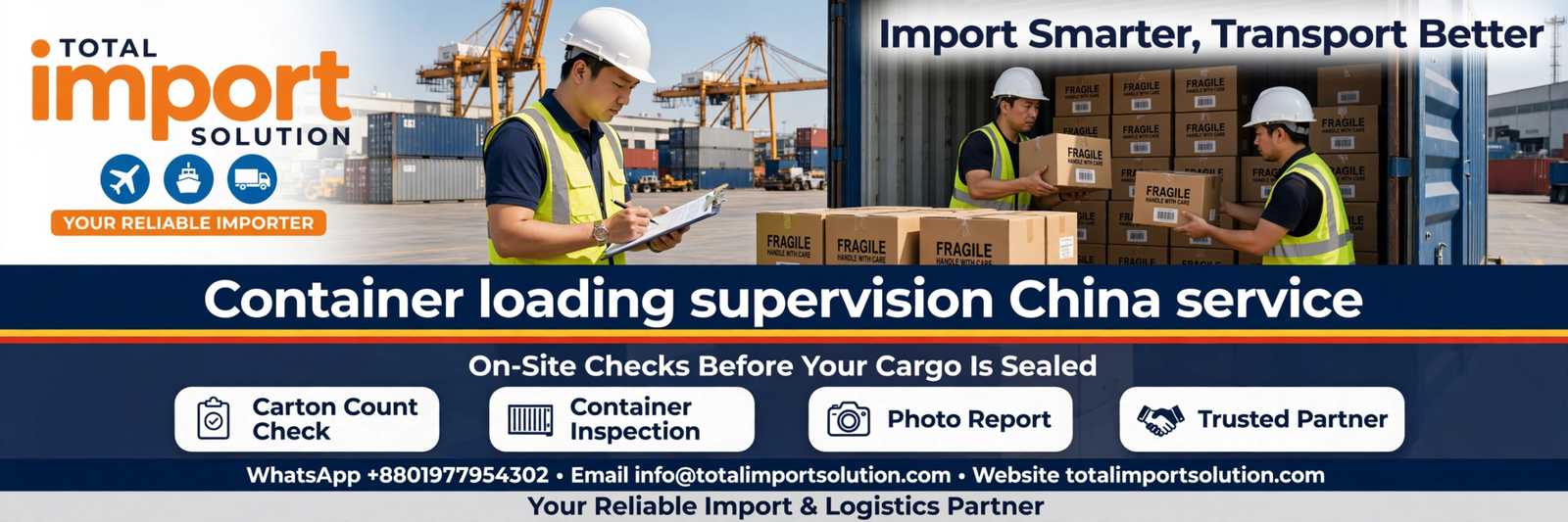
The work starts before the container arrives. The supervisor reads the order details, the packing list, the commercial invoice and your loading instructions. Then the supervisor goes to the warehouse or factory, checks the container, checks the cartons, watches the loading, takes photographs, and writes a report. When the loading is finished, the supervisor records the seal number and sends you the report with the photographs. Supervision is useful because you are in Bangladesh and the loading happens in China, so you cannot stand at the container door yourself. Without supervision, you only learn what was loaded when the container arrives and you open it, and by then a problem is much harder to sort out.
| Part of the service | What it covers |
|---|---|
| Document check | Packing list, invoice and order details are read before loading |
| Container check | The empty container is inspected inside and outside |
| Carton check | Carton count, marks and condition are checked |
| Loading watch | The loading order and handling are watched |
A supervisor does not decide the price of the goods, does not change the order, and does not sign shipping documents on your behalf unless you have agreed that in writing. The supervisor’s job is to observe, check, record and report.
2. Why Loading Supervision Matters for Bangladesh Buyers
Many importers in Bangladesh order goods from China in containers: garments, machinery parts, electronics, household goods, raw material or finished products. Whatever the cargo, the loading stage is where the order becomes a real shipment, and if the loading is wrong, the problem travels with the container all the way to Bangladesh.
One common problem is a count difference. The packing list may say one number of cartons, but a different number may be loaded, because of a packing mistake, a last-minute change, or a carton set aside and forgotten. A supervisor who counts the cartons as they go in can find the difference on the day, while the container is still open. Another common problem is wrong marks or mixed cartons: when one container holds goods for more than one style, size or order, cartons can be mixed up, and the marks are the only way to tell them apart. A supervisor who reads the marks and compares them with the packing list can catch a mix-up before the container is sealed. Container condition matters too: a container may have a damaged door, a hole in the roof, a wet floor or a strong smell from a previous cargo, and a supervisor checks the empty container first, so a damaged container can be refused and replaced before loading starts. Loading order matters as well: heavy cartons at the bottom, light cartons on top, and a balanced load that does not shift.
For a buyer in Bangladesh, supervision also gives peace of mind. You receive photographs and a report. If a question comes up later, the report is a record of what was seen on loading day.
3. Who Does the Supervision and What to Ask Before You Book
Loading supervision is usually arranged through an import service company, a buying agent, or an inspection team based near the loading place. Total Import Solution is an importer and logistics partner based in Bangladesh, and it works with supervision arrangements in China for buyers who need a loading record. Whoever arranges it, you should know who will be at the loading place, what will be checked, and what you will receive.
Before you book, ask for the plan in writing. Ask who the supervisor is, where the loading will take place, and what time the supervisor will arrive. Ask which documents the supervisor needs from you, and send them early, so the supervisor has time to read them. Ask about the scope: a basic supervision may cover the container check, the carton count, the loading watch and the seal record, while a wider scope may also cover a check of the goods inside a sample of cartons or a check of labels and marks. Be clear about what you need, because the supervisor can only check what you have asked for.
| Question to ask | What a clear answer looks like |
|---|---|
| Who will be at the loading? | A named supervisor, with a contact number |
| Where and when is the loading? | The warehouse address, and the planned date and time |
| Which documents are needed? | Packing list, invoice, order details, loading instructions |
| What will be checked? | Container, carton count, marks, loading order, seal |
| What will you receive? | Photographs and a written report after loading |
Total Import Solution has been serving importers since 2016, and a clear written scope is part of every supervision arrangement. Read the scope before loading day, and add anything missing in writing before the work starts.
4. The Documents You Need Before Loading Day
Good supervision starts with good documents. The supervisor checks the cargo against your documents, so the documents must be complete, correct and sent in time. If the packing list is wrong, the supervisor will count against a wrong list. If the order details are missing, the supervisor will not know which marks or styles to look for. Send the documents early and check them yourself first.
The packing list is the most important document. It lists the number of cartons, their contents, the marks, the weight and the measurements, and the supervisor uses it as the checking list. Ask the supplier to send the final packing list, not a draft. The commercial invoice shows the order value, the goods description, the buyer and the seller. The purchase order shows what you ordered, including style, size, colour, model or specification. Loading instructions are the document you write yourself: they tell the supervisor what matters most to you, such as the loading order, cartons that must stay together, or fragile cartons placed on top. Write them in simple, numbered points.
| Document | What it shows |
|---|---|
| Packing list | Carton count, marks, weight, measurements |
| Commercial invoice | Goods description, buyer, seller, order value |
| Purchase order | What you ordered: style, size, model |
| Loading instructions | Your own points: order, handling, photos |
Ask the supplier to confirm the loading date, time and place in writing, and share that confirmation with the supervisor. If the date changes, tell the supervisor at once: a supervisor who arrives on the wrong day cannot check a loading that has already happened.
5. How a Loading Plan Is Prepared
A loading plan is a simple written plan that says how the cartons will go into the container. It is prepared before loading day, using the packing list and the container details. The plan helps the loading team work in order, and it helps the supervisor check that the plan was followed.
Start with the container size and type. A standard container has a set length, width and height, and the number of cartons that fit depends on the carton size. The supplier or the loading team usually prepares the plan. Ask for the plan in writing and check it against the packing list. The plan should show the loading order: heavy cartons at the bottom, light cartons on top, and cartons needed first at the destination loaded last, so they come out first. Cartons for different styles or orders should be grouped together. Fragile cartons should be marked and placed where they are less likely to be crushed. The plan should also show how the load will be kept steady: cartons stacked in even layers, with gaps filled so the load does not move.
Steps to prepare a loading plan:
- Read the final packing list and note the carton count, size and weight.
- Confirm the container size and type from the booking details.
- List the cartons in loading order: heavy first, light last, first-needed last.
- Group cartons by style, size or order so they stay together.
- Mark fragile or special-handling cartons on the plan.
A loading plan does not need to be long. One page with a clear list is enough. The important part is that it is written, shared and followed.
6. Checking the Container Before Loading Starts
The container check happens before any carton is loaded. The supervisor inspects the empty container inside and outside, and only allows loading to start when the container is in a suitable condition. This check is short, but it matters a great deal, because a problem found after loading is much harder to fix.
Outside, the supervisor looks at the container doors, the door seals, the hinges and the locking rods. The doors should open and close smoothly and lock firmly. The supervisor looks for dents, holes, rust or damage to the walls and the roof, and reads the container number, so the report matches the right container. Inside, the supervisor looks at the floor, the walls and the roof. The floor should be dry, clean and strong, without holes or soft spots. The walls should be free of holes and sharp edges that could cut cartons, and the roof should be free of leaks. A smell inside the container should also be noted, because a strong smell from a previous cargo can pass to your goods.
| Check point | What the supervisor looks for |
|---|---|
| Container number | The number matches the booking details |
| Doors and locks | Doors open, close and lock smoothly |
| Walls and roof | No holes, dents or rust that weakens the container |
| Floor | Dry, clean, strong, no holes |
If the container fails the check, the supervisor tells you and the supplier, and loading waits until a suitable container is provided. This may take time, but it is better than loading goods into a container that could damage them. The supervisor photographs the container, inside and outside, so you can see its condition yourself.
7. Checking Cartons, Marks and Quantity at the Warehouse
Before loading starts, the supervisor checks the cartons that are waiting at the warehouse or factory. This check compares the physical cartons with the packing list. It is the main chance to find a count difference or a marking problem before the cartons go into the container.
The supervisor counts the cartons carton by carton, not by guessing from the size of the pile, and compares the count with the packing list. If the cartons are in groups, each group is counted on its own. If the count does not match the packing list, the supervisor notes the difference and tells you, so the missing or extra cartons can be found. The supervisor also reads the marks on the cartons, which usually show the buyer, the order number, the carton number, the style or item, and the quantity inside. The marks should match the packing list. The condition of the cartons is checked too: cartons should be dry, whole and properly sealed with tape, because a carton that is wet, torn, crushed or open may mean the goods inside are damaged.
Steps for the carton check:
- Read the packing list and note the expected carton count and marks.
- Count the cartons at the warehouse, group by group.
- Compare the count with the packing list and note any difference.
- Read the marks on a sample of cartons from each group.
- Look at the condition of the cartons: dry, whole, sealed, not crushed.
If cartons are missing, the supplier should look for them before loading starts. If cartons are damaged, they should be repacked or replaced if possible. If the marks are wrong, they should be corrected. The supervisor records what was found and what was done.
8. The Loading Process Step by Step
When the container has passed its check and the cartons have been counted, loading begins. The supervisor watches the whole loading, from the first carton to the last, and checks that the loading plan is followed. The supervisor does not load the cartons, but watches how they are loaded and notes anything that needs attention.
Loading usually starts with the heaviest cartons at the bottom, at the far end of the container. The loading team places the cartons in even layers, working from the far end towards the door. Light cartons go on top, and cartons that must come out first at the destination go in last, near the door. The supervisor checks the order against the loading plan and notes any change. Handling matters during loading: cartons should be lifted and placed, not thrown or dropped, and fragile cartons should be handled with care and placed where they are less likely to be crushed. As loading goes on, the supervisor counts the cartons going in and compares the running count with the packing list. This is the second count, and it should match the first count done at the warehouse.
| Loading stage | What the supervisor watches |
|---|---|
| First cartons | Heavy cartons at the bottom, far end first |
| Middle layers | Even layers, balanced load, gaps filled |
| Top layers | Light cartons on top, fragile cartons placed with care |
| Final cartons | First-needed cartons near the door |
When the container is full, the supervisor looks at the finished load before the doors are closed. The load should be even, steady and level, with no cartons pressing against the doors. The supervisor photographs the full load, so you can see how the goods were placed. Only then are the doors closed and the container prepared for sealing.
9. Photographs, Video and the Loading Report
Photographs are one of the most useful parts of loading supervision. You are not at the loading place, so the photographs are your eyes. A good set shows the empty container, the cartons, the loading at different stages, the finished load, the seal and the container number. The photographs should be clear, well lit and taken from angles that show what was checked.
The supervisor takes photographs at each stage: the empty container inside and outside, the carton stacks with the marks visible, the loading at the start, in the middle and at the end, the finished load before the doors are closed, and the seal after it is fitted, with the seal number readable. Some buyers also ask for a short video of the loading, which can show the handling of the cartons and the order of loading in a way that still photographs cannot. If you want a video, ask for it in advance, and say how long it should be and which stages it should cover.
The written report brings the photographs together: the date and place of loading, the container number, the carton count, the marks checked, the loading order, the seal number, and a list of any problems found and what was done about them. The report should be written in plain language, so anyone on your team can read it and understand what happened. Ask when the report will arrive: a report sent on the same day is most useful. Keep the report and the photographs with your shipment file.
10. Sealing the Container and Recording the Seal Number
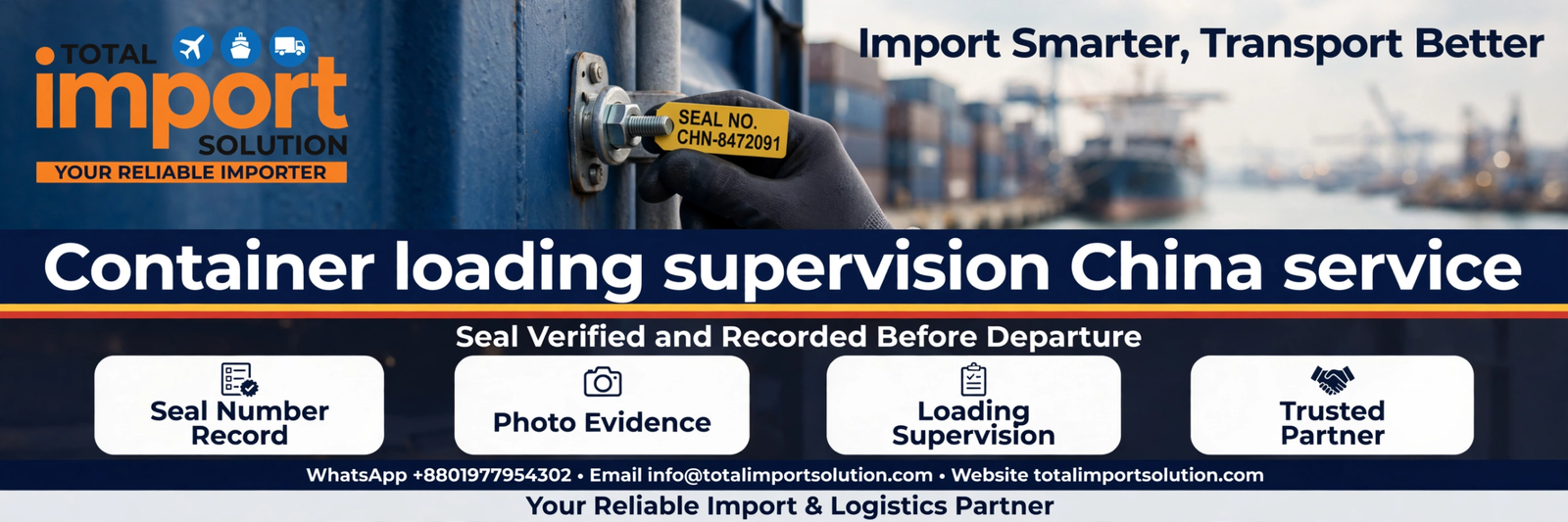
After the loading is finished and the doors are closed, the container is sealed. The seal is a small locking device fitted to the door, with a unique number on it. Once the seal is fitted, the container cannot be opened without breaking the seal. The seal number is the link between the loading in China and the arrival in Bangladesh.
The supervisor watches the sealing. The seal should be fitted to the correct door and locked firmly. The supervisor reads the seal number, writes it down, and photographs it so the number can be read clearly in the photograph. The seal number in the photograph and the seal number in the report should match, and both should match the number on the shipping documents. When the container reaches Bangladesh, the seal should still be in place and the number should be the same as the number recorded at loading. If the seal is broken or the number is different, it means the container was opened on the way, and that needs to be looked into before the container is unloaded.
Steps for sealing and recording:
- Close the container doors and check that they lock firmly.
- Fit the seal to the correct door and lock it.
- Read the seal number carefully and write it down.
- Photograph the seal so the number is clear and readable.
- Write the seal number in the report, exactly as it appears on the seal.
If it is broken, it shows that the container was opened. If it is whole and the number matches, it shows that the container arrived as it left. Keep the seal number with your shipment file, and check it against the seal on the container when the container arrives in Bangladesh.
11. Common Problems Found During Loading and How They Are Handled
Loading supervision often finds problems, and finding them on loading day is the point of the service. A problem found early can be fixed while the container is still open. The same problem found in Bangladesh is much harder to fix.
A short count is one of the most common problems. The packing list says one number of cartons, but fewer cartons are at the warehouse. The supervisor tells you at once, and the supplier looks for the missing cartons: they may be in another part of the warehouse, on another truck, or still at the factory. If they cannot be found, you decide whether to load what is there and send the rest later, or wait until the full count is ready. A damaged container is another common problem: the supervisor refuses it and asks for a replacement, which is checked in the same way before loading starts. Damaged cartons are found often too: if the goods inside are not damaged, the carton can be repacked, and if the goods are damaged, you decide whether to replace them or leave them out of the shipment.
| Problem | How it is usually handled |
|---|---|
| Short carton count | Missing cartons are looked for before loading |
| Damaged container | A replacement container is provided and checked |
| Wrong marks | Marks are corrected before loading |
| Damaged cartons | Cartons are repacked or goods are replaced |
The supervisor does not decide these matters for you. The supervisor finds the problem, tells you, and records what was decided. Your decision should be in writing, so the supervisor and the supplier both know what to do.
12. After Loading: What Happens Next
When the container is loaded, sealed and reported, the loading supervision work is finished, but the shipment is not. The container is moved to the port, loaded onto the vessel, and carried to Bangladesh. The report and photographs are now part of your shipment file.
First, read the report as soon as you receive it. Check the carton count, the seal number and the list of problems. Share the report with your own team, so everyone who will handle the arrival knows what to expect. Next, check the shipping documents: the seal number and the carton count on the documents should match the report. If there is a difference, ask for it to be corrected before the vessel leaves, if that is still possible. Then prepare for the arrival: tell your clearing agent or your warehouse team the container number, the seal number and the expected carton count. When the container arrives, check the seal before it is opened, and count the cartons as they come out and compare the count with the report.
| After loading | What you should do |
|---|---|
| Read the report | Check the count, the seal number and the problems list |
| Check the documents | Match the seal number and carton count with the report |
| Check on arrival | Check the seal, then count the cartons as they come out |
Since 2016, Total Import Solution has helped importers keep these records in order, and a complete file makes the arrival smoother. The loading report is the record that connects the loading in China with the arrival in Bangladesh, so keep it with the packing list, the invoice and the shipping documents.

13. How to Choose a Loading Supervision Service
Choosing a supervision service is about clarity, not about size. A good service gives you a written scope, a named supervisor, a clear list of what will be checked, and a report with photographs that you can read and understand. Ask for these things before you book, and compare the answers, not just the name of the company.
Start with the scope. Ask for a written list of what the supervision covers: the container check, the carton count, the marks check, the loading watch, the photographs, the seal record and the report. Ask what is not covered, so you are not surprised later. If you need extra checks, such as opening a sample of cartons or checking labels, ask for them to be added in writing. Ask about the supervisor: who will be at the loading place, and what experience does that person have with your cargo? Ask about the report: when will it arrive, what will it contain, and will the photographs be clear and in order?
Finally, ask about the cost and the payment terms in writing. A rate or a fee is confirmed only after checking the actual shipment and documents, because the work depends on the place, the number of containers and the scope you ask for. Get the cost in writing before the work starts, and check what it includes: the supervision, the photographs, the report and any travel to the loading place. A clear written cost, a clear written scope and a clear report are the signs of a service you can work with. Total Import Solution is an importer and logistics partner based in Bangladesh. If you need container loading supervision in China, contact the team with your order details, your packing list and your loading date.
Frequently Asked Questions
1. What is container loading supervision China service?
A supervisor is present at the loading place in China, checks the empty container, counts the cartons, watches the loading, takes photographs and writes a report for the buyer in Bangladesh.
2. Who needs loading supervision for a shipment from China?
Any buyer in Bangladesh who orders goods from China and cannot be at the loading place. It is useful for first orders with a new supplier, for large orders, and for fragile or high-value goods.
3. What does the supervisor check before loading starts?
The supervisor checks the container inside and outside, counts the cartons at the warehouse and reads the marks on them, comparing them with the packing list.
4. Which documents should I send to the supervisor?
Send the final packing list, the commercial invoice, the purchase order, your loading instructions, and the container booking details. Send them early, so the supervisor has time to read them.
5. How is the carton count checked?
The supervisor counts the cartons at the warehouse, group by group, and compares the count with the packing list. Then the supervisor counts the cartons again as they are loaded into the container.
6. What happens if the carton count does not match the packing list?
The supervisor tells you at once. The supplier then looks for the missing cartons. If they cannot be found, you decide whether to load what is there and send the rest later, or wait until the full count is ready.
7. What happens if the container is damaged?
The supervisor refuses the damaged container and asks for a replacement, which is checked in the same way before loading starts.
8. How are the goods placed inside the container?
Heavy cartons go at the bottom, light cartons go on top, and cartons that are needed first at the destination go in last, near the door. The load is kept even and balanced, with gaps filled so it does not move.
9. What photographs will I receive?
Photographs of the empty container, the carton stacks with the marks visible, the loading at each stage, the finished load, and the seal with the seal number readable.
10. What is in the written loading report?
The report has the date and place of loading, the container number, the carton count, the marks checked, the loading order, the seal number, and a list of any problems found and what was done.
11. Why is the seal number important?
The seal number links the loading in China with the arrival in Bangladesh. On arrival, the seal should still be whole and the number should match the report and the shipping documents.
12. Can the supervisor open cartons and check the goods inside?
That depends on the scope you agree in advance. A basic supervision covers the container check, the carton count, the marks and the loading watch. If you want cartons opened, ask for that in the written scope before loading day.
13. How much does loading supervision cost?
A rate or a fee is confirmed only after checking the actual shipment and documents, because the work depends on the place, the number of containers and the scope you ask for.
14. When will I receive the report?
Ask for the timing in writing before you book. A report sent on the same day as the loading is most useful, because you can read it while the details are fresh and act at once if there is a problem.
15. What should I do when the container arrives in Bangladesh?
Check the seal before the container is opened: it should be whole and the number should match the report. Then count the cartons as they come out and compare the count with the report.
16. How do I book container loading supervision with Total Import Solution?
Contact Total Import Solution with your order details, your packing list, your loading date and the loading place. The team will explain the scope and the next steps, and confirm the cost in writing before the work starts.
Contact Total Import Solution
- Service: Container loading supervision China service
- WhatsApp: +8801977954302
- Email: info@totalimportsolution.com
- Website: totalimportsolution.com
- Company: Total Import Solution — an importer and logistics partner based in Bangladesh.
