
Manufacturing plant relocation from China to Bangladesh
Moving a whole manufacturing plant from China to Bangladesh is very different from shipping a few machines. A plant relocation means taking apart production lines, packing every machine, part, cable and control panel, moving them across the sea, clearing them through customs in Bangladesh, and then putting the whole plant back together so production can start again at the new site.
This guide explains what plant relocation means, how to plan the move, dismantling, labelling, packing and container planning, the documents needed, HS classification in general terms, the step-by-step process from survey to reassembly, customs clearance in Bangladesh, transport to the new site, reassembly and testing, common problems and fixes, how to judge a good relocation partner, and the mistakes to avoid. A rate or fee is confirmed only after checking the actual shipment and documents.
Total Import Solution, an importer serving businesses in Bangladesh since 2016, supports plant relocation work with document checking, HS classification guidance, customs clearance support and delivery coordination to factory sites in Dhaka, Gazipur, Narayanganj and Chittagong.
1. What Manufacturing Plant Relocation Means
A manufacturing plant relocation is the complete move of a production setup from one country to another. It covers machines, production lines, spare parts, raw materials, tools, moulds, dies, control panels, cables, pipes, racks and workbenches. Some items travel in containers, some travel as break-bulk cargo on flat racks, and small high-value parts may travel by air when the schedule needs them.
The move usually starts because the business wants its production in Bangladesh, for a new factory site, closeness to buyers, or a change in the supply chain. Whatever the reason, the machines must arrive in working order. A machine that is damaged, lost, or wrongly documented can stop the whole production line, so the relocation is planned around keeping every machine safe and every document correct.
A plant relocation has three parts that must work together: the physical work in China, the shipping and customs work between the two countries, and the installation work in Bangladesh. One team should follow all three parts, with one inventory list and one schedule, so a problem in one stage is seen early and fixed before it affects the next stage.
2. Planning the Move Before Anything Is Touched
Planning starts before any machine is switched off. A good plan answers four questions: what is moving, how will it travel, what documents are needed, and when will each stage happen. If any of these questions is left unanswered, the move will face delays later, when fixing them costs more time and money.
The first planning step is a site visit at the factory in China. The survey team walks the production floor, notes each machine, measures the large machines, checks the condition of each unit, and takes photographs. The team also checks the factory doors, the loading area and the space for cranes and forklifts. A machine that cannot pass through the factory door needs a different dismantling plan, and that fact must be known before the move starts.
The second planning step is a site visit at the new factory in Bangladesh. The new site must be ready to receive machines: the floor must be strong enough, the power connection must be in place, the roof must be finished, and there must be space to store crates before installation. Machines that arrive at a site that is not ready must be stored somewhere else, which adds handling and risk of damage.
The third planning step is the schedule, which should leave room for delays at the port, in customs and on the road. The planning stage ends with a written relocation plan that the factory owner, the dismantling team, the shipping agent and the installation team all agree on.
| Planning step | What to check | Why it matters |
|---|---|---|
| Survey in China | Machines, sizes, condition, doors, loading area | Decides the dismantling and packing plan |
| Survey in Bangladesh | Floor strength, power, roof, storage space | Decides whether the site can receive machines |
| Inventory list | Every machine, part and crate with a number | Stops items going missing in transit |
| Document list | Invoice, packing list, certificates | Customs clearance depends on complete papers |
3. Survey, Inventory and Machine Records
The survey and inventory are the foundation of the whole relocation. Every machine, part and crate that moves must be on the inventory list, with a number, a description, a photograph and a note of its condition. If an item is not on the list, it can be left behind in China, or it can arrive in Bangladesh without documents and face questions at customs.
The survey team records each machine in the same way: machine name, maker, model, serial number, size, weight and condition, with photographs from several sides, including the control panel, the nameplate and any damage that already exists. They note which parts are fixed to the machine and which parts are loose, because loose parts need their own packing and labels.
The inventory list is built from the survey. Each item gets a unique number, written on the machine, on the packing list and on the crate label. The list is checked three times: after the survey, after packing, and after loading.
| Record | What it contains | Who uses it |
|---|---|---|
| Machine survey sheet | Name, maker, model, serial number, size, weight, condition, photos | Dismantling team and shipping agent |
| Inventory list | Unique number for every item, description, crate number | All teams, from survey to reassembly |
| Photographs | Machine, nameplate, control panel, existing damage | Customs, reassembly team |
| Packing list | Crate number, contents, weight, dimensions | Shipping agent and customs |
| Loading plan | Which crate goes in which container, in which order | Loading team and unloading team |
A careful survey also finds the machines that need special care: glass parts, precision instruments or electronic controls that need extra packing, and machines too large for a standard container that need a flat rack or an open-top container.
4. Dismantling and Labelling Machines
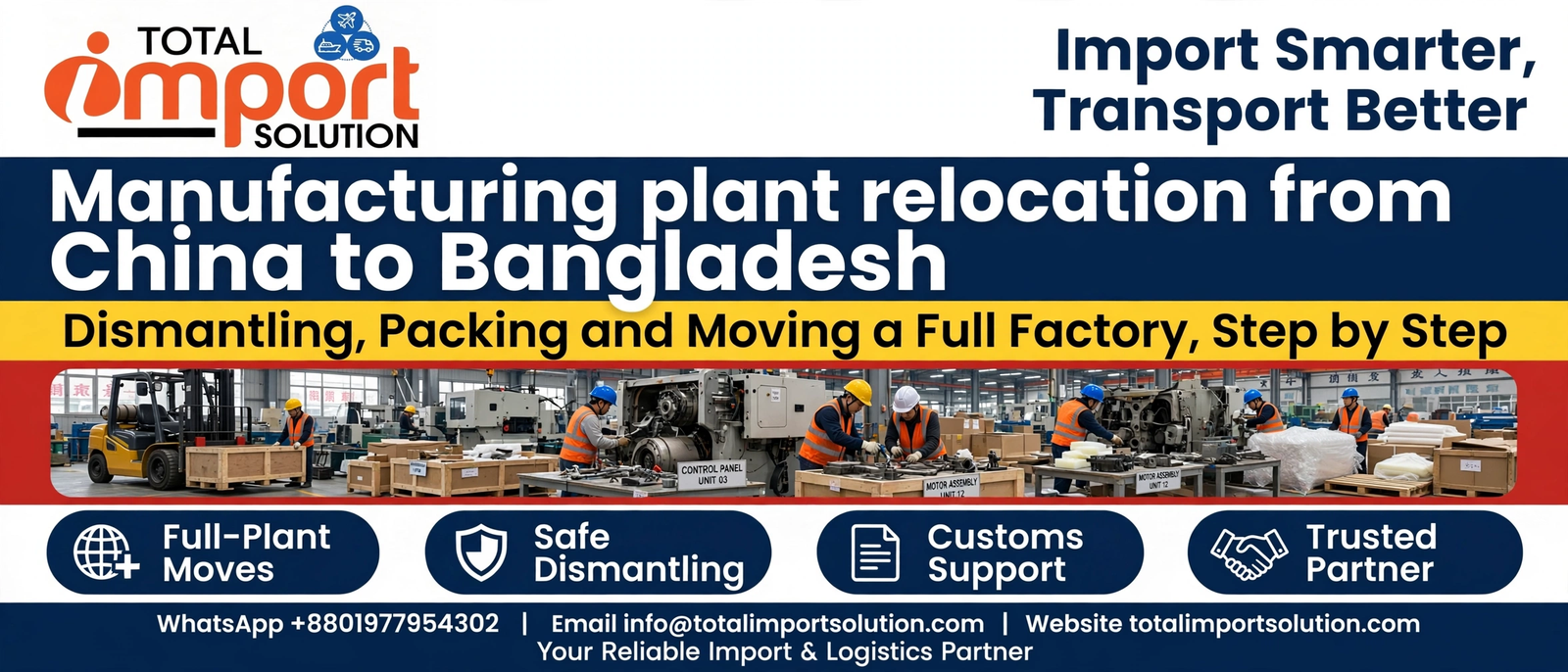
Dismantling is the careful taking apart of machines so they can be packed and shipped safely. It is not demolition. Every bolt, cable, pipe and panel that is removed must be labelled, packed and recorded, because the machine must be put back together in Bangladesh exactly as it was in China.
Dismantling starts with the machine manuals and drawings. The team reads the manual for each machine, notes the dismantling order, and marks the parts that must stay together. Photographs are taken at each stage, so the reassembly team can see how the machine looked before it was taken apart.
Each part that is removed gets a label showing the machine number, the part name and the crate number. Cables are labelled at both ends, so the reassembly team knows where each cable connects. Small parts such as bolts, nuts and screws go in sealed bags, each labelled with the machine number and the part it belongs to. A bag of bolts without a label is useless at the new site, because nobody can tell which machine it belongs to.
The dismantling steps for a typical machine follow this order:
- Stop the machine, switch off the power, and disconnect the power supply.
- Drain oil, coolant and other fluids, and seal the openings.
- Photograph the machine from all sides, including the control panel and cable connections.
- Remove the loose parts, tools and accessories, and label each one.
- Disconnect the cables, and label both ends of every cable.
- Remove the covers, guards and panels, and label each panel.
- Take the machine apart into transport-sized sections, following the manual.
- Label every section with the machine number and the section name.
- Pack the small parts in labelled bags and boxes.
- Check the dismantled parts against the inventory list, and correct any difference.
5. Packing and Container Planning
Packing protects machines during a long sea journey, loading and unloading, and road transport in Bangladesh. Good packing is the difference between a machine that starts work on arrival and a machine that needs repair before it can run.
Packing starts with cleaning. Machines are cleaned, dried and checked for rust before packing. Moving parts are fixed in place so they cannot shift during transport. Sharp edges are covered, glass parts are wrapped separately, and electronic controls are protected against moisture and shock.
The packing material depends on the machine. Heavy machines go in strong wooden crates with bracing inside. Large machines that do not fit in a crate are fixed to a flat rack or a steel base. Fragile parts go in boxes with padding, and cables are coiled and tied, not left loose. Each crate is marked with the crate number, the machine number, the weight, and handling marks that show which side is up and where the forklift should lift.
Container planning decides how many containers are needed and which crate goes in which container. The plan is made from the inventory list, the crate sizes and the crate weights. Heavy crates go at the bottom, light crates go on top, and crates that must be unloaded first go near the container door. Each crate is weighed and measured before loading, and the numbers are written on the packing list.
| Container and packing choice | When it is used | What to check |
|---|---|---|
| Standard dry container | Most machines and crates | Crate size fits the door, weight is within the limit |
| Open-top container | Tall machines that cannot pass the door | Top cover is fixed well, load is braced |
| Flat rack container | Very large or heavy machines | Machine is fixed to the rack, lifting points are marked |
| Wooden crate | Heavy machines and fragile parts | Wood is strong, bracing is inside, marks are clear |
6. Documents Needed for the Move
Documents are the part of a plant relocation that causes the most delay when they are wrong, and the least delay when they are right. Customs in Bangladesh checks the shipment against the documents, and any mismatch between the cargo and the papers can hold the shipment at the port. The documents must be prepared early, checked against the inventory list, and corrected before the ship sails.
The core documents are the commercial invoice, the packing list, the bill of lading and the certificate of origin. The commercial invoice lists each item with its value and description. The packing list lists each crate with its contents, weight and dimensions. The bill of lading is the shipping document that proves the cargo was loaded on the vessel. The certificate of origin states where the goods were made. Other documents may be needed depending on the machines, such as a fumigation certificate for wooden packing, a test certificate for electrical equipment, or a used machinery certificate for second-hand machines.
Document checking follows a simple rule: the same item must have the same name, the same number and the same quantity on every document.
| Document | What it shows | Who prepares it |
|---|---|---|
| Commercial invoice | Item names, quantities, values | Seller or factory owner |
| Packing list | Crate numbers, contents, weights, dimensions | Packing team or shipping agent |
| Bill of lading | Vessel, loading port, discharge port, package count | Shipping line |
| Certificate of origin | Country where the goods were made | Chamber of commerce or issuing body |
| Trade licence and import registration | Business permission to import in Bangladesh | Factory owner |
7. HS Classification in General Terms
HS classification is the system that customs uses to identify goods. HS stands for Harmonized System, and it is used by customs authorities around the world. Every product that crosses a border is given an HS code, and the code decides how customs treats the goods, which documents are needed, and which rules apply.
For a plant relocation, HS classification matters because a full plant contains many different kinds of goods. Complete machines have their own codes. Parts of machines have different codes. Electrical equipment, cables, tools, moulds, raw materials and office equipment each fall under their own headings. A machine and its spare parts are not classified together unless the rules say so, and the classification must be done item by item from the inventory list.
The classification is done from the description of each item, not from a guess. The team reads the machine name, the maker, the model, the function and the material, and then finds the heading that fits. A machine that cuts metal is classified differently from a machine that sews fabric, and a control panel is classified differently from the machine it controls. A wrong HS code can cause delay, extra questions, or a different customs treatment from the one expected, so the classification should be checked before the shipment leaves China, while there is still time to correct it.
8. Step-by-Step Process From Survey to Reassembly
Step 1: First meeting and scope. The factory owner and the relocation team meet, discuss which plant is moving and which machines are included, and write down the scope so everyone agrees on what is moving and what is staying behind.
Step 2: Survey in China. The team visits the factory in China, measures the machines, checks their condition, takes photographs, and notes the doors, the loading area and the power supply.
Step 3: Survey in Bangladesh. The team visits the new site and checks the floor, the power, the roof, the storage space and the road access, and lists what must be finished before the machines arrive.
Step 4: Inventory and records. The inventory list is prepared from the survey, with a unique number for every item, and photographs, manuals and condition notes are filed with the list.
Step 5: Dismantling plan. The dismantling order is written for each machine, with the labels, the bags for small parts, and the photographs to be taken at each stage.
Step 6: Documents and HS classification. The commercial invoice, packing list and other papers are prepared, each item is given its HS code from the inventory list, and the documents are checked so names, numbers and quantities match on every paper.
Step 7: Dismantling and packing. Machines are dismantled, labelled and packed crate by crate, with the packing list updated as each crate is finished.
Step 8: Container planning and booking. The container plan is finished, the containers are booked, and the loading order is written down.
Step 9: Loading and shipping. Crates are loaded into containers in the planned order, the containers are sealed, the bill of lading is issued, and the shipment leaves the port in China.
Step 10: Customs clearance in Bangladesh. The documents are filed with customs, the shipment is checked, and the cargo is released after the customs process is complete.
Step 11: Transport to the new site. Containers are moved from the port to the new factory site by truck, with the unloading order planned in advance.
Step 12: Unloading and checking. Crates are unloaded, checked against the inventory list, and any damage is noted at once. Crates are stored in the order the installation team needs them.
Step 13: Reassembly and installation. Machines are put back together, fixed in place, connected to power, and tested, and the production line is checked as a whole before production starts.
Step 14: Testing and production start. Each machine is tested on its own, then the full line is tested together. When the tests pass, production starts, and the relocation team hands the plant over to the factory team with the full records.

9. Customs Clearance in Bangladesh
Customs clearance in Bangladesh is the process of presenting the shipment to the customs authority, having the cargo and the documents checked, and receiving permission for the cargo to leave the port. The process starts before the ship arrives, because the documents should be ready and filed in advance, so the cargo does not wait at the port while papers are being prepared.
The clearing agent files the bill of entry with customs, together with the commercial invoice, the packing list, the bill of lading, the certificate of origin and the other papers that apply to the shipment. Customs checks the documents against the cargo, and the cargo may be examined to confirm that the items in the containers match the items on the papers. If the documents are complete and the cargo matches, the clearance moves ahead. If there is a mismatch, customs will ask questions, and the shipment will wait until the questions are answered.
Used machines often receive closer attention during examination, because customs needs to confirm the description, the condition and the value stated on the documents. The survey photographs, the machine manuals and the used machinery certificate, where required, help the examination.
Most plant relocation cargo for Bangladesh arrives through Chittagong Port, and small urgent parts may arrive through Dhaka Airport. A rate or fee for customs clearance is confirmed only after checking the actual shipment and documents, and the clearing agent should explain each charge in writing.
10. Transport and Delivery to the New Site
After customs release, the containers must travel from the port to the new factory site. This stage needs the same care as the sea journey, because a container that is handled badly on the road can damage the machines inside. The road, the truck, the route and the unloading plan should all be arranged before the containers leave the port.
The trucks must suit the load. A standard container travels on a container trailer, and a flat rack or an oversized load needs a low-bed trailer with the right permits. The route from the port to the site should be checked in advance for low bridges, narrow roads, weight limits and road works. A route that looks short on a map may not suit a heavy load, and a truck that turns back halfway causes delay and extra handling.
Delivery should be planned in the order the installation team needs the crates. The machines that must be installed first should arrive first, and the crates should be unloaded in the order shown on the loading plan. At the new site, the unloading area must be ready: the ground must be firm enough for a forklift and a crane, and the storage area must be covered.
11. Reassembly, Installation and Testing
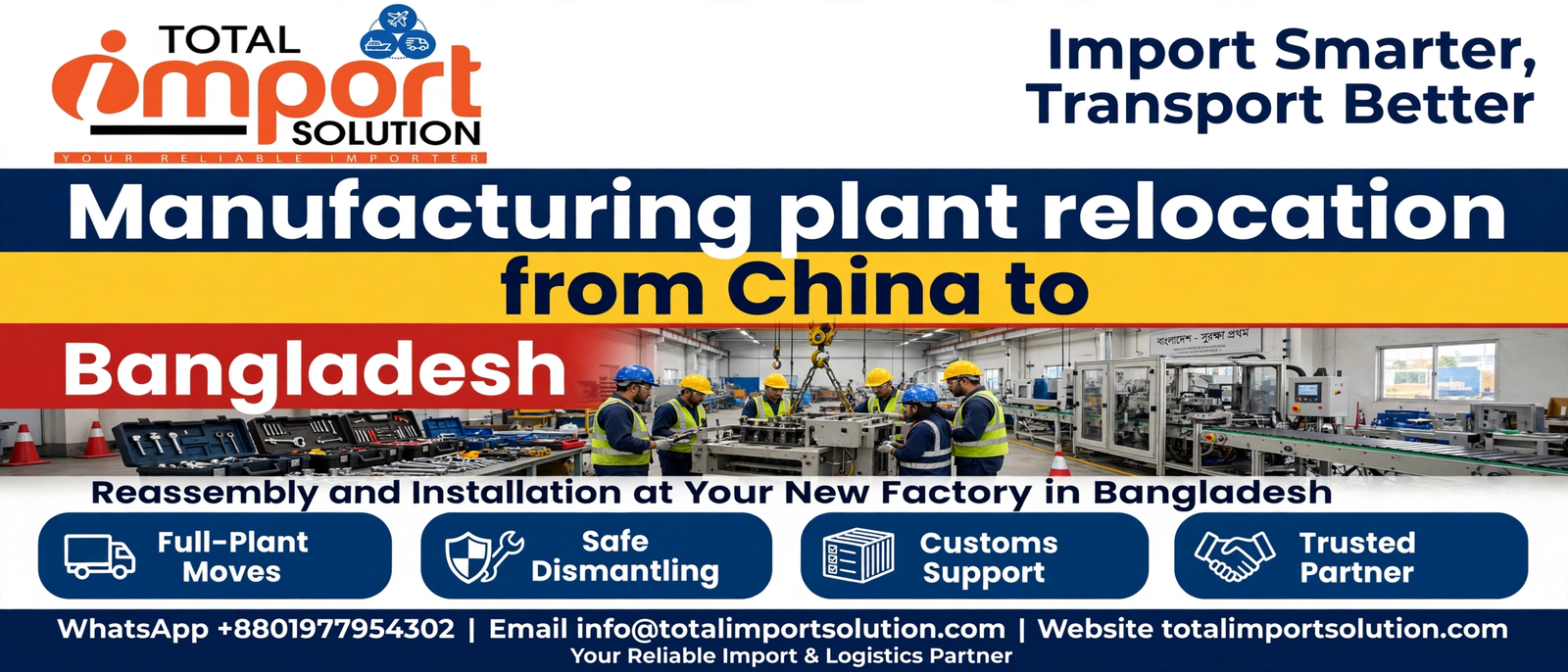
Reassembly is the reverse of dismantling, and it works only when the dismantling was done well. The reassembly team works from the dismantling reports, the photographs, the labels and the manuals. Each crate is opened in the order the team needs it, each part is checked against the label, and the machine is put back together step by step.
Installation starts with the machine base. The machine is placed in its marked position on the factory floor, levelled, and fixed in place. The parts removed in China are fitted back in the reverse order of dismantling. Cables are connected using the labels on both ends, pipes are reconnected, and the control panel is fitted and checked. The team follows the photographs taken during dismantling, because the photographs show how the machine looked before it was taken apart.
Testing happens in two stages. First, each machine is tested on its own: power, controls, moving parts, safety guards and lubrication are checked, the machine is run without load, and any noise, vibration or fault is noted and fixed. Second, the full production line is tested together: the machines are run in sequence, the material flow is checked, and the output is checked against the standard the factory expects.
12. Common Problems and Fixes
Even a well-planned plant relocation can face problems, and the table below lists the common problems and the fix for each one.
| Problem | Why it happens | Fix |
|---|---|---|
| Parts go missing | Labels fall off, small parts are not bagged | Label every part, bag small parts, check the list at each stage |
| Documents do not match the cargo | Names or numbers differ between papers | Check names, numbers and quantities on all papers before shipping |
| Crate is too large for the container | Machine size was not measured | Measure every machine during the survey, plan the container type early |
| Machine arrives damaged | Packing is weak, load shifts in transit | Use strong crates, brace the load, fix moving parts before packing |
| New site is not ready | Floor, power or roof is unfinished | Survey the new site early, finish the site before the ship sails |
| Customs asks questions | Used machine description is unclear | Keep photos, manuals and certificates with the documents |
| Crates arrive in the wrong order | Loading order was not planned | Write the loading order in the container plan, unload in that order |
| Cables cannot be reconnected | Cable ends were not labelled | Label both ends of every cable during dismantling |
13. How to Judge a Good Relocation Partner, Work With Your Agent, and Avoid Mistakes
A good relocation partner is judged by the plan, the records and the communication, not by promises. The partner should visit both sites before giving a plan, prepare a written inventory list, and explain the documents and the HS classification in plain words. The partner should give the charges in writing after checking the actual shipment and documents.
Working with your agent starts with clear information. Tell the agent which machines are moving, which machines are staying, the condition of each machine, and the date the new site will be ready. Share the machine manuals, the photographs and the business documents early, because the agent cannot prepare the papers without them.
The mistakes to avoid are simple, and they are the same in most relocations. Do not start dismantling before the inventory is finished. Do not pack without labels. Do not ship before the documents are checked. Do not send machines to a site that is not ready. Do not lose the manuals, the photographs and the dismantling reports. Each of these mistakes is easy to prevent during planning and hard to fix after the ship has sailed.
Total Import Solution has supported importers since 2016 with document checking, HS classification guidance, customs clearance support and delivery coordination for machinery shipments from China to Bangladesh. For a plant relocation, the team follows the shipment from the survey stage to the handover stage, with the inventory list, the documents and the schedule checked at each step. The aim is a move where every machine arrives, every document matches the cargo, and production starts at the new site without a long delay.
Frequently Asked Questions (FAQs)
1. What is manufacturing plant relocation from China to Bangladesh?
It is the complete move of a production setup from China to Bangladesh: machines are dismantled, labelled and packed in China, shipped to Bangladesh, cleared through customs, transported to the new site, then reassembled, installed and tested.
2. How long does a plant relocation take?
The time depends on the size of the plant, the number of machines, the documents, the shipping schedule, the customs process and the readiness of the new site. A written schedule with spare time for delays is the best way to plan.
3. Which machines can be moved in a plant relocation?
Most production machines can be moved, including production lines, processing machines, packing machines, moulds, dies, tools and control panels. Each machine is surveyed first for its size, weight and condition.
4. Can used machines be imported into Bangladesh?
Used machines are a normal part of plant relocation, and they need clear documents. The invoice and packing list must state that the machine is used, with its name, maker, model, serial number and condition.
5. What documents are needed for a plant relocation?
The core documents are the commercial invoice, the packing list, the bill of lading and the certificate of origin. Other papers may be needed, such as a fumigation certificate for wooden packing or a used machinery certificate.
6. What is HS classification and why does it matter?
HS classification is the system customs uses to identify goods. Each item is given an HS code from its description, function and material, and the code decides how customs treats the goods.
7. How are machines packed for the sea journey?
Machines are cleaned, dried and checked before packing. Moving parts are fixed in place, fragile parts are wrapped separately, and heavy machines go in strong wooden crates with bracing inside.
8. Which container type is used for large machines?
The container type depends on the size and weight of the machine. Most crates travel in a standard dry container, tall machines may need an open-top container, and very large machines may need a flat rack container.
9. How is customs clearance handled in Bangladesh?
The clearing agent files the bill of entry with customs, together with the invoice, packing list, bill of lading, certificate of origin and other papers. Customs checks the documents against the cargo before release.
10. Which port does the shipment arrive at?
Most plant relocation cargo for Bangladesh arrives through Chittagong Port, and small urgent parts may arrive through Dhaka Airport. The port of arrival should be written on the shipping documents.
11. How much does a plant relocation cost?
There is no fixed figure in this guide, because the cost depends on the machines, the number of containers, the documents, the customs treatment and the transport to the new site. A rate or fee is confirmed only after checking the actual shipment and documents.
12. What happens if a part goes missing during the move?
A missing part is found by checking the inventory list against the packing list and the crates. That is why every part is labelled and every small part is bagged with the machine number.
13. How are machines reassembled at the new site?
The reassembly team works from the dismantling reports, the photographs, the labels and the manuals. Machines are placed in their marked positions, levelled and fixed, parts are fitted back in reverse order, and cables are connected using the labels.
14. What should be ready at the new factory site before the machines arrive?
The floor must be strong enough, the power connection must be in place, the roof must be finished, and there must be covered storage space for the crates. The unloading area must be firm enough for a forklift and a crane.
15. What are the most common mistakes in a plant relocation?
The most common mistakes are starting dismantling before the inventory is finished, packing without labels, shipping before the documents are checked, sending machines to a site that is not ready, and losing the manuals and photographs.
16. How can Total Import Solution help with a plant relocation?
Total Import Solution supports the move with survey coordination, inventory and document checking, HS classification guidance, customs clearance support and delivery coordination to the new site, following the shipment from the first survey to handover.
Contact Total Import Solution
- WhatsApp: +8801977954302
- Email: info@totalimportsolution.com
- Website: totalimportsolution.com
- Service: Manufacturing plant relocation from China to Bangladesh.
- Company: Total Import Solution, an importer serving businesses in Bangladesh since 2016. Call or message on WhatsApp to discuss your plant relocation, share your machine list, and plan the move step by step.
