
1. What a Plastic Recycling Machine Does and Why Bangladesh Buyers Import It from China
A plastic recycling machine takes used plastic and turns it into a form that can be used again. Workers collect bottles, film, crates, pipes and bags, sort them by type and colour, wash them, and feed them into a machine that cuts, melts and reshapes the material. The output may be flakes, pellets or granules, depending on the line installed. In Bangladesh, plastic waste is widely available, and demand for recycled material exists in packaging, household goods and construction work, so a well planned plant can run on a steady supply.
China is a common source because Chinese factories build a wide range of recycling lines, from a single crusher to a full washing and pelletising line. A buyer can ask for a machine that matches the local plastic type, the plant space, the power supply and the output the business needs. That wide choice is why careful checking matters. Since 2016, Total Import Solution has worked as an importer, and the same care that applies to other industrial machines applies here: know the plastic, the daily amount, the final buyer and the plant limits before any order is placed.
This guide explains the full journey in plain steps: machine types, the requirement list, supplier checking, specification, inspection, packing, documents, customs clearance, transport, installation, trial run and daily operation. It gives no price, duty figure, transit time or carrier name, because a rate or a fee is confirmed only after checking the actual shipment and documents.
2. Types of Plastic Recycling Machines You Can Import from China
Each machine type does a different job. A shredder cuts large items into pieces. A crusher breaks bottles and crates into flakes. A washing line cleans flakes and film. A dryer removes water. An extruder melts the material and pushes it through a die. A pelletiser cuts the strand into pellets. A granulator makes granules of a set size. A film line handles soft bags and film, and a bottle line handles PET bottles and rigid items.
| Machine Type | Main Job | Plastic It Suits |
|---|---|---|
| Shredder | Cuts large items into pieces | Crates, pipes, drums |
| Crusher | Breaks hard plastic into flakes | Bottles, crates, hard items |
| Washing line | Washes flakes and film | Bottles, film, containers |
| Dryer | Removes water after washing | Washed flakes and film |
| Extruder | Melts material, forms a strand | Washed flakes |
| Pelletiser | Cuts strand into pellets | Melted plastic strand |
| Granulator | Makes granules of a set size | Hard plastic and flakes |
| Film recycling line | Washes and pellets film | Bags, film, soft plastic |
| Bottle recycling line | Washes and flakes bottles | PET bottles, rigid items |
A common bottle line is sorting, label removal, crushing, washing, drying, extruding and pelletising. A common film line is sorting, shredding, washing, drying, extruding and pelletising. A buyer who wants only flakes can stop after washing and drying, while a buyer who wants pellets needs the extruder and pelletiser too. Ask the supplier for a drawing showing each machine, the flow of material, the power need of each machine, and the parts that wear out first.
3. How to Define Your Machine Requirement Before You Talk to a Supplier
A clear requirement list saves time and prevents wrong orders. Start with the plastic: the types you will collect, the colour mix, the dirt level, and whether labels and caps will be removed first. A machine built for clean bottles will need extra washing if the input is dirty. Next, write down the amount: how many kilograms will arrive each day, how many days the plant will run each week, how much finished output you need, and how much storage you have for bales and pellets.
Then record the site facts: floor size, roof height, power supply, water supply, drain, road width and door size. Visit the site with a tape measure and record the facts.
| Requirement Point | What to Write Down | Why It Matters |
|---|---|---|
| Plastic type | PET, HDPE, PP, LDPE or mixed | Sets the machine type |
| Input form | Bottles, film, crates, bales | Sets the feed and shredder |
| Daily input amount | Kilograms per day | Sets the line size |
| Final output form | Flakes, pellets or granules | Sets the stages needed |
| Plant floor and height | Length, width, roof height | Sets the layout |
| Power and water | Available supply at the site | Sets the motor and washing plan |
| Door and road | Door size and road width | Sets the delivery plan |
| Storage space | Space for bales and pellets | Sets the daily flow |
Keep this list with the order documents and use it again when the machine arrives.
4. Finding and Checking a Supplier in China
Start with a short list, not a single name. Ask for introductions from other plant owners, trade contacts and an import support team that has handled industrial machines before. Look for factories that build recycling machines as a main product, not as a side item.
Check the supplier in steps. First, ask for the company name, address, business licence details and the name of the person you are dealing with. Ask for photos and a video of the factory floor showing machines being built, a list of machines built in the recent past, and a drawing of the exact machine you are considering, with sizes, power, weight and the main parts labelled. Second, ask for a clear written offer listing each machine, the motor, the heater, the control panel, the spare parts included, the packing method, the loading plan and the documents that will come with the machine. It should state the delivery term and the payment stages in plain words. Read it line by line and ask for any missing point to be added in writing.
Third, check the machine by video call if a visit is not possible. Ask the supplier to show the machine running, the control panel, the feed area and the output, and to show the nameplate on the motor and the main parts. Ask how the machine is tested before shipment, what record is kept of that test, and what happens if a part is found faulty during inspection. Keep every message, drawing and offer in one file. A good supplier will also ask about your plastic type, power supply, water supply and plant size.
5. Machine Specification, Capacity and Power: What to Confirm in Writing
The specification is the written promise of what the machine will do, and it must be clear enough to check at inspection and at the trial run. Confirm the machine type and model, the feed opening size, the output size, the motor power, the heater power, the total power need, the voltage and frequency, the machine size and weight. Each number should be written in the order, not only in a chat message.
Capacity needs special care. A capacity figure in kilograms per hour depends on the plastic type, the input size, the dirt level and the operator, so ask what input the figure is based on and ask for a range rather than a single figure. Plan on a steady working figure the plant can reach day after day. Power is a common source of trouble, so ask for the power need of each motor, each heater and the control panel, listed one by one, and check the total against the supply at the plant with an electrician before shipping.
| Specification Point | What to Confirm | How to Check It Later |
|---|---|---|
| Machine type and model | Exact type and model name | Check the nameplate on arrival |
| Feed opening and output size | Opening size, flake or pellet size | Measure the opening, check the sample |
| Motor and heater power | Power of each motor and heater | Check each nameplate and the panel |
| Total power, voltage, frequency | Total for the full line | Compare with the plant supply |
| Machine size and weight | Length, width, height, weight | Measure the machine on arrival |
| Main parts and control panel | Blades, screens, screw, filters, panel | Check the parts list and the panel |
| Spare parts included | Blades, screens and seals | Count them on arrival |
Confirm the control panel too: what it controls, what safety stops it has, and whether it has an emergency stop and overload protection. Ask for a simple operating manual in English, with drawings. A clear manual is part of the machine and should be listed in the order.
6. Inspection Before Shipment: What to Check and What to Record
Inspection before shipment is the last chance to catch a problem while the machine is still at the factory, so do not skip it. The inspection can be done by a visit, by a video call with a clear plan, or by an inspection team. Whatever method is used, write the plan before the day and keep the record after it. Check the machine against the specification from Section 5, not against a general impression.
Start with identity: check the model name, the nameplate, the motor nameplates and the main part labels against the order, and check that the machine size, weight and number of parts match the packing list. Count the spare parts. Next, check the build: the welding, bolts, guards, feed area, discharge area and control panel. Check that guards are fitted where moving parts are exposed, that the feed opening and screen size match the order, and that the panel starts and stops the machine in the right order.
Then run the machine if the factory can arrange a test, using material similar to the plastic you will process. Watch the feed, cutting, washing, drying, melting and pelletising, and keep a sample of the output. Note the sound, vibration, temperature readings and any leak from the tank or pipes. Record the inspection in a short report listing the date, the people present, the machine checked, each point checked, the result, and any point that needs fixing. Send it to the supplier in writing and ask for written confirmation that the fixes will be done before loading.
7. Packing, Loading and Container Planning for a Recycling Machine
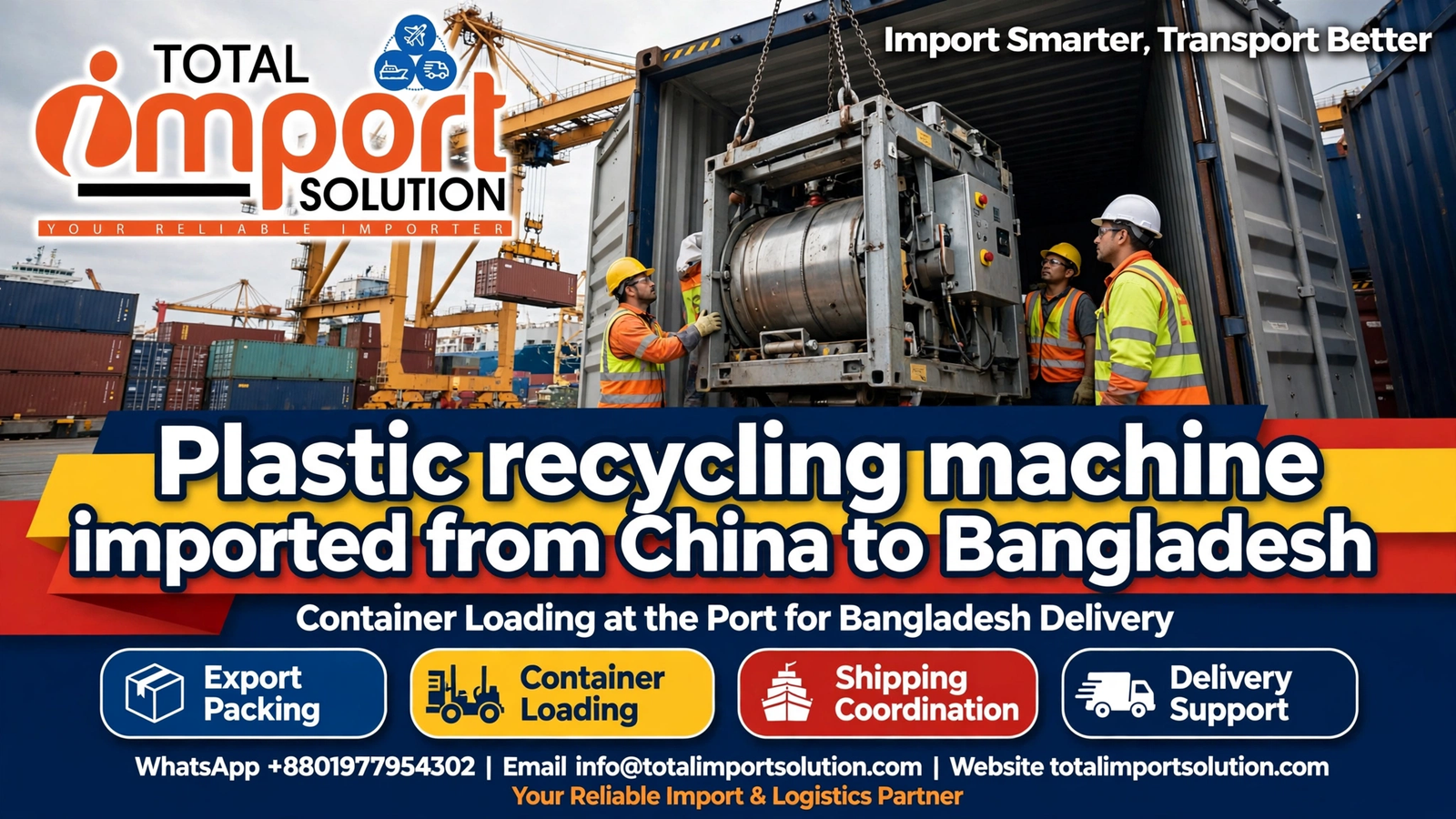
Packing protects the machine on the road, at the port and on the ship. A recycling machine is heavy, with sharp blades, a long screw, a control panel and parts that can be damaged by water or by a hard knock. Ask for photos of the packing before the container door is closed.
Large machines are often taken apart for shipping: the main body, motor, control panel, hopper, pipes and spare parts may travel as separate pieces. Each piece should be labelled, and the label should match the packing list, which states the number of pieces, the size and weight of each piece, and the contents of each box. The supplier should also give a loading plan showing how the pieces will sit in the container, where the heavy pieces will go, and how they will be fixed. Heavy pieces should sit low and be fixed so they cannot shift, sensitive parts should be protected from water and contact with heavy steel, and spare parts should travel in a marked box.
On loading day, lift from the lifting points marked by the factory. Take photos during loading, showing each large piece in place, the fixing, and the closed container door with the seal number, and record the seal number. Keep the packing list, loading photos, container number and seal number in one file and share it with the import support team, the clearance team and the transport team, so each team knows what is coming.
8. Documents You Need for Import to Bangladesh
Documents are the backbone of an import. Without the right documents, a machine can wait at the port while a missing paper is arranged. Start the document work early, before the machine is shipped, and keep a checklist.
| Document | Who Provides It | What It Should Show |
|---|---|---|
| Commercial invoice | Supplier in China | Seller, buyer, machine, value |
| Packing list | Supplier in China | Pieces, sizes, weights, contents |
| Bill of lading | Shipping line | Shipper, consignee, container, port |
| Certificate of origin | Supplier or chamber | Country where the machine was made |
| Technical sheet | Supplier in China | Model, size, power, main parts |
| Inspection record | Inspection team or factory | Points checked and results |
| Operating manual | Supplier in China | Operation, safety, maintenance |
| Import registration | Buyer in Bangladesh | Buyer import details |
| Bank documents | Buyer bank in Bangladesh | Payment and import record |
| Customs forms | Clearance team | Declaration for the shipment |
Check each document for the same details: the buyer name, machine name, model, number of pieces and container number should match across the invoice, packing list and bill of lading. Keep the documents in two forms, the original paper set and a clear scanned set. A rate or a fee is confirmed only after checking the actual shipment and documents, so do not plan the budget on a figure given before the documents are ready.
9. Customs Clearance in Bangladesh: Step by Step
Customs clearance follows a set order, and it is easier when the documents are ready and the clearance team has the full file before the ship arrives. First, share the scanned documents with the clearance team, who will read the invoice, packing list, bill of lading, certificate of origin and technical sheet and prepare the declaration stating the importer, the machine, the value, the origin and the port details.
Second, track the arrival. The shipping line will issue an arrival notice, and the team will check the container number and seal number against the bill of lading and the loading record. Third, the customs office will review the declaration and documents and may ask for a physical check, where an officer looks at the container contents and compares them with the packing list.
Fourth, the applicable charges are confirmed and paid. The clearance team will confirm the charges only after checking the actual shipment and documents, and will share a clear break-up with the buyer before payment. Fifth, move the container out of the port. Book the transport team before the release, so the container does not wait longer than needed, and share the container size, weight, plant address, road width and unloading plan in advance.
| Step | Main Action | Who Handles It |
|---|---|---|
| 1 | Share scanned documents with the clearance team | Buyer and import support team |
| 2 | Prepare the declaration from the documents | Clearance team |
| 3 | Track arrival, check container and seal numbers | Clearance team, shipping line |
| 4 | Customs review, physical check if asked for | Customs office, clearance team |
| 5 | Confirm charges from the actual shipment, pay | Clearance team, buyer |
| 6 | Receive release, move the container out | Clearance team, transport team |
| 7 | Check pieces at the plant against the packing list | Buyer, plant team |
10. Transport from the Port to Your Plant in Bangladesh
Transport is the link between the port and the plant, and it needs the same planning as the rest of the import. First, confirm the container size and total weight, and ask the transport team to confirm the truck type, trailer type and route in writing, based on the actual container details. Second, plan the route from the port to the plant, noting any narrow road, low bridge, sharp turn or weight limit, and share the full plant address, a landmark and a contact number for the person who will receive the container.
Third, prepare the unloading. The plant needs clear space for the container, lifting gear that can handle the heaviest piece, and a team that knows the unloading order. Lift from the lifting points marked by the factory, handle the control panel and sensitive parts with extra care, keep them dry, and place the pieces in the order they will be installed, so the installation team does not have to move a heavy piece twice.
Fourth, check for damage on arrival. Count the pieces, check the labels, and look for damage to the packing or the machine. If a piece is damaged, take a photo at once, note the damage in writing, and share the photo and note with the import support team and the supplier. Fifth, store the pieces under cover on a dry floor if they cannot be installed the same day, cover the control panel and open parts, and keep the spare parts box and the operating manual in a safe place.
11. Installation, Trial Run and Operator Training at Your Plant
Installation starts with the layout. Mark the floor where each machine will sit, using the supplier drawing showing the size of each machine, the space between machines, and the path for material to move from one machine to the next. Check the floor level, power points, water points and drain before any machine is moved into place. Fix the layout first, then move the machines.
Follow the supplier manual in order: place the main machines and fix them to the floor, connect the pipes between the washing tank, dryer and drain, connect the power cables to the control panel and ask an electrician to check the wiring before the power is switched on, fit the blades, screens and filters, and check all bolts, guards and safety stops. The trial run should then be done in stages: first run each machine without material and check that the motors start and stop in the right order, with no unusual sound or vibration; second, run the line with a small amount of clean material; third, run it with the normal input and check the output size, colour and cleanliness.
Train the operators during installation and the trial run, not after. They should learn how to start the line in order, feed material at a steady rate, watch the panel, stop the line safely, clean the screens and filters, and change a blade. Since 2016, Total Import Solution has followed this careful approach, and a clear installation record listing the date, the people present, the machines installed, the power and water checks, the trial run results and any point still needing attention is part of it. Share that record with the supplier and the import support team.
12. Running the Machine: Feedstock, Sorting, Washing and Output
Daily running starts with feedstock, the plastic material to be processed. Buy from known collectors and check each load before it is stored: the plastic type, the colour mix, the dirt level, and whether the load contains metal, glass, stone or thick rubber that should not go into the machine. Sort the feedstock on arrival and store each type separately with a clear label.
Sorting comes next. Workers should sort by type and colour, remove labels, caps and other parts where the line needs that, and work at a clean, well lit sorting table close to the feed area. Washing follows sorting: fill the tank with clean water, wash until the dirt and labels are removed, change the water when it becomes dirty, and keep the drain clear. Find the steady pace that gives a clean output and keep it each day.
Drying, melting and pelletising follow washing. The dryer should remove the water before the material reaches the extruder, because wet material will affect the melting. The operator should watch the panel readings during the run, and the pelletiser should cut the strand into pellets of the right size. Check the pellets during the run and keep a sample from each batch.
| Stage | Main Action | Main Check |
|---|---|---|
| 1 | Receive and check feedstock | Plastic type and dirt level |
| 2 | Sort by type and colour | Labels and caps removed |
| 3 | Shred or crush the material | Flake size and screen |
| 4 | Wash the flakes or film | Water clean, drain clear |
| 5 | Dry the washed material | Material dry before melting |
| 6 | Melt in the extruder | Panel readings steady |
| 7 | Cut into pellets | Pellet size and shape |
| 8 | Pack and store the output | Bags labelled, stored dry |
13. Common Problems, Spare Parts and Ongoing Support
Common problems often have simple causes. A machine that stops may have a blocked feed, a full screen, a tripped power supply or a worn blade. A line that runs slowly may have dirty material, a wrong screen size, or a feed rate that is too fast for the washing stage. An output that looks dirty may have come from dirty water, poor sorting or a washing time that was too short. An output that looks uneven may have come from a worn cutter, a wrong temperature or mixed plastic types in the feed. In each case, stop the line safely, check the simple points in order, and record what was found.
Keep spare parts at the plant, not ordered only after a breakdown. The parts that wear out first are blades, screens, filters, seals and belts. Keep a set of each, with the part name, the machine it fits and the date received written on the box, and record when each part was changed, so the team can see how long each part lasts. Order a new set when the stock runs low, not when the last part has been used.
Follow a weekly and monthly maintenance plan. Each week, clean the screens and filters, check the blades, bolts and pipes for leaks, and check the control panel for any warning. Each month, check the motors, heaters, wiring, guards and water tank. Plan ongoing support in writing too: ask the supplier what support is available after the trial run, how to report a problem, what information the supplier needs, and how spare parts can be ordered. Keep the supplier contact, machine model, order number and installation record in one file, so any message can include the full details. Keep a daily log of the feedstock, output, running hours and any stop or part changed.
Frequently Asked Questions
1. What is a plastic recycling machine imported from China to Bangladesh?
It is a machine or a full line built in China and brought to Bangladesh to process used plastic into flakes, pellets or granules, using stages such as sorting, shredding, washing, drying, extruding and pelletising.
2. Which plastic types can a recycling machine process?
Common types include PET bottles, HDPE bottles, PP crates, LDPE film and other hard plastic items. The right machine depends on the plastic type, input size and final output.
3. Do I need a full line or a single machine?
A single machine suits a buyer who only needs one stage, such as crushing or washing. A full line suits a buyer who wants to take sorted plastic through to pellets in one plant.
4. How do I choose the right machine size?
Start with the daily input amount, the final output form and the plant space, then ask the supplier for the capacity range, machine size, power need and water need, and check them against the site facts.
5. What should I check before I order from a supplier in China?
Check the company details, factory photos and video, the drawing of the exact machine, the written offer, the spare parts list and the documents provided.
6. What documents do I need for the import?
The main documents are the commercial invoice, packing list, bill of lading, certificate of origin, technical sheet, inspection record, operating manual, import registration and bank documents, all with matching details.
7. How does customs clearance work in Bangladesh?
Share the scanned documents with the clearance team before the ship arrives, so the team can prepare the declaration and confirm the charges from the actual shipment and documents.
8. How is the machine packed for shipping?
Each part is packed to protect it from water and knocks, labelled to match the packing list, with heavy pieces fixed low in the container, sensitive parts protected, and spare parts in a marked box.
9. How is the machine transported from the port to the plant?
A truck and trailer suited to the container size and weight carry it on a planned route, and the plant team unloads each piece, checks it against the packing list, and records any damage at once.
10. What happens during installation and the trial run?
The machines are placed by the supplier drawing, pipes and power are connected and checked, then the line runs first without material, then with a small amount, then with the normal input, while output samples are recorded.
11. What power and water supply does a recycling line need?
The need depends on the motors, heaters, washing stage and line size. Ask the supplier for the power need of each machine and the water need of the washing stage, and check them at the plant before shipping.
12. What spare parts should I keep at the plant?
Keep blades, screens, filters, seals and belts, with the part name, the machine it fits and the date received on each box, and order a new set when the stock runs low.
13. How do I keep the recycled output clean and consistent?
Sort by type and colour, remove labels and caps, wash with clean water, dry the material before melting, check the pellets during the run, and keep a sample from each batch.
14. Can Total Import Solution help with the import?
Yes. Since 2016, Total Import Solution has worked as an importer and can help with supplier checking, documents, customs clearance coordination, transport planning and follow up after delivery.
15. How long does the import process take from order to running?
The time depends on the machine build, inspection, shipping, clearance and installation. Agree the full plan in writing before ordering, and do not plan the opening on a date given before the checks are complete.
16. What should I do if a problem appears after installation?
Stop the line safely, check the simple points in order, record what was found with photos and panel readings, and share the full record with the supplier and the import support team.
Contact Total Import Solution
- WhatsApp: +8801977954302
- Email: info@totalimportsolution.com
- Website: totalimportsolution.com
- Company: Total Import Solution — Your Reliable Import & Logistics Partner
- For help with a plastic recycling machine imported from China to Bangladesh, share your plastic type, daily input amount, final output form, plant size, power supply and water supply, so the team can plan the import on your actual shipment and documents.
