
Printing Machine Import Logistics in Dhaka
1. Why Printing Machine Import Logistics Matters in Dhaka
Dhaka is one of the busiest printing and packaging centres in Bangladesh. Offset presses print books, newspapers, magazines and labels. Digital presses print short runs, personalised work and urgent jobs. Flexo presses print packaging, pouches and labels for food, garments and consumer goods. Large-format machines print banners, billboards, backdrops and display material for events and retail. Behind every one of those machines is a logistics chain that starts in another country and ends on a factory floor in Dhaka, Gazipur or Narayanganj.
Printing machine import logistics is the full chain of work that moves a machine from a supplier to a buyer in Dhaka in a safe, legal and organised way. It covers choosing the right machine, checking the supplier, preparing documents, arranging packing and transport, clearing customs, delivering the machine to the site, unloading it, installing it and testing it. When one link is weak, the whole project slows down: a missing document can hold a machine at the port, poor packing can damage a precision part, and a site that is not ready can leave a machine waiting in a crate for weeks.
Since 2016, Total Import Solution has worked in import and logistics in Bangladesh, and this guide reflects the practical lessons of that work: prepare the documents before the machine ships, check the site before the machine arrives, and keep one person responsible for the whole chain from order to installation.
2. Types of Printing Machines Imported into Dhaka
Different printing jobs need different machines, and the machine type changes the logistics. A small digital press may arrive in one crate, while a large offset press may arrive in several crates and need a crane and a reinforced floor. A flexo press may come with many rollers and parts to list separately, and a large-format printer may be long, tall and sensitive to dust and moisture.
| Machine type | Typical use in Dhaka | Main logistics points |
|---|---|---|
| Offset printing press | Books, newspapers, magazines, labels, commercial print | Heavy, many crates, crane and forklift often needed, floor load matters |
| Digital printing press | Short runs, personalised print, urgent jobs, photo books | Sensitive electronics, dry storage, careful handling, power supply check |
| Flexo printing press | Packaging, pouches, labels, cartons, flexible film | Many rollers and parts, long machine length, clean site needed |
| Large-format printer | Banners, billboards, backdrops, retail display | Long and tall crates, dust protection, wide access route needed |
| Screen printing machine | Textiles, garments, posters, special finishes | Frames and screens need flat storage, ink handling care |
| Binding and finishing machine | Cutting, folding, binding, lamination, die cutting | Often imported with a press, spare blades and parts need listing |
| Used or reconditioned press | Lower-cost entry for small and medium printers | Condition check, age and service history, extra inspection care |
Before ordering, a buyer should write down the machine name, model, serial number, dimensions, weight, power requirement and number of crates. That information is needed for the quotation, the packing list, the transport booking, the customs documents and the site preparation. If the supplier cannot give clear dimensions and weight, the buyer should ask again before paying. A buyer should also think about the work the machine will do in the first year, so the machine fits the business and not only the budget.
3. Planning the Import Before You Order
Good logistics starts before the order is placed. A buyer who plans early saves time later, because the documents, the site and the transport can all be prepared while the machine is being built, packed or shipped. A buyer who waits until the machine is at the port has to do everything at once, under pressure, and that is when mistakes happen.
The planning stage has five clear steps. First, define the machine and the job it will do. Write down the machine type, model, size, weight, power need and expected print volume. Second, check the site. Measure the door, the access road, the floor, the ceiling height and the power supply. Note where the machine will stand, where the crates will be stored, and how a truck and a crane will reach the site. Third, list the documents that will be needed, and start collecting the buyer documents early. Fourth, choose a logistics agent and agree who does what, from the supplier factory to the Dhaka site. Fifth, set a realistic schedule with room for inspection, document checks and customs work.
| Planning item | What to check | Who is responsible |
|---|---|---|
| Machine details | Model, size, weight, power, crates | Supplier and buyer |
| Site readiness | Door, floor, power, access road, storage | Buyer |
| Documents | Buyer documents, supplier documents, shipping documents | Buyer, supplier, agent |
| Transport | Mode, route, truck, crane, forklift | Logistics agent |
| Customs | Classification, documents, inspection | Logistics agent and buyer |
| Installation | Technician, tools, spare parts, testing | Supplier and buyer |
A buyer should keep a single file for the whole import, holding the quotation, invoice, packing list, shipping documents, customs papers, delivery notes and installation report.
4. Documents You Will Need
Documents are the backbone of printing machine import logistics. Customs, the bank, the shipping line and the transport team all work from documents, and if a document is missing, wrong or inconsistent, the shipment stops until it is fixed. The most common delay in Dhaka imports is a document that does not match another document, for example a packing list with a different crate count from the shipping document, or an invoice that spells the model differently from the order.
| Document | Who provides it | What it shows |
|---|---|---|
| Commercial invoice | Supplier | Machine, model, value, buyer and seller details |
| Packing list | Supplier | Number of crates, weight, dimensions, contents |
| Bill of lading or airway bill | Shipping line or airline | Shipment, vessel or flight, port, consignee |
| Certificate of origin | Supplier or chamber | Country where the machine was made |
| Insurance document | Insurer or agent | Cover for the shipment during transport |
| Import registration and trade licence | Buyer | Buyer business and import eligibility |
| Tax and VAT registration | Buyer | Buyer tax identity for customs work |
| Letter of credit or payment proof | Buyer bank | Payment terms agreed with the supplier |
| Inspection or survey report | Inspection body | Condition and details, when required |
| Technical catalogue or brochure | Supplier | Machine details, model and specification |
| Installation and service note | Supplier | Technician plan, tools and spare parts |
A buyer should check three things on every document: the buyer name and address match on all documents, the machine name, model and serial number match on the invoice, packing list and catalogue, and the crate count, weight and dimensions match on the packing list and the shipping document. A small difference can cause a long delay. Originals should be kept safe, and copies given to the agent in good time.
5. HS Code and Classification in General Terms
Every imported machine is classified under a code system used by customs around the world, called the HS code, short for Harmonized System code. The HS code tells customs what kind of machine it is, and it is used to work out how the shipment is treated at the border. A printing machine has a different code from a cutting machine, a binding machine or a spare part, so getting the code right matters.
A buyer does not need to memorise HS codes, but a buyer should understand how classification works in general terms. First, the machine is identified by what it does, not only by its name. An offset press, a digital press, a flexo press and a large-format printer do different work, and they are classified by that work. Second, the machine is classified as a complete machine or as parts. A complete press and a box of spare rollers are not the same item, and they should be listed separately. Third, accessories and spare parts that come with the machine should be listed clearly, with their own descriptions, so customs can see what is a part of the machine and what is a separate item.
The agent and the supplier should agree the classification before the documents are finalised, choosing a code that matches the machine, the catalogue and the invoice. A buyer should ask the agent to explain the classification in plain words. Each shipment should be classified on its own facts, using the actual machine, catalogue and packing list, never copied from an old shipment or a different machine.
6. Finding and Checking a Supplier
The supplier is the company that sells the printing machine. A good supplier will give clear information, answer questions, pack the machine well and send a technician for installation when that is agreed. A poor supplier will give vague answers, change the specification, pack badly or disappear after payment. Checking a supplier before paying is one of the most important steps in the whole import.
A buyer should start by asking for the full machine details in writing: the maker, the model, the year of manufacture, the serial number, the condition if the machine is used, the dimensions, the weight, the power requirement and the number of crates. A buyer should also ask for a catalogue, photos or a video of the actual machine, not only a stock photo. For a used machine, a buyer should ask for the service history, the running hours if available, and a report on the condition of the main parts. A buyer should also ask about the terms of sale in plain words. Does the price include packing, transport to the port, insurance, installation and training, or only the machine itself? Who arranges the shipping, who pays for the crane at the Dhaka site, and who sends the technician, and for how many days? A written quotation that answers those questions is worth far more than a short message with a single figure.
| Supplier check | What to look for | Warning sign |
|---|---|---|
| Machine details in writing | Maker, model, serial number, condition | Vague description, no serial number |
| Catalogue and photos | Actual machine, clear images | Stock photos only, no real machine shown |
| Service history for used machines | Maintenance record, running condition | No history, no inspection allowed |
| Clear quotation | What is included and what is not | One figure with no breakdown |
| Packing method | Wooden crates, moisture protection, labelling | No packing plan, loose packing |
| Installation and training | Technician, days, tools, training plan | No technician offered, no training |
| References | Other buyers in Bangladesh or nearby | No references, no contact details |
| Payment terms | Clear stages, bank payment, written contract | Full payment before any document |
A buyer should take time over this stage. A machine bought in a hurry often causes trouble later, while a checked supplier and a written quotation lead to a smoother import.
7. From Order to Shipment: A Step-by-Step Process
Once the buyer has chosen a machine and a supplier, the work moves in a clear order. Each step depends on the step before it, so a buyer should not skip a step to save time.
Step 1: Confirm the order in writing, stating the machine, model, serial number, condition, price, payment stages, packing, shipping terms, installation and training. Step 2: Arrange payment through the bank and keep the payment proof with the import file. Step 3: Ask the supplier to confirm the production schedule, and ask for a realistic date. Step 4: Confirm the packing list and shipping documents before the machine leaves the supplier, checking that the model, serial number, crate count, weight and dimensions all match. Step 5: Book the transport, with the agent booking the vessel or aircraft and the truck for the Dhaka leg. Step 6: Arrange insurance covering the journey from the supplier to the Dhaka site. Step 7: Prepare the site while the machine is in transit. Step 8: Prepare the customs documents, so the customs work can start as soon as the shipment arrives. Step 9: Track the shipment, and update the site team, truck and crane bookings if the arrival date changes. Step 10: Receive the machine at the port, count the crates, check the labels, and note any damage before the crates leave the port area.
8. Packing, Loading and Transport
Packing is one of the most important parts of printing machine logistics, because a printing machine is a precision machine. A press has rollers, cylinders, gears, electronic parts and fine adjustments. A knock, a drop or a long period in damp air can damage those parts. Good packing protects the machine, while poor packing leaves it open to damage that may only show up when the machine is tested.
A supplier should pack a printing machine in strong wooden crates, with the machine fixed inside so it cannot move. Sensitive parts should be wrapped and protected from moisture and dust. Each crate should be labelled with the machine name, the crate number, the total number of crates, the weight, the handling marks and the destination. The packing list should describe what is in each crate, so the buyer can check the crates on arrival without opening them all at once. Loading also needs care. A crate should be lifted with the right equipment, by people who know how to handle heavy machinery, and a crate should never be dragged, dropped or tipped.
Transport to Dhaka usually has two parts: the international leg by sea or by air, and the local leg by truck from the port or airport to the site. Sea transport suits large and heavy presses, while air transport suits smaller machines, urgent shipments and sensitive electronic parts. A buyer should ask the agent to explain the choice in plain words.
| Transport mode | Suits | Points to plan |
|---|---|---|
| Sea freight | Large presses, heavy crates, many crates | Port handling, container or break-bulk, truck from port |
| Air freight | Small presses, digital machines, urgent parts | Airport handling, size and weight limits, truck from airport |
| Truck from port or airport | Every shipment, final leg to the site | Road access, truck size, crane, forklift, timing |
The truck from the port or airport to the Dhaka site needs the same care as the international leg. The buyer should confirm the truck size, the route, the arrival time and the unloading equipment before the truck leaves the port.
9. Customs Clearance in Dhaka in General Terms
Customs clearance is the formal process that allows an imported machine to enter Bangladesh legally. It is handled by the logistics agent on behalf of the buyer, using the documents listed in Section 4. The buyer does not need to know every customs rule, but the buyer should understand the order of work, the role of the agent, and the documents that the agent will need.
The customs process follows a clear order. First, the agent receives the shipping documents and checks them against the invoice and the packing list. Second, the agent prepares the customs declaration, using the machine details, the HS code and the documents. Third, the declaration is submitted, and customs checks the documents. Fourth, customs may inspect the crates, to confirm that the contents match the documents. Fifth, when the documents and the inspection are in order, the machine is released for delivery to the buyer site. A rate or fee is confirmed only after checking the actual shipment and documents, so a buyer should not expect a fixed figure before the documents are checked.
A buyer can help the customs process by sending the documents early and in full, by making sure the documents match each other as described in Section 4, and by answering the agent questions quickly. Inspection is a normal part of customs work: customs may open a crate, check the machine, read the serial number and compare it with the documents. A buyer should keep a record of the customs work in the import file: the declaration number, the release note, the delivery order and the date of release.
10. Delivery, Unloading and Site Preparation
Delivery is the moment the machine leaves the port or airport and travels to the buyer site in Dhaka. It is also the moment when site preparation matters most. A machine that arrives at a site that is not ready will wait in its crates, exposed to dust, rain and delay. A machine that arrives at a site that is ready can be unloaded, placed and installed without losing days.
Site preparation should be finished before the machine arrives. The buyer should check the floor first: a printing press is heavy, and the floor must carry its weight, so the buyer should ask the supplier for the floor load and the machine footprint and check the floor against those figures. The buyer should also check the power supply, with the right voltage, phase and earth connection, and an electrician should check it before the machine arrives. Access is the next check: measure the gate, the door, the corridor and any turn the crate must make, and check whether a large truck and a crane can reach the gate. The buyer should also clear a covered, dry and secure storage area for the crates.
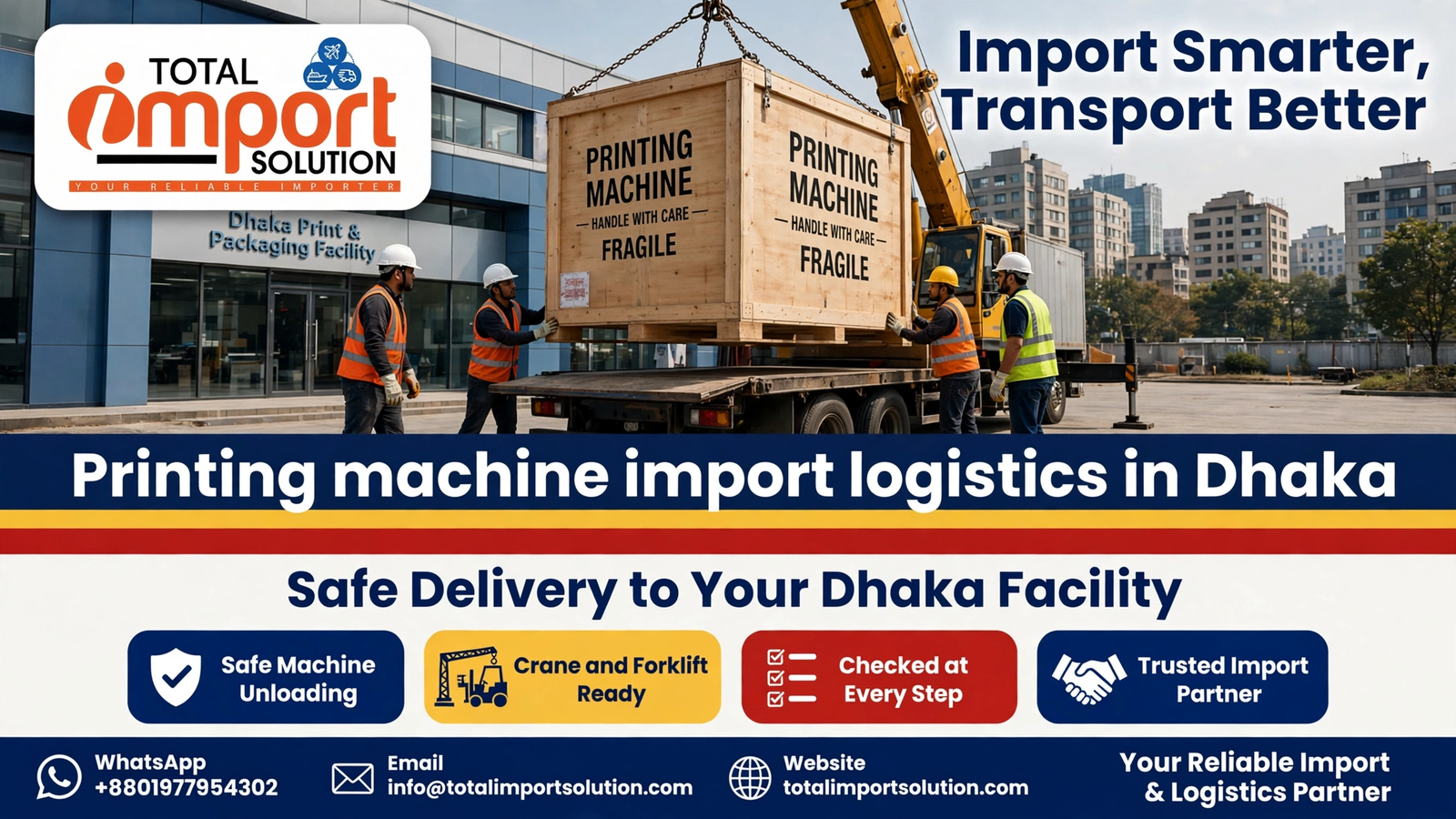
Unloading needs the right equipment and the right people. A crane, a forklift or a ramp should be booked in advance, matched to the crate weight. The unloading team should know the crate labels, the handling marks and the order in which the crates should come off the truck. The buyer or the agent should count the crates as they come off, check the labels, and note any visible damage before signing the delivery note. A delivery note signed without checking is hard to correct later.
| Site check | What to confirm |
|---|---|
| Floor | Load capacity, flat surface, machine footprint |
| Power | Voltage, phase, earth, switchboard, cable size |
| Access | Gate, door, corridor, road, turning space |
| Storage | Covered, dry, secure area for crates |
| Equipment | Crane, forklift, ramp, tools booked |
| Team | Unloading team, site supervisor, contact numbers |
A buyer who finishes this checklist before the delivery date will find the delivery day calm and organised.
11. Installation, Testing and Training
Installation starts when the crates are opened and the machine is placed in its final position. The supplier technician, when installation is agreed, should lead this work, with the buyer team helping as directed. The machine should be levelled carefully, because a press that is not level will print unevenly and wear out parts faster, and the power, water and air connections should be fitted by qualified people.
Testing should be done in stages. First, the technician should run the machine without paper, checking the movement, the controls and the safety stops. Second, the machine should be tested with paper, starting with a simple job and checking the print quality, the registration and the colour. Third, the machine should run a real job from the buyer order book, so the buyer can see how it performs on normal work. Any problem found during testing should be written down, with the part, the symptom and the fix, and that note should go into the import file.
Training is part of installation, not an extra. The buyer operators should be trained by the technician on starting, stopping, cleaning, changing plates or inks, and handling common faults, and the buyer should ask for a simple written guide listing the daily checks, the weekly checks and the spare parts to keep on site. Since 2016, Total Import Solution has supported buyers in Bangladesh, and the buyers who get the best results are the ones whose operators are trained on the actual machine before the technician leaves.
12. Common Problems and How to Handle Them
Most printing machine imports run into one or two problems, and most of them can be handled calmly if the buyer knows what to expect.
| Problem | Common cause | What to do |
|---|---|---|
| Document mismatch | Model or crate count differs between documents | Stop, compare all documents, ask the supplier to correct the wrong one |
| Machine held at the port | Documents late or incomplete | Send the missing document quickly, keep the agent informed |
| Crate damage on arrival | Poor packing or rough handling | Note the damage before signing, take photos, inform the insurer and the agent |
| Machine does not fit the site | Door, floor or power not checked | Measure before ordering, fix the site before delivery, never force a crate through a door |
| Missing spare part | Part not listed on the packing list | Check the packing list crate by crate, ask the supplier for the missing part in writing |
| Installation delayed | Technician date changed or site not ready | Confirm the technician date early, finish the site before the machine arrives |
| Print quality poor after install | Machine not levelled, wrong settings, untrained operator | Ask the technician to re-check levelling and settings, finish operator training |
| Spare parts hard to find later | No parts list kept, supplier contact lost | Keep the parts list and supplier contact in the import file from day one |
When a problem appears, a buyer should write down what happened, take photos where useful, and inform the agent and the supplier in writing. A problem described clearly, with photos and document numbers, is solved faster than one described in a hurry.
13. How to Judge a Good Logistics Agent and Mistakes to Avoid
A good logistics agent is the buyer partner for the whole import. The agent arranges transport, prepares the customs work, talks to the port and the shipping line, and keeps the buyer informed. A buyer should judge an agent on clear, practical points, not on promises. Does the agent explain the process in plain words? Does the agent give a written plan, with the documents needed, the steps and the responsibilities? Does the agent answer questions quickly and honestly, including saying when something is not yet known? Does the agent have experience with machinery imports, and can the agent give references from other machinery buyers? Does the agent check the documents before the machine ships, rather than waiting until it arrives? An agent who does those things is an agent worth working with.
A buyer should also watch for warning signs. An agent who gives a fixed rate or fee before seeing the shipment and the documents is not working from the actual facts, because a rate or fee is confirmed only after checking the actual shipment and documents. An agent who cannot explain the customs steps, who does not ask for the documents early, or who does not keep the buyer informed will leave the buyer guessing. The agent scope should be agreed in writing before the shipment: who books the transport, who prepares the customs work, who arranges the truck and the crane, and who the buyer should call at each stage.
The mistakes to avoid are simple, and they are the same mistakes that cause most delays. Do not order a machine before measuring the site. Do not pay in full before the documents and the packing are confirmed. Do not accept a quotation that does not state what is included. Do not send documents late, and do not sign a delivery note without counting the crates and checking for damage. Do not skip operator training, and do not lose the import file. Since 2016, Total Import Solution has worked with importers in Bangladesh, and the smoothest imports are the ones where the buyer, the supplier and the agent each did their part in the right order, with the documents ready and the site ready.
Frequently Asked Questions
1. What documents do I need to import a printing machine into Dhaka?
You need the commercial invoice, packing list, bill of lading or airway bill, certificate of origin, insurance document, and your import registration, trade licence and tax registration. Your agent will confirm the full list.
2. How do I choose between an offset, digital, flexo or large-format machine?
Choose by the work you will do: offset for books and commercial print, digital for short runs, flexo for packaging and labels, and large-format for banners and display material.
3. Can I import a used printing machine?
Yes, many buyers do. Ask for the service history, the condition of the main parts, and photos or a video of the actual machine before you pay.
4. What is an HS code?
It is the Harmonized System code that tells customs what kind of machine you are importing. Your agent and supplier agree it from the actual machine and documents.
5. Should my machine come by sea or by air?
Sea suits large and heavy presses, while air suits smaller machines, urgent shipments and sensitive electronic parts. Your agent will explain the choice for your shipment.
6. How is the cost of the import worked out?
A rate or fee is confirmed only after checking the actual shipment and documents, including the machine, the packing, the route and the customs papers.
7. How long does customs clearance take?
It depends on the documents, the inspection and the port workload. Sending complete and matching documents early is the best way to keep the work moving.
8. What should I do if a crate arrives damaged?
Note the damage before signing the delivery note, take photos, and inform the agent and the insurer in writing the same day.
9. What should I check at my site before delivery?
Check the floor load, the power supply, the gate and door sizes, the road access, and a covered, dry storage area for the crates.
10. Do I need a technician for installation?
Yes, if installation is agreed with the supplier. The technician levels the machine, tests it and trains your operators on the actual machine.
11. What spare parts should I order with the machine?
Order the parts the supplier recommends for the first year, list them on the packing list, and keep the parts list in your import file.
12. How do I check a supplier before I pay?
Ask for the machine details in writing, a catalogue and photos of the actual machine, a clear quotation, references, and the packing and installation plan.
13. How do I judge a good logistics agent?
A good agent explains the process in plain words, gives a written plan, asks for the documents early, answers questions quickly, and has experience with machinery imports.
14. What are the most common mistakes buyers make?
Ordering before measuring the site, paying in full before the documents are confirmed, sending documents late, and signing a delivery note without counting the crates.
15. What happens if my documents do not match?
The shipment can be held until the wrong document is corrected. Compare the invoice, packing list and shipping document before the machine leaves the supplier.
16. How can Total Import Solution help with my printing machine import?
Total Import Solution can handle the full chain from supplier to site: documents, transport, customs, delivery and installation support. Contact the team using the details below.
Contact Total Import Solution
- WhatsApp: +8801977954302
- Email: info@totalimportsolution.com
- Website: totalimportsolution.com