
Textile machinery import agent in Bangladesh
Bangladesh is one of the largest garment and textile manufacturing countries in the world. Behind every shirt and bed sheet that leaves a Bangladeshi factory, there is a machine: a loom, a knitting machine, a dyeing machine, or a sewing machine. Almost all of these machines are imported, because Bangladesh does not manufacture most textile machinery at home.
A textile machinery import agent is a specialist who helps a factory, a trader or a new entrepreneur bring textile machines into Bangladesh from another country. The agent finds the supplier, checks the machine, arranges the payment documents, books the transport, handles the customs clearance, and delivers the machine to the factory gate.
This guide explains the agent’s work, the machinery types, the documents, the HS code, the step-by-step process, customs clearance, costs, common problems, and how to judge a good agent. No fixed prices, duty figures or transit times are given here. A rate or fee is confirmed only after checking the actual shipment and documents.
Total Import Solution has supported importers in Bangladesh since 2016, including textile and garment factories that need machinery sourcing, documentation, customs clearance and delivery.
1. What a Textile Machinery Import Agent Does
A textile machinery import agent acts for the buyer in Bangladesh. The buyer may be a spinning mill, a weaving factory, a knitwear unit, a dyeing house, a garment factory, or a trader who supplies machines to factories. The agent handles the parts of the import that the buyer cannot easily do alone, especially when the supplier is in another country and the machine is large, heavy and expensive.
The work starts before the order is placed. The agent helps the buyer describe the machine correctly: type, model, year of manufacture, capacity, power requirement, and accessories. A wrong description causes problems later, because the documents, the HS code and the duty assessment all depend on it.
Next, the agent works with the supplier: checking that the supplier is real, confirming the machine specification in writing, arranging inspection where it is needed, and making sure the packing list matches the machine that will actually be shipped.
Then the agent handles the import documents: the commercial invoice, the packing list, the bill of lading or airway bill, the certificate of origin, and any inspection certificate that applies. The agent works with the bank on the letter of credit and with the customs house agent on the bill of entry. After the machine arrives at the port, the agent coordinates the clearance, any examination, the payment of the assessed duty and taxes, and the release of the cargo. Finally, the agent arranges transport to the factory and helps with unloading and placement.
2. Why Bangladesh Imports So Much Textile Machinery
Textiles and garments are the backbone of Bangladesh exports, and the industry keeps growing. New factories open, existing factories add lines, and older machines are replaced with faster and more efficient models. Every one of these changes needs machinery, and almost all of it comes from abroad.
The main reason is that Bangladesh does not have a large domestic textile machinery industry. The machines that Bangladeshi factories use are made in countries with long engineering traditions in textiles, and factories buy them because the quality, the speed and the spare parts support are proven. Factories usually choose a machine that other factories in Bangladesh already run, because the technicians know it and the spare parts are available.
The second reason is the scale of the industry. Bangladesh has thousands of textile and garment factories, each running many machines, so the import volume is very large and the process has to be handled by specialists who understand the machinery.
The third reason is technology change. New looms run faster and use less power, new dyeing machines use less water and give more even colour, and new knitting machines handle more fabric types. Factories that want to stay competitive must upgrade, and upgrading means importing new machines and sometimes replacing the old ones. The fourth reason is new product lines: a factory that made only woven garments may add a knitting line, and each new line needs its own machines. For all these reasons, the agent has become a permanent part of the industry.
3. Types of Textile Machinery Imported into Bangladesh
Bangladesh imports the full range of textile machinery, from spinning to finishing. The table below gives an overview of the main types, what they do, and what an importer should check for each type.
| Machinery type | What it does | What to check |
|---|---|---|
| Spinning machinery | Turns fibre into yarn | Spindle count, speed, power, spare parts list |
| Weaving looms | Weaves yarn into fabric | Loom width, speed, fabric types, year of manufacture |
| Knitting machines | Knits yarn into knitted fabric | Gauge, diameter, fabric weight, needle condition |
| Dyeing machines | Dyes fabric or yarn | Capacity, heating system, water use, control panel |
| Printing machines | Prints patterns on fabric | Print width, colours, screen or digital type |
| Finishing machines | Dries, presses and coats fabric | Working width, temperature range, fabric types |
| Sewing machines | Stitches garments | Machine type, stitch type, speed, motor type |
| Cutting machines | Cuts fabric layers into pieces | Cutting width, layer height, blade type |
| Embroidery machines | Adds embroidered designs | Number of heads, stitch area, design file format |
| Washing machines | Washes garments for finish | Drum capacity, wash programs, water and steam use |
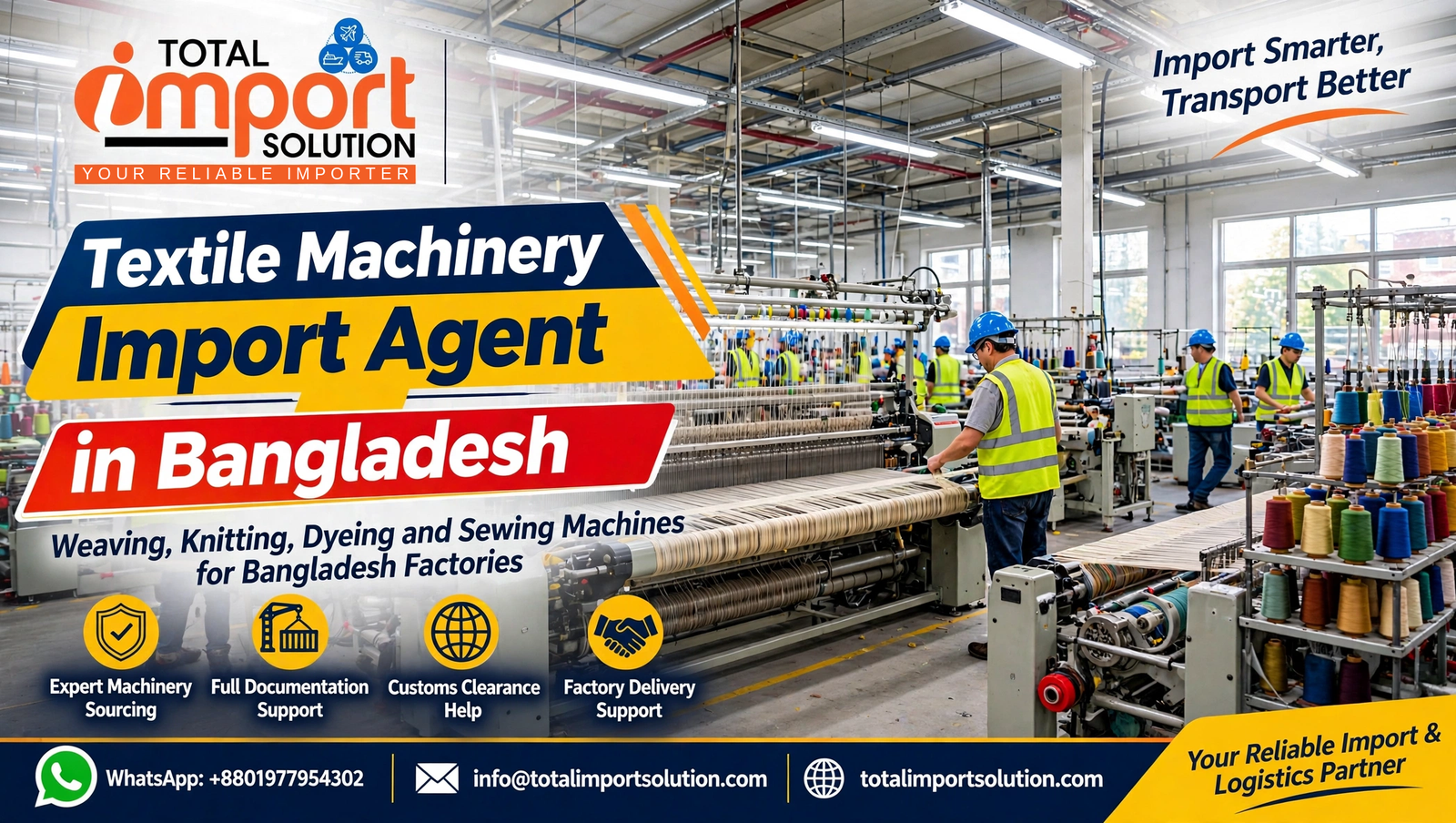
Spinning machinery is the start of the chain. A spinning mill buys ring frames, rotor spinning machines, and the preparatory machines that clean and card the fibre. These machines are large and heavy, and they often arrive in several containers.
Weaving looms are the most common single import for woven fabric factories. Modern looms include air jet, water jet and rapier looms, each suited to different fabrics. The importer should know the loom width and fabric types before ordering.
4. New, Used and Reconditioned Machinery
Textile machinery is imported in three conditions: new, used, and reconditioned. Each has its own advantages and its own risks, and the importer should understand the difference before placing an order.
New machinery comes straight from the manufacturer. It carries the maker’s warranty in the maker’s own terms, it has the latest model, and it comes with a full manual and a spare parts list. The main drawback is the higher purchase cost.
Used machinery is a machine that has already run in a factory in another country and is now sold on. Many Bangladeshi factories buy used looms, knitting machines and sewing machines, because the purchase cost is lower and the machine type is already familiar to local technicians. A used machine can be good value, but only if its condition is checked honestly, including the year of manufacture and the condition of the wearing parts.
Reconditioned machinery sits between the two. It is a used machine that has been serviced, repaired and tested before sale, with worn parts replaced. A properly reconditioned machine can run well for years, but the quality of the reconditioning depends entirely on who did it.
Three checks apply to every textile machine import. First, confirm the year of manufacture and the condition in writing, because customs may ask for these details and the duty assessment can depend on them. Second, confirm the spare parts position, because a machine that cannot be repaired locally is a poor investment even at a low price. Third, confirm the power and installation needs, because a machine that needs a power supply the factory does not have will sit idle after delivery.
5. Documents Needed to Import Textile Machinery
Documents are the foundation of a textile machinery import. If a document is missing, wrong or inconsistent with the others, the shipment can be delayed at the port. The table below lists the main documents, what each one does, and who usually provides it.
| Document | What it does | Provided by |
|---|---|---|
| Commercial invoice | Seller, buyer, machine description, quantity, value | Supplier |
| Packing list | Every crate and package, with weights and contents | Supplier |
| Bill of lading / airway bill | Proves loading and who may collect the goods | Shipping line or airline |
| Certificate of origin | Country where the machine was made | Supplier or chamber of commerce |
| Letter of credit papers | Agreed payment terms | Buyer’s bank |
| Pre-shipment inspection certificate | Machine inspected before shipment, where it applies | Inspection agency |
| Bill of entry | Customs declaration filed at the port | Clearing agent |
| Delivery order | Authorises release of the cargo from the port | Shipping line |
The commercial invoice and the packing list must agree with each other exactly. The description, model, quantity and value on the invoice must match the packing list and the bill of lading.
The certificate of origin matters because the duty treatment can depend on where the machine was made, so ask the supplier for it before shipment. The pre-shipment inspection certificate applies to certain shipments, including many used machines. The agent should confirm before booking whether an inspection is required.
The bill of entry is filed by the clearing agent at the port. It declares the machine, the HS code, the value and the duty payable. The importer should review the draft bill of entry before it is filed. Keep a complete file of every document for each shipment, so that a question from customs or the bank months later can be answered in minutes.
6. HS Code and Classification in General Terms
The HS code is the international system that classifies every traded product, including textile machinery. Each type of machine has its own code, and the code decides how customs treats the shipment. Getting the code right is one of the most important jobs in a textile machinery import.
The HS code is built in layers. The first digits place the machine in a broad family, and the later digits narrow it down to the specific type. Spinning machinery, weaving looms, knitting machines, dyeing machines and sewing machines each sit in their own part of the system, because each does different work. Two machines that look similar can have different codes if they do different work.
Classification depends on what the machine actually does, not on what it is called in a sales brochure. A machine that weaves fabric is classified as a weaving machine, even if the seller calls it by a trade name. When a machine does more than one job, the classification follows its main function.
Parts and accessories have their own treatment. A needle, a motor, a control panel or a loom part may be classified under the code for the part, or under the code for the machine it belongs to, depending on how it is shipped and declared. When parts arrive with the machine, the packing list should show them as parts of that machine.
A wrong HS code can mean a wrong duty assessment, a hold at the port, and extra port charges while the code is corrected. Give the agent the machine manual and a clear description of what the machine does, and settle the classification before the cargo sails.
7. The Step-by-Step Import Process from Order to Delivery
A textile machinery import follows a clear sequence of steps. When steps are skipped or done out of order, the shipment stalls.
| Step | Stage | Main task |
|---|---|---|
| 1 | Plan | Decide the machine type, capacity and budget |
| 2 | Source | Find the supplier, confirm the specification in writing |
| 3 | Inspect | Check the machine condition and year of manufacture |
| 4 | Agree terms | Fix price, payment terms and delivery terms in writing |
| 5 | Bank papers | Open the letter of credit or arrange the agreed payment |
| 6 | Book transport | Book the container or the break-bulk space |
| 7 | Ship | Load the machine, get the bill of lading and packing list |
| 8 | Track | Follow the vessel, prepare the clearance papers |
| 9 | Arrive | Cargo arrives at Chittagong Port or Dhaka Airport |
| 10 | Clear customs | File the bill of entry, pay assessed duty, attend examination |
| 11 | Release | Get the delivery order and collect the cargo |
| 12 | Deliver | Transport the machine to the factory |
| 13 | Install | Unload, place and test the machine at the factory |
Step 1 is planning: the factory decides the fabric or product it will make, the production volume, and the machine type that fits.
Step 2 is sourcing: the agent helps the buyer find suppliers, compare models, and confirm the specification in writing, including the model, the year of manufacture, the capacity, the power requirement, the accessories, and the packing.
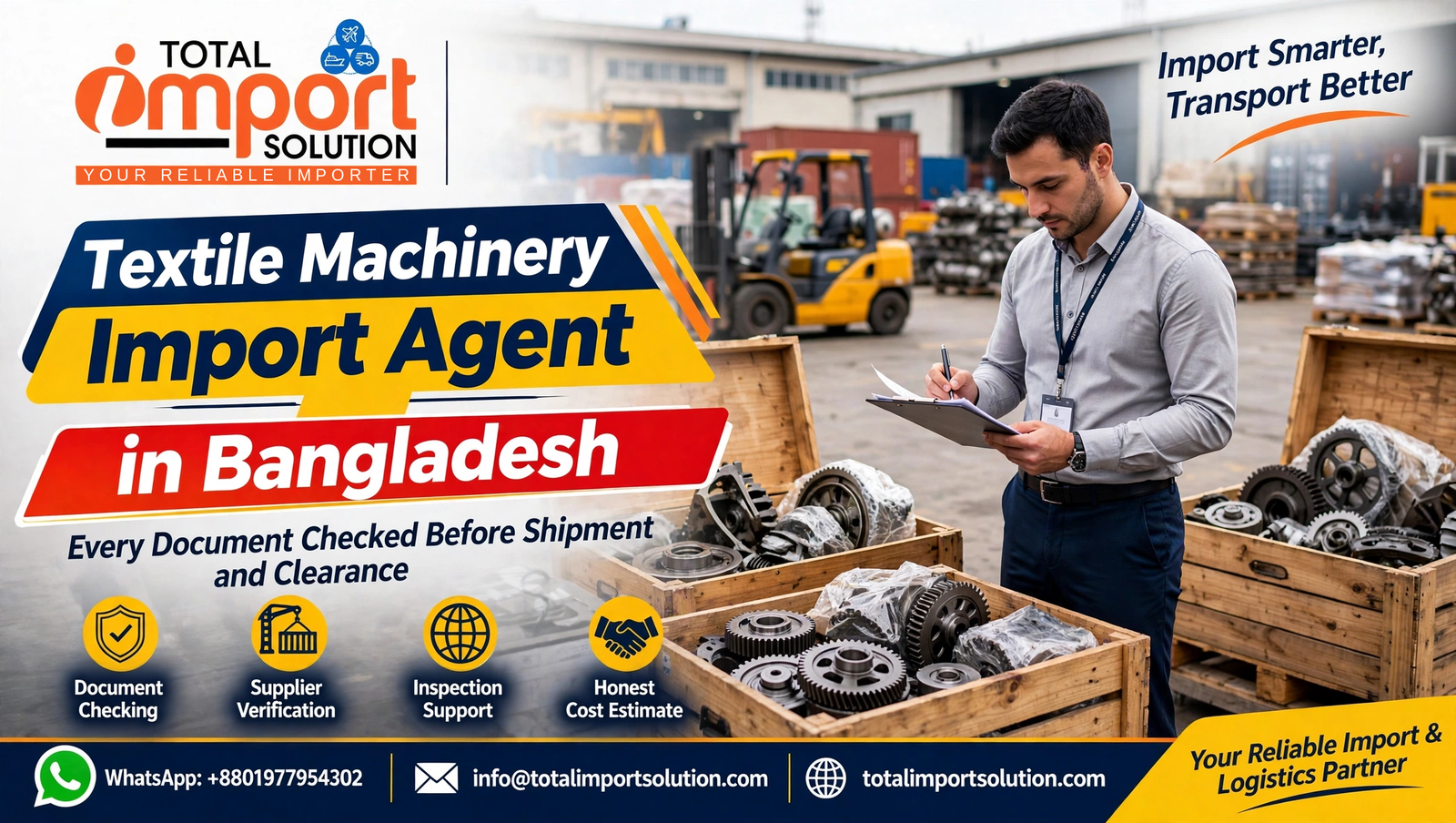
Step 3 is inspection: a factory test for new machines, and an inspection by a qualified person before shipment for used and reconditioned machines, recording the condition and the year of manufacture.
Step 4 is agreeing terms: price, payment terms, delivery terms, and who pays for freight and insurance, all written into the sales contract and the letter of credit. Step 5 is the bank papers, where the buyer’s bank opens the letter of credit.
Step 6 is booking transport. Textile machines are heavy and often oversized, so the agent checks the container size, the weight limit, and the loading plan.
Step 7 is shipping: the machine is loaded and the supplier and shipping line issue the invoice, packing list and bill of lading. Step 8 is tracking, while the agent prepares the clearance papers.
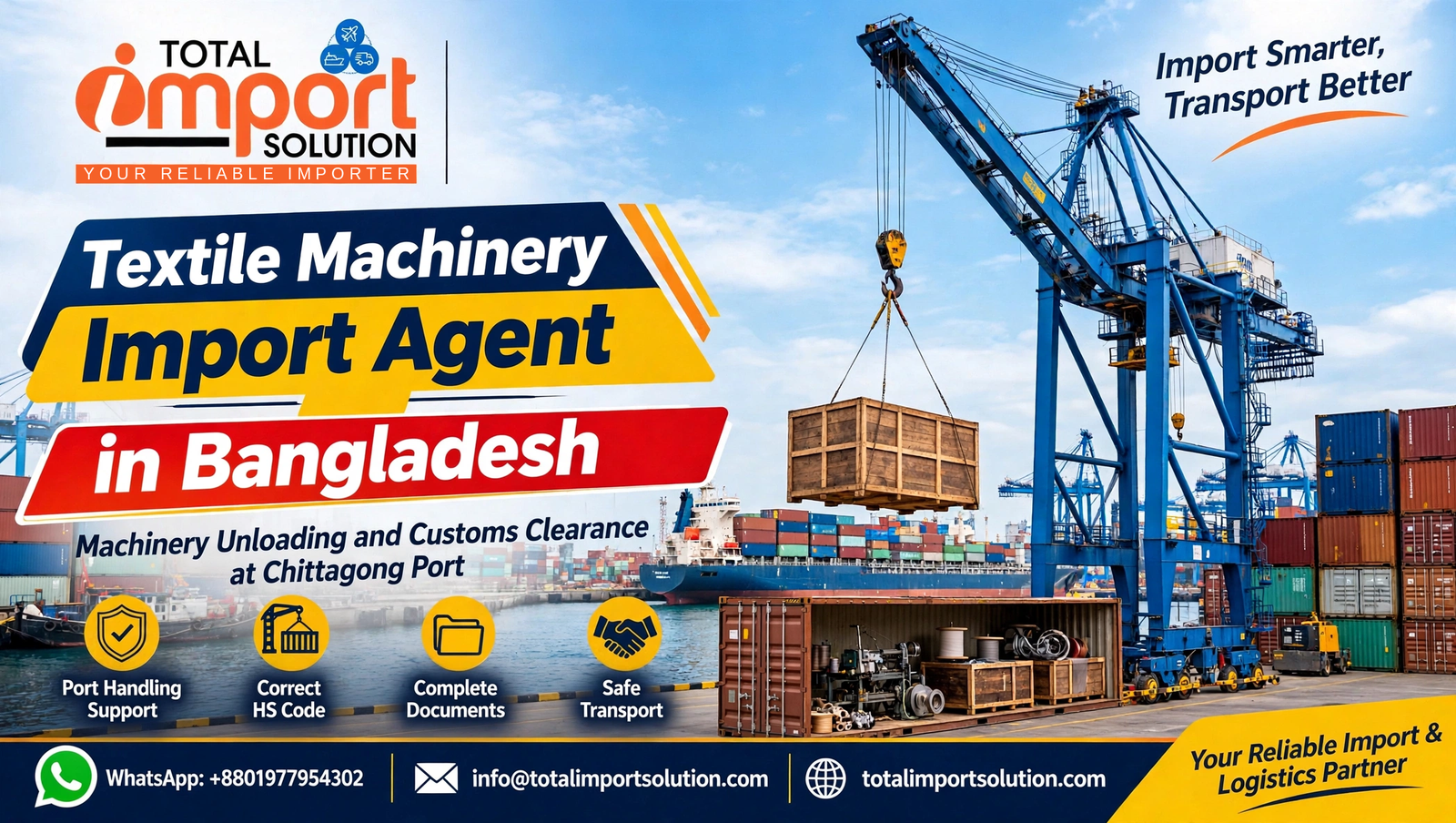
Step 9 is arrival at Chittagong Port, or Dhaka Airport for smaller machines. Step 10 is customs clearance, explained in the next section. Step 11 is release, when the delivery order is issued. Step 12 is delivery to the factory by truck. Step 13 is installation: unloading, placing the machine, connecting power, and running a test.
8. Customs Clearance in General Terms
Customs clearance is the stage where the machine is formally declared to the customs authority, the duty and taxes are assessed, and the cargo is released. It is a normal part of every import, and it goes smoothly when the documents are correct.
The clearance starts with the bill of entry. The clearing agent files this declaration at the port, stating the importer, the machine description, the HS code, the country of origin, the quantity and the value. The importer should check the draft before it is filed.
After filing, customs assesses the duty and taxes. The assessment depends on the HS code, the declared value, and the rules that apply to the machine type and condition. No fixed duty figure can be given in a general guide, because the amount depends on the actual machine and its documents. A rate or fee is confirmed only after checking the actual shipment and documents.
Customs may order an examination of the cargo. In an examination, customs officers open the container or the crates and check that the machine matches the declaration: the type, the model, the serial number, the year of manufacture and the quantity. The agent attends the examination and answers questions from the documents. An examination is routine for machinery, and the agent should plan for it.
Some shipments need extra steps: a used machine may need its inspection certificate verified, and parts arriving separately must be checked against the packing list. The agent checks these points before the cargo arrives. Once the assessment is paid and any examination is complete, customs issues the release and the shipping line issues the delivery order. Collect the cargo promptly, because port storage charges start after the free period ends. Keep the cleared bill of entry and all payment receipts in the shipment file.
9. Costs in General Terms
The total cost of importing textile machinery is made up of several parts, and the buyer should understand each part before placing an order. No fixed cost figure can be given in a general guide, because every machine, route and shipment is different. A rate or fee is confirmed only after checking the actual shipment and documents.
| Cost factor | What it covers | What affects the amount |
|---|---|---|
| Machine price | Purchase price agreed with the supplier | Type, model, age, condition, accessories |
| Freight | Sea or air transport to Bangladesh | Route, container type, weight, size, season |
| Insurance | Cover for loss or damage during transport | Machine value, route, cover type |
| Duty and taxes | Assessment made by customs on arrival | HS code, declared value, type and condition |
| Port charges | Handling, storage and documentation at the port | Cargo size, days in port, container type |
| Clearing agent fee | Fee for filing and handling the clearance | Shipment complexity, number of containers |
| Inland transport | Truck transport from the port to the factory | Distance, machine size, number of trucks |
The machine price is usually the largest part, but it is not the only part. The agent should give the buyer a full landed cost estimate before the order is placed, showing each part separately.
Freight depends on the route and the cargo. A machine shipped by sea costs less than one shipped by air, but takes longer. The agent should confirm the container type and the freight basis in writing before booking.
Duty and taxes are assessed by customs on arrival, from the HS code and the declared value.
Port charges grow with time, because every day the cargo stays at the port after the free period adds storage cost. Inland transport needs planning too, since a large loom cannot be moved on an ordinary truck. The agent should arrange a truck of the right size.
10. Common Problems and How to Avoid Them
Textile machinery imports can run into problems, and most of them are avoidable. The table below lists the common problems, why they happen, and how to avoid them.
| Problem | Why it happens | How to avoid it |
|---|---|---|
| Wrong machine for the product | Ordered without matching the machine to the fabric plan | Confirm type, width and gauge against the product plan |
| Documents do not match | Invoice, packing list and bill of lading differ | Check all three documents against each other before sailing |
| Wrong HS code | Classified by trade name instead of function | Classify by what the machine does, with the manual |
| Used machine in poor condition | Bought on photos alone, without inspection | Arrange inspection, get a written condition report |
| Delay at customs | Bill of entry filed late or with errors | Prepare the papers while the vessel is on its way |
| Extra port charges | Cargo left at the port while papers are corrected | Clear promptly, collect the cargo on release |
| Spare parts missing | Parts not listed on the packing list | List every part with part numbers |
The most common problem is a mismatch between documents. A single wrong model number or a different quantity on one document can hold the clearance for days. The fix is simple: the agent checks the invoice, the packing list and the bill of lading against each other before the vessel sails, and corrects any difference while the supplier can still fix it.
The second most common problem is buying a used machine without inspection. An inspection before shipment gives the buyer a written record of the condition and the year of manufacture. The third problem is delay at the port: the agent avoids it by preparing the clearance papers during the voyage, filing the bill of entry promptly, and collecting the cargo as soon as the release is issued.
11. How to Judge a Good Import Agent
Not every import agent is the same. A good agent for textile machinery has knowledge of the machines, a clear process, and honest communication. The table below gives a checklist the buyer can use when choosing an agent.
| Quality to look for | What good looks like | What to watch out for |
|---|---|---|
| Machinery knowledge | Explains machine types and the HS code in plain words | Cannot explain a loom from a knitting machine |
| Clear written process | Gives a written step list and timeline before the order | Works only on verbal promises, no written plan |
| Full cost estimate | Shows each cost part separately before the order | Gives one lump figure with no breakdown |
| Document care | Checks every document against the others before shipment | Sends documents without checking them |
| Honest about rates | Confirms a rate or fee only after checking the shipment | Quotes a fixed duty or fee for every machine |
| Port and customs experience | Has handled textile machinery clearance before | No experience with machinery clearance |
Ask the agent direct questions before you appoint them. How many textile machinery shipments have you handled? What happens if customs orders an examination? How do you check the HS code? What documents will you need from me, and when?
Check the agent’s history. Total Import Solution has worked with importers in Bangladesh since 2016, and a long record of machinery imports, with references from factories, is a strong sign. Be careful of an agent who promises a fixed duty figure for every machine, without seeing the shipment and the documents. Finally, judge the agent by the paperwork: a good agent gives you a written estimate, a written step list, and a complete file of your shipment documents at the end.
12. Mistakes to Avoid
The mistakes below are made by first-time textile machinery importers more than any others. Each one is easy to avoid once it is named.
First, ordering the machine before checking the factory. A machine needs floor space, power, water where it applies, and a trained team. Before ordering, measure the floor, confirm the power supply, and confirm that the factory team can run the machine or can be trained.
Second, accepting a verbal specification. The model, the year of manufacture, the capacity, the accessories and the packing must be written into the sales contract.
Third, ignoring the spare parts position. A machine is only as good as its spare parts supply. Before ordering, ask the supplier for the spare parts list, confirm which parts wear out first, and order the common wearing parts with the machine. A machine that waits for a needle or a motor from abroad is a machine that is not producing.
Fourth, choosing the agent on price alone. The cheapest agent fee can become the most expensive import if the documents are wrong or the cargo waits at the port.
Fifth, leaving the documents to the last day. The clearance papers should be prepared while the vessel is on its way. If the papers are started only after the cargo arrives, the clearance starts late, and the port charges start to grow.
Sixth, not recording serial numbers. Every machine has a serial number, and it should be on the invoice, the packing list and the bill of entry. Seventh, forgetting the installation plan: the machine must be unloaded, placed, connected, and tested, so plan the equipment and technician time before the truck arrives. Eighth, keeping no file. Every shipment should end with a complete file of the contract, invoice, packing list, bill of lading, bill of entry, and payment receipts.
13. Delivery, Installation and After-Sales Support
The import is not finished when the machine leaves the port. Delivery, installation and after-sales support decide whether the machine earns its return, and the agent should stay involved until the machine is running.
Delivery starts with the right truck. A textile machine is heavy, and some machines are wide or tall. The agent arranges a truck of the right size and weight capacity, with proper lashing and padding, and checks the road route to the factory for bridges, height limits and turning space.
At the factory, the unloading needs planning. The factory should have a clear path from the gate to the machine’s position, and the unloading equipment should be ready before the truck arrives. A forklift, a crane, or a team of workers may be needed, depending on the machine size.
Installation follows. The machine is connected to power, and where it applies, to water, steam and compressed air. The factory electrician should check the voltage and the phase against the machine’s requirement before switching on. The agent can help by making sure the machine manual is with the machine.
Testing is the next step. Run the machine empty first, then with a small trial of fabric or yarn, before full production starts. After-sales support covers spare parts, service and training: the factory should keep the common wearing parts in stock, and the team should be trained on daily cleaning, oiling where it applies, and the basic checks that catch a problem early. A written maintenance schedule, kept beside the machine, helps the team stay on routine. Total Import Solution supports importers in Bangladesh since 2016 with the full chain: sourcing, documents, clearance, delivery and coordination with the factory team.
Frequently Asked Questions
1. What does a textile machinery import agent do?
A textile machinery import agent helps a factory or trader bring textile machines into Bangladesh: finding the supplier, checking the machine, handling the documents, booking transport, and managing clearance and delivery.
2. Which textile machines can an agent import for my factory?
An agent can import spinning, weaving, knitting, dyeing, printing, finishing, sewing, cutting, embroidery and washing machines, with spare parts. The right machine depends on the product the factory makes.
3. Do I need a trade licence and import registration to import textile machinery?
Yes, the importer needs a valid trade licence and import registration, and the agent will check the papers before the shipment is booked.
4. What documents are needed to import a weaving loom?
The main documents are the commercial invoice, the packing list, the bill of lading, the certificate of origin, the bank papers, and the bill of entry. A pre-shipment inspection certificate may also apply.
5. What is an HS code, and why does it matter for textile machinery?
The HS code is the international classification for the machine, and it decides how customs treats the shipment. A wrong code can mean a wrong assessment and a hold at the port.
6. Can I import a used knitting machine into Bangladesh?
Used textile machines are imported regularly. Confirm the year of manufacture and condition in writing, arrange an inspection, and check which certificates apply.
7. How long does the import process take from order to delivery?
The time depends on the machine, the supplier, the shipping route, and the clearance at the port.
8. How are the duty and taxes on textile machinery decided?
Customs assesses the duty and taxes from the HS code, the declared value, and the rules for the machine type.
9. What should I check before buying a used dyeing machine?
Check the year of manufacture, capacity, heating system, control panel, and the condition of the main parts. Ask for an inspection report and confirm the spare parts position.
10. Can spare parts be imported with the machine?
Yes, spare parts can be imported with the machine or separately. Every part should be listed on the packing list with its part number and should match the machine model.
11. Which port is used for textile machinery imports?
Most textile machinery arrives by sea at Chittagong Port. Smaller machines and urgent parts can arrive by air at Dhaka Airport.
12. What happens if customs orders an examination of my machine?
Customs officers open the container or crates and check the machine against the declaration: type, model, serial number and year of manufacture. The agent attends with the documents.
13. How do I choose a good textile machinery import agent?
Look for machinery knowledge, a clear written process, a full cost estimate, careful document checking, and honest communication.
14. What are the common mistakes in textile machinery import?
The common mistakes are ordering the wrong machine, accepting a verbal specification, ignoring spare parts, leaving the documents to the last day, and not recording serial numbers.
15. Can a new factory import textile machinery, or is it only for large factories?
A new factory can import textile machinery. The agent helps with the registration papers, the supplier search, the documents, and the clearance, and explains each step.
16. How do I start a textile machinery import with Total Import Solution?
Contact Total Import Solution with the machine type, the product you make, and the capacity you need. The team will explain the steps and confirm the rate or fee only after checking the actual shipment and documents.
Contact Total Import Solution
- WhatsApp: +8801977954302
- Email: info@totalimportsolution.com
- Website: totalimportsolution.com
- Service: Textile machinery import agent in Bangladesh — sourcing, documentation, HS code, customs clearance, delivery and factory coordination
- Experience: Supporting importers across Bangladesh