
How to reduce shipping cost from China to Bangladesh
Shipping cost is the part of importing that most often surprises, because the freight figure is only one part of the bill. Handling, documentation, customs work, storage and delivery all add to the total, and each one can be managed when it is seen clearly. This guide explains how to reduce shipping cost from China to Bangladesh in plain language, by showing where the cost comes from and what can be done about each part.
Total Import Solution has served importers in Bangladesh since 2016, and this guide follows the working order used on a real shipment: see the whole bill, compare quotes on the full cost, choose the right container, pack to use the space, prepare the papers early, and review the cost after delivery. Each section covers one part of that order, and the questions at the end answer the points importers ask most often.
1. Where Shipping Cost Comes From
A shipping bill is made of many parts, and the freight figure is only one of them. The cost starts with the freight for the sea or air leg, and then adds the handling at the loading port, the documentation, the handling at the discharge port, the customs work, the storage where it applies, and the road delivery to the warehouse. Each part has its own basis, and each part can be checked separately. An importer who looks only at the freight figure is looking at only part of the bill, and the parts that are not looked at are the ones that surprise.
The first step in reducing shipping cost is therefore to see the whole bill. Ask for the full door-to-door cost in writing, with each charge listed separately, and keep that breakdown with the order. When the next shipment is quoted, the same breakdown can be compared line by line, and the parts that have moved can be seen at once. A shipping cost that is understood in full is a shipping cost that can be managed, and a bill that is never broken down cannot be reduced, because no one can see where the money goes.
| Cost part | What it covers | How it is checked |
|---|---|---|
| Freight | Sea or air leg | Quote for the same cargo and route |
| Port handling | Loading and discharge work | Named in the quote, basis shown |
| Documentation | Papers and bill of lading | Which papers, what each costs |
| Customs work | Bill of entry and examination | Agent’s list of steps |
| Storage and delivery | Port storage, road to warehouse | Free time, distance, truck size |
2. Comparing Freight Quotes the Right Way
A freight quote is only useful when it is compared with another quote for the same cargo, the same route and the same delivery point. Two quotes for different volumes, different ports or different delivery points are not comparable, and a lower figure on one quote can hide a higher charge on another line. The comparison should be made on the full door-to-door cost, with each charge listed separately, and the quote should be in writing so that the final bill can be checked against it.
Total Import Solution has served importers in Bangladesh since 2016, and the quotes that cause trouble are the ones with a single figure and no breakdown. A single figure cannot be checked, and when the final bill arrives with extra lines, the importer has no paper to point to. A good quote names the freight, the handling, the documentation, the customs work and the delivery, and it says what is not included. An importer should ask for that breakdown on every shipment, and should keep the quotes in the shipment file until the final bill is settled.
3. Choosing the Right Container Size and Type
The container is the unit of sea freight, and choosing the right one changes the cost per unit of cargo. A container that is too large for the order wastes space that is still paid for, and a container that is too small for the order means a second shipment and a second set of charges. The choice should be made from the measured volume of the packed cartons, not from a guess, and the supplier should confirm the carton count and the carton size before the container is booked.
A standard dry container suits most general cargo, while an open top or a flat rack suits cargo that is tall, wide or heavy, and a ventilated container suits cargo that needs air flow. Each type has its own handling and its own cost, so the type should be chosen by the cargo, not by habit. Where the order does not fill a container, a shared load should be considered, because paying for the space used is better than paying for a whole container that is half empty.
| Container choice | When it fits | Cost point |
|---|---|---|
| Standard dry container | Most general cargo, full load | Paid per container, full use matters |
| Shared load | Small order, part of a container | Paid for the space the cartons use |
| Open top or flat rack | Tall, wide or heavy cargo | Extra handling, chosen by the cargo |
| Right size, right type | Measured volume, known carton count | No wasted space, no second shipment |
4. Consolidation and Shared Loads
Consolidation puts cartons from several importers into one container, and each importer pays for the space their cartons use. It is the main way a small order can travel by sea without paying for a whole container, and it works well when the cartons are clearly marked, the packing list is exact and the goods are not fragile or sensitive to stacking. The saving comes from shared space, and the saving is real when the volume is measured honestly and the cost is divided by the space used.
The trade-off is waiting time. A shared container sails when it is full, so the sailing date depends on other importers as well as on the cargo. An importer with a firm delivery date should weigh that waiting time against the saving, and an importer with a flexible date can often use consolidation well. The forwarder should confirm the sailing plan and the cost division in writing, and the importer should ask how the cartons will be sorted at discharge. Clear marks and clear papers are what make a shared load work.
- Measure cartons and confirm the volume before booking a shared load.
- Mark every carton with importer name, carton number and total count.
- Keep the packing list exact for sorting at discharge.
- Ask the forwarder to confirm the sailing plan and cost division in writing.
- Weigh the saving against the waiting time for the container to fill.
5. Booking Early and Planning the Calendar
A shipment booked well ahead gives the forwarder time to find space, choose a sailing and plan the loading, while a shipment booked at the last minute may have to take whatever space is left. Planning ahead also gives the supplier time to produce, pack and load without a rush, and a rushed load is where damage and mistakes happen. The calendar is therefore a cost tool: orders placed early, in a steady pattern, are easier to ship than orders placed in a hurry.
Seasonal demand also plays a part. When many importers are shipping at once, space is tighter, and when demand is quiet, space is easier to find. An importer who can place orders ahead of the busiest weeks will usually find the comparison easier. The practical step is a simple order calendar: the months when stock is needed, the lead time for production, the sailing time and the clearance time, all written down so that each order is placed with room to spare.
Share that calendar with the supplier and the forwarder. A supplier who knows the next orders can plan production and loading without a rush, and a forwarder who knows the dates can look for space early rather than at the last minute. A calendar shared with the people who move the cargo is a calendar that works, and a calendar kept to one person is a plan that no one else can follow.
6. Packing Smarter to Use Space Well
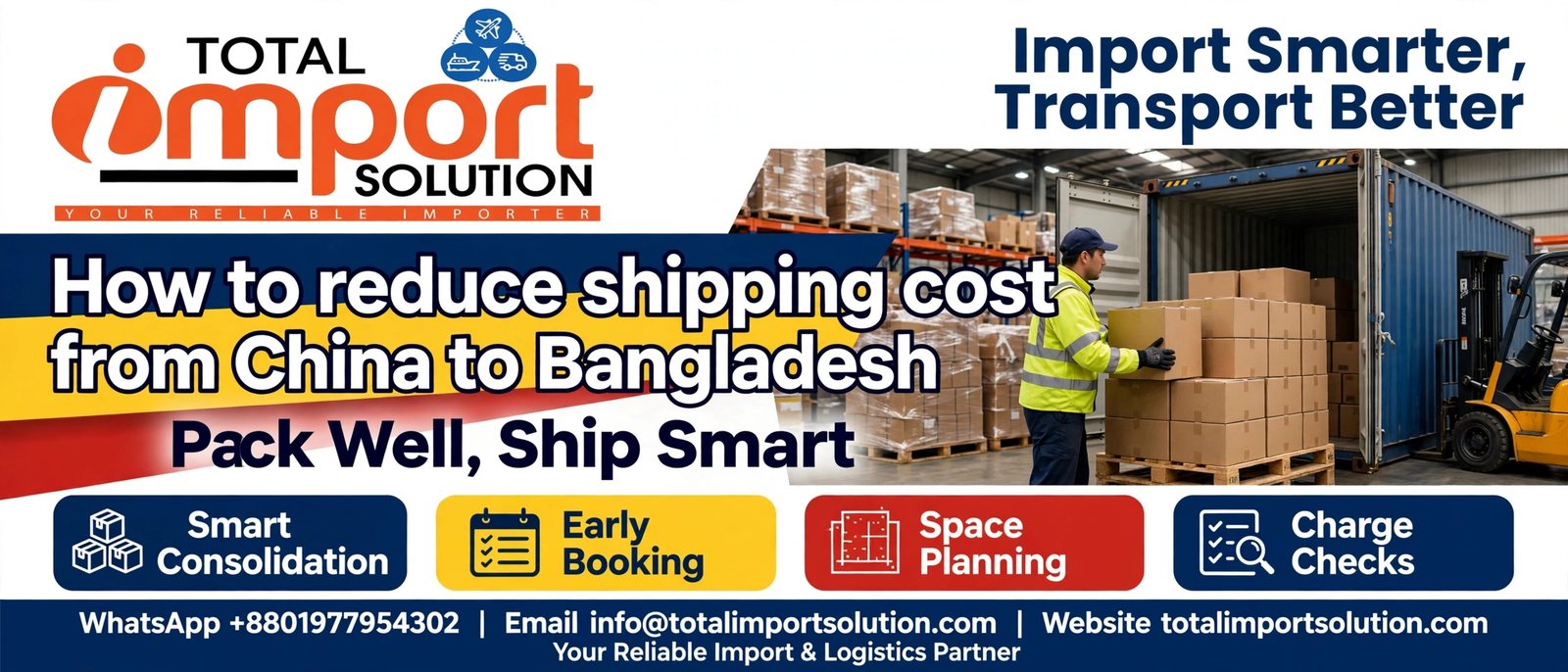
Packing decides how much of a container is used, and a container that is packed well carries more cargo for the same freight. The rule is compact, strong and stackable: cartons of one size where possible, filled to the top without bulging, strapped firmly and marked clearly, so that they stack evenly and leave no wasted gaps. A carton that is half empty wastes space that the importer still pays for, and a carton that is overfilled risks damage that costs far more than the space saved.
Pallets should be used where the cargo needs them, because they protect the load and speed up handling, but the pallet itself takes space and weight, so the choice should be made on the cargo. The supplier should photograph the loaded container before the doors are closed, and the importer should ask for those photos, because a well-packed container is visible in a photo and a badly packed one is too. Packing is not a small detail. It is one of the largest levers an importer has on the cost of a shipment.
- Use cartons of one size where possible, filled without bulging.
- Strap cartons firmly and mark each one clearly.
- Stack evenly and fill gaps so no space is wasted.
- Decide on pallets by the cargo, not by habit.
- Ask the supplier for photos of the loaded container.
7. Route and Port Choices That Change the Bill
The route from the factory in China to the warehouse in Bangladesh has two ends, and each end affects the cost. At the China end, the factory may be nearer to one loading port than to another, and the road cost from the factory to the port is part of the total. At the Bangladesh end, the discharge port affects the road distance to the warehouse and the handling at the port. A route that looks low-cost on the sea leg can be costly on the road leg, and only a door-to-door comparison shows the real figure.
The port of arrival in Bangladesh is usually Chittagong, with Mongla as another option, and the choice should be made on the warehouse location, the road distance and the handling terms. The importer should ask the supplier which port the factory normally uses, and should compare the full cost from that port with the cost from any other port the supplier can reach. A route chosen on the full journey, rather than on one leg alone, is the route that keeps the total in view.
| Route point | What to compare | Why it changes the total |
|---|---|---|
| Loading port in China | Road cost from the factory | Nearer port means lower road cost |
| Discharge port | Road distance to the warehouse | Longer road means higher delivery cost |
| Port handling | Handling and storage terms | Slow clearance adds storage charges |
| Road leg | Distance, road condition, truck size | Affects the final delivery cost |
8. Documents Done Right the First Time
Documents are the quiet source of extra cost in shipping. A missing certificate, a description that does not match the cargo, or a packing list that counts the cartons differently from the invoice can hold a container at the port while storage charges build up day by day. The prevention is to prepare the papers before the cargo sails, and to check them against each other: the names, the numbers and the descriptions should agree on every paper, and any certificate that applies should be in hand before the vessel leaves.
The customs agent should receive the papers early, so that the bill of entry can be prepared before arrival and any query can be answered from the same figures. A container that is cleared promptly leaves the port promptly, and a container that leaves the port promptly does not gather storage charges. The cost of good paperwork is a few hours of checking, and the saving is the storage bill that never arrives. Documents done right the first time are one of the best ways to reduce a shipping bill.
| Document | Check before sailing | What it prevents |
|---|---|---|
| Commercial invoice | Value and description match the cargo | Queries and reassessment |
| Packing list | Carton count and weight exact | Sorting and counting delays |
| Bill of lading | Container and seal numbers correct | Release problems at the port |
| Certificates | In hand before the vessel sails | Holds while a paper is fetched |
9. Avoiding Demurrage and Storage Charges
Demurrage and storage are the charges that grow by the day, and they are the charges an importer can most often avoid. Storage is charged when a container sits at the port beyond the free time allowed, and demurrage is charged when the container itself is held beyond its free time. Both start with a clock, and both are stopped by the same actions: papers ready before arrival, clearance done promptly, and the container collected as soon as the release papers are issued.
The importer should ask, before the shipment is confirmed, what the free time is, when it starts, and what the daily charge is after that. The customs agent should be told the arrival date early, and the transport to the warehouse should be booked before the vessel arrives, not after. A container that is planned out of the port is a container that does not gather charges, and a delivery that is booked late is a bill that grows while the truck is arranged.
- Ask the free time, its start point and the daily charge before confirming.
- Send papers to the customs agent early and prepare the bill of entry.
- Book the warehouse transport before the vessel arrives.
- Clear promptly and collect as soon as the release papers are issued.
- If a delay is likely, tell the agent and the forwarder at once.
10. Working With Suppliers on Loading and Timing
The supplier controls the loading, and the loading controls much of the cost. A supplier who loads carefully, packs compactly and photographs the load gives the importer a container that uses its space well and arrives in good order. A supplier who loads in a hurry can waste space, damage cartons and leave the importer to pay for the result. The importer should agree the packing, the carton size and the loading plan with the supplier before production, not after the goods are made.
Timing should be agreed at the same time. The supplier should confirm the production date, the loading date and the port, and should tell the importer at once if any of those dates move. A loading date that moves by a few days can change the sailing, and a sailing that changes can change the arrival and the clearance plan. Clear dates, agreed in writing, keep the shipment on the calendar and the cost on the plan.
Ask the supplier to confirm the loading plan in writing as well: how the cartons will be stacked, whether pallets will be used, and how the container will be filled. A loading plan agreed before production is a loading plan that can be checked with a photo when the doors are closed, and a photo of a well-loaded container is the proof that the space was used well. If the photo shows wasted space, the next order can be packed differently, and that is how the cost comes down order by order.
11. Tracking Shipments and Spotting Extra Charges Early
A shipment that is tracked is a shipment whose costs can be seen while there is still time to act. The importer should know the sailing date, the arrival date and the container number, and should check the progress at each stage: loaded, sailed, arrived, cleared, delivered. If the vessel is delayed, the customs agent and the transport can be told early, and the delivery can be moved instead of being missed. If a charge appears that was not in the quote, it can be asked about while the papers are still in hand.
Tracking also means watching the bill. The final bill should be checked line by line against the quote, and any line that does not match should be queried with the forwarder before it is paid. A charge that is queried promptly can be explained or corrected, and a charge that is paid without a question is rarely revisited. The habit of tracking the shipment and checking the bill is the habit that keeps extra charges from becoming a permanent part of the cost.
| Tracking point | What to check | Action if it moves |
|---|---|---|
| Loading and sailing | Dates match the plan | Tell the agent and the transport |
| Arrival | Vessel date, container number | Prepare clearance and delivery |
| Clearance | Bill of entry, queries answered | Answer from the same figures |
| Final bill | Each line matches the quote | Query any line before paying |

12. Reviewing Each Shipment After Delivery
The best way to reduce the next shipping cost is to review the last one. After delivery, write down the freight, the handling, the documentation, the customs work, the storage and the delivery, and keep the record with the order. Then look at the record and ask what could have been different: was the container the right size, was the packing compact, were the papers ready, was the container collected promptly, and did any charge appear that was not in the quote.
Over a few shipments, the record shows a pattern: which routes, which ports and which packing plans give the best total for that importer’s cargo. That pattern is worth more than any general advice, because it is built from the importer’s own shipments. An importer who reviews each shipment and keeps the record will see the cost come under control order by order, and the next quote will be compared against real figures rather than against memory. Total Import Solution has worked this way with importers since 2016, and the review below is the version to use after the next delivery.
Share the review with the forwarder as well. A forwarder who sees which routes worked and which charges surprised can suggest a different sailing, a different port or a different container plan for the next order, and that suggestion is worth more when it is based on the importer’s own record. A review kept in a drawer helps no one, while a review shared with the people who move the cargo helps the next shipment cost less.
| Review item | Question to ask | What the answer changes |
|---|---|---|
| Container size | Was the space used well | Next container choice |
| Packing | Was it compact and strong | Next packing plan |
| Papers | Were they ready before sailing | Next document routine |
| Clearance | Was the container collected promptly | Next clearance plan |
| Final bill | Did any charge surprise | Next quote comparison |
13. Shipping Cost Reduction Checklist
A checklist turns cost reduction into a routine that can be used on every order. Start with the cargo: the cartons measured and weighed, the volume known, the delivery date fixed. Then the quote: the full door-to-door cost in writing, with each charge listed separately, compared with another quote for the same cargo and route. Then the container: the right size and type, or a shared load where the order is small. Then the packing: compact, strong and stackable, photographed at loading.
Then the papers: invoice, packing list, bill of lading and certificates prepared before sailing and sent to the customs agent early. Then the delivery: transport booked before arrival, clearance done promptly, container collected as soon as the release papers are issued. Finally, the review: the full cost written down after delivery and kept with the order, so that the next comparison starts from real figures. A checklist used on every order is how a shipping cost comes down and stays down.
- Measure and weigh cartons; fix the volume and the delivery date.
- Ask for the full cost in writing and compare quotes line by line.
- Choose the right container size, or a shared load for a small order.
- Pack compactly and photograph the loaded container.
- Prepare papers before sailing and send them to the agent early.
- Book transport early, clear promptly and collect at once.
- Record the full cost after delivery and review it before the next order.
Frequently Asked Questions
1. Where does shipping cost come from?
Shipping cost is made of the freight for the sea or air leg plus handling at both ports, documentation, customs work, storage where it applies and road delivery to the warehouse. Each part has its own basis and should be checked separately.
2. How should two freight quotes be compared?
They should be compared for the same cargo, the same route and the same delivery point, on the full door-to-door cost with each charge listed separately. A lower freight figure can hide a higher charge on another line.
3. Why should a quote show a breakdown of charges?
Because a single figure with no breakdown cannot be compared with another quote and cannot be checked when the final bill arrives. Each charge should be named in writing before the shipment is confirmed.
4. How does container size affect shipping cost?
A container that is too large wastes space that is still paid for, and one that is too small means a second shipment with a second set of charges. The choice should be made from the measured volume of the packed cartons.
5. What is a shared load and when does it help reduce cost?
A shared load puts cartons from several importers in one container, and each importer pays for the space used. It helps small orders that would leave a full container half empty, but the container waits until it is full.
6. How does packing affect shipping cost?
Packing decides how much of a container is used. Compact, strong and stackable cartons use space well, while half-empty cartons waste space the importer still pays for, and overfilled cartons risk damage.
7. Does booking early help reduce shipping cost?
Yes. Booking ahead gives time to find space, choose a sailing and plan loading, while a last-minute booking may have to take whatever space is left. Planning ahead also gives the supplier time to load without a rush.
8. How does the choice of port change the shipping bill?
The loading port affects the road cost from the factory, and the discharge port affects the road distance to the warehouse. Only a door-to-door comparison shows the real total for the whole journey.
9. What is demurrage and how can it be avoided?
Demurrage is the charge for holding a container beyond the free time allowed. It is avoided by preparing papers before arrival, clearing promptly and collecting the container as soon as the release papers are issued.
10. How do documents affect shipping cost?
Missing or mismatched papers can hold a container at the port while storage charges build up day by day. Preparing the papers before sailing and checking them against each other prevents that cost.
11. What should be checked on the final bill?
Each line should be checked against the quote, and any line that does not match should be queried with the forwarder before it is paid. A charge queried promptly can be explained or corrected.
12. Why should shipments be tracked?
Tracking shows the sailing date, the arrival date and the container number at each stage, so a delay can be passed to the agent and the transport early, and an unexpected charge can be asked about while the papers are still in hand.
13. How does working with the supplier help reduce cost?
The supplier controls the loading, so agreeing the packing, carton size and loading plan before production gives a container that uses its space well. Agreeing dates in writing also keeps the sailing and the clearance plan on schedule.
14. What should be reviewed after each shipment?
The freight, handling, documentation, customs work, storage and delivery should be written down with the order. Over a few shipments the record shows which routes, ports and packing plans give the best total for that importer’s cargo.
15. What is the most common mistake that raises shipping cost?
Booking on a guessed volume, late paperwork, poor packing and confirming a quote without a breakdown. Each is preventable by measuring cartons, preparing papers early, packing well and asking for the full cost in writing.
16. Who should an importer contact to reduce shipping cost on a shipment?
Contact Total Import Solution on WhatsApp at +8801977954302 or by email at info@totalimportsolution.com, with the carton measurements, weight, quantity and delivery date, so the full cost can be compared and planned.
Contact Total Import Solution
- WhatsApp: +8801977954302 (https://wa.me/8801977954302)
- Email: info@totalimportsolution.com
- Website: totalimportsolution.com
- Service: How to reduce shipping cost from China to Bangladesh
- Company: Total Import Solution, serving importers in Bangladesh.
